As a Petroleum Supply Specialist in the U.S. Army Reserve, you will play a vital role in ... Terminal Operater, Compliance Specialist, Refinery Inspection Engineer. About Our Organization: The ...
As a Petroleum Supply Specialist in the U.S. Army Reserve, you will play a vital role in ... Terminal Operater, Compliance Specialist, Refinery Inspection Engineer. About Our Organization: The ...
As a Petroleum Supply Specialist in the U.S. Army Reserve, you will play a vital role in ... Terminal Operater, Compliance Specialist, Refinery Inspection Engineer. About Our Organization: The ...
As a Petroleum Supply Specialist in the U.S. Army Reserve, you will play a vital role in ... Terminal Operater, Compliance Specialist, Refinery Inspection Engineer. About Our Organization: The ...
As a Petroleum Supply Specialist in the U.S. Army Reserve, you will play a vital role in ... Terminal Operater, Compliance Specialist, Refinery Inspection Engineer. About Our Organization: The ...
As a Petroleum Supply Specialist in the U.S. Army Reserve, you will play a vital role in ... Terminal Operater, Compliance Specialist, Refinery Inspection Engineer. About Our Organization: The ...
As a Petroleum Supply Specialist in the U.S. Army Reserve, you will play a vital role in ... Terminal Operater, Compliance Specialist, Refinery Inspection Engineer. About Our Organization: The ...
As a Petroleum Supply Specialist in the U.S. Army Reserve, you will play a vital role in ... Terminal Operater, Compliance Specialist, Refinery Inspection Engineer. About Our Organization: The ...
As a Petroleum Supply Specialist in the U.S. Army Reserve, you will play a vital role in ... Terminal Operater, Compliance Specialist, Refinery Inspection Engineer. About Our Organization: The ...
As a Petroleum Supply Specialist in the U.S. Army Reserve, you will play a vital role in ... Terminal Operater, Compliance Specialist, Refinery Inspection Engineer. About Our Organization: The ...
As a Petroleum Supply Specialist in the U.S. Army Reserve, you will play a vital role in ... Terminal Operater, Compliance Specialist, Refinery Inspection Engineer. About Our Organization: The ...
As a Petroleum Supply Specialist in the U.S. Army Reserve, you will play a vital role in ... Terminal Operater, Compliance Specialist, Refinery Inspection Engineer. About Our Organization: The ...
As a Petroleum Supply Specialist in the U.S. Army Reserve, you will play a vital role in ... Terminal Operater, Compliance Specialist, Refinery Inspection Engineer. About Our Organization: The ...
As a Petroleum Supply Specialist in the U.S. Army Reserve, you will play a vital role in ... Terminal Operater, Compliance Specialist, Refinery Inspection Engineer. About Our Organization: The ...
As a Petroleum Supply Specialist in the U.S. Army Reserve, you will play a vital role in ... Terminal Operater, Compliance Specialist, Refinery Inspection Engineer. About Our Organization: The ...
As a Petroleum Supply Specialist in the U.S. Army Reserve, you will play a vital role in ... Terminal Operater, Compliance Specialist, Refinery Inspection Engineer. About Our Organization: The ...
As a Petroleum Supply Specialist in the U.S. Army Reserve, you will play a vital role in ... Terminal Operater, Compliance Specialist, Refinery Inspection Engineer. About Our Organization: The ...
As a Petroleum Supply Specialist in the U.S. Army Reserve, you will play a vital role in ... Terminal Operater, Compliance Specialist, Refinery Inspection Engineer. About Our Organization: The ...
As a Petroleum Supply Specialist in the U.S. Army Reserve, you will play a vital role in ... Terminal Operater, Compliance Specialist, Refinery Inspection Engineer. About Our Organization: The ...
As a Petroleum Supply Specialist in the U.S. Army Reserve, you will play a vital role in ... Terminal Operater, Compliance Specialist, Refinery Inspection Engineer. About Our Organization: The ...
As a Petroleum Supply Specialist in the U.S. Army Reserve, you will play a vital role in ... Terminal Operater, Compliance Specialist, Refinery Inspection Engineer. About Our Organization: The ...
As a Petroleum Supply Specialist in the U.S. Army Reserve, you will play a vital role in ... Terminal Operater, Compliance Specialist, Refinery Inspection Engineer. About Our Organization: The ...
As a Petroleum Supply Specialist in the U.S. Army Reserve, you will play a vital role in ... Terminal Operater, Compliance Specialist, Refinery Inspection Engineer. About Our Organization: The ...
As a Petroleum Supply Specialist in the U.S. Army Reserve, you will play a vital role in ... Terminal Operater, Compliance Specialist, Refinery Inspection Engineer. About Our Organization: The ...
As a Petroleum Supply Specialist in the U.S. Army Reserve, you will play a vital role in ... Terminal Operater, Compliance Specialist, Refinery Inspection Engineer. About Our Organization: The ...
As a Petroleum Supply Specialist in the U.S. Army Reserve, you will play a vital role in ... Terminal Operater, Compliance Specialist, Refinery Inspection Engineer. About Our Organization: The ...
As a Petroleum Supply Specialist in the U.S. Army Reserve, you will play a vital role in ... Terminal Operater, Compliance Specialist, Refinery Inspection Engineer. About Our Organization: The ...
As a Petroleum Supply Specialist in the U.S. Army Reserve, you will play a vital role in ... Terminal Operater, Compliance Specialist, Refinery Inspection Engineer. About Our Organization: The ...
As a Petroleum Supply Specialist in the U.S. Army Reserve, you will play a vital role in ... Terminal Operater, Compliance Specialist, Refinery Inspection Engineer. About Our Organization: The ...
As a Petroleum Supply Specialist in the U.S. Army Reserve, you will play a vital role in ... Terminal Operater, Compliance Specialist, Refinery Inspection Engineer. About Our Organization: The ...
As a Petroleum Supply Specialist in the U.S. Army Reserve, you will play a vital role in ... Terminal Operater, Compliance Specialist, Refinery Inspection Engineer. About Our Organization: The ...
As a Petroleum Supply Specialist in the U.S. Army Reserve, you will play a vital role in ... Terminal Operater, Compliance Specialist, Refinery Inspection Engineer. About Our Organization: The ...
As a Petroleum Supply Specialist in the U.S. Army Reserve, you will play a vital role in ... Terminal Operater, Compliance Specialist, Refinery Inspection Engineer. About Our Organization: The ...
As a Petroleum Supply Specialist in the U.S. Army Reserve, you will play a vital role in ... Terminal Operater, Compliance Specialist, Refinery Inspection Engineer. About Our Organization: The ...
As a Petroleum Supply Specialist in the U.S. Army Reserve, you will play a vital role in ... Terminal Operater, Compliance Specialist, Refinery Inspection Engineer. About Our Organization: The ...
As a Petroleum Supply Specialist in the U.S. Army Reserve, you will play a vital role in ... Terminal Operater, Compliance Specialist, Refinery Inspection Engineer. About Our Organization: The ...
As a Petroleum Supply Specialist in the U.S. Army Reserve, you will play a vital role in ... Terminal Operater, Compliance Specialist, Refinery Inspection Engineer. About Our Organization: The ...
As a Petroleum Supply Specialist in the U.S. Army Reserve, you will play a vital role in ... Terminal Operater, Compliance Specialist, Refinery Inspection Engineer. About Our Organization: The ...
As a Petroleum Supply Specialist in the U.S. Army Reserve, you will play a vital role in ... Terminal Operater, Compliance Specialist, Refinery Inspection Engineer. About Our Organization: The ...
As a Petroleum Supply Specialist in the U.S. Army Reserve, you will play a vital role in ... Terminal Operater, Compliance Specialist, Refinery Inspection Engineer. About Our Organization: The ...
Entry Level Petroleum Engineer information
See salary details
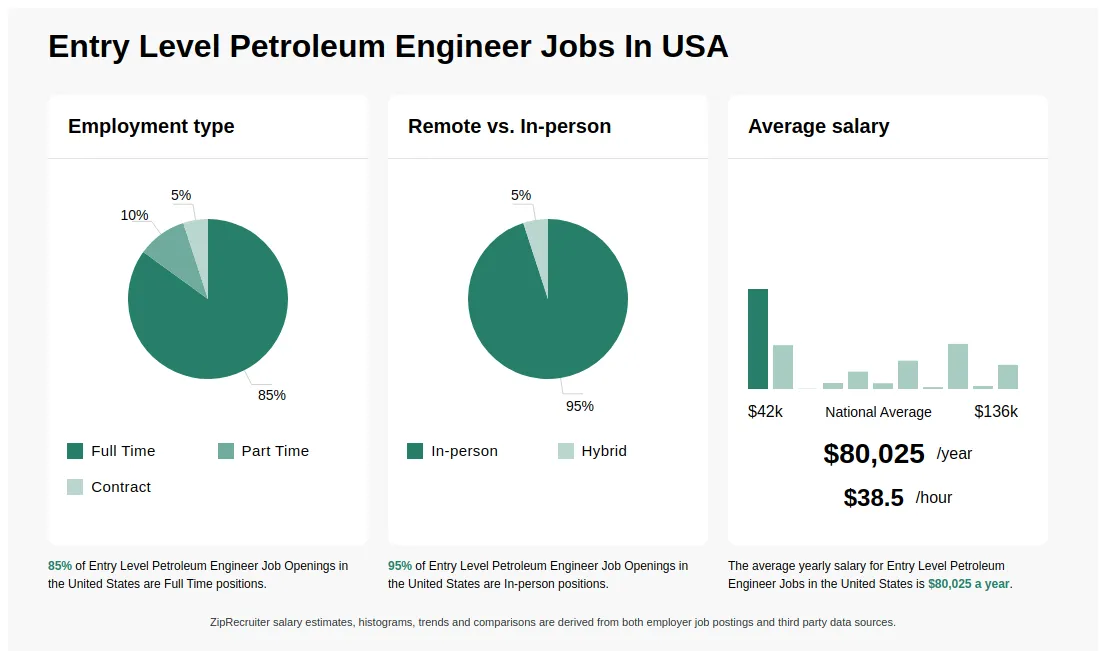
$47.7K is the 25th percentile. Wages below this are outliers.
$42K - $50.5K
38% of jobs
The median wage is $57.4K / yr.
$50.5K - $59.1K
16% of jobs
$59.1K - $67.6K
0% of jobs
$67.6K - $76.2K
2% of jobs
$76.2K - $84.7K
6% of jobs
$84.7K - $93.3K
2% of jobs
$93.3K - $101.8K
10% of jobs
$101.8K - $110.4K
0% of jobs
$110.9K is the 75th percentile. Wages above this are outliers.
$110.4K - $118.9K
17% of jobs
$118.9K - $127.5K
1% of jobs
$127.5K - $136K
8% of jobs
$42K
$80K
$136K
How much do entry level petroleum engineer jobs pay per year?
As of Sep 9, 2026, the average yearly pay for entry level petroleum engineer in the United States is $80,025.00, according to ZipRecruiter salary data. Most workers in this role earn between $44,000.00 and $114,000.00 per year, depending on experience, location, and employer.
What does an entry-level petroleum engineer do?
As an entry-level petroleum engineer, your job is to help design and develop the equipment used to extract oil and gas during drilling operations. In this role, you may use software like AutoCAD to help create machines and products, assemble a sequence of work, develop permit plans, and perform calculations to determine the minimum yield strength. Petroleum engineering should not be confused with drilling—this job focuses on the machines used in the industry, not the work of using said machines, though you may occasionally visit work sites to ensure all machines are being used properly. Entry-level petroleum engineers usually work under the supervision of a senior engineer.
What is an entry level petroleum engineer?
An Entry Level Petroleum Engineer is a beginner role in the oil and gas industry focused on designing and developing methods for extracting petroleum from underground reservoirs. They assist in analyzing geological data, optimizing drilling operations, and ensuring efficient resource recovery. Typically, they work under the supervision of experienced engineers while gaining hands-on experience in field operations, reservoir management, and production techniques. This role often requires a bachelor's degree in petroleum engineering or a related field.
What kinds of projects or tasks can I expect as an entry level petroleum engineer?
As an entry-level petroleum engineer, you will typically assist with collecting and analyzing data from drilling sites, monitoring production operations, and preparing technical reports for senior engineers. You may also help design and evaluate drilling and extraction strategies, while learning to use industry software and simulation tools. Most new engineers work as part of a team alongside experienced engineers, geologists, and field personnel, gaining exposure to both office-based analysis and occasional fieldwork. This hands-on involvement in ongoing projects helps you build practical skills, become familiar with company operations, and lays the groundwork for future advancement.
What are the key skills and qualifications needed to thrive as an entry level petroleum engineer?
To thrive as an Entry Level Petroleum Engineer, you typically need a bachelor's degree in petroleum engineering or a related field, strong analytical abilities, and knowledge of engineering principles. Familiarity with industry-standard software such as PETREL, MATLAB, and reservoir simulation tools, as well as a basic understanding of safety regulations, is important. Strong teamwork, communication skills, and adaptability help newcomers integrate into multidisciplinary teams and adjust to dynamic project requirements. These skills and qualities are crucial to ensuring accurate data analysis, effective collaboration, and successful execution of engineering tasks in complex, solution-driven environments.
Are entry level petroleum engineers still in demand?
Entry level petroleum engineers are still in demand due to ongoing energy needs and technological advancements in exploration and production. However, employment opportunities can fluctuate with oil prices, industry investment, and shifts toward renewable energy, making relevant skills like reservoir modeling and safety protocols valuable.
How easy is it to get a job as an entry level petroleum engineer?
Entry level petroleum engineering jobs are competitive but accessible for candidates with a bachelor's degree in petroleum engineering or a related field. Strong technical skills, internships, and relevant certifications can improve employment prospects, which often depend on industry demand and regional opportunities.
How much does an entry level petroleum engineer make?
Entry-level petroleum engineers typically earn a starting salary between $70,000 and $90,000 per year, depending on location, education, and industry demand. They often work in oil and gas exploration, utilizing skills in geology, reservoir engineering, and software tools. Salaries can increase with experience and additional certifications.
More about Entry Level Petroleum Engineer jobs
What cities are hiring for Entry Level Petroleum Engineer jobs?
Cities with the most Entry Level Petroleum Engineer job openings:
What are the most commonly searched types of Petroleum Engineer jobs?
The most popular types of Petroleum Engineer jobs are:
What states have the most Entry Level Petroleum Engineer jobs?
States with the most job openings for Entry Level Petroleum Engineer jobs include:
What are popular job titles related to Entry Level Petroleum Engineer jobs?
For Entry Level Petroleum Engineer jobs, the most frequently searched job titles are:

Petroleum Supply Specialist - Entry Level
Onyx, CA • On-site
U.S Army Reserve •
National Security • 5 - 10K employees5,001 - 10,000 employees
Part-time
Medical, Dental, Vision, Retirement, PTO
This job post has expired today. Applications are no longer accepted.
Job description
Job Overview:
As a Petroleum Supply Specialist in the U.S. Army Reserve, you will play a vital role in establishing and maintaining a dependable fuel supply in support of unit operations. Serving in a part-time federal service role, you will oversee the receipt, storage, and distribution of bulk and packaged petroleum-based products during training and mobilization periods. This position offers hands-on technical training and experience, allowing you to develop valuable skills in assembling and operating refueling systems, conducting detailed quality assurance checks, and managing fuel supply and storage from multiple sources. These in-demand technical and logistics skills directly support civilian careers in energy, transportation, and industrial operations, while enabling mission readiness and organizational effectiveness.
Requirements:
Attend a 21-week paid training program to gain skills and certifications in bulk fueling systems operations, fuel system maintenance, fuel accountability, forecasting, fuel distribution, bulk fuel distribution, petroleum storage, packaged petroleum logistics, petroleum shipment, environmental regulation compliance, hazmat compliance, emergency management, technical inspections, and OSHA regulations.
Advanced certifications require additional full funded training programs.
Benefits:
Pay and Promotion:
Additional Career Opportunities:
Upon successful completion of first term contract, you are guaranteed up to 5 interviews with your choice 1,200 industry leading organizations including Fuel Delivery Services, Superior Fuel Company, and Guardian Fueling.
Similar Career Fields Include: Terminal Operater, Compliance Specialist, Refinery Inspection Engineer.
About Our Organization:
The U.S. Army is wealth of possibilities for your future � whether you are looking to build a meaningful career, continue your education, or start a family, the Army is committed to helping you build the future you are looking for and improve yourself in the process. Be All You Can Be.
Now Hiring Part Time Positions.
***Click apply for an Interview***

About U.S. Army Reserve
Sourced by ZipRecruiter
Industry
National security and national security and international affairs
Company size
5,001 - 10,000 Employees
Headquarters location
Fort Bragg, NC, US