1

Petroleum Engineer Intern Jobs (NOW HIRING)

next page

Showing results 1-20

Petroleum Engineer Intern information

See salary details

$11

$19

$29

How much do petroleum engineer intern jobs pay per hour?

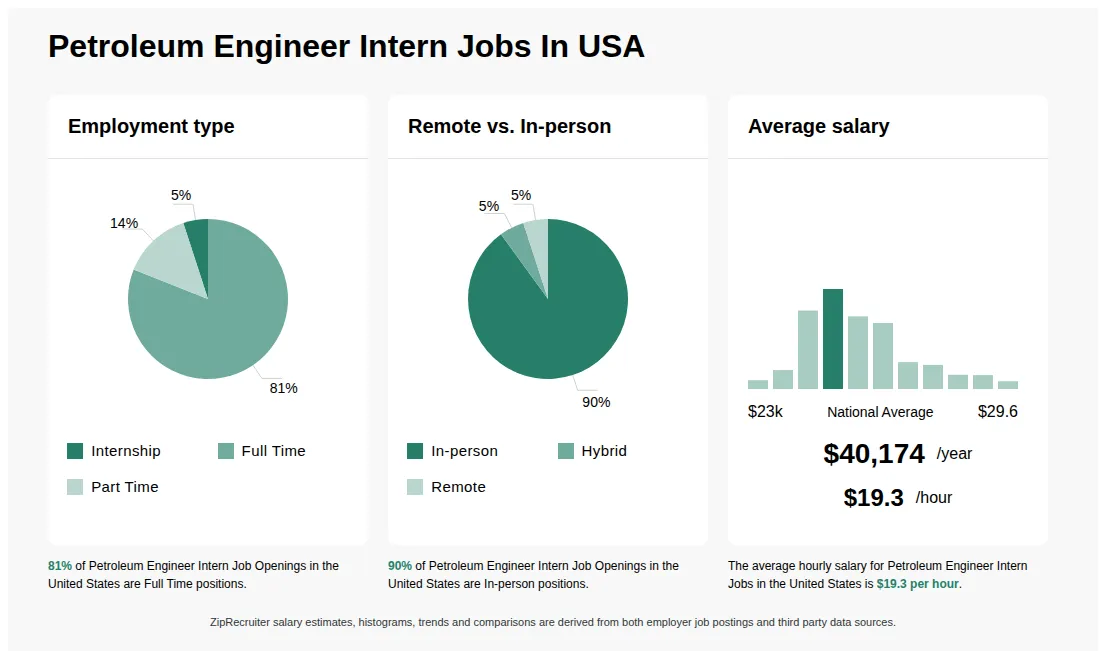
As of Jul 8, 2026, the average hourly pay for petroleum engineer intern in the United States is $19.31, according to ZipRecruiter salary data. Most workers in this role earn between $16.11 and $20.91 per hour, depending on experience, location, and employer.

What are the key skills and qualifications needed to thrive in the Petroleum Engineer Intern position, and why are they important?

To thrive as a Petroleum Engineer Intern, you need a foundational understanding of engineering principles, geology, and fluid mechanics, typically gained through coursework in petroleum or chemical engineering. Familiarity with industry-standard software such as Petrel, MATLAB, or AutoCAD, and knowledge of safety and environmental regulations are highly beneficial. Strong analytical thinking, attention to detail, effective communication, and a willingness to learn set outstanding candidates apart. These skills and qualities are crucial for accurately supporting engineering projects, ensuring safety, and communicating findings within multidisciplinary teams.

What is a Petroleum Engineer Intern job?

A Petroleum Engineer Intern assists engineers in designing and optimizing oil and gas extraction processes. Interns may analyze reservoir data, support drilling operations, or work on production techniques to improve efficiency. They often collaborate with multidisciplinary teams, gaining hands-on experience with industry software and field operations. This role helps develop technical skills and industry knowledge, preparing interns for future engineering positions.

What types of projects or responsibilities can I expect as a Petroleum Engineer Intern?

As a Petroleum Engineer Intern, you’ll typically assist with tasks such as analyzing production data, conducting reservoir simulations, supporting field operations, and preparing technical reports. You may work closely with experienced engineers, geologists, and field personnel to contribute to both office-based and on-site projects. Interns often get exposure to both the technical and practical sides of oil and gas extraction, allowing them to develop a well-rounded skill set. This hands-on experience is valuable for building your resume and understanding the day-to-day challenges and rewards of a career in petroleum engineering.

More about Petroleum Engineer Intern jobs
What cities are hiring for Petroleum Engineer Intern jobs? Cities with the most Petroleum Engineer Intern job openings:
What are the most commonly searched types of Petroleum Engineer jobs? The most popular types of Petroleum Engineer jobs are:
What states have the most Petroleum Engineer Intern jobs? States with the most job openings for Petroleum Engineer Intern jobs include:
What job categories do people searching Petroleum Engineer Intern jobs look for? The top searched job categories for Petroleum Engineer Intern jobs are:
Infographic showing various Petroleum Engineer Intern job openings in the United States as of July 2026, with employment types broken down into 25% Internship, and 75% Full Time. Highlights an 50% In-person, and 50% Remote job distribution, with an average salary of $40,174 per year, or $19.3 per hour.
Petroleum Engineer

$122K/yr

Other

Posted 20 days ago


U.S. Department Of The Interior rating

7.8

Company rating: 7.8 out of 10

Based on 14 frontline employees who took The Breakroom Quiz

309th of 675 rated public administrative organizations


Job description

The Bureau of Safety & Environmental Enforcement (BSEE) works to promote safety, protect the environment, and conserve resources offshore through vigorous regulatory oversight and enforcement. For information about our bureau go to: http://www.bsee.gov/Qualifications:Minimum Qualification Requirements:
To qualify for this position you must meet the
(1) Basic Educational Requirements AND (2) Specialized Experience for the series to which you are applying.

(1) Basic Educational Requirements:
To be eligible for this position, you must meet either A or B below for the series to which you are applying.
A. Degree: Engineering.
To be acceptable, the program must: (1) lead to a bachelor's degree in a school of engineering with at least one program accredited by ABET; or (2) include differential and integral calculus and courses (more advanced than first-year physics and chemistry) in five of the following seven areas of engineering science or physics: (a) statics, dynamics; (b) strength of materials (stress-strain relationships); (c) fluid mechanics, hydraulics; (d) thermodynamics; (e) electrical fields and circuits; (f) nature and properties of materials (relating particle and aggregate structure to properties); and (g) any other comparable area of fundamental engineering science or physics, such as optics, heat transfer, soil mechanics, or electronics.
-OR-
B. Combination of education and experience -- college-level education, training, and/or technical experience that furnished (1) a thorough knowledge of the physical and mathematical sciences underlying engineering, and (2) a good understanding, both theoretical and practical, of the engineering sciences and techniques and their applications to one of the branches of engineering. The adequacy of such background must be demonstrated by one of the following:
  1. Professional registration or licensure -- Current registration as an Engineer Intern (EI), Engineer in Training (EIT), or licensure as a Professional Engineer (PE) by any State, the District of Columbia, Guam, or Puerto Rico. Absent other means of qualifying under this standard, those applicants who achieved such registration by means other than written test (e.g., State grandfather or eminence provisions) are eligible only for positions that are within or closely related to the specialty field of their registration. For example, an applicant who attains registration through a State Board's eminence provision as a manufacturing engineer typically would be rated eligible only for manufacturing engineering positions.
  2. Written Test -- Evidence of having successfully passed the Fundamentals of Engineering (FE) examination or any other written test required for professional registration by an engineering licensure board in the various States, the District of Columbia, Guam, and Puerto Rico.
-AND-
(2) Specialized Experience
To qualify for the GS-13, you must possess at least one full year of specialized experience equivalent to the GS-12 level in the Federal service, or comparable experience not gained through Federal service. Specialized experience is experience that equipped the applicant with the particular knowledge, skills, and abilities to perform successfully the duties of the position, and that is in or related to the work of the position to be filled.
Specialized experience is defined as demonstrated experience:
1. Experience evaluating reservoir rock properties, fluid properties, reservoir drive mechanisms, and
production forecasting and history matching.
2. Experience calculating shut-in pressures of proposed wells to determine design integrity for adequate well containment
3. Experience with reservoir simulation, reservoir fluid PVT(Pressure, Volume, Temperature) analysis, IPR(Inflow Performance Relationship) and TPR(Tubing Performance Relationship) curves.
4. Proficiency preparing technical reports or other technical written documentation
Must meet all.
Additional information on the qualification requirements is outlined in the OPM Qualification Standards Handbook of General Schedule Positions and is available at OPM's website: https://www.opm.gov/qualifications/standards/indexes/num-ndx.asp
All qualification requirements must be met by the closing date of this announcement.
Merit Promotion candidates must also meet Time-in-Grade requirements by the closing date of the announcement.Education:
Education: If this position requires specific educational course work to qualify, or you are qualifying based in whole or part on education, you are required to provide transcripts as proof of meeting the requirements.
Foreign Education: Education completed in colleges or universities outside the United States may be used to meet the specific educational requirements as stated above. You must provide acceptable documentation that the foreign education is comparable to that received in an accredited educational institution in the United States. For more information on how foreign education is evaluated, visit: http://www.opm.gov/policy-data-oversight/classification-qualifications/general-schedule-qualification-policies/#url=e4Employment Type: OTHER

What U.S. Department Of The Interior employees say

Pay

Hours and flexibility

Workplace

Get the full story on Breakroom