1

Petroleum Engineer Internship Jobs (NOW HIRING)

... Petroleum Engineering required; Chemical Engineering Degree preferred EXPERIENCE REQUIREMENTS * 4+ years of relevant work experience required * College engineering internship preferred; oil and ...

... Petroleum Engineering required; Chemical Engineering Degree preferred EXPERIENCE REQUIREMENTS * 4+ years of relevant work experience required * College engineering internship preferred; oil and ...

next page

Showing results 1-20

Petroleum Engineer Internship information

See salary details

$11

$19

$29

How much do petroleum engineer internship jobs pay per hour?

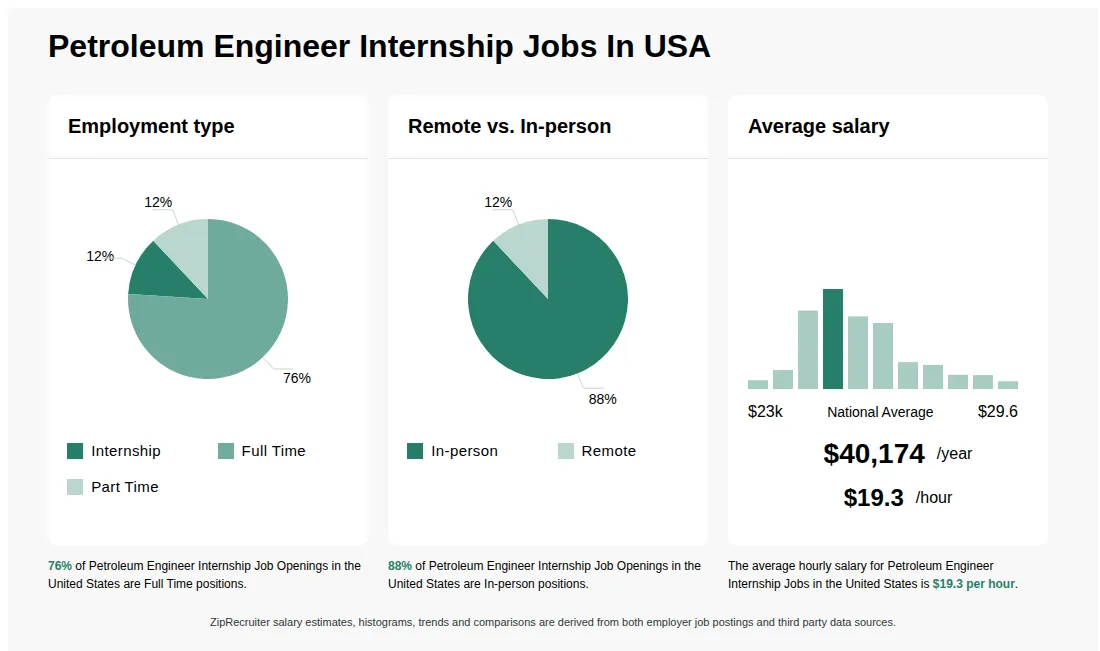
As of Jun 16, 2026, the average hourly pay for petroleum engineer internship in the United States is $19.31, according to ZipRecruiter salary data. Most workers in this role earn between $16.11 and $20.91 per hour, depending on experience, location, and employer.

What are the key skills and qualifications needed to thrive as a Petroleum Engineer Intern, and why are they important?

To thrive as a Petroleum Engineer Intern, you need a strong background in engineering principles, mathematics, and geology, typically supported by progress toward a bachelor's degree in petroleum engineering or a related field. Familiarity with industry-standard software such as Petrel, Eclipse, and MATLAB, as well as knowledge of drilling and reservoir simulation tools, is highly valuable. Strong analytical thinking, effective communication, and teamwork skills help interns collaborate with multidisciplinary teams and adapt to dynamic project environments. These competencies are essential for contributing to real-world engineering projects, ensuring safety, and developing innovative solutions in the energy industry.

Is a 3.0 GPA good for internships?

For a petroleum engineer internship, a 3.0 GPA is generally considered acceptable, especially if combined with relevant coursework, technical skills, and internship or project experience. Many employers value practical skills and problem-solving abilities alongside GPA, but a higher GPA can improve competitiveness for competitive programs.

What Are the Qualifications to Get a Petroleum Engineer Internship?

The qualifications and skills that you need to get a petroleum engineering internship include enrollment as a student in an engineering degree program and completion of relevant coursework related to your internship responsibilities. If you perform field work, you usually need to undergo safety training before starting your internship. Petroleum engineering students qualify for internship opportunities, but options are also available for mechanical and chemical engineering students. Some internships are for college juniors and seniors, while others accept any students who meet grade point average requirements.

Can you intern on an oil rig?

Petroleum engineering internships can sometimes be offered on oil rigs, but they are less common than office-based internships. Most internships are conducted at company offices or training facilities, and working on an oil rig typically requires specialized safety training, certifications, and adherence to strict safety protocols. Interns interested in rig work should seek programs that specifically offer offshore or field-based experience and ensure they meet safety and qualification requirements.

Are petroleum engineers still in demand?

Petroleum engineers are still in demand due to ongoing global energy needs and the continued importance of oil and gas extraction. However, demand can fluctuate with market conditions, technological advancements, and shifts toward renewable energy sources. Strong technical skills and knowledge of drilling and reservoir management remain valuable in the industry.

What is the difference between Petroleum Engineer Internship vs Petroleum Engineer?

AspectPetroleum Engineer InternshipPetroleum Engineer
CredentialsTypically pursuing or recent graduate with a degree in petroleum engineering or related fieldBachelor's degree in petroleum engineering; professional licensure may be required
Work EnvironmentInternship sites, office settings, field operationsFull-time work in exploration, drilling, production, and office environments
Employer & Industry UsageInternship programs offered by oil and gas companies for trainingFull professional role within oil and gas industry companies

Petroleum Engineer Internships provide students or recent graduates with practical experience and training in the field, often as a stepping stone to a full career. Petroleum Engineers are fully qualified professionals responsible for designing and managing extraction processes. Internships are temporary and educational, while petroleum engineering roles involve ongoing responsibilities and career development.

What is a Petroleum Engineer Internship?

A Petroleum Engineer Internship is a temporary, supervised training position for students or recent graduates interested in the petroleum engineering field. Interns typically work with experienced engineers on projects related to oil and gas exploration, drilling, production, or reservoir management. This hands-on experience allows interns to apply classroom knowledge, develop technical skills, and gain insight into industry operations. Internships can improve job prospects and help students decide if petroleum engineering is the right career path for them.

How much do Petroleum Engineer interns make?

Petroleum Engineer interns typically earn between $15 and $25 per hour, depending on location, company, and level of education. Internships often last for a few months during summer or academic breaks and may include additional benefits such as mentorship and training in industry-standard tools like reservoir simulation software.

What types of projects and responsibilities can I expect during a Petroleum Engineer Internship?

As a Petroleum Engineer Intern, you can expect to work on a variety of projects supporting reservoir analysis, drilling operations, or production optimization. Common responsibilities include collecting and analyzing field data, assisting with simulation models, preparing technical reports, and collaborating with senior engineers during site visits. Interns often participate in team meetings and may be tasked with presenting findings or contributing to ongoing research, providing hands-on exposure to industry practices and valuable networking opportunities.
What cities are hiring for Petroleum Engineer Internship jobs? Cities with the most Petroleum Engineer Internship job openings:
What are the most commonly searched types of Petroleum Engineer jobs? The most popular types of Petroleum Engineer jobs are:
What states have the most Petroleum Engineer Internship jobs? States with the most job openings for Petroleum Engineer Internship jobs include:
Infographic showing various Petroleum Engineer Internship job openings in the United States as of June 2026, with employment types broken down into 5% Internship, 2% As Needed, 89% Full Time, and 4% Part Time. Highlights an 87% Physical, 5% Hybrid, and 8% Remote job distribution, with an average salary of $40,174 per year, or $19.3 per hour.
Associate/Full Professor and Holder of the Ross B. Matthews Professorship in Petroleum Engineering

Associate/Full Professor and Holder of the Ross B. Matthews Professorship in Petroleum Engineering

Texas Christian University

Fort Worth, TX • On-site

Full-time

Posted yesterday


Texas Christian University rating

7.1

Company rating: 7.1 out of 10

Based on 19 frontline employees who took The Breakroom Quiz

352nd of 537 rated colleges and universities


Job description

Application Deadline:
Open until filled.
Position Details:
This full-time faculty position is on-campus and in-person.
Key Responsibilities
I. Research Leadership
A. Conduct high-impact research in petroleum engineering, with potential focus areas including reservoir engineering, geothermal resources, drilling technologies, subsurface flows, production optimization, enhanced oil recovery, carbon capture and storage, and energy transition strategies and storage.
B. Secure external funding from federal agencies (e.g., Department of Energy), industry partners, and other sources to support research initiatives.
C. Publish in top-tier peer-reviewed journals and present findings at national and international conferences, such as those hosted by the Society of Petroleum Engineers (SPE).
D. Collaborate with the industry partners to address global energy challenges, leveraging TCU's strategic position in the energy sector.
II. Teaching and Mentorship
A. Teach undergraduate and graduate courses in petroleum engineering, such as reservoir simulation, drilling engineering, petrophysics, fluid flow, thermodynamics, and production engineering, within the Department of Engineering.
B. Develop and update curriculum to reflect industry advancements, incorporating practical applications and emerging technologies, such as data analytics or sustainable energy practices.
C. Mentor undergraduate and graduate students, guiding research projects, theses, and career development, with an emphasis on preparing students for leadership roles in the energy industry.
D. Utilize industry experience to bridge academic and practical perspectives in the classroom, enhancing student engagement and learning outcomes.
E. Provide leadership in development of a petroleum engineering program at TCU.
III. Service and Industry Engagement
A. Provide leadership within the Department of Engineering, contributing to strategic planning, curriculum development, accreditation processes, and new graduate engineering programs.
B. Foster strong partnerships with energy industry stakeholders to enhance research opportunities, internships, and job placements for students.
C. Engage with professional organizations (e.g., SPE, ASME, AIAA) through leadership roles, conference participation, or technical committees.
D. Contribute to TCU's mission by participating in university-wide initiatives, such as sustainability efforts or interdisciplinary energy research.
IV. Public and Professional Impact
A. Communicate research and industry insights to diverse audiences, including policymakers, industry leaders, and the public, to promote responsible energy development.
B. Serve as a role model for faculty and students, embodying excellence in scholarship, teaching, and professional conduct.
V. Qualifications Required
A. Ph.D. in Petroleum Engineering, Chemical Engineering, Mechanical Engineering, or a closely related field.
B. Extensive industry experience in petroleum engineering or energy-related fields, demonstrating practical expertise and professional impact.
C. A distinguished record of scholarly research, including significant publications and a history of securing external funding.
D. Proven excellence in teaching at the undergraduate and/or graduate levels, with the ability to translate industry experience into effective pedagogy.
E. Eligibility for appointment at the rank of Full Professor with tenure.
VI. Preferred
A. Expertise in emerging areas of petroleum engineering, such as carbon sequestration, geothermal energy, or digital technologies for reservoir management.
B. Established relationships with energy industry leaders or experience in industry-academia collaborations.
C. Leadership roles in professional organizations or significant contributions to the petroleum engineering community.
D. A record of mentoring successful graduate students or early-career professionals.
Department Details:
The Department of Engineering in the College of Science & Engineering offers an ABET-accredited undergraduate program in engineering, with areas of emphasis in mechanical and electrical engineering. The department serves approximately 300 students and is supported by 13 dedicated faculty members with extensive industry experience and a strong commitment to teaching and student engagement. Emphasizing experiential learning, the program offers a year-long capstone senior design project, where students develop skills in communication, teamwork, and system-level thinking while solving real-world engineering problems.
School/College Description:
The Louise Dilworth Davis College of Science & Engineering encompasses 9 departments (Biology, Chemistry & Biochemistry, Computer Science, Engineering, Environmental and Geological Sciences, Mathematics, Nutritional Sciences, Physics & Astronomy, and Psychology) as well as the Ranch Management Program, which offers both an undergraduate degree and a one-year certificate program. Davis College is also home to the Pre-Health Professions Institute, the Karyn Purvis Institute for Child Development, the Institute of Behavioral Research, the Institute for Environmental Studies, Monnig Meteorite Gallery, and the Institute for Ranch Management. Davis College is the second largest at TCU in terms of both undergraduate enrollment and number of majors. It contains a disproportionate percentage of high-achieving students, as evidenced by the fact that almost one-half of the students in the Honors College have majors in The Louise Dilworth Davis College of Science & Engineering. Research opportunities abound for undergraduates, with 46 percent of majors engaging in a substantive experience during which they work one-on-one with their faculty mentor. Davis College also has five doctoral programs and 16 master's programs, as well as two graduate certificate programs. Davis College faculty are true teacher-scholars, for whom instruction and research are viewed as complementary activities.
University & Fort Worth Description:
About TCU
Founded in 1873, Texas Christian University is a world-class, private, Carnegie-classified national research university located in Fort Worth, Texas. Inspired by its mission and core values of integrity, engagement, community, and excellence, TCU consistently ranks among the top universities and colleges in the United States.
TCU's campus - regularly ranked among the nation's most beautiful - spans 302 acres in a primarily residential area just minutes from downtown.
The university comprises nine schools and colleges offering 117 areas of undergraduate study, 62 master's level programs, and 37 areas of doctoral study. TCU is a leader across several disciplines, including health care, business, energy, and the arts. Total enrollment stands at 12,980, including 11,152 undergraduates and 1,828 graduate students. Students are supported by over 2,200 faculty and staff, including more than 700 full-time faculty members.
About Fort Worth
Fort Worth blends the approachable charm of a smaller city with the amenities, cultural energy, and distinctive personality of a major metro. As the nation's 11th-largest city, with a rapidly growing population of more than 1 million, Fort Worth and TCU share a relationship that spans more than a century - one that continues to deepen as many Horned Frogs choose to stay after graduation, drawn by the region's thriving job market. Part of the Dallas-Fort Worth metropolitan area - the nation's fourth-largest and a top tourism destination - Fort Worth earned recognition from U.S. News & World Report in 2025 as the No. 4 best big city to live in the United States.
Fort Worth offers an impressive array of cultural, educational, and entertainment opportunities, anchored by three world-class art museums - the Kimbell Art Museum, the Modern Art Museum of Fort Worth, and the Amon Carter Museum of American Art. The Bass Performance Hall stands as one of the premier performance venues in the country. Throughout the year, residents and visitors alike enjoy concerts, film festivals, and other cultural events at Sundance Square, Dickies Arena, Panther Island, and Near Southside venues.
Required Application Materials & Application Instructions:
Interested candidates should submit the following materials:
• A cover letter detailing their qualifications, industry experience, research agenda, and vision for the Ross B. Matthews Professorship.
• A current curriculum vitae (CV).
• A research statement outlining past accomplishments and future research plans.
• A teaching statement describing teaching philosophy, industry-informed approaches, and proposed courses (2-3 pages).
• Contact information for 3-5 professional references.
Employment Values Statement:
Texas Christian University values Integrity, Engagement, Community, and Excellence in the workplace. TCU treats applicants and employees with fairness and respect. TCU hires and promotes individuals based on their qualifications and their commitment to making a positive impact on our student-centered community. TCU is an equal opportunity employer and follows all applicable employment laws. TCU fairly considers all qualified individuals, ensuring we are a workplace free from unlawful discrimination and harassment.

What Texas Christian University employees say

Pay

Hours and flexibility

Workplace

Get the full story on Breakroom