
The Metallurgical Engineer will address quality issues related to the area of support, and will evaluate and develop products, processes, and equipment based on customer requirements. Arconic ...
The Metallurgical Engineer will address quality issues related to the area of support, and will evaluate and develop products, processes, and equipment based on customer requirements. Arconic ...
Senior Metallurgical Engineer Department: Operations - Foundry Reports To: VP of Operations FLSA Status: Exempt Position Summary Baker Manufacturing is seeking an experienced Senior Metallurgical ...
Senior Metallurgical Engineer Department: Operations - Foundry Reports To: VP of Operations FLSA Status: Exempt Position Summary Baker Manufacturing is seeking an experienced Senior Metallurgical ...

Sr. Metallurgical Engineer
$75K - $110K/yr
As a Staff Metallurgical Engineer, you will engage in all facets of process R&D, design, and implementation of our proprietary lithium-ion battery recycling processes and primary resource extraction ...
Sr. Metallurgical Engineer
$75K - $110K/yr
As a Staff Metallurgical Engineer, you will engage in all facets of process R&D, design, and implementation of our proprietary lithium-ion battery recycling processes and primary resource extraction ...
The Metallurgical Engineer will lead continuous improvement in process metallurgy, driving excellence in manufacturing, evaluation, and performance of sheet products produced at TN operations in ...
The Metallurgical Engineer will lead continuous improvement in process metallurgy, driving excellence in manufacturing, evaluation, and performance of sheet products produced at TN operations in ...
Metallurgical Engineer
Alcoa, TN · On-site
The Metallurgical Engineer will lead continuous improvement in process metallurgy, driving excellence in manufacturing, evaluation, and performance of sheet products produced at TN operations in ...
Metallurgical Engineer
Alcoa, TN · On-site
The Metallurgical Engineer will lead continuous improvement in process metallurgy, driving excellence in manufacturing, evaluation, and performance of sheet products produced at TN operations in ...
The Metallurgical Engineer will lead continuous improvement in process metallurgy, driving excellence in manufacturing, evaluation, and performance of sheet products produced at TN operations in ...
The Metallurgical Engineer will lead continuous improvement in process metallurgy, driving excellence in manufacturing, evaluation, and performance of sheet products produced at TN operations in ...
The Metallurgical Engineer will lead continuous improvement in process metallurgy, driving excellence in manufacturing, evaluation, and performance of sheet products produced at TN operations in ...
The Metallurgical Engineer will lead continuous improvement in process metallurgy, driving excellence in manufacturing, evaluation, and performance of sheet products produced at TN operations in ...
Metallurgical Engineer
Kennesaw, GA · On-site
Bachelor of Science degree in Metallurgical Engineering * Less than 1-year of industrial experience * Understanding of microstructure-property relationships in metals and alloys Preferred ...
Metallurgical Engineer
Kennesaw, GA · On-site
Bachelor of Science degree in Metallurgical Engineering * Less than 1-year of industrial experience * Understanding of microstructure-property relationships in metals and alloys Preferred ...
Bachelor of Science degree in Metallurgical Engineering * Less than 1-year of industrial experience * Understanding of microstructure-property relationships in metals and alloys Preferred ...
Bachelor of Science degree in Metallurgical Engineering * Less than 1-year of industrial experience * Understanding of microstructure-property relationships in metals and alloys Preferred ...

Metallurgical Engineer
Cleveland, OH · On-site
A Bachelor's degree in Metallurgical Engineering, Materials Science Engineering, or Chemical Engineering from an accredited institution, or a minimum 8 years of metallurgical manufacturing experience ...
Metallurgical Engineer
Cleveland, OH · On-site
A Bachelor's degree in Metallurgical Engineering, Materials Science Engineering, or Chemical Engineering from an accredited institution, or a minimum 8 years of metallurgical manufacturing experience ...

Bachelor's Degree in Metallurgy, Metallurgical Engineering, Materials Science, or Chemical Engineering from an accredited institution * Strong analytical, troubleshooting, and problem-solving ...
Bachelor's Degree in Metallurgy, Metallurgical Engineering, Materials Science, or Chemical Engineering from an accredited institution * Strong analytical, troubleshooting, and problem-solving ...
The Metallurgical Engineer will lead continuous improvement in process metallurgy, driving excellence in manufacturing, evaluation, and performance of sheet products produced at TN operations in ...
The Metallurgical Engineer will lead continuous improvement in process metallurgy, driving excellence in manufacturing, evaluation, and performance of sheet products produced at TN operations in ...
Bachelor's Degree in Metallurgy, Metallurgical Engineering, Materials Science, or Chemical Engineering from an accredited institution * Strong analytical, troubleshooting, and problem-solving ...
Bachelor's Degree in Metallurgy, Metallurgical Engineering, Materials Science, or Chemical Engineering from an accredited institution * Strong analytical, troubleshooting, and problem-solving ...
Sr. Metallurgical Engineer
Reno, NV · On-site
$75K - $110K/yr
As a Staff Metallurgical Engineer, you will engage in all facets of process R&D, design, and implementation of our proprietary lithium-ion battery recycling processes and primary resource extraction ...
Sr. Metallurgical Engineer
Reno, NV · On-site
$75K - $110K/yr
As a Staff Metallurgical Engineer, you will engage in all facets of process R&D, design, and implementation of our proprietary lithium-ion battery recycling processes and primary resource extraction ...

The Metallurgical Engineer is responsible for developing materials application, forged product and manufacturing related technologies using fundamentals of engineering foundations and material ...
The Metallurgical Engineer is responsible for developing materials application, forged product and manufacturing related technologies using fundamentals of engineering foundations and material ...
Sr. Metallurgical Engineer
Reno, NV · On-site
$75K - $110K/yr
As a Staff Metallurgical Engineer, you will engage in all facets of process R&D, design, and implementation of our proprietary lithium-ion battery recycling processes and primary resource extraction ...
Quick apply
Sr. Metallurgical Engineer
Reno, NV · On-site
$75K - $110K/yr
As a Staff Metallurgical Engineer, you will engage in all facets of process R&D, design, and implementation of our proprietary lithium-ion battery recycling processes and primary resource extraction ...

As a Metallurgical Engineer, you'll be at the forefront of process development, customer collaboration, and technical problem-solving -- shaping the future of our products and our technology.
As a Metallurgical Engineer, you'll be at the forefront of process development, customer collaboration, and technical problem-solving -- shaping the future of our products and our technology.
Metallurgical Engineer - ADL
Columbus, MS · On-site
Bachelor's Degree in Metallurgy, Metallurgical Engineering, Materials Science, or Chemical Engineering from an accredited institution * Strong analytical, troubleshooting, and problem-solving ...
Metallurgical Engineer - ADL
Columbus, MS · On-site
Bachelor's Degree in Metallurgy, Metallurgical Engineering, Materials Science, or Chemical Engineering from an accredited institution * Strong analytical, troubleshooting, and problem-solving ...
Senior Metallurgical Engineer
Temple, TX · On-site
We are seeking a highly skilled and detail-oriented Senior Metallurgical Engineer to join our technical team. This role is critical in overseeing the production, quality, and technical integrity of ...
Senior Metallurgical Engineer
Temple, TX · On-site
We are seeking a highly skilled and detail-oriented Senior Metallurgical Engineer to join our technical team. This role is critical in overseeing the production, quality, and technical integrity of ...
The Metallurgical Engineeris responsible fordeveloping materials application,forgedproductand manufacturing related technologies using fundamentals of engineering foundations and material science. A ...
The Metallurgical Engineeris responsible fordeveloping materials application,forgedproductand manufacturing related technologies using fundamentals of engineering foundations and material science. A ...
Metallurgical Engineer information
See salary details
$33K - $43.2K
6% of jobs
$43.2K - $53.5K
1% of jobs
$53.5K - $63.7K
2% of jobs
$63.7K - $73.9K
11% of jobs
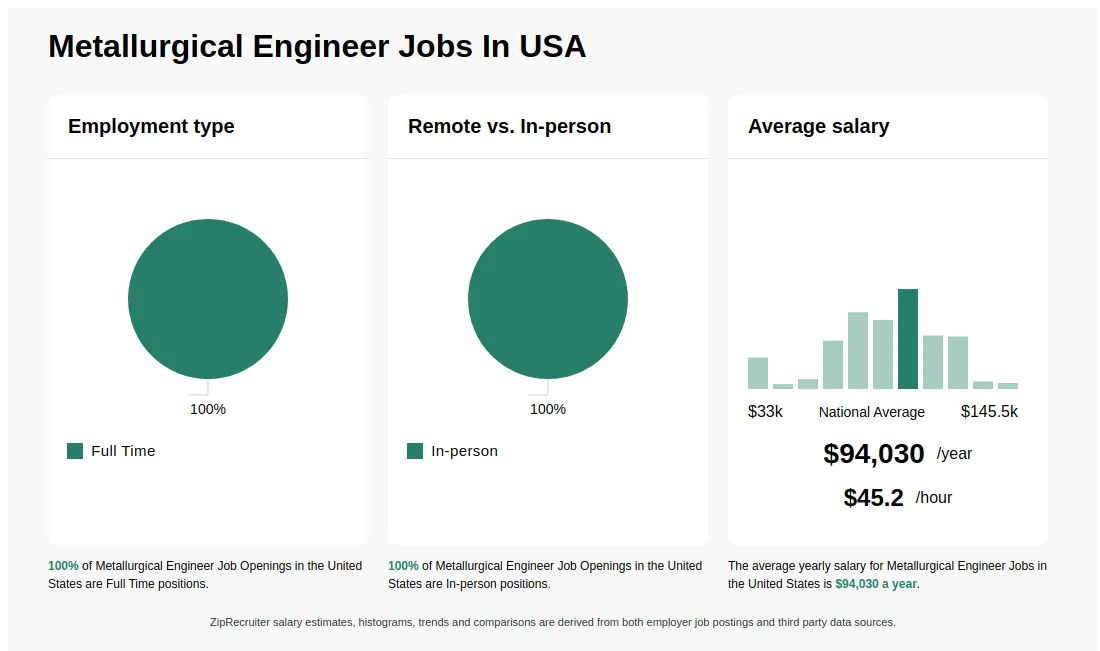
$76.9K is the 25th percentile. Wages below this are outliers.
$73.9K - $84.1K
17% of jobs
The median wage is $92.7K / yr.
$84.1K - $94.4K
16% of jobs
$94.4K - $104.6K
22% of jobs
$104.8K is the 75th percentile. Wages above this are outliers.
$104.6K - $114.8K
12% of jobs
$114.8K - $125K
12% of jobs
$125K - $135.3K
1% of jobs
$135.3K - $145.5K
1% of jobs
$33K
$94K
$145.5K
How much do metallurgical engineer jobs pay per year?
As of Jul 22, 2026, the average yearly pay for metallurgical engineer in the United States is $94,030.00, according to ZipRecruiter salary data. Most workers in this role earn between $77,500.00 and $108,500.00 per year, depending on experience, location, and employer.
What is the difference between Metallurgical Engineer vs Materials Engineer?
| Aspect | Metallurgical Engineer | Materials Engineer |
|---|---|---|
| Credentials | Bachelor's in Metallurgical or Materials Engineering, possibly Professional Engineer (PE) license | Bachelor's in Materials Science or Engineering, possibly PE license |
| Work Environment | Factories, research labs, mining sites, manufacturing plants | Research labs, manufacturing facilities, R&D departments |
| Industry Usage | Mining, metal production, alloy development, failure analysis | Polymers, ceramics, composites, metals, and advanced materials |
Metallurgical Engineers focus on metals and alloys, working in mining, metal production, and failure analysis. Materials Engineers have a broader scope, working with various materials like polymers, ceramics, and composites. Both roles require similar credentials and often work in manufacturing or research environments, but their specific materials focus differs.
What are some common challenges Metallurgical Engineers face when working on large-scale industrial projects?
Metallurgical Engineers working on large-scale industrial projects often encounter challenges related to material selection, process optimization, and quality control. Coordinating with multidisciplinary teams, such as mechanical engineers and production supervisors, is crucial to ensure that metallurgical processes align with overall project goals. Adapting to evolving technologies and troubleshooting unexpected material behavior under real-world conditions also require strong problem-solving skills. Staying up-to-date with industry standards and safety regulations is essential for success in this dynamic environment.
What jobs can a Metallurgical Engineer do?
A Metallurgical Engineer can work in industries such as mining, materials manufacturing, aerospace, automotive, and energy, focusing on the development, processing, and testing of metals and alloys. They often work in research labs, production facilities, or quality control environments, utilizing skills in materials analysis, failure analysis, and process optimization. Certifications like Professional Engineer (PE) can enhance career opportunities.
What engineers make $300,000 a year?
Senior metallurgical engineers with extensive experience, advanced technical skills, and leadership roles can earn $300,000 or more annually. High salaries are often associated with working in specialized industries such as aerospace, energy, or consulting firms, especially when combined with bonuses and profit sharing.
What are the key skills and qualifications needed to thrive as a Metallurgical Engineer, and why are they important?
To thrive as a Metallurgical Engineer, you need a strong background in materials science, chemistry, and engineering principles, typically supported by a bachelor's degree in metallurgical engineering or a related field. Familiarity with metallurgical analysis tools, laboratory testing equipment, and software such as AutoCAD or MATLAB is commonly required. Attention to detail, problem-solving abilities, and effective communication are crucial soft skills for collaborating with teams and interpreting technical data. These skills and qualities are essential to ensure the development, testing, and improvement of metals and alloys for safe and efficient industrial applications.
What Do Metallurgical Engineers Do?
A metallurgical engineer develops ways to extract metal materials and produce metal products more efficiently. As a metallurgical engineer, you may work in the mining industry or for a manufacturer that utilizes metal products, such as automotive, aerospace, electronics, and large equipment companies. In the mining industry, you may focus on finding environmentally-friendly methods to extract minerals from mines. Those working in the manufacturing field may design techniques to remove metals from other materials or convert raw metals into new alloys and types of metals.
What does a Metallurgical Engineer do?
A Metallurgical Engineer specializes in the study, development, and processing of metals and alloys. They work on extracting metals from their ores, refining them, and designing new materials with specific properties for various applications such as construction, automotive, and electronics. Metallurgical Engineers also focus on improving production efficiency, ensuring quality control, and finding innovative ways to recycle and use metals sustainably. Their work often involves laboratory analysis, fieldwork, and collaboration with other engineers and scientists.
What does a Metallurgist engineer do?
A metallurgical engineer studies and applies principles of materials science to extract, process, and develop metals and alloys. They work on improving material properties, solving manufacturing problems, and ensuring quality control in industries such as mining, aerospace, and manufacturing, often using tools like microscopy and spectrometry. Strong analytical skills and knowledge of thermodynamics and materials testing are essential for this role.
What engineers make $500,000 a year?
Highly experienced engineers in specialized fields such as petroleum, aerospace, or software engineering can reach or exceed $500,000 annually, often through a combination of base salary, bonuses, and stock options. These roles typically require advanced skills, extensive experience, and often involve leadership or executive responsibilities.
More about Metallurgical Engineer jobs
What cities are hiring for Metallurgical Engineer jobs? Cities with the most Metallurgical Engineer job openings:
What are the most commonly searched types of Metallurgical Engineer jobs? The most popular types of Metallurgical Engineer jobs are:
Who are the top companies hiring for Metallurgical Engineer jobs? The top employers for Metallurgical Engineer jobs are:
What states have the most Metallurgical Engineer jobs? States with the most job openings for Metallurgical Engineer jobs include:
What job categories do people searching Metallurgical Engineer jobs look for? The top searched job categories for Metallurgical Engineer jobs are:
What are popular job titles related to Metallurgical Engineer jobs? For Metallurgical Engineer jobs, the most frequently searched job titles are:
Job description
Arconic is currently in search of a Metallurgical Engineer to join our Sheet Department in Davenport, IA.
At Arconic, we take pride in our work and our innovative products and technologies that advance sustainable solutions for a better world. We strive to create a safe, inclusive, and collaborative workplace with competitive benefits, development opportunities and a culture that values and rewards employees on all levels of the organization.
Job Summary:
The Metallurgical Engineer will provide support and leadership to the manufacturing processes and products, in the Sheet department. The Metallurgical Engineer will address quality issues related to the area of support, and will evaluate and develop products, processes, and equipment based on customer requirements.
Arconic Corporation is a leading provider of aluminum sheet, plate and extrusions, as well as innovative architectural products, that advance the automotive, aerospace, commercial transportation, industrial and building and construction markets. Building on more than a century of innovation, Arconic helps to transform the way we fly, drive, and build.
We live our core values and commit to delivering sustainable value to our customers, our employees, our communities and our stakeholders.
At Arconic, we:
Act With Integrity : We lead with respect, honesty, transparency and accountability.
Safeguard our Future : We protect and improve the health and safety of our employees, communities and environment.
Grow Stronger Together : We cultivate an inclusive and diverse culture that advocates for equity.
Earn Customer Loyalty : We build customer partnerships through best-in-class products and service.
Drive Operational Excellence : We pursue continuous improvement through innovation, agility, people development and collaboration.
Create Value : We achieve success by generating and growing value for our stakeholders.
This position is subject to Export Control Law: This position requires access to controlled technology, as defined in the Export Administration Regulations (15 C.F.R. 730, et seq.) and/or the International Traffic in Arms Regulations (ITAR). Authorizations from the relevant government agency may be required to meet export control compliance requirements.
United States EEO Statement: Arconic Corporation is an equal opportunity employer. We take action to ensure equal opportunity for all applicants without regard to race, color, religion, sex, sexual orientation, gender identity, national origin, disability, Veteran status, or other legally protected characteristics.
Davenport Works is the country's largest aluminum rolling mill, it was opened in 1948 and currently employs more than 2,000 people and ships product worldwide. It is in Riverdale in the Quad Cities (Davenport and Bettendorf in southeastern Iowa, and Rock Island and Moline in northwestern Illinois). The Quad Cities is 3 hours south-west of Chicago, 4 hours north of St. Louis, and less than 3 hours from Des Moines. The Quad Cities is home to St. Ambrose University among 8 educational institutes. Major outdoor summer music festivals include the Bix Beiderbecke Memorial Jazz Festival, Mississippi Valley Blues Festival, and River Roots Live.
You have:
- Bachelor's Degree in Metallurgy, Metallurgical Engineering, Material Science, or Chemical Engineering from an accredited institution.
- 1 year of related experience or internship equivalent.
- This position is subject to the International Traffic in Arms Regulations (ITAR) which requires U.S. person status. ITAR defines U.S. person as an U.S. Citizen, U.S. Permanent Resident (i.e. 'Green Card Holder'), Political Asylee, or Refugee.
- Employees must be legally authorized to work in the United States. Verification of employment eligibility will be required at the time of hire. Visa sponsorship is not available for this position.
- This position may require access to export-controlled technology, as defined in the Export Administration Regulations (15 C.F.R. 730, et seq.) and/or the International Traffic in Arms Regulations (ITAR). Qualified candidate must be a U.S. citizen, lawful permanent resident of the U.S., protected individual as defined by 8 U.S.C. 1324b(a)(3), or be eligible to obtain the required authorizations from the relevant government agency. Business demands may require employer to proceed with candidates who are immediately eligible to access controlled technology.
Exceptional Candidates also have:
- At least 4 years metallurgical experience
- Quality system experience (IATF16949 or AS9100)
- Lean manufacturing experience
- Experience with Statistical Methods, Engineering Calculations, Physical Metallurgy, Mechanical Metallurgy, Phase Diagrams, Heat Transfer, Fluid Mechanics, Metals Solidification Theory, Thermodynamics, and Material Processing
- Experience in the metals or aluminum industry
In this role, you will:
- Ensure procedures and product/process control.
- Resolve quality issues and evaluate and develop products, processes, and equipment based on customer requirements.
- Work with support staff, shift leaders, and the hourly work force.
Also note:
- Due to the 24/7 manufacturing environment, working off-shift hours and/or weekends to support operations may be required

About Arconic
Sourced by ZipRecruiter
Industry
Construction
Company size
5,001 - 10,000 Employees
Headquarters location
Pittsburgh, PA, US
Year founded
1888