$80 - $100/hr
... and macro social work practice. * Evidence of experience mentoring students on master's thesis/projects. * Evidence of current clinical licensure in Social Work (LCSW). Duties: The primary ...
$80 - $100/hr
... and macro social work practice. * Evidence of experience mentoring students on master's thesis/projects. * Evidence of current clinical licensure in Social Work (LCSW). Duties: The primary ...
$80 - $100/hr
... and macro social work practice. * Evidence of experience mentoring students on master's thesis/projects. * Evidence of current clinical licensure in Social Work (LCSW). Duties: The primary ...
Greenwood, SC · On-site
One year social work experience in a health care setting is required. State-specific requirements ... Current state licensure as a Licensed Master Social Worker (LMSW), Licensed Advanced Macro Social ...
Greenwood, SC · On-site
One year social work experience in a health care setting is required. State-specific requirements ... Current state licensure as a Licensed Master Social Worker (LMSW), Licensed Advanced Macro Social ...
D.) Experience: * 2 Under appropriate professional supervision and clinical or macro social work practice in a medical setting Skills: * Strong interpersonal and critical thinking skills * Clinical ...
D.) Experience: * 2 Under appropriate professional supervision and clinical or macro social work practice in a medical setting Skills: * Strong interpersonal and critical thinking skills * Clinical ...
Los Angeles, CA · On-site
$80 - $100/hr
... and macro social work practice. * Evidence of experience mentoring students on master's thesis/projects. * Evidence of current clinical licensure in Social Work (LCSW). Duties: The primary ...
Los Angeles, CA · On-site
$80 - $100/hr
... and macro social work practice. * Evidence of experience mentoring students on master's thesis/projects. * Evidence of current clinical licensure in Social Work (LCSW). Duties: The primary ...
Chipley, FL · On-site
One year social work experience in a health care setting is required State-specific requirements ... Current state licensure as a Licensed Master Social Worker (LMSW), Licensed Advanced Macro Social ...
Chipley, FL · On-site
One year social work experience in a health care setting is required State-specific requirements ... Current state licensure as a Licensed Master Social Worker (LMSW), Licensed Advanced Macro Social ...
Ogden, UT · On-site
... as behavioral health, macro practice, and clinical practice theory and methods. Other ... A PhD in Social Work or a related field (ABD with completion of dissertation by June, 2027 will be ...
Ogden, UT · On-site
... as behavioral health, macro practice, and clinical practice theory and methods. Other ... A PhD in Social Work or a related field (ABD with completion of dissertation by June, 2027 will be ...
D.) Experience: * 2 Under appropriate professional supervision and clinical or macro social work practice in a medical setting Skills: * Strong interpersonal and critical thinking skills * Clinical ...
D.) Experience: * 2 Under appropriate professional supervision and clinical or macro social work practice in a medical setting Skills: * Strong interpersonal and critical thinking skills * Clinical ...
Franklin, TN · On-site
One year social work experience in a health care setting is required State-specific requirements ... Current state licensure as a Licensed Master Social Worker (LMSW), Licensed Advanced Macro Social ...
Franklin, TN · On-site
One year social work experience in a health care setting is required State-specific requirements ... Current state licensure as a Licensed Master Social Worker (LMSW), Licensed Advanced Macro Social ...
Salt Lake City, UT · On-site
Micro-, Mezzo-, and Macro Social Work Practice; Research and Evaluation; Applied Social Work Statistics; Social Welfare Policy; to Substance Use Counseling. The courses taught in the MSW program ...
Salt Lake City, UT · On-site
Micro-, Mezzo-, and Macro Social Work Practice; Research and Evaluation; Applied Social Work Statistics; Social Welfare Policy; to Substance Use Counseling. The courses taught in the MSW program ...
Salt Lake City, UT · On-site
$20K - $500K/yr
Micro-, Mezzo-, and Macro Social Work Practice; Research and Evaluation; Applied Social Work Statistics; Social Welfare Policy; to Substance Use Counseling. The courses taught in the MSW program ...
Salt Lake City, UT · On-site
$20K - $500K/yr
Micro-, Mezzo-, and Macro Social Work Practice; Research and Evaluation; Applied Social Work Statistics; Social Welfare Policy; to Substance Use Counseling. The courses taught in the MSW program ...
Campus, IL · On-site
Micro-, Mezzo-, and Macro Social Work Practice; Research and Evaluation; Applied Social Work Statistics; Social Welfare Policy; to Substance Use Counseling. The courses taught in the MSW program ...
Campus, IL · On-site
Micro-, Mezzo-, and Macro Social Work Practice; Research and Evaluation; Applied Social Work Statistics; Social Welfare Policy; to Substance Use Counseling. The courses taught in the MSW program ...
Department Social Work By applying to this posting, you are entering an applicant pool for ... macro settings serving vulnerable and underserved populations. We work to actively to engage in ...
Department Social Work By applying to this posting, you are entering an applicant pool for ... macro settings serving vulnerable and underserved populations. We work to actively to engage in ...
Micro-, Mezzo-, and Macro Social Work Practice; Research and Evaluation; Applied Social Work Statistics; Social Welfare Policy; to Substance Use Counseling. The courses taught in the MSW program ...
Micro-, Mezzo-, and Macro Social Work Practice; Research and Evaluation; Applied Social Work Statistics; Social Welfare Policy; to Substance Use Counseling. The courses taught in the MSW program ...
Campus, IL · On-site
Micro-, Mezzo-, and Macro Social Work Practice; Research and Evaluation; Applied Social Work Statistics; Social Welfare Policy; to Substance Use Counseling. The courses taught in the MSW program ...
Campus, IL · On-site
Micro-, Mezzo-, and Macro Social Work Practice; Research and Evaluation; Applied Social Work Statistics; Social Welfare Policy; to Substance Use Counseling. The courses taught in the MSW program ...
Orono, ME · On-site
$60 - $80/hr
Expertise in social work practice (clinical and/or macro) and/or social welfare policy. * Experience and/or interest in teaching both in‑person and online classes. * Experience and/or interest in ...
Orono, ME · On-site
$60 - $80/hr
Expertise in social work practice (clinical and/or macro) and/or social welfare policy. * Experience and/or interest in teaching both in‑person and online classes. * Experience and/or interest in ...
Orono, ME · On-site
$60 - $80/hr
Expertise in social work practice (clinical and/or macro) and/or social welfare policy; * Experience and/or interest in teaching both in-person and online classes; * Experience and/or interest in ...
Orono, ME · On-site
$60 - $80/hr
Expertise in social work practice (clinical and/or macro) and/or social welfare policy; * Experience and/or interest in teaching both in-person and online classes; * Experience and/or interest in ...
Orono, ME · On-site
$80 - $100/hr
Expertise in social work practice (clinical and/or macro) and/or social welfare policy; * Experience and/or interest in teaching both in-person and online classes; * Experience and/or interest in ...
Orono, ME · On-site
$80 - $100/hr
Expertise in social work practice (clinical and/or macro) and/or social welfare policy; * Experience and/or interest in teaching both in-person and online classes; * Experience and/or interest in ...
Expertise in social work practice (clinical and/or macro) and/or social welfare policy; * Experience and/or interest in teaching both in-person and online classes; * Experience and/or interest in ...
Expertise in social work practice (clinical and/or macro) and/or social welfare policy; * Experience and/or interest in teaching both in-person and online classes; * Experience and/or interest in ...
Expertise in social work practice (clinical and/or macro) and/or social welfare policy; * Experience and/or interest in teaching both in-person and online classes; * Experience and/or interest in ...
Expertise in social work practice (clinical and/or macro) and/or social welfare policy; * Experience and/or interest in teaching both in-person and online classes; * Experience and/or interest in ...
... macro settings serving vulnerable and underserved populations. We work to actively to engage in ... Our mission is to prepare social workers to engage in skillful, ethical, justice-oriented, and ...
... macro settings serving vulnerable and underserved populations. We work to actively to engage in ... Our mission is to prepare social workers to engage in skillful, ethical, justice-oriented, and ...
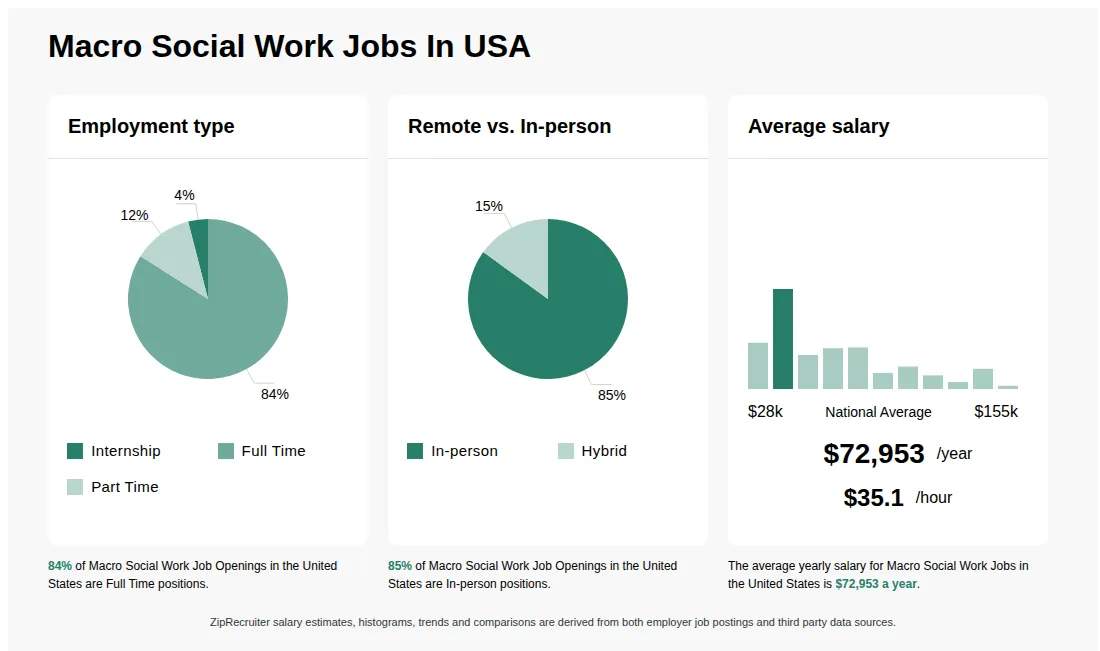
$28K - $39.5K
14% of jobs
$43.8K is the 25th percentile. Wages below this are outliers.
$39.5K - $51.1K
30% of jobs
The median wage is $58.1K / yr.
$51.1K - $62.6K
10% of jobs
$62.6K - $74.2K
12% of jobs
$82.6K is the 75th percentile. Wages above this are outliers.
$74.2K - $85.7K
13% of jobs
$85.7K - $97.3K
4% of jobs
$97.3K - $108.8K
6% of jobs
$108.8K - $120.4K
3% of jobs
$120.4K - $131.9K
2% of jobs
$131.9K - $143.5K
5% of jobs
$143.5K - $155K
0% of jobs
$28K
$73K
$155K
Macro social work includes efforts that help communities and other large groups. This may include deciding which programs to make available in a particular area, conducting research on the needs of a region, and helping implement large interventions to change the character of a region. This is the broadest type of social work and emphasizes systems and processes over working with individual people. Macro social work should not be confused with the two other types of social work: mezzo and micro. Mezzo social work focuses on neighborhoods, small groups, and companies, while micro social work focuses on individuals and families. These three levels are not mutually exclusive because what happens in one usually affects the others. Given the scope and duties of this position, macro social workers often work for city governments, healthcare organizations, or related companies.
| Aspect | Macro Social Work | Micro Social Work |
|---|---|---|
| Focus | Community and policy-level change | Individual and family-level support |
| Work Environment | Nonprofits, government agencies, advocacy groups | Hospitals, schools, clinical settings |
| Credentials | Bachelor's or Master's in Social Work (BSW/MSW) | Bachelor's or Master's in Social Work (BSW/MSW) |
| Typical Tasks | Policy development, program management, community organizing | Counseling, case management, individual therapy |
Macro Social Work focuses on systemic change at the community or policy level, while Micro Social Work emphasizes direct support to individuals and families. Both roles require similar credentials but differ in work environment and daily tasks, making them complementary in the social work field.
Cities with the most Macro Social Work job openings:
The most popular types of Macro Social Work jobs are:
States with the most job openings for Macro Social Work jobs include:
Popular job titles for Macro Social Work:

On-site
$80 - $100/hr
Other
Posted 22 days ago
teach courses in social work and related areas, including behavioral health, macro policy, and social work practice with children, youth, and families
advise students, participate in campus and system-wide committees, and collaborate with colleagues
engage in research, scholarly activity, and community service related to social work
7.5
Based on 47 frontline employees who took The Breakroom Quiz
315th of 633 rated colleges and universities
Job no: 560237
Work type: Instructional Faculty - Tenured/Tenure-Track
Location: Los Angeles
Categories: Unit 3 - CFA - California Faculty Association, Faculty - Social Sciences, Probationary, Full Time
College: Rongxiang Xu College of Health and Human Services
Position Title: LA- 2026-27 AY Assistant Professor Tenure Track Position - Social Work (3)
School of Social Work
Instructional Faculty - Tenure/Tenure-Track
The School of Social Work in the Rongxiang Xu College of Health and Human Services at Cal State LA, is seeking to fill three full-time, academic year, assistant professor tenure track position in Social Work, with appointment beginning Spring Term 2027, Summer Term 2027, or Fall Term 2027.
The successful candidate will be committed to the academic success of our students and to an environment that acknowledges, encourages, and celebrates diversity and differences. To this end, the successful candidate will work effectively, respectfully, and collaboratively in diverse, multicultural, and inclusive settings. In addition, the successful candidate will be ready to join faculty, staff, students, and administrators in our University’s shared commitment to the principles of engagement, service, and the public good.
The primary professional responsibilities of instructional faculty members are: teaching, research, scholarship and/or creative activity, and service to the University, social work profession, and to the community. These responsibilities generally include but not limited to: advising students, participation in campus and system-wide committees, maintaining office hours, working collaboratively and productively with colleagues, and participation in traditional academic functions.
Initial salary is commensurate with qualifications and experience (anticipated hiring range: $86,886 - 96,540 annually.
California State University, Los Angeles (Cal State LA) is one of 22 campuses within the California State University system. The University is the premier comprehensive public university in the heart of Los Angeles. Cal State LA is ranked number one in the U.S. for the upward mobility of its students, and is dedicated to engagement, service, and the public good. We offer nationally recognized programs in science, the arts, business, criminal justice, engineering, nursing, education, ethnic studies, and the humanities. Ourfaculty have a strong commitment to scholarship, research, creative pursuits, community engagement, and service.
Our 240,000 alumni reflect the City and County’s dynamic mix of populations. The University has one of the most diverse student populations of any college or university in the nation. As a federally recognized Hispanic-Serving Institution, and Asian-American, Native American, and Pacific Islander-Serving Institution, Cal State LA recognizes the transformative power of education and embraces its duty to identify and serve the needs of all of its students. The University is committed to creating a community in which a diverse population can live, work and learn in an atmosphere of civility and respect for the rights and sensibilities of each individual.
Some of the strengths of our program include:
The Master of Social Work program is an Advanced Generalist practice program that prepares professional social workers to work with diverse populations and settings. We offer a 1-year Advanced Standing Program (ASP), a 2-year full-time program, and a 3-year program. In the 3-year program, courses are offered in the evening and Saturdays. These programs are cohorted, i.e., all students take the same courses in the same sequence (Master of Social Work (MSW) | Cal State LA).
Field work is an integral part of a social work education. BASW students are placed in professional social work internships for 14 hours per week in the senior year of the program. MSW students have internships of 16 hours per week in the first year and 20 hours per week in the second year of the program. In the 3-year MSW program, internships will be taken in the second and third years (Field (Practicum) Education | Cal State LA). ASP students have internships of 24 hours per week.
Finalists for the position will be required to:
Employment is contingent upon proof of eligibility to work in the United States.
*A United States (US) Equivalency certification is required for earned/awarded/conferred foreign terminal degrees. The US Equivalency certification is used to validate foreign studies by an academic credential evaluation agency and is evaluated on foreign studies and deemed to be equivalent to degrees from the United States. The certification must translate the information in English, and confirm that your highest terminal degree is US Equivalent to a US terminal degree (i.e., Master's, Doctorate’s, Doctor’s of Philosophy).
Deadline: Review of applications will begin September 1, 2026. Review of applications will continue until the positions are filled. Applications received after this date may be considered.
Note: The person holding this position is considered a "mandated reporter" under the California Child Abuse and Neglect Reporting Act and is required to comply with the requirements set forth in CSU Executive Order 1083 as a condition of employment.
Beginning January 1, 2022, campuses may not hire or reappoint an Employee to perform CSU-related work outside of California. Requests for exceptions are very limited based on CSU Policy and must have prior written approval from the University President.
Background Check: A background check (including a criminal records check) must be satisfactorily completed. Offers of employment are conditional and may be rescinded if the background check reveals disqualifying information, and/or it is discovered that the candidate knowingly withheld or falsified information. Failure to satisfactorily complete the background check may affect the continued employment of a current CSU employee who was conditionally offered the position.
Education Code 89521 Requirements: Applicants will be required to disclose whether they have received a final administrative decision or final judicial decision determining that they have committed sexual harassmentwithin the last seven yearsonly after a determination is made that they meet the minimum qualifications for the position, and before an offer of employment is extended.Applicants who reach the final stages of the application process must sign a release form that authorizes the release of information by the applicant's current and/or former employers to the CSU concerning any substantiated allegations of misconduct.
Equal Opportunity and Excellence in Education and Employment:
All university programs and activities are open and available to all regardless of race, sex, color, ethnicity or national origin. Consistent with California law and federal civil rights laws, California State University, Los Angeles provides equal opportunity in education and employment without unlawful discrimination or preferential treatment based on race, sex, color, ethnicity, or national origin. Our commitment to equal opportunity means ensuring that every student and employee has access to the resources and support they need to thrive and succeed in a university environment and in their communities. California State University, Los Angeles complies with Title VI of the Civil Rights Act of 1964, Title IX of the Education Amendments of 1972, the Americans with Disabilities Act (ADA), Section 504 of the Rehabilitation Act, the California Equity in Higher Education Act, California’s Proposition 209 (Art. I, Section 31 of the California Constitution), other applicable state and federal anti-discrimination laws, and CSU’s Nondiscrimination Policy. We prohibit discriminatory preferential treatment, segregation based on race or any other protected status, and all forms of discrimination, harassment, and retaliation in all university programs, policies, and practices. California State University, Los Angeles is a diverse community of individuals who represent many perspectives, beliefs and identities, committed to fostering an inclusive, respectful, and intellectually vibrant environment. We cultivate a culture of open dialogue, mutual respect, and belonging to support educational excellence and student success. Through academic programs, student organizations and activities, faculty initiatives, and community partnerships, we encourage meaningful engagement with diverse perspectives. As a higher education institution, we are dedicated to advancing knowledge and empowering individuals to reach their full potential by prioritizing inclusive curriculum development, faculty and staff training, student mentorship, and comprehensive support programs. At California State University, Los Angeles, excellence is built on merit, talent, diversity, accessibility, and equal opportunity for all.
AN EQUAL OPPORTUNITY/TITLE IX EMPLOYER
Upon request, reasonable accommodation will be provided to individuals with protected disabilities to (a) complete the employment process and (b) perform essential job functions when this does not cause undue hardship.
The School of Social Work in the Rongxiang Xu College of Health and Human Services at Cal State LA, is seeking applications for three academic year Assistant Professor Tenure-Track faculty positions.
The School of Social Work in the Rongxiang Xu College of Health and Human Services at Cal State LA, is seeking applications for three academic year Assistant Professor Tenure-Track faculty positions.
Get the full story on Breakroom

Sourced by ZipRecruiter
California State University, Fresno is one of 23 campuses in the California State University System. The University's mission is to boldly educate and empower students for success through our values of Discovery, Diversity and Distinction. The current student population is more than 25,000, including a large percentage of students with diverse and culturally rich backgrounds. The University serves the San Joaquin Valley while maintaining deep involvement with the state, nation, and across the globe.
Colleges, universities, and professional schools
1,001 - 5,000 Employees
Long Beach, CA, US


