1

Legislative Attorney Jobs (NOW HIRING)

Under the direction of the Office Administrator, the Legislative Coordinator provides administrative assistance to Government Policy Advisors and Attorneys. The Legislative Coordinator drafts ...

The ACLU of Georgia is hiring Fellows for the 2027 Legislative Session. The dates of the fellowship ... Graduate students, law students, recent graduates, and lawyers are welcome to apply. The fellowship ...

The ACLU of Georgia is hiring Fellows for the 2027 Legislative Session. The dates of the fellowship ... Graduate students, law students, recent graduates, and lawyers are welcome to apply. The fellowship ...

Staff Attorney

Springfield, IL · On-site

$68.40 - $83.60/hr

LEGISLATIVE REFERENCE BUREAU 112 State House, Springfield, Illinois 62706-1300 Phone: 217/782-6625 Staff Attorney Legislative Reference Bureau is a nonpartisan legislative support services agency ...

next page

Showing results 1-20

Legislative Attorney information

See salary details

$30K

$64.2K

$121K

How much do legislative attorney jobs pay per year?

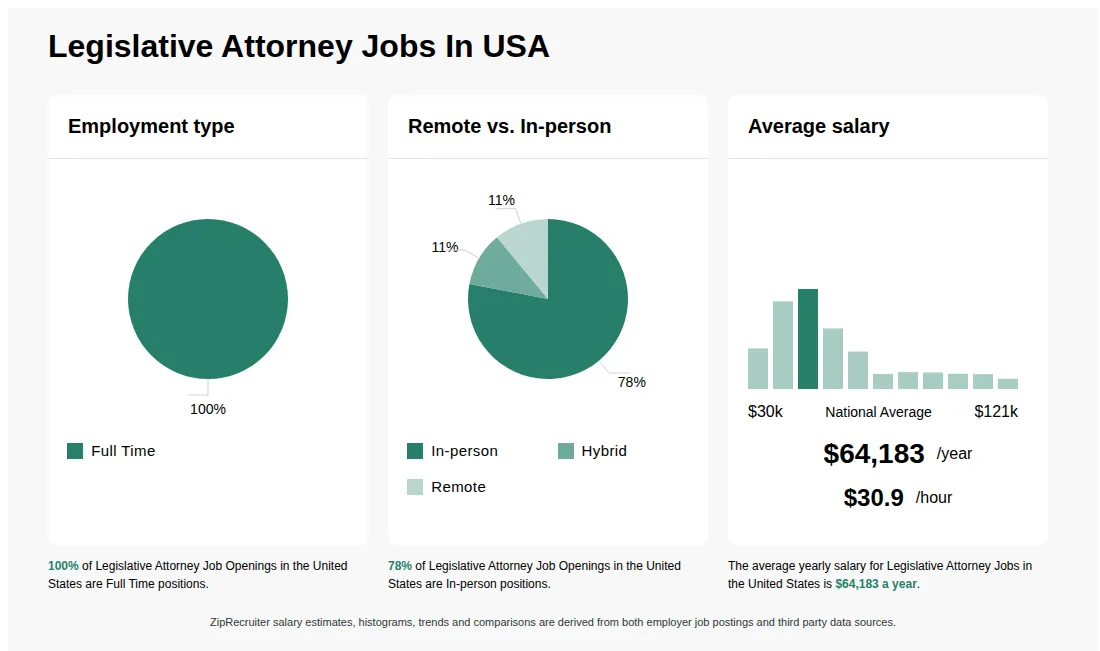
As of Sep 5, 2026, the average yearly pay for legislative attorney in the United States is $64,183.00, according to ZipRecruiter salary data. Most workers in this role earn between $44,000.00 and $71,500.00 per year, depending on experience, location, and employer.

What is a legislative attorney?

A Legislative Attorney is a legal professional who specializes in analyzing, drafting, and interpreting legislation for government bodies, lawmakers, and committees. They provide legal advice on the implications of proposed laws and help ensure that legislation complies with existing legal frameworks. Legislative Attorneys also conduct legal research, prepare written opinions, and may assist in the legislative process by testifying before committees or advising on policy issues. Their work is essential to the development of clear, effective, and lawful public policy.

What does a legislative attorney do?

As a legislative attorney, your job is to support a legislative body as they prepare reports, documents, and proposed materials. In this role, you may help determine whether or not a proposed bill complies with existing law and suggest solutions for any issues. You also ensure that the legislators follow the correct procedures throughout the process of creating laws. Legislative attorneys often write formal opinions examining the constitutionality, effect, or operation of a bill and provide these to others as necessary. The duties of this job can vary somewhat from area to area, but legislative attorneys almost always work directly for legislative bodies like city councils or state houses of representatives.


What are the key skills and qualifications needed to thrive as a legislative attorney, and why are they important?

To thrive as a Legislative Attorney, you need a law degree, bar admission, and expertise in legislative research, statutory interpretation, and legal writing. Familiarity with legislative tracking systems, legal databases like Westlaw or LexisNexis, and government document management tools is common. Strong analytical thinking, attention to detail, and effective communication are crucial soft skills for advising lawmakers and drafting legislation. These skills and qualifications are vital to ensure accurate, legally sound, and actionable guidance in the fast-paced legislative environment.

How does a legislative attorney typically collaborate with policymakers and other stakeholders during the legislative process?

Legislative Attorneys work closely with lawmakers, legislative staff, and subject matter experts to draft, analyze, and refine proposed legislation. They often participate in meetings or committee hearings to provide legal advice, explain the implications of legal language, and ensure proposed bills comply with state or federal laws. Effective communication and teamwork are essential, as Legislative Attorneys must translate complex legal concepts into accessible language for non-lawyers and help build consensus among diverse stakeholders.

What is the difference between Legislative Attorney vs Legislative Analyst?

AspectLegislative AttorneyLegislative Analyst
Required CredentialsLaw degree, bar admission often preferredBachelor's or master's degree in political science, public policy, or related fields
Work EnvironmentLegal offices, government agencies, legislative bodiesLegislative offices, government agencies, policy research organizations
Employer & Industry UsageLegal departments within legislative bodies, government legal teamsLegislative offices, think tanks, policy analysis firms
Common Search & ComparisonLegal expertise, legislative process, policy reviewPolicy analysis, legislative research, data interpretation

While both roles work within the legislative environment, a Legislative Attorney primarily provides legal advice, drafts legislation, and ensures legal compliance. In contrast, a Legislative Analyst focuses on researching policies, analyzing legislative proposals, and supporting decision-making with data. Understanding these differences helps clarify career paths and job expectations in legislative careers.

What cities are hiring for Legislative Attorney jobs?

Cities with the most Legislative Attorney job openings:

What states have the most Legislative Attorney jobs?

States with the most job openings for Legislative Attorney jobs include:

What job categories do people searching Legislative Attorney jobs look for?

The top searched job categories for Legislative Attorney jobs are:

Infographic showing various Legislative Attorney job openings in the United States as of August 2026, with employment types broken down into 86% Full Time, 13% Part Time, and 1% Contract. Highlights an 71% Physical, 8% Hybrid, and 21% Remote job distribution, with an average salary of $64,183 per year, or $30.9 per hour.

LEGISLATIVE ATTORNEY II

State of Arkansas

Little Rock, AR • On-site

$71K - $169K/yr

Full-time

Posted 19 days ago


State Of Arkansas rating

7.4

Company rating: 7.4 out of 10

Based on 81 frontline employees who took The Breakroom Quiz

34th of 50 rated states


Job description

BUREAU OF LEGISLATIVE RESEARCH
JOB DESCRIPTION
POSITION: Legislative Attorney II, Administrative Rules Review Section
GRADE: SPC05
SUMMARY OF POSITION: The Legislative Attorney II works under the direct supervision of the Administrative Rules Chief Legal Counsel. The legislative attorneys in the section provide services to members of the General Assembly with regard to the legislative review of state agency rules, litigation reports provided to the Legislative Council, and claims appealed to the Claims Review/Litigation Reports Oversight Subcommittee of the Legislative Council. The legislative attorneys in the section conduct a thorough review of each proposed state agency rule and appealed claim filed with the Legislative Council, perform prereviews and final reviews of administrative rules to assess and ensure consistency with Code of Arkansas Rules style, and work with members of the General Assembly to answer questions concerning administrative rules and communicate member concerns relating to proposed rules to state agencies, as well as staffing the Administrative Rules and Claims Review/Litigation Reports Oversight Subcommittees of the Legislative Council. The Legislative Attorney II has established legal research skills and experience with Arkansas law and legal writing.
Position grade and salary will be commensurate with experience. The grade range is SPC03-SPC08, and the salary range is $71,027-$169,298.
The Bureau of Legislative Research seeks a Legislative Attorney II who will review administrative rules, conduct legal research for the Arkansas General Assembly, and codify administrative rules for inclusion in the Code of Arkansas Rules. Candidates who demonstrate strong research, writing, editing, and oral communication skills, have research experience in and broad general knowledge of various legal issues, and possess a portfolio of high-quality legal analytical writing are encouraged to apply. Regular contact with legislative members and agency personnel is required. Given that the Arkansas General Assembly often deals with issues that are at the forefront of the law, candidates must be capable of working in a number of different areas of the law and have the intellectual curiosity to seek out and maintain a broad working knowledge of legal issues.
Experience in administrative law is preferred but not required.
BLR works exclusively for the Arkansas General Assembly, providing various services, including bill drafting and legal analysis, to committees and members of both the House of Representatives and the Senate, regardless of political affiliation. BLR is known for analysis that is authoritative, confidential, objective, and nonpartisan. BLR seeks to ensure that the Arkansas General Assembly has immediate access to high-quality research, analysis, and writing on issues of interest to its members and committees.
Application Requirements: Applicants must submit a resume and cover letter in addition to an application. A background check is required.
ESSENTIAL FUNCTIONS:
  • Be available to members of the General Assembly, state agency staff, and Bureau staff to provide answers to legal issues that may arise and provide legal research and legal memoranda.
  • Review state agency rules filed with the Legislative Council under Arkansas Code § 10-3-309 for content and compliance with statutory authority before the expiration of the rule's public comment period and prepare legal summaries for legislative members.
  • Prereview state agency rules for compliance with Code of Arkansas Rules style and review and proof state agency rules for codification following Legislative Council approval and agency finalization.
  • Attend public hearings concerning state agency rules filed with the Legislative Council.
  • Communicate with members of the General Assembly concerning proposed state agency rules and public feedback on those rules, as well as the rule's compliance with state law.
  • Provide legal staff support to the Administrative Rules and Claims Review/Litigation Reports Oversight Subcommittees of the Legislative Council.
  • Attend other legislative committee meetings to which state agency rules have been referred or statutorily assigned.
  • Keep track of Acts passed by the General Assembly that require the promulgation of rules by state agencies and assist in preparing a report of those Acts for legislative members.
  • Develop and maintain expertise in assigned subject matter areas, including monitoring case law, trends in other jurisdictions, news items, and emerging developments.
  • Review appealed claims, awarded claims, and litigation reports to be considered by the Claims Review/Litigation Reports Oversight Subcommittee of the Legislative Council and prepare legal summaries for legislative members.
  • Staff the Claims Review/Litigation Reports Oversight Subcommittee as necessary.

OTHER FUNCTIONS:
  • Prepare materials and conduct presentations concerning administrative rules and the legislative process in general.
  • Occasional in-state and out-of-state travel to conferences and seminars.
  • Perform other duties as requested by the Administrative Rules Chief Legal Counsel, the Deputy Director for Legal Services, and the Director of the Bureau.

QUALIFICATIONS/SKILLS:
  • Doctor of Jurisprudence degree.
  • License to practice law in Arkansas, maintained in good standing.
  • At least two (2) years as a Legislative Attorney I or other relevant experience as determined by the Director of the Bureau and the Deputy Director for Legal Services.
  • Knowledge of state and federal laws and constitutions, especially Arkansas Code § 10-3-309, the Arkansas Administrative Procedure Act at Arkansas Code § 25-15-201, et seq., and the Freedom of Information Act at Arkansas Code § 25-19-101, et seq.
  • Knowledge and proficiency in English grammar, spelling, and punctuation.
  • Knowledge of or the ability to expeditiously develop knowledge of the legislative process and the functions of state and federal agencies.
  • Knowledge of or the ability to expeditiously develop knowledge of laws, precedents, and procedures related to the General Assembly.
  • Ability to proficiently conduct objective legal research and perform legal analysis.
  • Proficiency in or writing experience that demonstrates the ability to quickly develop proficiency in the Code of Arkansas Rules style manual.
  • Ability to independently organize workload and set priorities.
  • Ability to communicate appropriately with Bureau Staff, state agency staff, members of the General Assembly, and members of the public.
  • Valid Arkansas Driver's License and less than 10 points on current traffic violation report under the Arkansas State Vehicle Safety Program.

PRODUCTION STANDARDS:
  • Accurately analyzes and provides nonpartisan legislative solutions to complex legal issues.
  • Adept in communicating with Bureau staff, members of the General Assembly, state agency staff, and members of the public, both verbally and in writing.
  • Demonstrates proficient time management skills, including the ability to complete work under strict time deadlines.
  • Exhibits a professional attitude and appearance.
  • Functions independently and cooperates as part of an administrative rule review team, including without limitation assisting with the workload of other section members when necessary.
  • Maintains high standard of professional ethics and exercises appropriate discretion with confidential matters.

Position Information
Summary
Functions
Dimensions
Knowledge, Skills and Abilities
Minimum Qualifications
Licenses

What State Of Arkansas employees say

Pay

Benefits

Hours and flexibility

Workplace

Get the full story on Breakroom


State of Arkansas logo

About State of Arkansas

Sourced by ZipRecruiter

The "State of Arkansas" is not a company but the governmental body of the U.S. state of Arkansas. Its primary operations are situated in the state's capital, Little Rock. As a governmental entity, its services span various domains including education, health, businesses, transportation, and environment, among others. Its mission revolves around serving the needs of the Arkansas citizens, ensuring their safety, health and welfare, overseeing the state's resources, and contributing to the overall prosperity and quality of life in the state. The state government has achieved various milestones improving the local infrastructure, health facilities, and implementing progressive policies for the betterment of the communities.

Industry

Public administration

Company size

10,000+ Employees

Headquarters location

Little Rock, AR, US