1

Junior Instrument Technician Jobs (NOW HIRING)

When assigned as an EI&C Technician 2: * Provide coaching and guidance to junior Electrical, Instrument and Control Technicians. * Process work orders, assist in inventory, and requisitioning of ...

When assigned as an EI&C Technician 2: * Provide coaching and guidance to junior Electrical, Instrument and Control Technicians. * Process work orders, assist in inventory, and requisitioning of ...

This position requires effective collaboration with instrument technicians, hands-on expertise ... Important risk note: mid-level or junior talent increases the risk of costly errors in this ...

This position requires effective collaboration with instrument technicians, hands-on expertise ... Important risk note: mid-level or junior talent increases the risk of costly errors in this ...

A minimum of 2 years of electrical and instrument control experience preferably in a manufacturing ... Team-oriented, with a strong desire to support and mentor junior mechanics or apprentices in ...

Showing results 41-60

Junior Instrument Technician information

See salary details

$7

$26

$47

How much do junior instrument technician jobs pay per hour?

As of Sep 6, 2026, the average hourly pay for junior instrument technician in the United States is $26.96, according to ZipRecruiter salary data. Most workers in this role earn between $16.35 and $33.17 per hour, depending on experience, location, and employer.

What is a junior instrument technician?

Junior Instrument Technicians are entry-level professionals who assist in the installation, maintenance, calibration, and repair of instrumentation and control systems used in various industries such as manufacturing, oil and gas, and power generation. They work under the supervision of senior technicians or engineers to ensure that all instruments and equipment operate correctly and safely. Their responsibilities often include troubleshooting faults, performing routine preventive maintenance, and documenting their work. This role is ideal for those starting their careers in industrial automation or instrumentation.

What are the key skills and qualifications needed to thrive as a junior instrument technician?

To thrive as a Junior Instrument Technician, you generally need a background in instrumentation or electrical engineering, often supported by a relevant diploma or technical certification. Familiarity with calibration tools, PLCs, and maintenance management systems is typically required. Attention to detail, problem-solving abilities, and effective teamwork are important soft skills for this role. These skills ensure accurate instrument maintenance, reliable system performance, and safe operations in industrial environments.

What are some common challenges faced by a junior instrument technician during the first year on the job?

As a Junior Instrument Technician, one of the main challenges in the first year is quickly adapting to various types of instrumentation and control systems, especially in fast-paced industrial environments. New technicians often need to learn to interpret technical diagrams, follow strict safety protocols, and troubleshoot under pressure—all while balancing hands-on tasks with ongoing training. Collaborating effectively with senior technicians and engineers is also essential, as it helps in gaining practical knowledge and building confidence. Overcoming these challenges early on leads to steady professional growth and opens up opportunities for advancement within maintenance or engineering teams.

What is the difference between Junior Instrument Technician vs Instrument Technician?

AspectJunior Instrument TechnicianInstrument Technician
CertificationsTypically entry-level certifications or apprenticeshipsAdvanced certifications, such as ISA certifications or equivalent
Work ExperienceLess than 2 years or on-the-job training2+ years of experience in instrumentation maintenance and repair
Work EnvironmentAssisting senior technicians, basic troubleshootingPerforming complex calibration, troubleshooting, and installation
Job ResponsibilitiesSupporting instrumentation tasks, basic repairsMaintaining, calibrating, and troubleshooting instrumentation systems

The main difference between a Junior Instrument Technician and an Instrument Technician lies in experience, certifications, and responsibilities. Junior Instrument Technicians are typically entry-level, assisting more experienced technicians, while Instrument Technicians have more experience and handle complex tasks independently.

Are junior instrument technicians in demand?

Junior instrument technicians are in demand in industries such as manufacturing, oil and gas, and utilities, where they assist with installing, maintaining, and calibrating control systems and instrumentation. Employment opportunities often depend on industry growth, technical skills, and certifications like ISA or NCCER. The demand for these technicians is expected to remain steady due to ongoing infrastructure and technological upgrades.

Where do junior instrument technicians make the most money?

Junior instrument technicians tend to earn higher salaries in regions with a strong industrial or manufacturing presence, such as areas with large oil and gas, chemical, or power plant industries. Salaries are also higher in locations with a higher cost of living and where specialized skills, certifications, and experience are in demand. Typically, working in remote or high-demand industrial environments can lead to increased compensation for entry-level technicians.
More about Junior Instrument Technician jobs

What cities are hiring for Junior Instrument Technician jobs?

Cities with the most Junior Instrument Technician job openings:

What are the most commonly searched types of Instrument Technician jobs?

The most popular types of Instrument Technician jobs are:

What states have the most Junior Instrument Technician jobs?

States with the most job openings for Junior Instrument Technician jobs include:

What job categories do people searching Junior Instrument Technician jobs look for?

The top searched job categories for Junior Instrument Technician jobs are:

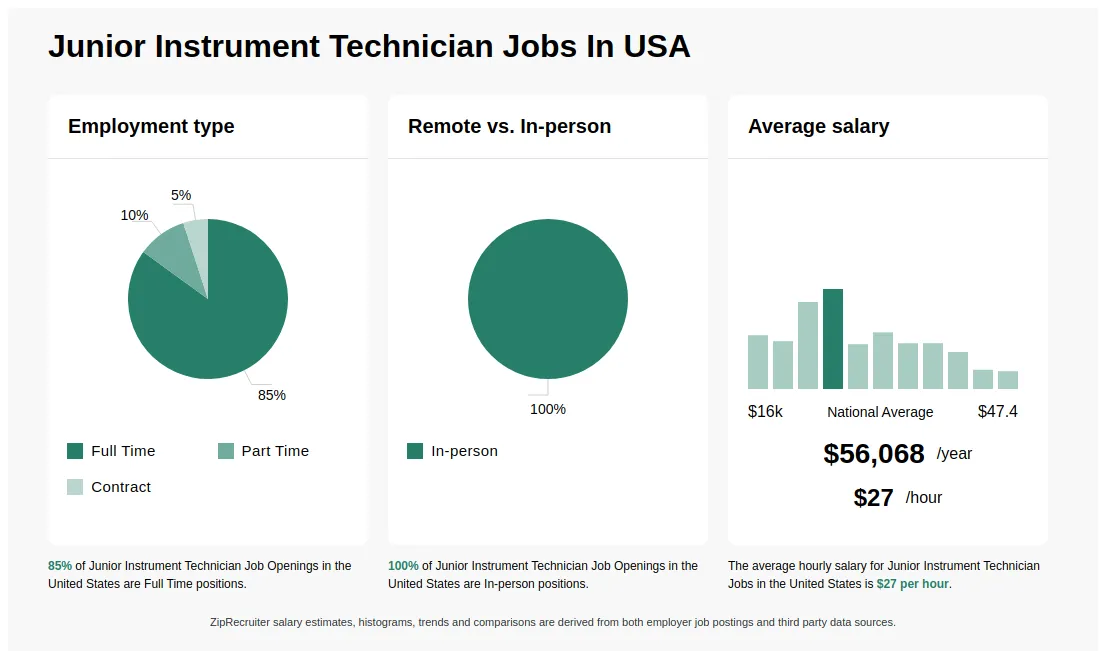
Infographic showing various Junior Instrument Technician job openings in the United States as of August 2026, with employment types broken down into 1% As Needed, 82% Full Time, 13% Part Time, 3% Contract, and 1% Nights. Highlights an 99% Physical, and 1% Remote job distribution, with an average salary of $56,068 per year, or $27 per hour.

Junior Survey Party Chief - High-Precision As-Built Surveying

Encompass Energy Services

Manhattan, NY • On-site

$60 - $80/hr

Other

Posted 4 days ago


Job description

Must be a resident of and able to work in the following counties - Allegany, Steuben, Chemung, Schuyler, Genesee, Orleans, Monroe, Wyoming, Livingston, Wayne, Ontario, Seneca, Yates, Niagara, Erie, Chautauqua, or Cattaraugus along with a minimum of five (5) years of verifiable professional surveying experience is required.

Junior Survey Party Chief – High-Precision As-Built Surveying

The Junior Survey Party Chief is responsible for leading small survey crews in the execution of high-precision as-built surveys for industrial, commercial, heavy civil, and energy construction projects. Working under the direction of a Senior Survey Party Chief, Project Manager, or Survey Manager, this position performs field operations using Trimble survey equipment while ensuring compliance with project specifications and company quality standards.

Minimum Qualifications
  • Minimum of five (5) years of verifiable professional land surveying experience, including at least two (2) years serving as an Instrument Operator, Survey Technician, or Assistant Party Chief on industrial, commercial, heavy civil, or energy construction projects.
  • Demonstrated experience performing high-accuracy as-built surveys.
  • Working knowledge of Trimble robotic total stations, GNSS receivers, and Trimble Access software.
  • Understanding of survey control, traversing, leveling, coordinate geometry (COGO), and construction layout.
  • Ability to read and interpret engineering drawings, IFC plans, fabrication drawings, and construction specifications.
  • Valid driver's license with the ability to travel to project sites.
Essential Duties and Responsibilities
  • Lead assigned field personnel during daily survey operations.
  • Perform high-precision as-built surveys using Trimble robotic total stations and GNSS equipment.
  • Establish and verify project control under the direction of senior survey personnel.
  • Perform instrument setup, backsight verification, calibration checks, and routine equipment inspections.
  • Collect accurate field data while maintaining project tolerances and quality standards.
  • Verify measurements through redundant observations and quality control procedures.
  • Coordinate daily survey activities with project supervision and construction personnel.
  • Prepare and submit complete electronic field data, reports, and documentation.
  • Report field discrepancies, conflicts, and potential issues to project management.
  • Ensure compliance with company safety policies and project-specific safety requirements.
  • Assist in training Survey Technicians and Instrument Operators.
  • Maintain survey equipment and ensure proper handling, storage, and transportation.
Technical Requirements
  • Proficient with:
    • Trimble SX10, S9, S7, S5, or equivalent robotic total stations.
    • Trimble R-Series GNSS receivers.
    • Trimble Access.
  • Working knowledge of:
    • Trimble Business Center (TBC).
    • AutoCAD Civil 3D (preferred).
  • Ability to perform work within project tolerances and company quality standards.
Physical Requirements
  • Ability to work outdoors in varying weather conditions.
  • Ability to lift and carry survey equipment weighing up to 50 pounds.
  • Ability to walk long distances over uneven terrain and active construction sites.
  • Ability to safely work around heavy equipment and industrial operations.
#J-18808-Ljbffr