You'll support automation, ensure compliance with safety and electrical standards, and help mentor junior technicians to uphold the highest performance standards. Leadership Principles Our principles ...
You'll support automation, ensure compliance with safety and electrical standards, and help mentor junior technicians to uphold the highest performance standards. Leadership Principles Our principles ...
Junior UAS Survey Field Technician
Lake Mary, FL · On-site
$17.25 - $23.50/hr
Instrument person/rodman experience ( Required ) * Instrument person/ rodman certification ... Junior UAS Survey Field Technician → UAS Survey Field Technician → UAS Pilot / Crew Lead → ...
New
Junior UAS Survey Field Technician
Lake Mary, FL · On-site
$17.25 - $23.50/hr
Instrument person/rodman experience ( Required ) * Instrument person/ rodman certification ... Junior UAS Survey Field Technician → UAS Survey Field Technician → UAS Pilot / Crew Lead → ...
New

Space Instrument Mechanical Technician (Development and Fabrication Technician 3/4)
Los Alamos, NM · On-site
Description Job Title Space Instrument Mechanical Technician (Development and Fabrication ... mentoring junior staff. They may lead instrument integration for project teams, perform ...
Space Instrument Mechanical Technician (Development and Fabrication Technician 3/4)
Los Alamos, NM · On-site
Description Job Title Space Instrument Mechanical Technician (Development and Fabrication ... mentoring junior staff. They may lead instrument integration for project teams, perform ...

... junior technicians, and maintain ISO 13485 traceability. On-site benefits include comprehensive medical, PTO, and life insurance offerings.
... junior technicians, and maintain ISO 13485 traceability. On-site benefits include comprehensive medical, PTO, and life insurance offerings.
... junior technicians, and maintain ISO 13485 traceability. On-site benefits include comprehensive medical, PTO, and life insurance offerings.
... junior technicians, and maintain ISO 13485 traceability. On-site benefits include comprehensive medical, PTO, and life insurance offerings.

Calibration Technician - Aliquippa, PA
Aliquippa, PA · On-site
$22 - $29/hr
Calibration Technician - Aliquippa, PA Aliquippa, PA | Instrument Calibration Solutions, LLC ... of junior technicians as experience allows * Identify potential service opportunities during ...
Quick apply
Calibration Technician - Aliquippa, PA
Aliquippa, PA · On-site
$22 - $29/hr
Calibration Technician - Aliquippa, PA Aliquippa, PA | Instrument Calibration Solutions, LLC ... of junior technicians as experience allows * Identify potential service opportunities during ...
Calibration Technician - Pittsburgh, PA
Pittsburgh, PA · On-site
$22 - $29/hr
Description Calibration Technician - Pittsburgh, PA Pittsburgh, PA | Instrument Calibration ... of junior technicians as experience allows * Identify potential service opportunities during ...
Calibration Technician - Pittsburgh, PA
Pittsburgh, PA · On-site
$22 - $29/hr
Description Calibration Technician - Pittsburgh, PA Pittsburgh, PA | Instrument Calibration ... of junior technicians as experience allows * Identify potential service opportunities during ...
Calibration Technician - Pittsburgh, PA
Pittsburgh, PA · On-site
$22 - $29/hr
Calibration Technician - Pittsburgh, PA Pittsburgh, PA | Instrument Calibration Solutions, LLC ... of junior technicians as experience allows * Identify potential service opportunities during ...
Quick apply
Calibration Technician - Pittsburgh, PA
Pittsburgh, PA · On-site
$22 - $29/hr
Calibration Technician - Pittsburgh, PA Pittsburgh, PA | Instrument Calibration Solutions, LLC ... of junior technicians as experience allows * Identify potential service opportunities during ...
Calibration Technician - Pittsburgh, PA
Pittsburgh, PA · On-site
$22 - $29/hr
Description Calibration Technician - Pittsburgh, PA Pittsburgh, PA | Instrument Calibration ... of junior technicians as experience allows * Identify potential service opportunities during ...
Calibration Technician - Pittsburgh, PA
Pittsburgh, PA · On-site
$22 - $29/hr
Description Calibration Technician - Pittsburgh, PA Pittsburgh, PA | Instrument Calibration ... of junior technicians as experience allows * Identify potential service opportunities during ...
Calibration Technician - Aliquippa, PA
Aliquippa, PA · On-site
$22 - $29/hr
Description Calibration Technician - Aliquippa, PA Aliquippa, PA | Instrument Calibration Solutions ... of junior technicians as experience allows * Identify potential service opportunities during ...
Calibration Technician - Aliquippa, PA
Aliquippa, PA · On-site
$22 - $29/hr
Description Calibration Technician - Aliquippa, PA Aliquippa, PA | Instrument Calibration Solutions ... of junior technicians as experience allows * Identify potential service opportunities during ...

Jr. Party Chief
Stafford, VA · On-site
$27 - $30/hr
A telecommunications and engineering services client is seeking a Jr. Party Chief to support ... This role is ideal for an experienced Instrument Operator, Field Survey Technician, Survey ...
Quick apply
Jr. Party Chief
Stafford, VA · On-site
$27 - $30/hr
A telecommunications and engineering services client is seeking a Jr. Party Chief to support ... This role is ideal for an experienced Instrument Operator, Field Survey Technician, Survey ...
Calibration Technician - Aliquippa, PA
Aliquippa, PA · On-site
$22 - $29/hr
Description Calibration Technician - Aliquippa, PA Aliquippa, PA | Instrument Calibration Solutions ... of junior technicians as experience allows * Identify potential service opportunities during ...
Calibration Technician - Aliquippa, PA
Aliquippa, PA · On-site
$22 - $29/hr
Description Calibration Technician - Aliquippa, PA Aliquippa, PA | Instrument Calibration Solutions ... of junior technicians as experience allows * Identify potential service opportunities during ...
Space Instrument Development and Fabrication Technician (Development and Fabrication Tec 3/4)
Los Alamos, NM · On-site
$44K - $60K/yr
... junior staff. The position may assist in leading instrument integration, performing verification ... Additional Job Requirements for Development and Fabrication Technician 4: In addition to the ...
Space Instrument Development and Fabrication Technician (Development and Fabrication Tec 3/4)
Los Alamos, NM · On-site
$44K - $60K/yr
... junior staff. The position may assist in leading instrument integration, performing verification ... Additional Job Requirements for Development and Fabrication Technician 4: In addition to the ...
Space Instrument Mechanical Technician (Development and Fabrication Technician 3/4)
Los Alamos, NM · On-site
Development and Fabrication Technician 3 ($66,100 - $103,600) duties include, though are not ... mentoring junior staff. They may lead instrument integration for project teams, perform ...
Space Instrument Mechanical Technician (Development and Fabrication Technician 3/4)
Los Alamos, NM · On-site
Development and Fabrication Technician 3 ($66,100 - $103,600) duties include, though are not ... mentoring junior staff. They may lead instrument integration for project teams, perform ...

Survey Instrument Operator/Civil Engineering Technician
Boston, MA · On-site
$22 - $30/hr
Description: Survey Instrument Operator, Field and construction Surveyor, Survey or Civil ... junior Survey Technicians.- Reviews and verifies that all field work needed on site was performed ...
Quick apply
Survey Instrument Operator/Civil Engineering Technician
Boston, MA · On-site
$22 - $30/hr
Description: Survey Instrument Operator, Field and construction Surveyor, Survey or Civil ... junior Survey Technicians.- Reviews and verifies that all field work needed on site was performed ...
Space Instrument Development and Fabrication Technician (Development and Fabrication Tec 3/4)
Los Alamos, NM · On-site
$44K - $60K/yr
... junior staff. The position may assist in leading instrument integration, performing verification ... Additional Job Requirements for Development and Fabrication Technician 4: In addition to the ...
Space Instrument Development and Fabrication Technician (Development and Fabrication Tec 3/4)
Los Alamos, NM · On-site
$44K - $60K/yr
... junior staff. The position may assist in leading instrument integration, performing verification ... Additional Job Requirements for Development and Fabrication Technician 4: In addition to the ...
Space Instrument Development and Fabrication Technician (Development and Fabrication Tec 3/4)
Los Alamos, NM · On-site
$66 - $115/hr
... junior staff. The position may assist in leading instrument integration, performing verification ... Additional Job Requirements for Development and Fabrication Technician 4: Technical Advanced skills ...
Space Instrument Development and Fabrication Technician (Development and Fabrication Tec 3/4)
Los Alamos, NM · On-site
$66 - $115/hr
... junior staff. The position may assist in leading instrument integration, performing verification ... Additional Job Requirements for Development and Fabrication Technician 4: Technical Advanced skills ...

Junior Survey Party Chief - High-Precision As-Built Surveying The Junior Survey Party Chief is ... an Instrument Operator, Survey Technician, or Assistant Party Chief on industrial, commercial ...
Quick apply
Junior Survey Party Chief - High-Precision As-Built Surveying The Junior Survey Party Chief is ... an Instrument Operator, Survey Technician, or Assistant Party Chief on industrial, commercial ...
Junior Survey Party Chief - High-Precision As-Built Surveying The Junior Survey Party Chief is ... an Instrument Operator, Survey Technician, or Assistant Party Chief on industrial, commercial ...
Junior Survey Party Chief - High-Precision As-Built Surveying The Junior Survey Party Chief is ... an Instrument Operator, Survey Technician, or Assistant Party Chief on industrial, commercial ...
Junior Survey Party Chief - High-Precision As-Built Surveying The Junior Survey Party Chief is ... serving as an Instrument Operator, Survey Technician, or Assistant Party Chiefon industrial ...
Junior Survey Party Chief - High-Precision As-Built Surveying The Junior Survey Party Chief is ... serving as an Instrument Operator, Survey Technician, or Assistant Party Chiefon industrial ...
Junior Instrument Technician information
See salary details
$7.69 - $11.30
9% of jobs
$11.30 - $14.90
8% of jobs
$16.53 is the 25th percentile. Wages below this are outliers.
$14.90 - $18.51
16% of jobs
The median wage is $21.80 / hr.
$18.51 - $22.12
18% of jobs
$22.12 - $25.72
8% of jobs
$25.72 - $29.33
11% of jobs
$31.24 is the 75th percentile. Wages above this are outliers.
$29.33 - $32.93
8% of jobs
$32.93 - $36.54
8% of jobs
$36.54 - $40.14
6% of jobs
$40.14 - $43.75
3% of jobs
$43.75 - $47.36
3% of jobs
$7
$26
$47
How much do junior instrument technician jobs pay per hour?
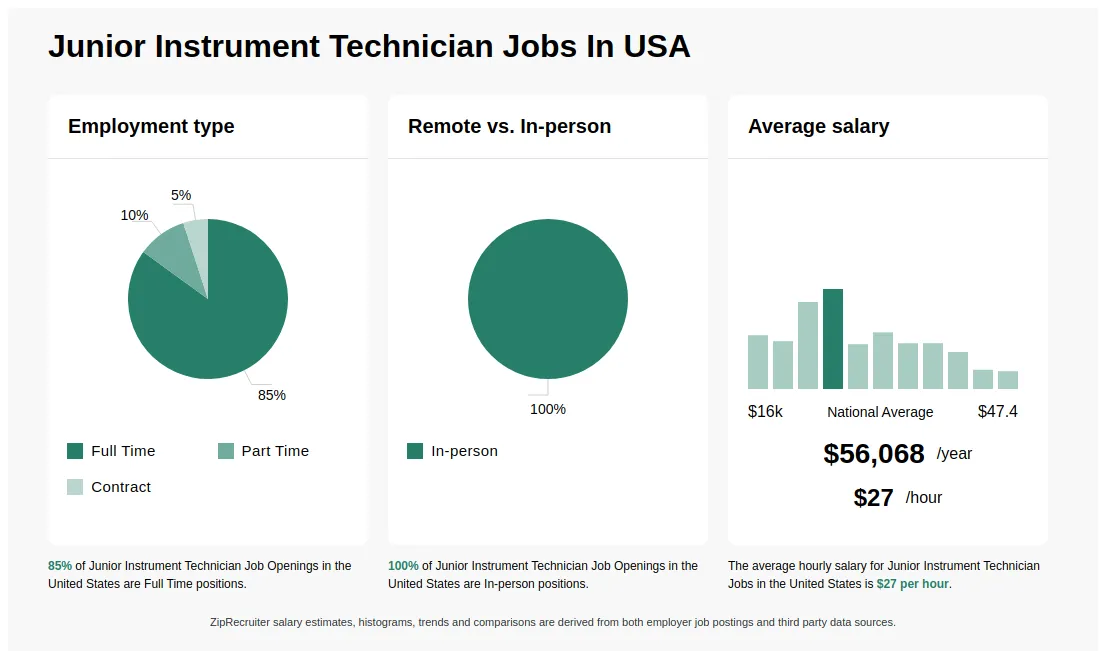
As of Sep 6, 2026, the average hourly pay for junior instrument technician in the United States is $26.96, according to ZipRecruiter salary data. Most workers in this role earn between $16.35 and $33.17 per hour, depending on experience, location, and employer.
What is a junior instrument technician?
Junior Instrument Technicians are entry-level professionals who assist in the installation, maintenance, calibration, and repair of instrumentation and control systems used in various industries such as manufacturing, oil and gas, and power generation. They work under the supervision of senior technicians or engineers to ensure that all instruments and equipment operate correctly and safely. Their responsibilities often include troubleshooting faults, performing routine preventive maintenance, and documenting their work. This role is ideal for those starting their careers in industrial automation or instrumentation.
What are the key skills and qualifications needed to thrive as a junior instrument technician?
To thrive as a Junior Instrument Technician, you generally need a background in instrumentation or electrical engineering, often supported by a relevant diploma or technical certification. Familiarity with calibration tools, PLCs, and maintenance management systems is typically required. Attention to detail, problem-solving abilities, and effective teamwork are important soft skills for this role. These skills ensure accurate instrument maintenance, reliable system performance, and safe operations in industrial environments.
What are some common challenges faced by a junior instrument technician during the first year on the job?
As a Junior Instrument Technician, one of the main challenges in the first year is quickly adapting to various types of instrumentation and control systems, especially in fast-paced industrial environments. New technicians often need to learn to interpret technical diagrams, follow strict safety protocols, and troubleshoot under pressure—all while balancing hands-on tasks with ongoing training. Collaborating effectively with senior technicians and engineers is also essential, as it helps in gaining practical knowledge and building confidence. Overcoming these challenges early on leads to steady professional growth and opens up opportunities for advancement within maintenance or engineering teams.
What is the difference between Junior Instrument Technician vs Instrument Technician?
| Aspect | Junior Instrument Technician | Instrument Technician |
|---|---|---|
| Certifications | Typically entry-level certifications or apprenticeships | Advanced certifications, such as ISA certifications or equivalent |
| Work Experience | Less than 2 years or on-the-job training | 2+ years of experience in instrumentation maintenance and repair |
| Work Environment | Assisting senior technicians, basic troubleshooting | Performing complex calibration, troubleshooting, and installation |
| Job Responsibilities | Supporting instrumentation tasks, basic repairs | Maintaining, calibrating, and troubleshooting instrumentation systems |
The main difference between a Junior Instrument Technician and an Instrument Technician lies in experience, certifications, and responsibilities. Junior Instrument Technicians are typically entry-level, assisting more experienced technicians, while Instrument Technicians have more experience and handle complex tasks independently.
Are junior instrument technicians in demand?
Junior instrument technicians are in demand in industries such as manufacturing, oil and gas, and utilities, where they assist with installing, maintaining, and calibrating control systems and instrumentation. Employment opportunities often depend on industry growth, technical skills, and certifications like ISA or NCCER. The demand for these technicians is expected to remain steady due to ongoing infrastructure and technological upgrades.
Where do junior instrument technicians make the most money?
Junior instrument technicians tend to earn higher salaries in regions with a strong industrial or manufacturing presence, such as areas with large oil and gas, chemical, or power plant industries. Salaries are also higher in locations with a higher cost of living and where specialized skills, certifications, and experience are in demand. Typically, working in remote or high-demand industrial environments can lead to increased compensation for entry-level technicians.
More about Junior Instrument Technician jobs
What cities are hiring for Junior Instrument Technician jobs?
Cities with the most Junior Instrument Technician job openings:
What are the most commonly searched types of Instrument Technician jobs?
The most popular types of Instrument Technician jobs are:
What states have the most Junior Instrument Technician jobs?
States with the most job openings for Junior Instrument Technician jobs include:
What job categories do people searching Junior Instrument Technician jobs look for?
The top searched job categories for Junior Instrument Technician jobs are:
Full-time
Medical, Dental, Vision, Retirement, PTO
Re-posted 20 days ago
Job description
Position Title: Electronics & Instrumentation Technician FRY
Position Type: Regular - Full-Time
Grade:Scale EIT_UFCW
Requisition ID:41367
Location: Wisconsin Rapids, WI (Fry Facility)
About McCainAt McCain, we're feeding the world: from French fries to cakes, we contribute to the important role food plays in people's lives. That's why we're dedicated to ensuring our core values-Family, Authentic, Trusted, and Quality-shine through every day. As a privately owned family company with over 60 years of experience, a presence in more than 160 countries, and a global team of 22,000 people, our values and culture are at the heart of everything we do. We believe that we can work together, along with our business and community partners, to bring sustainable growth and positive change today, tomorrow, and for generations to come. Join us and see how you can MAKE IT at McCain!
Why join the McCain familyYour Life- we're here to help you fulfill your potential, flourish, and thrive in work and life.
Your Success- work alongside passionate individuals who are committed to supporting your career ambitions, drive, and success.
Your Impact- we want you to make a meaningful, lasting impact for you, for your colleagues, and for the business.
McCain is a place where you can grow from the ground up, so join us and see how you can MAKE IT at McCain.
About the RoleAs an E&I Technician, you will play a key role in minimizing unplanned downtime and maintaining the efficiency and safety of production equipment. This includes installing, programming, and troubleshooting instrumentation such as control valves and transmitters, and working with complex electrical systems. You'll support automation, ensure compliance with safety and electrical standards, and help mentor junior technicians to uphold the highest performance standards.
Leadership PrinciplesOur principles, each with related practices, guide our actions across the organization. Together, they address how McCain interacts with our customers and employees, and how we work as individuals and collectively to find success. While each role adheres to the Leadership Principles, individual roles may focus more on a specific principle or principles.
We are customer obsessed- By understanding their needs and leveraging insights, we drive mutual success.
We think big and plan ahead- We take smart risks, innovate, and refine processes for long-term success.
We bring out the best in our people- Inclusion, trust, and empowerment help our people thrive.
We act like owners- We clear obstacles and own our work, together.
Perform electrical maintenance, repair, installation, and calibration work on production and facility equipment. Responsibilities include troubleshooting control systems, programming PLCs, and ensuring equipment meets NEC, OSHA, and plant safety standards.
Major Duties and ResponsibilitiesPerform routine and complex maintenance on electrical and control systems
Calibrate, program, and troubleshoot instrumentation (temperature, pressure, level transmitters, control valves)
Design and install control systems; program PLCs/PCs
Maintain power distribution systems and troubleshoot AC/DC systems, VFDs, and 480V three-phase power
Read and interpret electrical schematics, wiring diagrams, and technical documentation
Assist with improvements and upgrades to equipment
Support and mentor junior maintenance staff
Maintain accurate records and documentation for work performed
Ensure a clean, organized, and safe work environment at all times
Follow all NEC, NFPA 70E, and OSHA regulations
Perform other duties as assigned by the Maintenance Supervisor or Department Manager
High mental and manual aptitude with strong attention to detail
Able to work independently and problem-solve effectively
Excellent communication skills with a strong safety mindset
Journeyman Electrician certification or willingness to pursue through the State E&I program (sponsored by McCain)
Certification and training in NEC and OSHA safety practices preferred
Associate degree in electronics or a related electrical field
At least 5 years of relevant maintenance experience
Minimum of 1 year in a factory or industrial setting
Proficient with PLCs, VFDs, motor controls, and industrial wiring
Skilled in troubleshooting and repairing electronic and electromechanical equipment
We are McCain: this statement is about our power collectively and our importance individually-your impact is a significant part of the business. Our winning culture focuses on authenticity and trust so we can always bring out the best in our people. Here, you have the opportunity to learn, grow, and thrive while being yourself. Join our team to see why we're better together.
The Benefits of Working for McCainMcCain offers full benefits including health, vision, and dental insurance. In addition, we offer other benefits including but not limited to:
401k match at 6%
Adoption Assistance
Infertility Assistance
Paid Maternity and Paternity Leave
Tuition reimbursement and more
#LI-TN1
Compensation Package: $35.53 - $46.21 USD (starting amount TBD per pay for skills) Starting at 35.53 USD hourly + Bonus eligibility + Hourly Pay Differential for applicable shifts
The above reflects the target compensation range for the position at the time of posting. Hiring compensation will be determined based on experience, skill set, education and training, and other organizational needs. This posting is for an existing vacancy.
Benefits: At McCain, we're on a mission to create a winning culture that puts employee safety and well-being at the heart of what we do, every day. We understand and appreciate that each person's needs are unique and ensure our benefits & well-being programs reflect that. Employees are eligible for the following benefits: health coverage (medical, dental, vision, prescription drug), retirement savings benefits, and leave support, including medical, family and bereavement.Well-being programs include vacation and holidays, company-supported volunteering time, and mental health resources. Coverages are aligned with applicable law and can vary by work level, location, and nature of the role. Additional benefits details available during the application process.
Your well-being matters to us, and we're here to provide you with the necessary resources to support you in being your best self at work - and at home.
McCain Foods is an equal opportunity employer. As a global family-owned company, we strive to be the employer of choice in the diverse communities around the world in which we live and work. We recognize that inclusion drives our creativity, resilience, and success and makes our business stronger. All qualified applicants will receive consideration for employment without regard to race, religion, color, national origin, sex, age, veteran status, disability, or any other protected characteristic under applicable law.
McCain is an accessible employer. If you require an accommodation throughout the recruitment process (including alternate formats of materials or accessible meeting rooms), pleaselet us know and we will work with you to find appropriate solutions.
Your privacy is important to us. By submitting personal data or information to us, you agree this will be handled in accordance with McCain's Global Privacy Policyand Global Employee Privacy Policy, as applicable. McCain leverages AI in the hiring process, though all final decisions are made by humans. You can understand our approach to AI and how your personal information isbeing handled here.
Job Family:Manufacturing
Location(s): US - United States of America : Wisconsin : Wisconsin Rapids
Company:McCain Foods USA, Inc.
Employment Type: OTHER