1

Junior Instrument Technician Jobs (NOW HIRING)

Mentor and train Jr. Instrument Technicians * Perform other duties as required. You'll be a perfect fit if you have: * High school diploma or equivalent. Associates degree or certification from trade ...

Mentor and train Jr. Instrument Technicians * Perform other duties as required. You'll be a perfect fit if you have: * High school diploma or equivalent. Associates degree or certification from trade ...

... Instrument Instrumentation LCMS HPLC MS Mass Spec Spectrometry SCIEX Waters Agilent - . Seeking ... junior technicians and clients on equipment maintenance and operation. • Market value added ...

... Instrument Instrumentation LCMS HPLC MS Mass Spec Spectrometry SCIEX Waters Agilent - . Seeking ... junior technicians and clients on equipment maintenance and operation. • Market value added ...

next page

Showing results 1-20

Junior Instrument Technician information

See salary details

$7

$26

$47

How much do junior instrument technician jobs pay per hour?

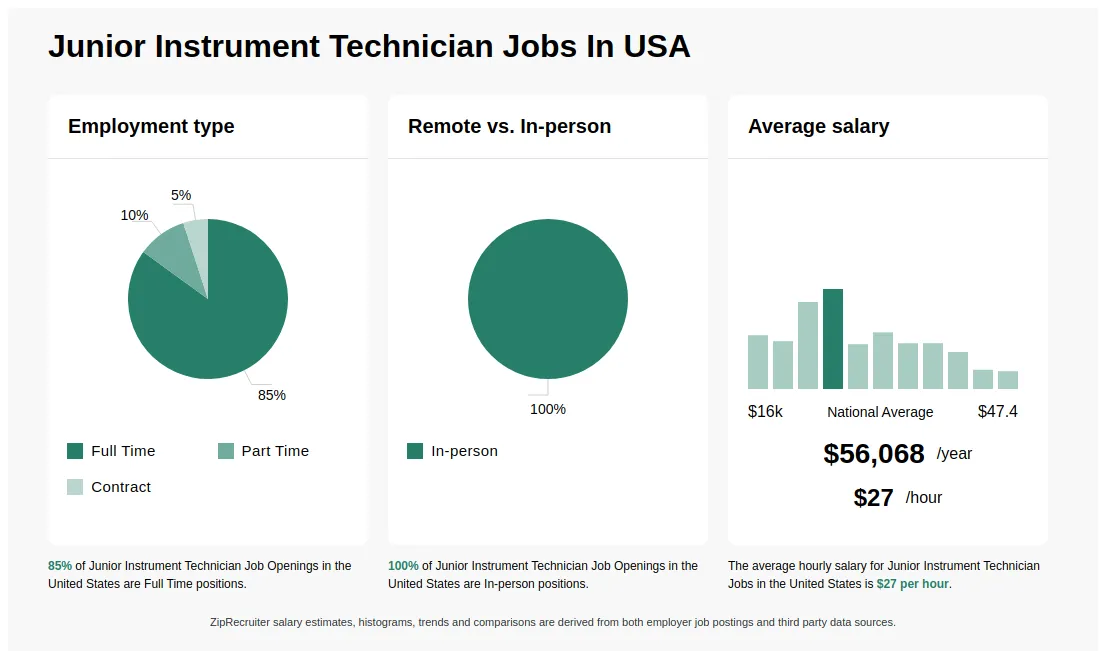
As of Jun 10, 2026, the average hourly pay for junior instrument technician in the United States is $26.96, according to ZipRecruiter salary data. Most workers in this role earn between $16.35 and $33.17 per hour, depending on experience, location, and employer.

What is the difference between Junior Instrument Technician vs Instrument Technician?

AspectJunior Instrument TechnicianInstrument Technician
CertificationsTypically entry-level certifications or apprenticeshipsAdvanced certifications, such as ISA certifications or equivalent
Work ExperienceLess than 2 years or on-the-job training2+ years of experience in instrumentation maintenance and repair
Work EnvironmentAssisting senior technicians, basic troubleshootingPerforming complex calibration, troubleshooting, and installation
Job ResponsibilitiesSupporting instrumentation tasks, basic repairsMaintaining, calibrating, and troubleshooting instrumentation systems

The main difference between a Junior Instrument Technician and an Instrument Technician lies in experience, certifications, and responsibilities. Junior Instrument Technicians are typically entry-level, assisting more experienced technicians, while Instrument Technicians have more experience and handle complex tasks independently.

What are some common challenges faced by a Junior Instrument Technician during the first year on the job?

As a Junior Instrument Technician, one of the main challenges in the first year is quickly adapting to various types of instrumentation and control systems, especially in fast-paced industrial environments. New technicians often need to learn to interpret technical diagrams, follow strict safety protocols, and troubleshoot under pressure—all while balancing hands-on tasks with ongoing training. Collaborating effectively with senior technicians and engineers is also essential, as it helps in gaining practical knowledge and building confidence. Overcoming these challenges early on leads to steady professional growth and opens up opportunities for advancement within maintenance or engineering teams.

What are Junior Instrument Technicians?

Junior Instrument Technicians are entry-level professionals who assist in the installation, maintenance, calibration, and repair of instrumentation and control systems used in various industries such as manufacturing, oil and gas, and power generation. They work under the supervision of senior technicians or engineers to ensure that all instruments and equipment operate correctly and safely. Their responsibilities often include troubleshooting faults, performing routine preventive maintenance, and documenting their work. This role is ideal for those starting their careers in industrial automation or instrumentation.

What are the key skills and qualifications needed to thrive as a Junior Instrument Technician, and why are they important?

To thrive as a Junior Instrument Technician, you generally need a background in instrumentation or electrical engineering, often supported by a relevant diploma or technical certification. Familiarity with calibration tools, PLCs, and maintenance management systems is typically required. Attention to detail, problem-solving abilities, and effective teamwork are important soft skills for this role. These skills ensure accurate instrument maintenance, reliable system performance, and safe operations in industrial environments.
More about Junior Instrument Technician jobs
What cities are hiring for Junior Instrument Technician jobs? Cities with the most Junior Instrument Technician job openings:
What are the most commonly searched types of Instrument Technician jobs? The most popular types of Instrument Technician jobs are:
What states have the most Junior Instrument Technician jobs? States with the most job openings for Junior Instrument Technician jobs include:
What job categories do people searching Junior Instrument Technician jobs look for? The top searched job categories for Junior Instrument Technician jobs are:
Infographic showing various Junior Instrument Technician job openings in the United States as of June 2026, with employment types broken down into 99% Full Time, and 1% Part Time. Highlights an 94% Physical, 1% Hybrid, and 5% Remote job distribution, with an average salary of $56,068 per year, or $27 per hour.
Instrument Technician

Instrument Technician

Olin Corporation

Niagara Falls, NY • On-site

$39/hr

Other

Posted 26 days ago


Olin Corporation rating

5.9

Company rating: 5.9 out of 10

Based on 29 frontline employees who took The Breakroom Quiz

80th of 89 rated chemical manufacturers


Job description

Title: Instrument Technician or Junior Instrument Technician
Location: Niagara Falls, NY
Salary: $39/hour starting rate ($37/hour for Junior level); $42/hour top craft rate (after training completion)
Schedule: 4 10-hour shifts
Website: Olin.com
Focus: Instrument technicians troubleshoot equipment instrumentation, control systems (DCS/PLC/MLC) and ladder logic.
Junior Instrument Technician Essential Job Functions:
Successful candidates will join the development instrument technician program and will complete a training program of up to 24 months. Training will include classroom, vendor and CBT components. At the conclusion of the 24-month training period, hires into the development program must have satisfied the training requirements for an instrument tech. See essential job functions below.
Instrument Technician Essential Job Functions:
Instrument technicians are Journeyman level technicians that troubleshoot equipment instrumentation, control systems (DCS/PLC/MLC) and ladder logic. Instrument Technicians receive very little descriptive information concerning the production problem and learn to calibrate, install and maintain a variety of instruments used to measure temperature, level, pressure, pH, conductivity and flow. He or she will install & maintain pneumatic systems; monitor specific equipment; and may monitor and replace control valves. Instrument Technicians participate in safety meetings and training activities and follow established safety and operating procedures and practices.
Job activities involve working near heavy equipment, various gases, moving machinery, high (up to 150 ft.) locations and congested areas. Improper actions or mistakes could result in serious injury or lethal accidents. Burns and explosions are a potential hazard. Errors in work could result in loss of production. Errors in judgment could result in serious damage to machines and equipment costing thousands of dollars. Necessity of continuous operation demands cooperation, teamwork, and close attention.
Journeylevel Instrument Technicians work with minimum supervision and daily duties involve reading and interpreting work orders, technical descriptions and safety manuals and maintaining records to comply with company, state and federal compliance regulations.
Junior Instrument Technician Minimum Requirements:
  • High school diploma or equivalent.
  • Candidate must meet one of the following criteria:
    • Two years continuous and current industrial instrument technician experience ; OR
    • Completed Associate of applied science degree* in an instrument related discipline; OR
    • Completed Military Maintenance A School (Electronics Technician or Interior Communications programs only)
  • Able to demonstrate basic computer skills, math and problem-solving; mechanical, numerical and verbal aptitude to learn our jobs quickly
  • Must be able to work call-ins and overtime when support is needed
  • Able to pass a functional physical testing and able to use standard safety equipment; must be able to lift up to 50 pounds
  • Able to climb ladders/stairs and work at heights
  • Able to work in tight or closed-in spaces
  • Pass a physical, drug screen and background check if job offer is received and accepted

Preferred Qualifications:
  • Minimum of 5 years instrument technician work experience (industrial setting preferred) or Journeyman level as an Instrument Tech
  • Demonstrated proficiency as an Instrument Technician (Instrument Tech primary craft)
  • A complete employment application that explains a detailed work history required (resume must cover at least 5 years work experience)

*Degree must be from a school that is accredited by an accrediting agency recognized by the Secretary of Education of the U.S. Department of Education or equivalent program from an international university.
Olin does not provide any form of sponsorship. We will only employ those who are legally authorized to work in the United States. Individuals with temporary visas such as E, F-1, H-1, H-2, L, B, J or TN or who need sponsorship now or in the future, are not eligible for hire.
Olin is an equal opportunity employer and all qualified applicants will receive consideration for employment without regard to race, color, religion, sex, sexual orientation, gender identity, national origin, disability status, protected veteran status, or any other characteristic protected by law.

What Olin Corporation employees say

Pay

Benefits

Hours and flexibility

Workplace

Get the full story on Breakroom