1

International Human Rights Law Jobs (NOW HIRING)

Showing results 41-60

International Human Rights Law information

See salary details

$30K

$45K

$65.5K

How much do international human rights law jobs pay per year?

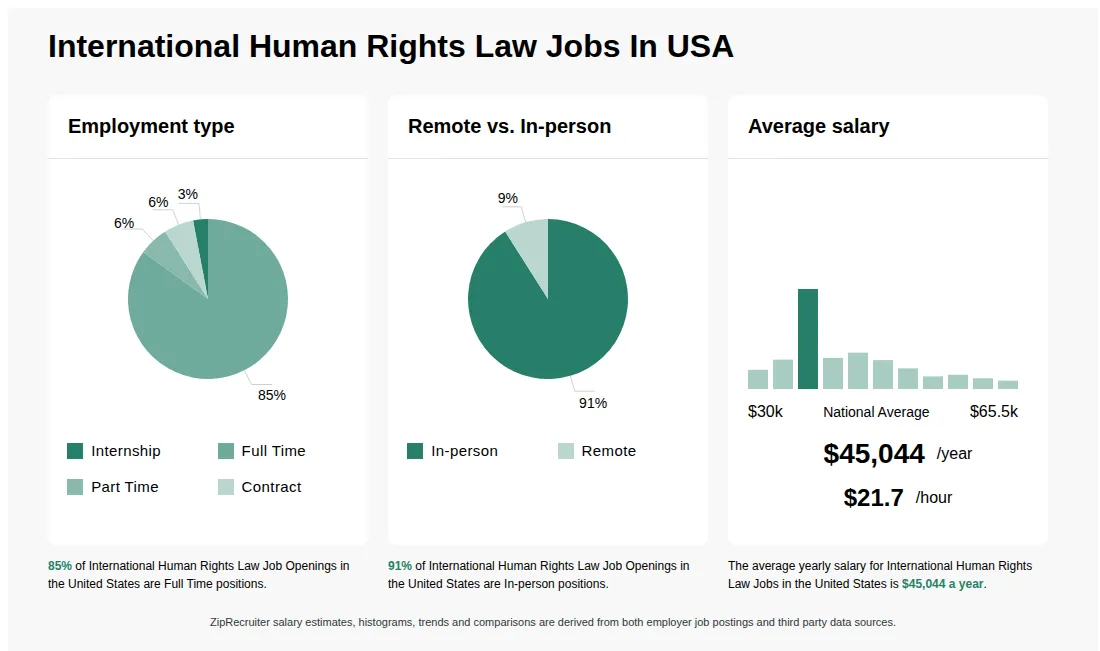
As of Sep 5, 2026, the average yearly pay for international human rights law in the United States is $45,044.00, according to ZipRecruiter salary data. Most workers in this role earn between $37,500.00 and $49,500.00 per year, depending on experience, location, and employer.

What are some typical challenges faced by professionals working in international human rights law?

Professionals in International Human Rights Law often navigate complex legal systems across multiple countries and must stay updated on evolving international treaties and conventions. The role frequently involves managing sensitive cases, working with diverse stakeholders such as NGOs, governments, and affected communities, and sometimes operating in high-pressure or resource-limited environments. Advocacy can require extensive research, travel, and collaboration with multidisciplinary teams, making adaptability and strong communication skills essential. Despite these challenges, the work is highly rewarding for those passionate about advancing human rights globally.

What are the key skills and qualifications needed to thrive as an international human rights lawyer, and why are they important?

To thrive as an International Human Rights Lawyer, you need a law degree, strong knowledge of international law, and relevant bar admission or licensure. Familiarity with legal research databases, international treaties, and case management systems is typically required. Outstanding communication, cultural sensitivity, and advocacy skills help professionals navigate complex cases and diverse environments. These skills are essential to effectively defend human rights, influence policy, and achieve meaningful legal outcomes on a global scale.

What is the difference between International Human Rights Law vs International Human Rights Advocacy?

AspectInternational Human Rights LawInternational Human Rights Advocacy
FocusLegal frameworks, treaties, and enforcement of human rights lawsPromoting awareness, policy change, and supporting victims through advocacy
CredentialsLaw degree, legal certifications, knowledge of international lawBackground in human rights, communications, or social sciences
Work EnvironmentLegal institutions, international courts, NGOs with legal focusNGOs, advocacy groups, international organizations
Employer & IndustryInternational courts, governments, NGOs with legal departmentsHuman rights organizations, advocacy groups, UN agencies

International Human Rights Law primarily involves understanding and applying legal frameworks to protect human rights, while International Human Rights Advocacy focuses on raising awareness and influencing policy. Both roles often collaborate but serve different functions within the human rights sector.

More about International Human Rights Law jobs

What cities are hiring for International Human Rights Law jobs?

Cities with the most International Human Rights Law job openings:

What states have the most International Human Rights Law jobs?

States with the most job openings for International Human Rights Law jobs include:

Infographic showing various International Human Rights Law job openings in the United States as of August 2026, with employment types broken down into 1% As Needed, 78% Full Time, 19% Part Time, and 2% Contract. Highlights an 94% Physical, 2% Hybrid, and 4% Remote job distribution, with an average salary of $45,044 per year, or $21.7 per hour.

Fall 2026 & Spring 2027 Academic Year Externship

Center for Democracy & Technology

Washington, DC โ€ข On-site, Remote

$47K - $58K/yr

Part-time

Re-posted 23 days ago


Job description

The Center for Democracy & Technology (CDT) occasionally hosts externs during the academic year, who work to support CDT’s work championing civil liberties and international human rights issues related to technology and the internet, including online free expression, electronic surveillance, digital copyright, disability rights in technology, cybersecurity, internet governance, equity in technology, and consumer privacy.  

College, law, and graduate students with an interest in internet and technology policy, human rights, and/or civil liberties are invited to apply. Externships are unpaid and must be coordinated with the extern’s college or university for academic credit. Prospective externs must be enrolled at an academic institution at the time of application & during their prospective externship period.

Applications should include: 

  • a cover letter explaining your interest in externing at CDT, the team you would like to work with, and tentative dates for your externship;
  • a current resume or CV; and, 
  • a writing sample.

The availability of positions for externs are determined by the current needs of CDT’s policy teams. We recommend that prospective externs apply at least six weeks before they would like their externships to begin. This opening is specific to the 2026 - 2027 academic year (Fall 2026 Semester & Spring 2027 Semester).

We accept applications for five types of externships: legal, policy analyst, research, technologist, and nonprofit communications and development. Responsibilities and requirements for these positions are described below. Please specify in your cover letter if you are applying for a legal, policy, research, technologist, or communications and development position.

Job Responsibilities:

  • Law students: Externs who are current law students can contribute to CDT’s work by conducting legal and policy research, drafting reports and legal analyses, assisting in the preparation of testimony, presentations, legislative proposals, regulatory comments, and court briefs, and creating online educational resources.
  • Policy analysts: Externs with training or experience in policy and advocacy can contribute to CDT’s work by conducting policy research, drafting reports and analyses, assisting in the preparation of testimony, presentations, and legislative proposals, and creating online educational resources.
  • Researchers: Externs who are currently graduate students or PhD students can contribute to CDT by working with the Research Team in the development of research proposals, drafting literature reviews and issue-specific memoranda, data analysis, primary data collection, and translating research deliverables for policy-focused audiences. Students from all majors and degree programs are encouraged to apply.
  • Technologists: Externs with technical training or experience can contribute to CDT’s work by conducting research, evaluating technical standards, drafting accessible policy papers about technical topics and reports, assisting in the preparation of testimony and legislative proposals, and designing online educational resources. Students from all technical or scientific majors and degree programs are encouraged to apply.
  • Nonprofit communications, development, and management specialists: Externs with strong writing skills and an interest in learning about public policy communications and nonprofit management can contribute to the work of CDT’s Communications and/or Development and Finance teams. Work will include drafting and editing social media content; editing blogposts and reports; writing newsletters and other CDT communications; contributing to grant applications and reports; and office administrative tasks as assigned. Undergraduate or graduate students are encouraged to apply.

Qualifications:

Students from all majors and degree programs are encouraged to apply. Applicants should have an interest in internet and technology policy, civil liberties and/or human rights law, strong research and writing skills, the ability to take initiative and prioritize responsibilities in a fast-paced working environment, and a strong academic record.

This position is based in CDT’s Washington, D.C. office and is also available as a remote opportunity. Candidates should be comfortable working within Eastern Time Zone (EST & EDT) business hours. 

Compensation:

CDT is unfortunately unable to provide compensation for externships during the academic year. Externships are coordinated with the extern’s college or university for academic credit. We are only able to accept applicants who can coordinate with their college or university for credit. 

Due to the large number of applications we receive, only applicants selected for interviews will be contacted. 

Employment Type: PART_TIME