Adjunct Faculty in Intelligent Systems Engineering Full-time Faculty Positions Full-time faculty positions will be posted on a per-opening basis. Postings are organized by college/school and ...
Adjunct Faculty in Intelligent Systems Engineering Full-time Faculty Positions Full-time faculty positions will be posted on a per-opening basis. Postings are organized by college/school and ...

A strong background in Intelligent Systems Engineering and related areas is highly desirable. Application Instructions The BS in Intelligent Systems Engineering program prepares students for ...
A strong background in Intelligent Systems Engineering and related areas is highly desirable. Application Instructions The BS in Intelligent Systems Engineering program prepares students for ...
This role operates at the intersection of industrial systems, data engineering, and applied AI. You ... The Intelligent Systems Platform Engineer partners closely with data scientists, product managers ...
This role operates at the intersection of industrial systems, data engineering, and applied AI. You ... The Intelligent Systems Platform Engineer partners closely with data scientists, product managers ...

Intelligent Systems Development Engineer
Laurel, MD · On-site
$171K - $203K/yr
... intelligent autonomous systems that will save US warfighter's lives and ensure our nation ... If you are graduating with a degree in Computer Science, Math, Physics, and/or Engineering or ...
Intelligent Systems Development Engineer
Laurel, MD · On-site
$171K - $203K/yr
... intelligent autonomous systems that will save US warfighter's lives and ensure our nation ... If you are graduating with a degree in Computer Science, Math, Physics, and/or Engineering or ...

Faith Technologies Inc. in Menasha, WI seeks a Director of Engineering to lead Intelligent Systems in the R&D group, overseeing Advanced Simulation, AI and optimization teams on-site. You will bridge ...
Faith Technologies Inc. in Menasha, WI seeks a Director of Engineering to lead Intelligent Systems in the R&D group, overseeing Advanced Simulation, AI and optimization teams on-site. You will bridge ...
As the Director of Engineering for Intelligent Systems in the R&D group, you will be responsible for leading Advanced Simulation, AI and optimization teams on-site in the Menasha-Appleton, WI area at ...
As the Director of Engineering for Intelligent Systems in the R&D group, you will be responsible for leading Advanced Simulation, AI and optimization teams on-site in the Menasha-Appleton, WI area at ...
Intelligent Systems Architect
Washington, DC · On-site
$254K/yr
We are seeking a highly skilled Intelligent Systems Architect to help the FBI uncover actionable ... Strong scripting and programming capabilities. * Minimum 5 years of experience supporting data ...
Intelligent Systems Architect
Washington, DC · On-site
$254K/yr
We are seeking a highly skilled Intelligent Systems Architect to help the FBI uncover actionable ... Strong scripting and programming capabilities. * Minimum 5 years of experience supporting data ...
Director of Engineering- Intelligent Systems
Menasha, WI · On-site
$200 - $250/hr
As the Director of Engineering for Intelligent Systems in the R&D group, you will be responsible for leading Advanced Simulation, AI and optimization teams on-site in the Menasha-Appleton, WI area at ...
Director of Engineering- Intelligent Systems
Menasha, WI · On-site
$200 - $250/hr
As the Director of Engineering for Intelligent Systems in the R&D group, you will be responsible for leading Advanced Simulation, AI and optimization teams on-site in the Menasha-Appleton, WI area at ...
As the Director of Engineering for Intelligent Systems in the R&D group, you will be responsible for leading Advanced Simulation, AI and optimization teams on-site in the Menasha-Appleton, WI area at ...
As the Director of Engineering for Intelligent Systems in the R&D group, you will be responsible for leading Advanced Simulation, AI and optimization teams on-site in the Menasha-Appleton, WI area at ...
As the Director of Engineering for Intelligent Systems in the R&D group, you will be responsible for leading Advanced Simulation, AI and optimization teams on-site in the Menasha-Appleton, WI area at ...
As the Director of Engineering for Intelligent Systems in the R&D group, you will be responsible for leading Advanced Simulation, AI and optimization teams on-site in the Menasha-Appleton, WI area at ...
We are looking for a motivated, creative, and team-focused AI/ML and autonomy software engineer to ... Have experience developing autonomous or artificially intelligent systems for flight software.
We are looking for a motivated, creative, and team-focused AI/ML and autonomy software engineer to ... Have experience developing autonomous or artificially intelligent systems for flight software.
As the Director of Engineering for Intelligent Systems in the R&D group, you will be responsible for leading Advanced Simulation, AI and optimization teams on-site in the Menasha-Appleton, WI area at ...
As the Director of Engineering for Intelligent Systems in the R&D group, you will be responsible for leading Advanced Simulation, AI and optimization teams on-site in the Menasha-Appleton, WI area at ...

... intelligent autonomous systems that will save US warfighter's lives and ensure our nation ... If you are graduating with a degree in Computer Science, Math, Physics, and/or Engineering or ...
... intelligent autonomous systems that will save US warfighter's lives and ensure our nation ... If you are graduating with a degree in Computer Science, Math, Physics, and/or Engineering or ...

Senior Systems Engineer
Indianapolis, IN · On-site
$50 - $67.34/hr
Apply Today If you're ready to solve complex engineering challenges and help build the next generation of intelligent HVAC systems, apply today and take the next step in your engineering career with ...
Senior Systems Engineer
Indianapolis, IN · On-site
$50 - $67.34/hr
Apply Today If you're ready to solve complex engineering challenges and help build the next generation of intelligent HVAC systems, apply today and take the next step in your engineering career with ...
Software Engineer: ML Robotics Systems
Palo Alto, CA · On-site
$203K - $241K/yr
S32 is a venture capital firm investing at the frontiers of technology, seeking ML Robotics Systems Engineers who are passionate about building intelligent systems. The role involves making a ...
Software Engineer: ML Robotics Systems
Palo Alto, CA · On-site
$203K - $241K/yr
S32 is a venture capital firm investing at the frontiers of technology, seeking ML Robotics Systems Engineers who are passionate about building intelligent systems. The role involves making a ...
Apply Today If you're ready to solve complex engineering challenges and help build the next generation of intelligent HVAC systems, apply today and take the next step in your engineering career with ...
Quick apply
Apply Today If you're ready to solve complex engineering challenges and help build the next generation of intelligent HVAC systems, apply today and take the next step in your engineering career with ...

Staff Machine Learning Engineer - Automotive Cybersecurity
San Diego, CA · On-site
$150 - $200/hr
Build intelligent systems for document understanding, review automation, and engineering productivity * Develop and deploy solutions leveraging LLMs, GenAI, and agentic AI frameworks * Contribute to ...
Staff Machine Learning Engineer - Automotive Cybersecurity
San Diego, CA · On-site
$150 - $200/hr
Build intelligent systems for document understanding, review automation, and engineering productivity * Develop and deploy solutions leveraging LLMs, GenAI, and agentic AI frameworks * Contribute to ...

Senior Intelligent Transportation Systems Engineer
Manhattan, NY · On-site
$150K - $190K/yr
TransCore (TCI), a subsidiary of ST Engineering, is seeking a full-time Senior Intelligent Transportation Systems Engineer to join our Intelligent Transportation Systems (ITS) team based in Manhattan ...
Senior Intelligent Transportation Systems Engineer
Manhattan, NY · On-site
$150K - $190K/yr
TransCore (TCI), a subsidiary of ST Engineering, is seeking a full-time Senior Intelligent Transportation Systems Engineer to join our Intelligent Transportation Systems (ITS) team based in Manhattan ...

GPI seeks an Intelligent Transportation Systems (ITS) Engineer to join our Bridgewater, NJ, office ... GPI is a multi-disciplinary engineering firm that has been providing planning, design, and ...
GPI seeks an Intelligent Transportation Systems (ITS) Engineer to join our Bridgewater, NJ, office ... GPI is a multi-disciplinary engineering firm that has been providing planning, design, and ...
Senior Intelligent Transportation Systems Engineer
Manhattan, NY · On-site
$150K - $190K/yr
TransCore (TCI), a subsidiary of ST Engineering, is seeking a full-time Senior Intelligent Transportation Systems Engineer to join our Intelligent Transportation Systems (ITS) team based in Manhattan ...
Senior Intelligent Transportation Systems Engineer
Manhattan, NY · On-site
$150K - $190K/yr
TransCore (TCI), a subsidiary of ST Engineering, is seeking a full-time Senior Intelligent Transportation Systems Engineer to join our Intelligent Transportation Systems (ITS) team based in Manhattan ...
Intelligent Systems Engineering information
See salary details
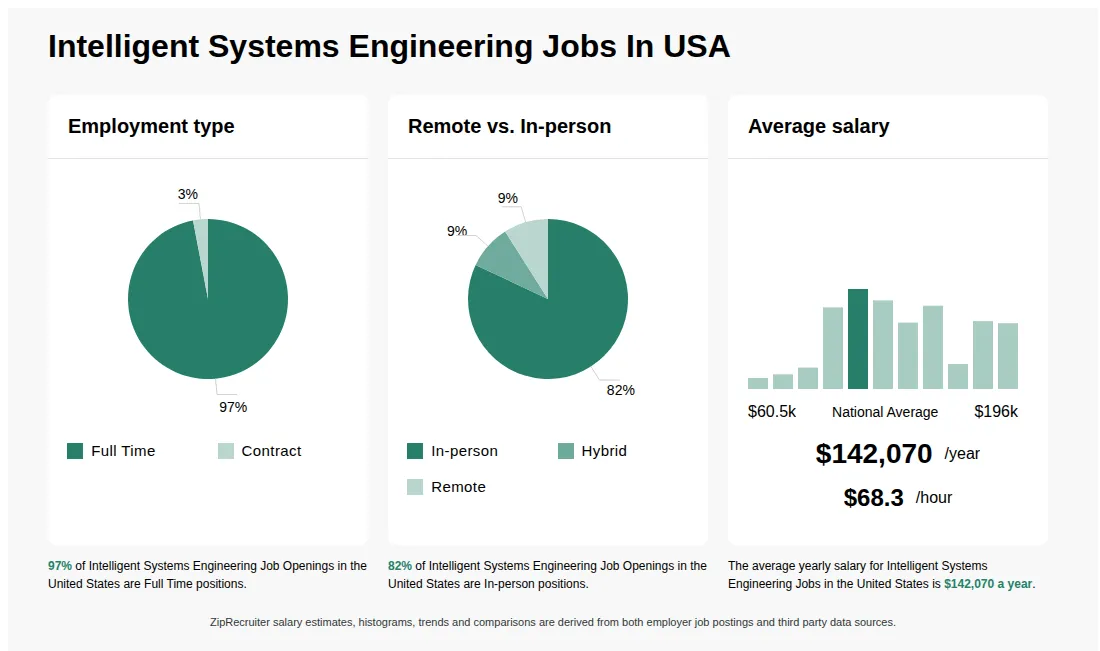
$60.5K - $72.8K
1% of jobs
$72.8K - $85.1K
2% of jobs
$85.1K - $97.5K
3% of jobs
$97.5K - $109.8K
14% of jobs
$113.5K is the 25th percentile. Wages below this are outliers.
$109.8K - $122.1K
16% of jobs
The median wage is $133.5K / yr.
$122.1K - $134.4K
15% of jobs
$134.4K - $146.7K
11% of jobs
$158.6K is the 75th percentile. Wages above this are outliers.
$146.7K - $159K
14% of jobs
$159K - $171.4K
3% of jobs
$171.4K - $183.7K
11% of jobs
$183.7K - $196K
11% of jobs
$60.5K
$142.1K
$196K
How much do intelligent systems engineering jobs pay per year?
As of Sep 7, 2026, the average yearly pay for intelligent systems engineering in the United States is $142,070.00, according to ZipRecruiter salary data. Most workers in this role earn between $114,000.00 and $173,000.00 per year, depending on experience, location, and employer.
What is intelligent systems engineering?
An Intelligent Systems Engineering job involves designing, developing, and optimizing smart systems that integrate AI, machine learning, and advanced computing. Professionals in this field work on applications such as autonomous systems, robotics, cybersecurity, and biomedical devices. They use data-driven approaches and computational models to enhance decision-making and automation. These roles exist in industries like healthcare, automotive, aerospace, and IoT.
What are the main challenges faced when working as an intelligent systems engineer?
Intelligent Systems Engineers often encounter challenges such as integrating diverse hardware and software components, ensuring system reliability, and optimizing performance under real-world conditions. They must stay current with rapidly evolving technologies and continuously adapt their solutions to meet new requirements or constraints. Collaboration across multidisciplinary teams, including software developers, hardware engineers, and data scientists, is common and essential for project success. Tackling these challenges develops a well-rounded skill set and provides significant opportunities for professional growth and innovation.
What are the key skills and qualifications needed to thrive in intelligent systems engineering, and why are they important?
Successful careers in Intelligent Systems Engineering require a strong background in computer science, control systems, mathematics, and often an advanced degree in engineering or a related field. Proficiency with programming languages (such as Python, C++, or MATLAB), experience with machine learning frameworks, and familiarity with embedded systems and sensor integration are typically expected. Strong analytical thinking, problem-solving skills, and effective collaboration are essential soft skills in this position. These competencies enable professionals to design, develop, and optimize complex intelligent systems that perform reliably in real-world applications.
How much do intelligent systems engineers make?
Intelligent systems engineers typically earn a median annual salary of around $100,000 to $130,000, depending on experience, education, and location. Professionals with advanced skills in machine learning, robotics, or AI tools may earn higher salaries, especially in specialized or high-demand industries.
What do intelligent systems engineers do?
Intelligent systems engineers design, develop, and implement software and hardware systems that incorporate artificial intelligence, machine learning, and automation technologies. They analyze complex problems, create algorithms, and work with tools like robotics, data analysis, and programming languages such as Python or C++. Their work often involves testing, optimization, and ensuring systems operate reliably in real-world environments.
More about Intelligent Systems Engineering jobs
What cities are hiring for Intelligent Systems Engineering jobs?
Cities with the most Intelligent Systems Engineering job openings:
What are the most commonly searched types of Intelligent Systems Engineering jobs?
The most popular types of Intelligent Systems Engineering jobs are:
What states have the most Intelligent Systems Engineering jobs?
States with the most job openings for Intelligent Systems Engineering jobs include:
What job categories do people searching Intelligent Systems Engineering jobs look for?
The top searched job categories for Intelligent Systems Engineering jobs are:

Part-time
This job post has expired 4 days ago. Applications are no longer accepted.
Job description
Adjunct Faculty in Intelligent Systems Engineering
Full-time Faculty Positions
Full-time faculty positions will be posted on a per-opening basis. Postings are organized by college/school and department. Applicants will be evaluated at the college/school level for the position which they are submitting an application. Unless noted by a close date, positions will remain open until they are filled. Qualified applicants are encouraged to apply.
Part-time Faculty Positions
DePaul University invites expressions of interest for a pool of qualified Part Time Faculty to teach courses in a variety of disciplines across all 10 colleges and schools. Individuals may enter expressions of interest by submitting their credentials to any posting for which they are qualified to teach. Postings are organized by college/school and department. Screening of individuals in the pool is ongoing, depending on curricular need and funding. Individuals will be contacted by the department if they reach the finalist stage for teaching a particular course or set of courses. The pool will remain in place until the closing date specified in the posting details; those interested in remaining in the pool beyond that time must resubmit. All individuals in the pool will be notified by email when the posting is closed.
Below you will find the details for the posting including any supplementary documentation and questions you should review before applying for the opening or submitting your interest in teaching. To apply for the position, please click the Apply for this Job link/button.
Posting Details
Job ID: 47782
College/School: Chicago, IL - Jarvis College of Computing & Digital Media
Position Description:
DePaul's Jarvis College of Computing & Digital Media (CDM) is located in the heart of Chicago's Loop, the central business district of Chicago. Our students represent many different experiences, perspectives, and cultures, and the university strives to recruit and sustain a faculty community where all backgrounds are valued and supported. Part-time teaching positions are available throughout the academic year, including summer sessions. Academic course schedules fluctuate from quarter to quarter, and the college will work with selected individuals to determine a quarterly schedule. Courses are not guaranteed, however the college does its best to give ample notice about available courses. Applicants with expertise that matches course scheduling needs will be contacted for an interview.
The School of Computing (SoC) offers a variety of undergraduate and graduate programs including Computer Science, Artificial Intelligence, Cybersecurity, Data Science, Game Programming, Health Informatics, Human-Computer Interaction, Information Systems, Information Technology, Intelligent Systems Engineering, Network Engineering and Security, and Software Engineering. Find out more about SoC at .
Qualifications:
Minimum requirements include a master's degree in the discipline, or 18 semester/27 quarter hours of graduate work in the discipline, or an undergraduate degree with a minimum of five years of demonstrated relevant professional experience. Exceptions may be considered with approval of the dean.
The BS in Intelligent Systems Engineering program prepares students for engineering systems that integrate physical processes, computation, and control. The BS In Intelligent Systems Engineering is a hybrid program between traditional Computer Science, Computer Engineering, and generalist Engineering programs. Just like any engineering program, it has rigorous math and science requirements and a focus on building systems based on theoretical foundations and fundamental engineering design principles. Unlike most engineering programs, it is multi-disciplinary and includes a broad and deep foundation in computer science and software development.
We are looking for instructors with an engineering background who can teach courses on embedded systems, electromagnetism and electronic circuits, signals and signal processing, linear physical systems and feedback control, and/or the design of reliable cyber-physical systems.
Considerations:
Exceptions to standard rates may apply to courses with unique credit hours, supervision, labs, clinical/practicum courses, coaching, administrative tasks, and courses that are either over-enrolled or under-enrolled.
General Compensation/Benefits Statement:
DePaul University has provided a compensation range that represents its good faith estimate of what the University may pay for the position at the time of posting. The salary offered to the selected candidate will be determined based on factors such as (but not limited to) the qualifications, education, experience, and training of the selected candidate, the scope and responsibilities of the position, departmental budget availability, internal salary equity considerations, and available market information.
DePaul University offers a variety of benefit options for qualified part-time employees. Further information regarding benefits can be found here:
About DePaul University's Academic Calendar:
Except for the College of Law, DePaul University operates on a quarter system. Classes in Autumn, Winter, and Spring quarters are 11 weeks in length (including finals week) and Summer courses, in two sessions, are typically 5 weeks in length. The College of Law operates on the semester system. Classes in the Fall and Spring semesters are 16 weeks in length (including finals week) and it offers a Summer Session of 7 weeks (including final exams).
Salary Information: The anticipated hiring rate of this position is between $4,800 and $6,100 per course, commensurate with qualifications and experience.
Applicant Documents
Cover Letter(1)
C.V.(1)
Full-time Faculty Positions
Full-time faculty positions will be posted on a per-opening basis. Postings are organized by college/school and department. Applicants will be evaluated at the college/school level for the position which they are submitting an application. Unless noted by a close date, positions will remain open until they are filled. Qualified applicants are encouraged to apply.
Part-time Faculty Positions
DePaul University invites expressions of interest for a pool of qualified Part Time Faculty to teach courses in a variety of disciplines across all 10 colleges and schools. Individuals may enter expressions of interest by submitting their credentials to any posting for which they are qualified to teach. Postings are organized by college/school and department. Screening of individuals in the pool is ongoing, depending on curricular need and funding. Individuals will be contacted by the department if they reach the finalist stage for teaching a particular course or set of courses. The pool will remain in place until the closing date specified in the posting details; those interested in remaining in the pool beyond that time must resubmit. All individuals in the pool will be notified by email when the posting is closed.
Below you will find the details for the posting including any supplementary documentation and questions you should review before applying for the opening or submitting your interest in teaching. To apply for the position, please click the Apply for this Job link/button.
Posting Details
Job ID: 47782
College/School: Chicago, IL - Jarvis College of Computing & Digital Media
Position Description:
DePaul's Jarvis College of Computing & Digital Media (CDM) is located in the heart of Chicago's Loop, the central business district of Chicago. Our students represent many different experiences, perspectives, and cultures, and the university strives to recruit and sustain a faculty community where all backgrounds are valued and supported. Part-time teaching positions are available throughout the academic year, including summer sessions. Academic course schedules fluctuate from quarter to quarter, and the college will work with selected individuals to determine a quarterly schedule. Courses are not guaranteed, however the college does its best to give ample notice about available courses. Applicants with expertise that matches course scheduling needs will be contacted for an interview.
The School of Computing (SoC) offers a variety of undergraduate and graduate programs including Computer Science, Artificial Intelligence, Cybersecurity, Data Science, Game Programming, Health Informatics, Human-Computer Interaction, Information Systems, Information Technology, Intelligent Systems Engineering, Network Engineering and Security, and Software Engineering. Find out more about SoC at .
Qualifications:
Minimum requirements include a master's degree in the discipline, or 18 semester/27 quarter hours of graduate work in the discipline, or an undergraduate degree with a minimum of five years of demonstrated relevant professional experience. Exceptions may be considered with approval of the dean.
- Candidates should have the ability to teach foundational courses in electrical and computer engineering, including, but not limited to, analog and digital circuits, embedded systems, and control systems. A strong background in Intelligent Systems Engineering and related areas is highly desirable.
The BS in Intelligent Systems Engineering program prepares students for engineering systems that integrate physical processes, computation, and control. The BS In Intelligent Systems Engineering is a hybrid program between traditional Computer Science, Computer Engineering, and generalist Engineering programs. Just like any engineering program, it has rigorous math and science requirements and a focus on building systems based on theoretical foundations and fundamental engineering design principles. Unlike most engineering programs, it is multi-disciplinary and includes a broad and deep foundation in computer science and software development.
We are looking for instructors with an engineering background who can teach courses on embedded systems, electromagnetism and electronic circuits, signals and signal processing, linear physical systems and feedback control, and/or the design of reliable cyber-physical systems.
Considerations:
Exceptions to standard rates may apply to courses with unique credit hours, supervision, labs, clinical/practicum courses, coaching, administrative tasks, and courses that are either over-enrolled or under-enrolled.
General Compensation/Benefits Statement:
DePaul University has provided a compensation range that represents its good faith estimate of what the University may pay for the position at the time of posting. The salary offered to the selected candidate will be determined based on factors such as (but not limited to) the qualifications, education, experience, and training of the selected candidate, the scope and responsibilities of the position, departmental budget availability, internal salary equity considerations, and available market information.
DePaul University offers a variety of benefit options for qualified part-time employees. Further information regarding benefits can be found here:
About DePaul University's Academic Calendar:
Except for the College of Law, DePaul University operates on a quarter system. Classes in Autumn, Winter, and Spring quarters are 11 weeks in length (including finals week) and Summer courses, in two sessions, are typically 5 weeks in length. The College of Law operates on the semester system. Classes in the Fall and Spring semesters are 16 weeks in length (including finals week) and it offers a Summer Session of 7 weeks (including final exams).
Salary Information: The anticipated hiring rate of this position is between $4,800 and $6,100 per course, commensurate with qualifications and experience.
Applicant Documents
Cover Letter(1)
C.V.(1)

About DePaul
Sourced by ZipRecruiter
Industry
Health care and social assistance
Company size
1,001 - 5,000 Employees
Headquarters location
Rochester, NY, US
Year founded
1958