1

Industrial Maintenance Jobs (NOW HIRING)

Industrial Maintenance Summary: Service and repair machines and equipment throughout the facility for production efficiency. Industrial Maintenance Essential Duties and Responsibilities: Install ...

New

Industrial Maintenance Summary: Service and repair machines and equipment throughout the facility for production efficiency. Industrial Maintenance Essential Duties and Responsibilities: Install ...

New

We are seeking an Industrial Maintenance to join our team! * This position is the maintenance of automated industrial machinery! What We Offer: * Work in a team-oriented environment where ...

We are seeking an Industrial Maintenance to join our team! * This position is the maintenance of automated industrial machinery! What We Offer: * Work in a team-oriented environment where ...

Industrial Maintenance Competitive Pay up to $40 per hour Shifts Available: 2nd shift (2:00pm-10:00pm) 3rd shift (10:00pm-6:00am) Metal Technologies, come join us! Opportunities: Metal Technologies ...

INDUSTRIAL MAINTENANCE

Simpsonville, SC · On-site

$25.75 - $31.75/hr

Millwood is looking for 1st shift Industrial Maintenance Technician to help maintain our Simpsonville, SC. facility. Good pay depending on experience and good benefits available! Maintain ...

Express Employment Professionals has partnered with a growing company out of Ottawa, IL, in search of an industrial maintenance technician to join the team who is proficient in electrical maintenance ...

next page

Showing results 1-20

Industrial Maintenance information

See salary details

$38.5K

$88.6K

$134.5K

How much do industrial maintenance jobs pay per year?

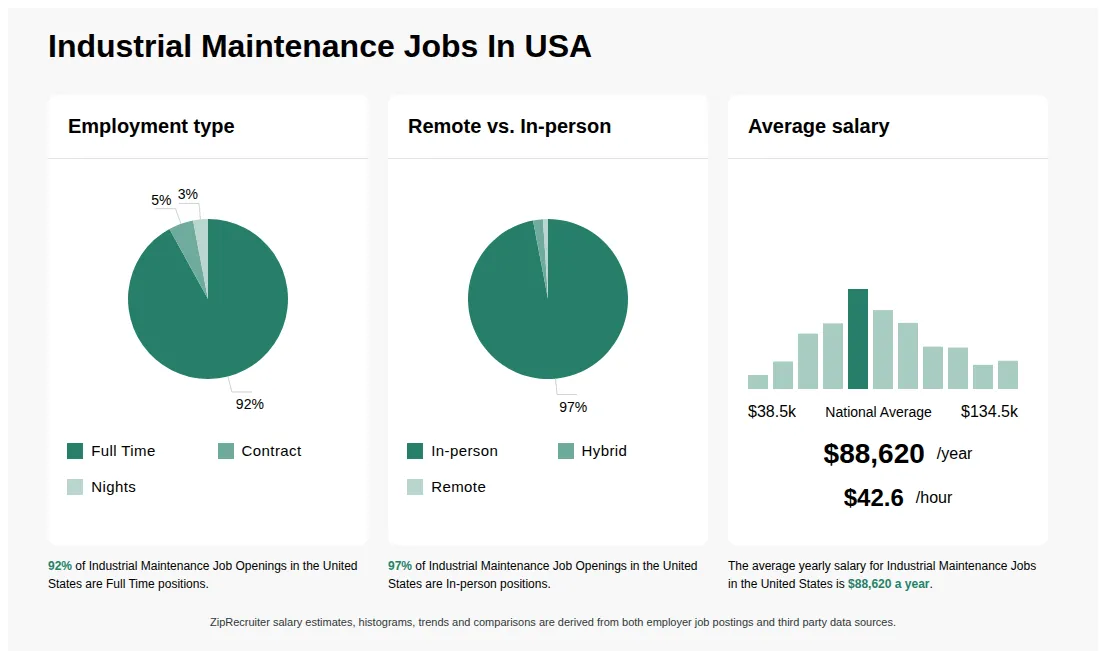
As of Jun 14, 2026, the average yearly pay for industrial maintenance in the United States is $88,620.00, according to ZipRecruiter salary data. Most workers in this role earn between $70,000.00 and $103,500.00 per year, depending on experience, location, and employer.

What is the highest paying maintenance job?

In industrial maintenance, specialized roles such as industrial maintenance managers or senior maintenance engineers tend to have the highest salaries, often exceeding $80,000 annually. These positions typically require advanced technical skills, certifications, and experience in equipment troubleshooting, automation, and safety protocols.

What Is Industrial Maintenance?

Industrial maintenance refers to the maintenance or service that is done by maintenance technicians or mechanics in manufacturing and production settings. Industrial machinery is used in a variety of manufacturing settings and often needs troubleshooting and adjustments to work properly. The industry calls for individuals who can install new equipment and give advice to the workers who use that equipment daily. Jobs in this sector include industrial maintenance technicians, industrial maintenance mechanics, installers, and machine salespeople. All of the jobs in this industry require general industry knowledge, and most require additional certifications beyond a high school diploma.

What are some common challenges faced by industrial maintenance technicians, and how can they overcome them?

Industrial maintenance technicians often encounter challenges such as troubleshooting complex machinery, minimizing downtime, and keeping up with advancing technology. To overcome these, technicians should continuously update their knowledge through training, develop strong problem-solving skills, and collaborate closely with production and engineering teams. Effective communication and a proactive approach to preventive maintenance are also key to resolving issues quickly and maintaining a smooth workflow.

What is industrial maintenance?

Industrial maintenance refers to the upkeep, repair, and optimization of machinery, equipment, and systems used in manufacturing or industrial facilities. Professionals in this field ensure that machines run efficiently, safely, and with minimal downtime by performing routine inspections, troubleshooting issues, and conducting preventive maintenance. Their work is essential for maximizing productivity, reducing costly breakdowns, and maintaining workplace safety. Industrial maintenance can involve mechanical, electrical, and electronic systems, and often requires specialized training and certifications.

Is it hard to get into industrial maintenance?

Getting into industrial maintenance can require technical skills, such as knowledge of electrical, mechanical, or hydraulic systems, and often involves completing relevant training or certifications. Entry can be competitive, but hands-on experience and a strong understanding of equipment operation improve job prospects.

What is industrial maintenance work?

Industrial maintenance work involves inspecting, repairing, and maintaining machinery and equipment in manufacturing or industrial settings to ensure smooth operations. It requires technical skills, knowledge of tools and systems, and often involves troubleshooting, preventive maintenance, and safety procedures.

What jobs pay 2000 a day?

In industrial maintenance, high-paying roles such as senior maintenance managers, specialized technicians, or contractors working on large-scale projects can earn around $2,000 per day, especially with extensive experience, certifications, and in industries like oil and gas or manufacturing. These positions often require advanced skills, certifications, and the ability to work in demanding environments or on complex systems.

What are the key skills and qualifications needed to thrive as an Industrial Maintenance Technician, and why are they important?

To thrive as an Industrial Maintenance Technician, you need strong mechanical aptitude, electrical troubleshooting skills, and typically a high school diploma or technical certification in industrial maintenance or a related field. Familiarity with programmable logic controllers (PLCs), computerized maintenance management systems (CMMS), and various hand and power tools is essential. Problem-solving ability, attention to detail, and effective communication are standout soft skills for this role. These skills ensure efficient equipment operation, minimize downtime, and promote workplace safety in industrial environments.

What is the difference between Industrial Maintenance vs Industrial Machinery Repair?

AspectIndustrial MaintenanceIndustrial Machinery Repair
CertificationsHVAC, electrical, mechanical certificationsMechanical, electrical, hydraulic certifications
Work EnvironmentFactories, plants, manufacturing facilitiesFactories, manufacturing plants, equipment-focused
Employer & Industry UsageManufacturing, production, industrial facilitiesIndustrial plants, machinery-focused companies
Common Search & ComparisonYesYes

Industrial Maintenance involves maintaining and repairing a wide range of equipment and systems in industrial settings, focusing on preventive and corrective tasks. Industrial Machinery Repair specifically targets fixing and maintaining machinery and mechanical systems. While both roles require similar certifications and work environments, Maintenance covers broader systems, whereas Machinery Repair emphasizes mechanical components.

What cities are hiring for Industrial Maintenance jobs? Cities with the most Industrial Maintenance job openings:
What are the most commonly searched types of Industrial Maintenance jobs? The most popular types of Industrial Maintenance jobs are:
What states have the most Industrial Maintenance jobs? States with the most job openings for Industrial Maintenance jobs include:
Infographic showing various Industrial Maintenance job openings in the United States as of June 2026, with employment types broken down into 50% Full Time, and 50% Contract. Highlights an 100% In-person job distribution, with an average salary of $88,620 per year, or $42.6 per hour.

INDUSTRIAL MAINTENANCE

John A Biewer Co Inc

Winona, MS • On-site

Full-time

Posted yesterday


Job description

Biewer Sawmill Winona is looking to add an Industrial Maintenance employee to our team! Apply now to join a fast paced environment offering competitive benefits and the ability to grow in the Lumber industry.
Industrial Maintenance Summary:

Service and repair machines and equipment throughout the facility for production efficiency.


Industrial Maintenance Essential Duties and Responsibilities:

Install, maintain, repair and modify production equipment, instrumentation in accordance with relevant codes and from blueprints, schematics and sketches. Study manufacturer manuals and directions when setting up machinery.

Clean, lubricate, perform routine maintenance and disposal of defective parts on machinery.

Locate sources of issues by observing machinery in operation.

Test equipment repairs.

Calibrate and align equipment.

Troubleshoot production equipment (motors, gear boxes, drives, sprockets, chains, belts, etc.) using mechanical aptitude.

Maintain inventory of equipment, parts, and supplies by checking stock and placing orders.

Train production employees on routine preventive maintenance by workstation.

Determine changes in requirements of parts by inspecting and measuring using various instruments.

Prepare maintenance reports by collecting data and summarizing information and trends.

Demonstrate rigging and lifting practices.

Observe all safety rules, policies, and precautions. Reports and corrects unsafe work conditions. Submit safety ideas to Safety Committee Members. Complete required safety and regulatory training.

Communicate with electrical team and management of any equipment that is not operating properly.

Safely operate shop tools (lathe, drill press, grinder) and equipment.


Update scheduling systems, including adding notes to system and requesting work orders for maintenance repairs and activities and preventive maintenance.


Provide ideas, innovation and suggestions for continuous improvement and opportunities.


Follow established departmental housekeeping, safety practices and standard operation procedures.


Industrial Maintenance Basic Qualifications:

Previous lumber industry experience or industrial maintenance experience.


Language skills to read and interpret documents such as safety rules, operating and maintenance instructions, and procedure manuals. Ability to write routine reports and correspondence.


Basic knowledge of hydraulic, pneumatic, torching, arc welding and electrical principles.


Ability to safely operate forklift, scissor lift, and manual lift.


Follow verbal and written instructions.


Mathematic skills with the ability to calculate figures and amounts using addition, subtraction, multiplication, division.


Reasoning ability to apply common sense understanding to carry out instructions furnished in written, verbal, or diagram form. Ability to deal with problems involving several concrete variables in standardized situations.


Good eye/hand coordination and reflexes.


Industrial Maintenance Education, Experience, and Certifications:

High school diploma or equivalent.

General lumber knowledge such as board sizing and quality terminology/requirements.

Previous experience operating similar equipment preferred.


Industrial Maintenance Work Environment:

Industrial setting that includes but is not limited to frequent exposure to airborne particles, moving mechanical parts and vibration. The employee is occasionally exposed to a variety of extreme conditions at manufacturing job sites. The noise level in the work environment and job sites can be loud.


Able to work at high elevations.


This safety-sensitive position requires employees to comply with all OSHA regulations, company safety policies, and required drug and alcohol testing procedures.


Industrial Maintenance Physical Demands:

Climb and descend a flight of stairs several times per day


Walk, stand, or kneel for up to 12 hours


Bend and lift up to 50 lbs.