1

Histology Lab Jobs (NOW HIRING)

Histology: Bachelor's degree or a master's degree in a chemical, physical, biological or clinical laboratory science or medical technology with at least one year of training and/or experience in high ...

As the Histotechnologist Supervisor you will oversee the activities of the lab and Signatera team ... Supervise the day-to-day operations of the Histology department * Ensure laboratory tests are ...

As the Histotechnologist Supervisor you will oversee the activities of the lab and Signatera team ... Supervise the day-to-day operations of the Histology department * Ensure laboratory tests are ...

As the Histotechnologist Supervisor you will oversee the activities of the lab and Signatera team ... Supervise the day-to-day operations of the Histology department * Ensure laboratory tests are ...

Responsible for the day-to-day operations of the histology department in the absence of the histology supervisor. Maintains complete and accurate documentation of data generated and work performed ...

Responsible for the day-to-day operations of the histology department in the absence of the histology supervisor. Maintains complete and accurate documentation of data generated and work performed ...

Showing results 41-60

Histology Lab information

See salary details

$16

$35

$62

How much do histology lab jobs pay per hour?

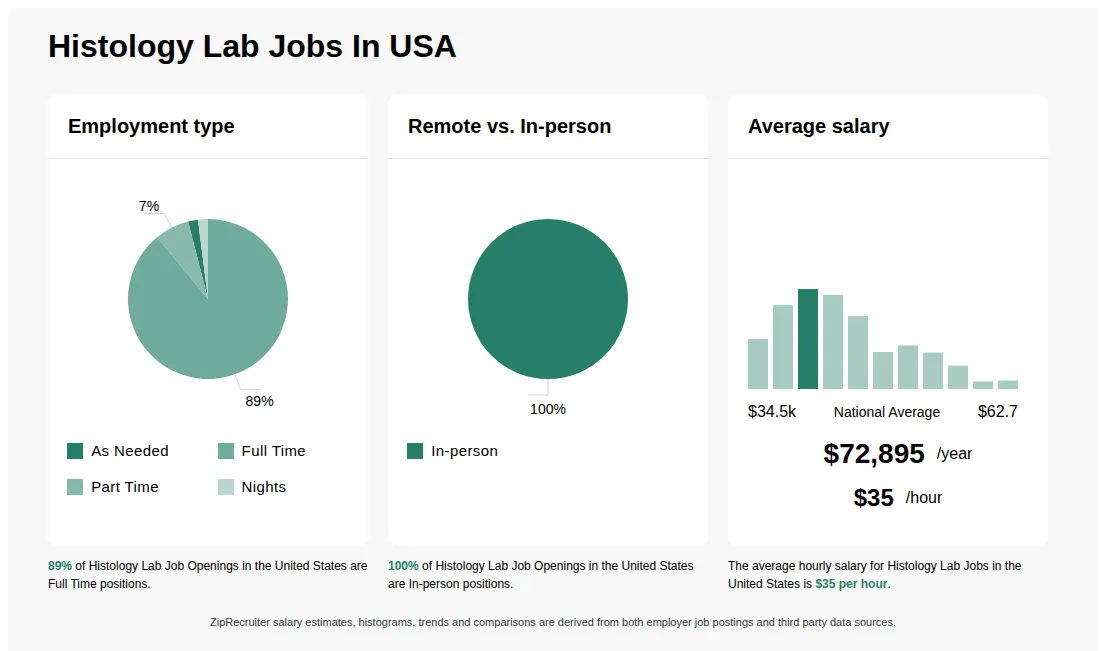
As of Sep 14, 2026, the average hourly pay for histology lab in the United States is $35.05, according to ZipRecruiter salary data. Most workers in this role earn between $25.48 and $41.59 per hour, depending on experience, location, and employer.

What is a histology lab?

A histology lab is a specialized laboratory where tissue samples from plants, animals, or humans are processed, sectioned, stained, and examined under a microscope. The main goal is to study the microscopic structure of tissues to help diagnose diseases, guide treatment, or conduct research. Histology labs play a crucial role in medical diagnostics, especially in pathology, by allowing doctors to observe abnormalities in tissue samples. Technicians in these labs use a variety of specialized equipment and stains to prepare slides for examination. These labs are often found in hospitals, research centers, and universities.

What are typical daily responsibilities for a professional working in a histology lab?

A professional in a histology lab is responsible for preparing and processing tissue samples for microscopic examination, which includes tasks such as embedding, sectioning, staining, and labeling specimens. Daily duties often involve maintaining laboratory equipment, adhering to strict safety and quality control protocols, and accurately documenting sample information. Collaboration with pathologists and other laboratory staff is essential to ensure timely and accurate diagnostic results. The work environment is detail-oriented and requires strong organizational skills to manage multiple tasks efficiently.

What are the key skills and qualifications needed to thrive as a histology lab technician, and why are they important?

To thrive as a Histology Lab Technician, you need a solid understanding of biology, laboratory procedures, and tissue processing, usually supported by an associate's degree in laboratory science or histotechnology certification. Familiarity with laboratory information systems (LIS), microtomes, staining equipment, and relevant safety protocols is essential. Attention to detail, manual dexterity, and strong organizational skills help ensure accuracy and efficiency in sample preparation. These competencies are crucial for producing reliable diagnostic results that support effective patient care.

What is the difference between Histology Lab vs Histotechnologist?

AspectHistology LabHistotechnologist
CredentialsTypically requires a certification or associate degree in histotechnology or related fieldRequires certification (HT or HTL) and an associate or bachelor's degree in histotechnology
Work EnvironmentLaboratory setting, processing tissue samples for diagnosisSame as histology lab, focusing on preparing tissue slides for pathologists
Industry UsageUsed broadly in hospitals, research labs, and diagnostic labsCommonly used term for professionals working in histology labs

Histology Lab refers to the overall laboratory environment where tissue processing occurs, while Histotechnologist is a specific role within that environment responsible for preparing tissue slides. Both are closely related, with the histotechnologist being a key professional working in the histology lab setting.

More about Histology Lab jobs

What cities are hiring for Histology Lab jobs?

Cities with the most Histology Lab job openings:

What are the most commonly searched types of Histology Lab jobs?

The most popular types of Histology Lab jobs are:

What states have the most Histology Lab jobs?

States with the most job openings for Histology Lab jobs include:

What are popular job titles related to Histology Lab jobs?

For Histology Lab jobs, the most frequently searched job titles are:

Infographic showing various Histology Lab job openings in the United States as of September 2026, with employment types broken down into 1% Internship, 2% As Needed, 70% Full Time, 13% Part Time, 13% Contract, and 1% Nights. Highlights an 95% Physical, 1% Hybrid, and 4% Remote job distribution, with an average salary of $72,895 per year, or $35 per hour.

Histology Lab Grossing Technician

Beaverton, OR • On-site

$24 - $28/hr

Full-time

Posted 5 days ago


Job description

Description:

A Grosser (or Grossing Lab Technician) is a specialized laboratory professional who prepares and examines human tissue and biopsy specimens before microscopic evaluation. They assist pathologists by measuring, describing, and dissecting tissue samples, ensuring correct cassette placement for accurate disease diagnosis (like cancer).

Requirements:

Key Responsibilities

  • Specimen Receipt & Assessment: Verify patient information, log specimens, and ensure integrity upon arrival.
  • Gross Description: Dictate or enter detailed descriptions of macroscopic features, including anatomic site, dimensions, color, weight, and abnormalities.
  • Tissue Dissection: Cut and dissect tissue, carefully placing specific samples into correctly labeled cassettes for histologic processing.
  • Escalation: Identify and escalate non-routine or complex specimens to a Lab Manager or Pathologist.
  • Equipment Maintenance: Clean, sterilize, and perform routine maintenance on laboratory equipment and work areas.
  • Quality Assurance: Strictly follow CLIA, HIPAA, and OSHA regulations regarding hazardous waste disposal and specimen handling.

Qualifications & Requirements

  • Education: Typically requires an Associate’s or Bachelor's degree in Biology, Clinical Laboratory Science, or a related biological science.
  • Knowledge Base: Must have a strong understanding of medical terminology, anatomy, and standard histology/pathology laboratory protocols.
  • Skills: Excellent hand-eye coordination, fine motor skills, meticulous attention to detail, and a flawless ability to pass standardized color blindness tests.