... high functioning autism. KTS has an opening for the 2026/2027 school year in a STRIDE middle school classroom. STRIDE is an 11-month School program for students who exhibit significant challenges ...
... high functioning autism. KTS has an opening for the 2026/2027 school year in a STRIDE middle school classroom. STRIDE is an 11-month School program for students who exhibit significant challenges ...
The Katherine Thomas School is a private special education school that services students with language, learning, sensory motor disabilities and moderate to high functioning autism. This is a ...
Quick apply
The Katherine Thomas School is a private special education school that services students with language, learning, sensory motor disabilities and moderate to high functioning autism. This is a ...
The Katherine Thomas School is a private special education school that services students with language, learning, sensory motor disabilities and moderate to high functioning autism. This is a ...
The Katherine Thomas School is a private special education school that services students with language, learning, sensory motor disabilities and moderate to high functioning autism. This is a ...
Special Education Teacher - Middle School (SY 2026/2027)
Rockville, MD · On-site
$62K - $85K/yr
... high functioning autism. KTS has an opening for the 2026/2027 school year in a STRIDE middle school classroom. STRIDE is an 11-month School program for students who exhibit significant challenges ...
Special Education Teacher - Middle School (SY 2026/2027)
Rockville, MD · On-site
$62K - $85K/yr
... high functioning autism. KTS has an opening for the 2026/2027 school year in a STRIDE middle school classroom. STRIDE is an 11-month School program for students who exhibit significant challenges ...
... high functioning autism. KTS has an opening for the 2026/2027 school year in a STRIDE middle school classroom. STRIDE is an 11-month School program for students who exhibit significant challenges ...
Quick apply
... high functioning autism. KTS has an opening for the 2026/2027 school year in a STRIDE middle school classroom. STRIDE is an 11-month School program for students who exhibit significant challenges ...
The Katherine Thomas School is a special education school that serves students with language, learning, and sensory motor disabilities and moderate to high functioning autism. KTS has openings for ...
Quick apply
The Katherine Thomas School is a special education school that serves students with language, learning, and sensory motor disabilities and moderate to high functioning autism. KTS has openings for ...
The Katherine Thomas School is a special education school that serves students with language, learning, and sensory motor disabilities and moderate to high functioning autism. KTS has openings for ...
The Katherine Thomas School is a special education school that serves students with language, learning, and sensory motor disabilities and moderate to high functioning autism. KTS has openings for ...

Special Education Teacher
Richmond, MA · On-site
$50K - $75K/yr
... of high-functioning Autism. We are committed to serving the whole child, including the child's family. Our goal is to assist students in developing the skills necessary to successfully return to a ...
Quick apply
Special Education Teacher
Richmond, MA · On-site
$50K - $75K/yr
... of high-functioning Autism. We are committed to serving the whole child, including the child's family. Our goal is to assist students in developing the skills necessary to successfully return to a ...
Special Education Teacher
Springfield, MA · On-site
$50K - $75K/yr
... of high-functioning Autism. We are committed to serving the whole child, including the child's family. Our goal is to assist students in developing the skills necessary to successfully return to a ...
Quick apply
Special Education Teacher
Springfield, MA · On-site
$50K - $75K/yr
... of high-functioning Autism. We are committed to serving the whole child, including the child's family. Our goal is to assist students in developing the skills necessary to successfully return to a ...
Requires knowledge of the characteristics of Asperger Syndrome and high functioning autism and be familiarity with Applied Behavioral Analysis utilizing, discrete trial, pivotal response, functional ...
Requires knowledge of the characteristics of Asperger Syndrome and high functioning autism and be familiarity with Applied Behavioral Analysis utilizing, discrete trial, pivotal response, functional ...
$45K - $60K/yr
Requires knowledge of the characteristics of Asperger Syndrome and high functioning autism and be familiarity with Applied Behavioral Analysis utilizing, discrete trial, pivotal response, functional ...
$45K - $60K/yr
Requires knowledge of the characteristics of Asperger Syndrome and high functioning autism and be familiarity with Applied Behavioral Analysis utilizing, discrete trial, pivotal response, functional ...
Instructional Assistant
Richmond, MA · On-site
$20 - $22/hr
... of high-functioning Autism. We are committed to serving the whole child, including the child's family. Our goal is to assist students in developing the skills necessary to successfully return to a ...
Quick apply
Instructional Assistant
Richmond, MA · On-site
$20 - $22/hr
... of high-functioning Autism. We are committed to serving the whole child, including the child's family. Our goal is to assist students in developing the skills necessary to successfully return to a ...
$45K - $59K/yr
Requires knowledge of the characteristics of Asperger Syndrome and high functioning autism and be familiarity with Applied Behavioral Analysis utilizing, discrete trial, pivotal response, functional ...
$45K - $59K/yr
Requires knowledge of the characteristics of Asperger Syndrome and high functioning autism and be familiarity with Applied Behavioral Analysis utilizing, discrete trial, pivotal response, functional ...
Requires knowledge of the characteristics of Asperger Syndrome and high functioning autism and be familiarity with Applied Behavioral Analysis utilizing, discrete trial, pivotal response, functional ...
Requires knowledge of the characteristics of Asperger Syndrome and high functioning autism and be familiarity with Applied Behavioral Analysis utilizing, discrete trial, pivotal response, functional ...
$50K - $66K/yr
Requires knowledge of the characteristics of Asperger Syndrome and high functioning autism and be familiarity with Applied Behavioral Analysis utilizing, discrete trial, pivotal response, functional ...
$50K - $66K/yr
Requires knowledge of the characteristics of Asperger Syndrome and high functioning autism and be familiarity with Applied Behavioral Analysis utilizing, discrete trial, pivotal response, functional ...
Founding 8th Grade ELA Teacher
Bronx, NY · On-site
Our students, who include high functioning children with autism spectrum disorders, will become independent learners and critical thinkers, will acquire the academic skills that they need to succeed ...
Quick apply
Founding 8th Grade ELA Teacher
Bronx, NY · On-site
Our students, who include high functioning children with autism spectrum disorders, will become independent learners and critical thinkers, will acquire the academic skills that they need to succeed ...
Middle and High Social Studies Teacher
Wickatunk, NJ · On-site
$50K - $60K/yr
Must have experience working with students with a diagnosis of high-functioning autism * Strong background in positive behavior modification and classroom management strategies * Excellent written ...
Quick apply
Middle and High Social Studies Teacher
Wickatunk, NJ · On-site
$50K - $60K/yr
Must have experience working with students with a diagnosis of high-functioning autism * Strong background in positive behavior modification and classroom management strategies * Excellent written ...
Founding 8th Grade History Teacher
Bronx, NY · On-site
$73K - $95K/yr
Our students, who include high functioning children with autism spectrum disorders, will become independent learners and critical thinkers, will acquire the academic skills that they need to succeed ...
Founding 8th Grade History Teacher
Bronx, NY · On-site
$73K - $95K/yr
Our students, who include high functioning children with autism spectrum disorders, will become independent learners and critical thinkers, will acquire the academic skills that they need to succeed ...

Our son has high functioning autism. Thank you. We look forward to hearing from you. Applyto NannyPod and work based on your availability! We have thousandsof families across the USA who book a ...
Our son has high functioning autism. Thank you. We look forward to hearing from you. Applyto NannyPod and work based on your availability! We have thousandsof families across the USA who book a ...
Founding 8th Grade Math Teacher
Bronx, NY · On-site
$73K - $95K/yr
Our students, who include high functioning children with autism spectrum disorders, will become independent learners and critical thinkers, will acquire the academic skills that they need to succeed ...
Founding 8th Grade Math Teacher
Bronx, NY · On-site
$73K - $95K/yr
Our students, who include high functioning children with autism spectrum disorders, will become independent learners and critical thinkers, will acquire the academic skills that they need to succeed ...
High Functioning Autism Adults information
See salary details
$9.62 - $10.77
3% of jobs
$10.77 - $11.93
2% of jobs
$11.93 - $13.09
3% of jobs
$13.09 - $14.25
5% of jobs
$15.01 is the 25th percentile. Wages below this are outliers.
$14.25 - $15.41
17% of jobs
The median wage is $16.35 / hr.
$15.41 - $16.56
23% of jobs
$16.56 - $17.72
18% of jobs
$17.90 is the 75th percentile. Wages above this are outliers.
$17.72 - $18.88
17% of jobs
$18.88 - $20.04
7% of jobs
$20.04 - $21.20
2% of jobs
$21.20 - $22.36
1% of jobs
$9
$16
$22
How much do high functioning autism adults jobs pay per hour?
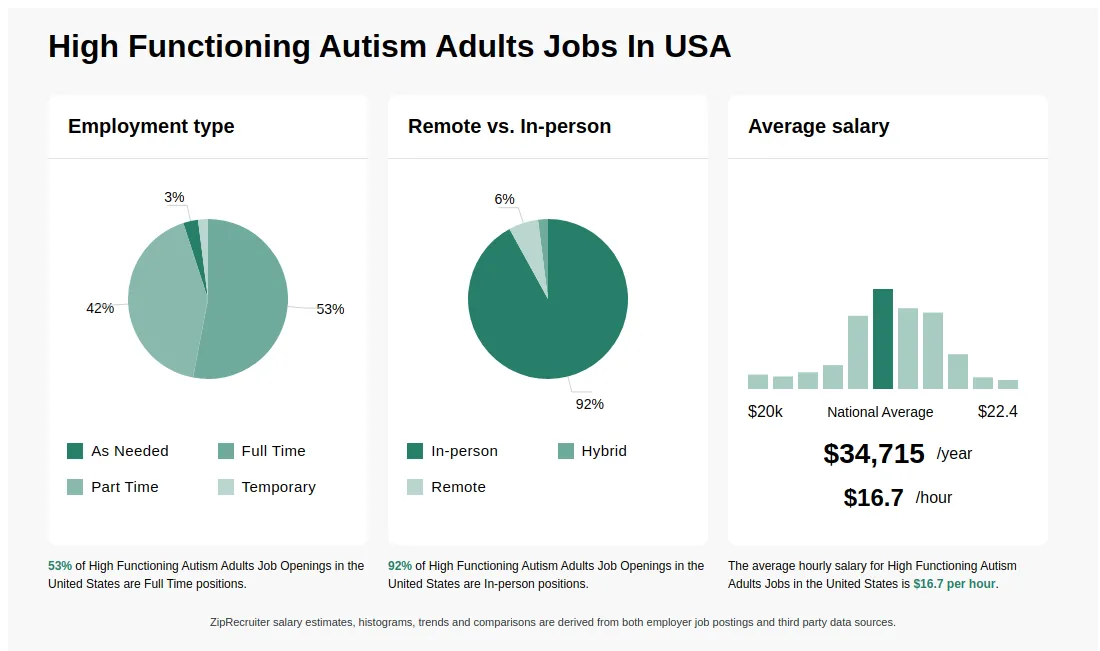
As of Jun 13, 2026, the average hourly pay for high functioning autism adults in the United States is $16.69, according to ZipRecruiter salary data. Most workers in this role earn between $15.14 and $18.27 per hour, depending on experience, location, and employer.
What are the key skills and qualifications needed to thrive as an Autism Support Specialist for high-functioning adults, and why are they important?
To excel as an Autism Support Specialist for high-functioning adults, a background in psychology, social work, or special education—often with a relevant degree or certification—is essential. Familiarity with behavior intervention plans, assistive communication technologies, and case management systems is typically required. Patience, strong interpersonal skills, and cultural competence help build trust and support effective advocacy. These skills enable specialists to empower adults with autism to achieve greater independence and improve their quality of life.
What are good jobs for high-functioning autistic adults?
High-functioning autistic adults often excel in jobs that require attention to detail, routine, and minimal social interaction, such as data entry, computer programming, technical support, library work, or quality assurance. These roles typically involve structured environments, clear expectations, and the use of specific skills or tools, which can help reduce sensory overload and social stress.
What jobs are best for adults with high-functioning autism?
Adults with high-functioning autism often thrive in jobs that align with their strengths, such as attention to detail, deep focus, and structured environments. Careers in technology, engineering, data analysis, graphic design, and skilled trades can be a great fit. Many also excel in roles that involve routine tasks, logical problem-solving, or working independently. It's important to find a job that matches individual strengths while accommodating any sensory or social challenges. Supportive employers and workplace accommodations can enhance success and job satisfaction.
What unique challenges might adults with high-functioning autism face in the workplace, and how can employers support them?
Adults with high-functioning autism may encounter challenges such as sensory sensitivities, difficulty with social cues, or adapting to changes in routine. Employers can support these individuals by providing clear communication, structured tasks, and flexible work environments. Encouraging open dialogue and offering reasonable accommodations—like noise-cancelling headphones or written instructions—can help foster a productive and inclusive atmosphere. Collaboration with HR and regular check-ins can also ensure ongoing support and career development.
What is the difference between High Functioning Autism Adults vs Data Entry Clerks?
| Aspect | High Functioning Autism Adults | Data Entry Clerks |
|---|---|---|
| Required Skills | Attention to detail, routine, strong focus | Typing speed, accuracy, computer skills |
| Work Environment | Varies; often structured, may require accommodations | Office setting, repetitive tasks |
| Certifications | Not typically required, but may have special education or therapy certifications | None usually required, but familiarity with software is essential |
High Functioning Autism Adults often excel in structured environments with routine, focusing on specific tasks, while Data Entry Clerks perform repetitive data input tasks requiring accuracy and speed. Understanding these differences helps in providing appropriate job support and accommodations for individuals with high functioning autism in roles suited to their strengths.
Is high-functioning autism a disability?
High-functioning autism is considered a developmental condition that can impact social communication and behavior, but many individuals with it are able to work successfully in various roles. Whether it is classified as a disability depends on the severity of symptoms and the context, and accommodations may be available under disability laws to support job performance.
What is the 6 second rule for autism?
The 6 second rule for autism refers to a communication strategy where individuals are encouraged to pause for six seconds before responding, allowing time for processing and reducing impulsive reactions. This technique can help adults with high functioning autism improve social interactions and emotional regulation in the workplace.
What to say instead of high-functioning autism?
High-functioning autism is often referred to as autism spectrum disorder (ASD) without intellectual disability or as Asperger's syndrome, though the latter is now considered part of ASD in diagnostic manuals. Using terms like ASD or autism spectrum can be more accurate and respectful, emphasizing individual strengths and challenges without implying a hierarchy of functioning levels.
What are high functioning autism adults?
High functioning autism adults are individuals on the autism spectrum who exhibit average or above-average intelligence and can perform daily activities with minimal support. They may have challenges with social communication, sensory sensitivities, and certain behaviors, but are often able to live independently, work, and maintain relationships. The term 'high functioning' is informal and sometimes controversial, as it may not fully capture the unique challenges these individuals face. Many prefer to use more specific language, such as 'autistic adults without intellectual disability.'
More about High Functioning Autism Adults jobs
What cities are hiring for High Functioning Autism Adults jobs? Cities with the most High Functioning Autism Adults job openings:
What states have the most High Functioning Autism Adults jobs? States with the most job openings for High Functioning Autism Adults jobs include:
What job categories do people searching High Functioning Autism Adults jobs look for? The top searched job categories for High Functioning Autism Adults jobs are:

Special Education Teacher - Middle School (SY 2026/2027)
TLC - The Treatment and Learning Centers, Inc.Rockville, MD
$62K - $85K/yr
Full-time
Posted 13 days ago
Job description
The Katherine Thomas School, located in Rockville, MD, is a special education school that serves students with language, learning, and sensory motor disabilities and moderate to high functioning autism. KTS has an opening for the 2026/2027 school year in a STRIDE middle school classroom. STRIDE is an 11-month School program for students who exhibit significant challenges with engagement, attention, regulation, group process and social interactions that require more intensive support to succeed academically and socially. Small classes with team support. Working Hours: 8:30-4:15. EOE
Annual salary range of $62,000 to $85,000, depending on experience and level of education
Join a great team of professionals in a supportive work environment!
NO SPONSORSHIP AVAILABLE. Must be able to obtain Maryland Special Education Teaching Certification and legally allowed to work in the U.S.
Responsibilities of the STRIDE Teacher include:
- Develop instruction following the MD State Curriculum providing necessary accommodation to meet individual, group, and program needs
- Be an expert at modifying grade level curriculum for all students
- Write and implement IEPs
- Create a supportive learning environment
- Create partnerships with parents and the KTS school community
- Supervise TAs
- Work collaboratively with team members
- Utilize technology and/or AAC devices to assist students in accessing curriculum and communication

About TLC The Treatment and Learning Centers
Sourced by ZipRecruiter
Industry
Individual, family and community social assistance
Company size
51 - 200 Employees
Headquarters location
Rockville, MD, US
Year founded
1950