Overview Verity is building the next generation of highperformance missile systems, and we're looking for a Lead Missile Flight Software Engineer who wants to own real hardware, make technical ...
Overview Verity is building the next generation of highperformance missile systems, and we're looking for a Lead Missile Flight Software Engineer who wants to own real hardware, make technical ...

Flight Guidance Engineer
Mountain View, CA · On-site
$185K - $245K/yr
As a Flight Guidance Engineer at Reliable Robotics, you will be a part of the Guidance, Navigation, and Control team. You will contribute to the design, implementation, and testing of the guidance ...
Flight Guidance Engineer
Mountain View, CA · On-site
$185K - $245K/yr
As a Flight Guidance Engineer at Reliable Robotics, you will be a part of the Guidance, Navigation, and Control team. You will contribute to the design, implementation, and testing of the guidance ...

Flight Sciences Engineer
Costa Mesa, CA · On-site
$166K - $220K/yr
PhD in Aerospace Engineering, Mechanical Engineering, or related field * Experience with flight control design and analysis for fixed and rotary wing aircraft or missile systems * C/C++ Expertise
Flight Sciences Engineer
Costa Mesa, CA · On-site
$166K - $220K/yr
PhD in Aerospace Engineering, Mechanical Engineering, or related field * Experience with flight control design and analysis for fixed and rotary wing aircraft or missile systems * C/C++ Expertise
Flight Sciences Engineer
Costa Mesa, CA · On-site
$166K - $220K/yr
PhD in Aerospace Engineering, Mechanical Engineering, or related field * Experience with flight control design and analysis for fixed and rotary wing aircraft or missile systems * C/C++ Expertise
Flight Sciences Engineer
Costa Mesa, CA · On-site
$166K - $220K/yr
PhD in Aerospace Engineering, Mechanical Engineering, or related field * Experience with flight control design and analysis for fixed and rotary wing aircraft or missile systems * C/C++ Expertise

Flight Engineering Manager
$153K - $207K/yr
Flight Engineering Manager Company: The Boeing Company Boeing Commercial Airplanes (BCA)is seeking a Flight Engineering Manager (Level K) to lead the Noise, Vibration & Emissions organization within ...
Flight Engineering Manager
$153K - $207K/yr
Flight Engineering Manager Company: The Boeing Company Boeing Commercial Airplanes (BCA)is seeking a Flight Engineering Manager (Level K) to lead the Noise, Vibration & Emissions organization within ...

Flight Sciences Engineer
Mojave, CA · Hybrid
As a Flight Science Engineer, you will contribute to a small hypersonic advanced design team, designing current and future Stratolaunch hypersonic vehicles. Your tasking may include conceptual design ...
Flight Sciences Engineer
Mojave, CA · Hybrid
As a Flight Science Engineer, you will contribute to a small hypersonic advanced design team, designing current and future Stratolaunch hypersonic vehicles. Your tasking may include conceptual design ...
Flight Sciences Engineer
Mojave, CA · On-site
As a Flight Science Engineer, you will contribute to a small hypersonic advanced design team, designing current and future Stratolaunch hypersonic vehicles. Your tasking may include conceptual design ...
Flight Sciences Engineer
Mojave, CA · On-site
As a Flight Science Engineer, you will contribute to a small hypersonic advanced design team, designing current and future Stratolaunch hypersonic vehicles. Your tasking may include conceptual design ...
Spacecraft Flight Computing EngineerThe Opportunity We are supporting a well-funded space company ... You would work directly with the engineer who architected the fault-tolerant computing and ...
Quick apply
Spacecraft Flight Computing EngineerThe Opportunity We are supporting a well-funded space company ... You would work directly with the engineer who architected the fault-tolerant computing and ...
Flight Guidance Engineer
Mountain View, CA · On-site
$185K - $245K/yr
As a Flight Guidance Engineer at Reliable Robotics, you will be a part of the Guidance, Navigation, and Control team. You will contribute to the design, implementation, and testing of the guidance ...
Flight Guidance Engineer
Mountain View, CA · On-site
$185K - $245K/yr
As a Flight Guidance Engineer at Reliable Robotics, you will be a part of the Guidance, Navigation, and Control team. You will contribute to the design, implementation, and testing of the guidance ...

The Flight Assurance Engineer will independently execute mechanisms-specific flight assurance processes and practices to ensure product reliability, compliance, and quality throughout the lifecycle ...
The Flight Assurance Engineer will independently execute mechanisms-specific flight assurance processes and practices to ensure product reliability, compliance, and quality throughout the lifecycle ...
C-130 L-382 Instructor Flight Engineer with Security Clearance
Tampa, FL · On-site
$59K - $67K/yr
Minimum of 2000 hours of flight time as a C-130/L-382 Flight Engineer * Previous experience in curriculum development. * Ability to hold creditability and the attention of the customer attendees.
C-130 L-382 Instructor Flight Engineer with Security Clearance
Tampa, FL · On-site
$59K - $67K/yr
Minimum of 2000 hours of flight time as a C-130/L-382 Flight Engineer * Previous experience in curriculum development. * Ability to hold creditability and the attention of the customer attendees.

The Flight Sciences Engineer supports the design, analysis, and validation of advanced aerospace and defense systems through specialized engineering analyses across multiple flight sciences ...
The Flight Sciences Engineer supports the design, analysis, and validation of advanced aerospace and defense systems through specialized engineering analyses across multiple flight sciences ...
The Flight Sciences Engineer supports the design, analysis, and validation of advanced aerospace and defense systems through specialized engineering analyses across multiple flight sciences ...
Quick apply
The Flight Sciences Engineer supports the design, analysis, and validation of advanced aerospace and defense systems through specialized engineering analyses across multiple flight sciences ...
The Flight Sciences Engineer supports the design, analysis, and validation of advanced aerospace and defense systems through specialized engineering analyses across multiple flight sciences ...
The Flight Sciences Engineer supports the design, analysis, and validation of advanced aerospace and defense systems through specialized engineering analyses across multiple flight sciences ...

Overview Joby Aviation's Flight Research team is looking for a Software Project Engineer to help drive technical execution across our software and autonomy development portfolio. You will work across ...
Overview Joby Aviation's Flight Research team is looking for a Software Project Engineer to help drive technical execution across our software and autonomy development portfolio. You will work across ...
Entry Level Flight Deck Crew Operations Engineer Company: The Boeing Company Job ID: 00000299268 Date Posted: 2022-03-08-08:00 Location: USA - Everett, WA Qualifications: In Flight Deck, we define ...
Entry Level Flight Deck Crew Operations Engineer Company: The Boeing Company Job ID: 00000299268 Date Posted: 2022-03-08-08:00 Location: USA - Everett, WA Qualifications: In Flight Deck, we define ...
Entry Level Flight Deck Crew Operations Engineer Company: The Boeing Company Job ID: 00000299268 Date Posted: 2022-03-08-08:00 Location: USA - Everett, WA Qualifications: In Flight Deck, we define ...
Entry Level Flight Deck Crew Operations Engineer Company: The Boeing Company Job ID: 00000299268 Date Posted: 2022-03-08-08:00 Location: USA - Everett, WA Qualifications: In Flight Deck, we define ...

FLIGHT SCIENCES ENGINEER
Huntsville, AL · On-site
Ignite is currently seeking a driven, detail-oriented Flight Sciences engineer to join our team supporting the NGI Program in Huntsville, AL.Responsibilities include, but are not limited to: Lead ...
FLIGHT SCIENCES ENGINEER
Huntsville, AL · On-site
Ignite is currently seeking a driven, detail-oriented Flight Sciences engineer to join our team supporting the NGI Program in Huntsville, AL.Responsibilities include, but are not limited to: Lead ...
Manage employees performing engineering and technical activities in the areas of Flight Engineering ... Mentoring or technical lead engineer experience. Drug Free Workplace: Boeing is a Drug Free ...
Manage employees performing engineering and technical activities in the areas of Flight Engineering ... Mentoring or technical lead engineer experience. Drug Free Workplace: Boeing is a Drug Free ...

About the Role Muon seeks a Flight Dynamics Software Engineer to join our Mission Planning Platform team. This role focuses on orbit determination and flight dynamics software development for Muon ...
About the Role Muon seeks a Flight Dynamics Software Engineer to join our Mission Planning Platform team. This role focuses on orbit determination and flight dynamics software development for Muon ...
Flight Engineer information
See salary details
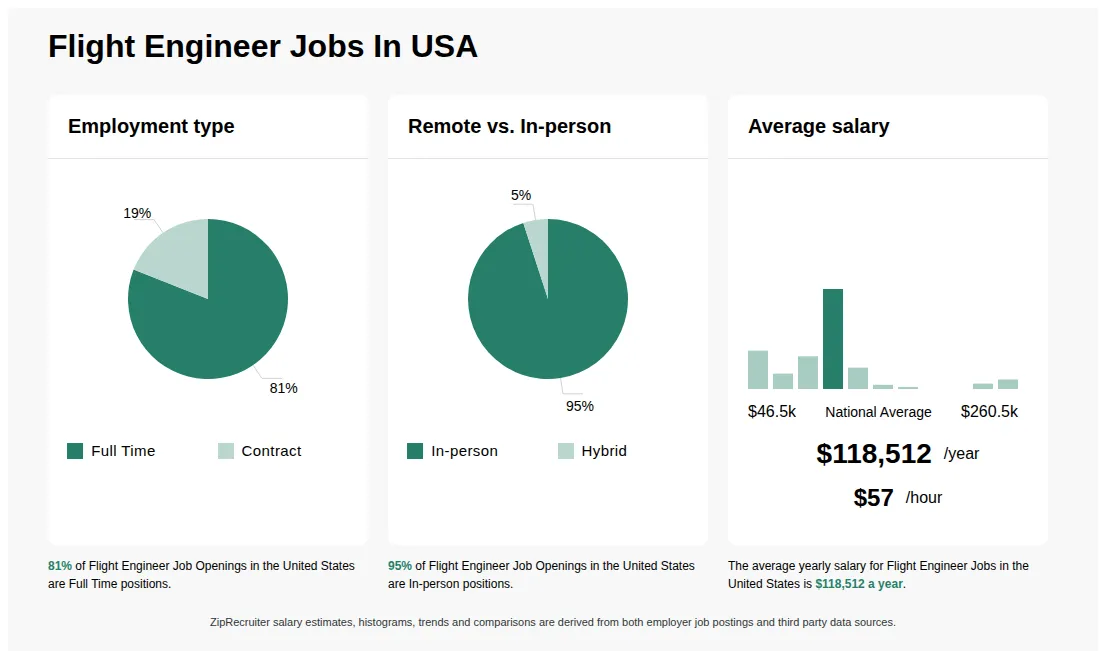
$46.5K - $66K
17% of jobs
$66K - $85.4K
6% of jobs
$87.8K is the 25th percentile. Wages below this are outliers.
$85.4K - $104.9K
15% of jobs
The median wage is $110.1K / yr.
$104.9K - $124.3K
45% of jobs
$124.3K - $143.8K
9% of jobs
$143.8K - $163.2K
1% of jobs
$163.2K - $182.7K
0% of jobs
$182.7K - $202.1K
0% of jobs
$202.1K - $221.6K
0% of jobs
$221.6K - $241K
2% of jobs
$241K - $260.5K
4% of jobs
$46.5K
$118.5K
$260.5K
How much do flight engineer jobs pay per year?
As of Jul 8, 2026, the average yearly pay for flight engineer in the United States is $118,512.00, according to ZipRecruiter salary data. Most workers in this role earn between $95,000.00 and $115,000.00 per year, depending on experience, location, and employer.
What are the key skills and qualifications needed to thrive as a Flight Engineer, and why are they important?
To thrive as a Flight Engineer, you need a solid background in mechanical and aeronautical engineering principles, typically supported by an associate's or bachelor's degree and relevant licensure or certification. Familiarity with aircraft systems, diagnostic tools, and flight management computers is essential for managing in-flight operations and troubleshooting issues. Strong attention to detail, communication, and problem-solving skills help Flight Engineers work effectively with pilots and maintenance crews. These skills are crucial for ensuring safe, efficient aircraft operation and prompt resolution of technical challenges during flights.
How much money do flight engineers make?
Flight engineers typically earn a median annual salary of around $80,000 to $130,000, depending on experience, airline, and location. They often work long hours and require certifications such as an FAA Airframe and Powerplant license or equivalent. Salaries can increase with seniority and specialized skills in aircraft systems and maintenance.
Is flight engineer still a job?
Yes, the flight engineer role still exists, primarily in certain types of aircraft such as military planes and some cargo or specialized aircraft. However, the position has become less common in commercial aviation due to automation and modern aircraft systems, with many responsibilities now handled by pilots and onboard technology. Certification and technical skills remain important for those pursuing this career.
How does a Flight Engineer collaborate with pilots and maintenance crews during a typical flight operation?
A Flight Engineer works closely with pilots in the cockpit to monitor and manage all aircraft systems, such as engines, fuel, and hydraulics, ensuring optimal performance and safety throughout the flight. They regularly communicate with maintenance crews before and after flights to discuss technical issues, prepare aircraft for departures, and log any discrepancies for follow-up repairs. This collaborative environment requires strong teamwork, technical expertise, and clear communication to ensure safe and efficient flight operations.
What do flight engineers do?
Flight engineers are responsible for monitoring and operating aircraft systems during flight, including engines, hydraulics, and electrical systems. They assist pilots with technical issues, perform pre-flight checks, and ensure safety protocols are followed, often working in the cockpit or engineering station. Certification and technical knowledge are essential for this role.
What are flight engineers?
Flight engineers are specialized crew members responsible for monitoring and operating complex aircraft systems during flights. They assist pilots by managing engines, fuel, electrical, and environmental controls, ensuring that the aircraft operates safely and efficiently. While modern aircraft often automate many of these tasks, flight engineers remain essential on older, multi-crew airplanes and in certain specialized aviation roles. They play a key role in troubleshooting issues and optimizing aircraft performance during flight.
What is the difference between Flight Engineer vs Aircraft Maintenance Engineer?
| Aspect | Flight Engineer | Aircraft Maintenance Engineer |
|---|---|---|
| Credentials | FAA/AESA certifications, engineering degree often preferred | Aircraft Maintenance Engineer license, certifications in aircraft systems |
| Work Environment | Onboard aircraft during flights, in flight operations | Maintenance hangars, repair facilities, and on aircraft ground checks |
| Industry Usage | Commercial and cargo airlines, military aviation | Aircraft maintenance companies, airline ground operations |
| Primary Role | Monitor aircraft systems during flight, assist pilots | Inspect, repair, and maintain aircraft systems on the ground |
While both roles involve aircraft systems, Flight Engineers focus on monitoring and supporting aircraft operations during flights, whereas Aircraft Maintenance Engineers handle ground-based inspections and repairs. Understanding these differences helps clarify career paths and employer expectations in aviation.
What Is a Flight Engineer?
As a flight engineer, it is your job to monitor an airplane’s instrument systems during flight. Your main duties are to regulate cabin pressure, communicate with dispatchers, oversee fuel use, and assist the pilot. The career requires aviation experience as well as a flight engineer (FE) license from the Federal Aviation Administration. Most commercial airlines require additional qualifications such as a bachelor’s degree in aviation. You must receive regular training throughout your career to keep your license.
What engineering jobs pay $500,000?
High-level aerospace and aviation engineering roles, such as senior flight engineers or aerospace project managers, can reach or exceed $500,000 annually with experience, bonuses, and specialized skills. These positions often require advanced certifications, extensive experience, and work in high-stakes environments like commercial or military aviation. Compensation varies based on industry, location, and level of responsibility.
More about Flight Engineer jobs
What cities are hiring for Flight Engineer jobs? Cities with the most Flight Engineer job openings:
What are the most commonly searched types of Flight Engineer jobs? The most popular types of Flight Engineer jobs are:
Who are the top companies hiring for Flight Engineer jobs? The top employers for Flight Engineer jobs are:
What states have the most Flight Engineer jobs? States with the most job openings for Flight Engineer jobs include:
What job categories do people searching Flight Engineer jobs look for? The top searched job categories for Flight Engineer jobs are:
- Flight Operations Engineer
- C 130 Flight Engineer
- Urgently Hiring C 130 Flight Engineer
- Remote C 130 Flight Engineer
- Contract Aw139 Mechanic
- Embedded Flight Software Engineer
- Freelance Airline Pilots Copilots Flight Engineers
- Flight Performance Engineer
- Fulltime International Flight Nurse
- Freelance Helicopter Flight Engineer
What are popular job titles related to Flight Engineer jobs? For Flight Engineer jobs, the most frequently searched job titles are:

Full-time
Posted 14 days ago
Job description
Overview
Verity is building the next generation of highperformance missile systems, and we're looking for a Lead Missile Flight Software Engineer who wants to own real hardware, make technical decisions that matter, and see their work go all the way to flight test.
Key Responsibilities
Technical Leadership & Systems Integration
- Lead the design, development, integration, and verification of embedded flight software for missile flight computers • Work across disciplines (GNC, avionics, seeker, propulsion, systems engineering) to define requirements and architect highreliability solutions • Own software execution from concept through hardwareintheloop (HIL), qualification, and flight test events
Embedded Software & RealTime Development
- Develop missioncritical software in C/C++ (Rust or other languages as applicable) for realtime processors, microcontrollers, and custom missile hardware • Implement and optimize control loops, state estimation, actuator control, sensor fusion, and telemetry handling • Develop board support packages, device drivers, and hardwareabstraction layers for flight processors • Ensure deterministic timing, robust faultmanagement, and safetycritical execution
Test, Verification, and Flight Readiness
- Lead HIL/SIL/processorintheloop testing and simulationdriven verification • Debug and resolve systemlevel issues involving timing, concurrency, and embedded communications • Support captivecarry testing, ground test facilities, integration labs, and livefire developmental test campaigns
Program Leadership & Execution
- Guide software planning, scheduling, team tasking, and technical execution • Estimate software size/cost, plan staffing needs, and support proposal development • Collaborate directly with customers, internal stakeholders, and flight test teams • Ensure adherence to DevSecOps pipelines, configuration management, and secure coding best practices
Basic Qualifications
- Bachelor's degree in Aerospace Engineering, Computer Engineering, Software Engineering, Computer Science, Electrical Engineering, or related field • 10+ years in embedded systems or realtime flight software; 3+ years leading technical teams • Strong proficiency in C/C++ and experience with embedded processors (ARM, PowerPC, DSPs, or SoCs) • Hands-on experience delivering software for a fielded product or operational defense system • Experience integrating sensors, actuators, IMUs, seekers, GNSS, telemetry, and avionics components • Familiarity with RTOS or bare-metal environments and communication protocols (SPI, UART, CAN, 1553, Ethernet, etc.) • Working knowledge of CI/CD, Git, CMake, Docker, and hardware-level debugging tools • Ability to obtain and maintain a U.S. Secret clearance
Preferred Qualifications
- Missile or weaponsystem flight software experience • Experience with guidance, control, terminal homing, seeker integration, and flightcomputer hardware • Experience developing safetycritical software (DO178C, MILSTD, AIAA standards) • Experience with HIL testing, 6DOF simulation environments, MATLAB/Simulink, or missionsimulation frameworks • Knowledge of secure coding, antitamper, and cyberhardening for embedded systems • Experience with Agile development leading a software IPT, Scrum team, or technical product area
Why Join Us?
- Work directly on flightcritical and flighttestproven missile systems • Influence architecture, system design, and missioncritical code from day one • Small, hightrust engineering teams with major technical ownership • Direct contact with hardware, flight computers, and test environments-not just software on a laptop • Clear advancement path: Principal Engineer, Chief Engineer, or Program Technical Lead • Competitive compensation, strong benefits, and a missiondriven culture

About Verity Integrated Systems
Sourced by ZipRecruiter
Company size
11 - 50 Employees
Headquarters location
Huntsville, AL, US
Year founded
2013