... are looking for entry-level software programmers, Java Full stack developers, Python/Java ... If you're a Java developer, software programmer, data scientist, or data analyst struggling to ...
... are looking for entry-level software programmers, Java Full stack developers, Python/Java ... If you're a Java developer, software programmer, data scientist, or data analyst struggling to ...

Software Engineer I
Mountain View, CA · On-site
$116K - $174K/yr
We're searching for a Software Engineer to join our Vehicle Platforms team. This role is a unique ... LI-Entry-Level Working at Aurora At Aurora, we bring together extraordinarily talented and ...
Software Engineer I
Mountain View, CA · On-site
$116K - $174K/yr
We're searching for a Software Engineer to join our Vehicle Platforms team. This role is a unique ... LI-Entry-Level Working at Aurora At Aurora, we bring together extraordinarily talented and ...

Software Engineer (Xcode), Developer Workflows
$150K - $277K/yr
... software engineer to join us in designing and building next-generation testing products, infrastructure, and workflows. As a member of the team you'll work with engineers across Apple to design new ...
Software Engineer (Xcode), Developer Workflows
$150K - $277K/yr
... software engineer to join us in designing and building next-generation testing products, infrastructure, and workflows. As a member of the team you'll work with engineers across Apple to design new ...

We are seeking a motivated and tech-savvy Entry-Level IT Engineer to join our growing IT team. This role is ideal for someone with a foundational background in software engineering and a keen ...
We are seeking a motivated and tech-savvy Entry-Level IT Engineer to join our growing IT team. This role is ideal for someone with a foundational background in software engineering and a keen ...
We are seeking a motivated and tech-savvy Entry-Level IT Engineer to join our growing IT team. This role is ideal for someone with a foundational background in software engineering and a keen ...
We are seeking a motivated and tech-savvy Entry-Level IT Engineer to join our growing IT team. This role is ideal for someone with a foundational background in software engineering and a keen ...

Software Engineer - Integration and Test
$91K - $137K/yr
OR a Master's degree in a STEM discipline and entry level engineering experience. Experience in integration and testing of software and hardware component in unix and windows environments. Experience ...
Software Engineer - Integration and Test
$91K - $137K/yr
OR a Master's degree in a STEM discipline and entry level engineering experience. Experience in integration and testing of software and hardware component in unix and windows environments. Experience ...

The Software Development Engineer II is responsible for designing, developing, debugging, testing, and implementing software enhancements while also correcting defects in existing applications and ...
The Software Development Engineer II is responsible for designing, developing, debugging, testing, and implementing software enhancements while also correcting defects in existing applications and ...
Under general supervision, the Software Development Engineer II designs, develops, debugs, tests and implements software enhancements. Responsibilities include correcting defects in existing ...
Under general supervision, the Software Development Engineer II designs, develops, debugs, tests and implements software enhancements. Responsibilities include correcting defects in existing ...
... * Entry level professional AI/software engineering experience; demonstrated ability to ship ... production-grade code * Ability to obtain and maintain final US Government Secret Clearance * Must ...
... * Entry level professional AI/software engineering experience; demonstrated ability to ship ... production-grade code * Ability to obtain and maintain final US Government Secret Clearance * Must ...
Payload Pointing Control Software Engineer
Mountain View, CA · On-site
$53.50 - $68.25/hr
... Software Engineer to lead the development of our onboard, real-time beam control system. You will ... Experience: Seeking both entry-level applicants as well as senior-level applicants with prior ...
Payload Pointing Control Software Engineer
Mountain View, CA · On-site
$53.50 - $68.25/hr
... Software Engineer to lead the development of our onboard, real-time beam control system. You will ... Experience: Seeking both entry-level applicants as well as senior-level applicants with prior ...
Software Engineer - Integration and Test
San Diego, CA · On-site
$91K - $137K/yr
OR a Master's degree in a STEM discipline and entry level engineering experience. • Experience in integration and testing of software and hardware component in unix and windows environments. • ...
Software Engineer - Integration and Test
San Diego, CA · On-site
$91K - $137K/yr
OR a Master's degree in a STEM discipline and entry level engineering experience. • Experience in integration and testing of software and hardware component in unix and windows environments. • ...
AI Engineer Software (Level 2 or 3)
$103K - $142K/yr
... * Entry level professional AI/software engineering experience; demonstrated ability to ship ... production-grade code * Ability to obtain and maintain final US Government Secret Clearance * Must ...
AI Engineer Software (Level 2 or 3)
$103K - $142K/yr
... * Entry level professional AI/software engineering experience; demonstrated ability to ship ... production-grade code * Ability to obtain and maintain final US Government Secret Clearance * Must ...
Junior Web Application Developer
Sunnyvale, CA · On-site
$78K - $101K/yr
Currently, We are looking for entry-level software programmers, Java Full stack developers, Python/Java developers, Data analysts/Data Engineers/ Data Scientists, Machine Learning engineers for ...
Junior Web Application Developer
Sunnyvale, CA · On-site
$78K - $101K/yr
Currently, We are looking for entry-level software programmers, Java Full stack developers, Python/Java developers, Data analysts/Data Engineers/ Data Scientists, Machine Learning engineers for ...
AI Engineer Software (Level 2 or 3)
$103K - $141K/yr
... * Entry level professional AI/software engineering experience; demonstrated ability to ship ... production-grade code * Ability to obtain and maintain final US Government Secret Clearance * Must ...
AI Engineer Software (Level 2 or 3)
$103K - $141K/yr
... * Entry level professional AI/software engineering experience; demonstrated ability to ship ... production-grade code * Ability to obtain and maintain final US Government Secret Clearance * Must ...
Junior data scientist/Data Engineer -- Build the Backbone of Data-Driven Teams Data engineering is ... Currently, We are looking for entry-level software programmers, Java Full stack developers, Python ...
Junior data scientist/Data Engineer -- Build the Backbone of Data-Driven Teams Data engineering is ... Currently, We are looking for entry-level software programmers, Java Full stack developers, Python ...

R&D Test Software Engineer
Santa Rosa, CA · On-site
Responsibilities We are seeking an entry-level NPI Software & Test Process Engineer to support transitioning new electronic products into production by developing and improving software-driven test ...
R&D Test Software Engineer
Santa Rosa, CA · On-site
Responsibilities We are seeking an entry-level NPI Software & Test Process Engineer to support transitioning new electronic products into production by developing and improving software-driven test ...
Currently, We are looking for entry-level software programmers, Java Full stack developers, Python/Java developers, Data analysts/Data Engineers/ Data Scientists, Machine Learning engineers for ...
Currently, We are looking for entry-level software programmers, Java Full stack developers, Python/Java developers, Data analysts/Data Engineers/ Data Scientists, Machine Learning engineers for ...
Currently, We are looking for entry-level software programmers, Java Full stack developers, Python/Java developers, Data analysts/Data Engineers/ Data Scientists, Machine Learning engineers for ...
Currently, We are looking for entry-level software programmers, Java Full stack developers, Python/Java developers, Data analysts/Data Engineers/ Data Scientists, Machine Learning engineers for ...
SynergisticIT is considering candidates for entry-level Java developer, Python developer, software programmer, data analyst, data engineer, data scientist, and ML/AI programmer paths. This ...
SynergisticIT is considering candidates for entry-level Java developer, Python developer, software programmer, data analyst, data engineer, data scientist, and ML/AI programmer paths. This ...
ML Engineer / Junior AI Developer -- Build AI With Strong Foundations Machine learning and AI roles ... For junior candidates, strong foundations in Python, SQL, statistics, and software thinking are ...
ML Engineer / Junior AI Developer -- Build AI With Strong Foundations Machine learning and AI roles ... For junior candidates, strong foundations in Python, SQL, statistics, and software thinking are ...
Entry Level Software Engineer information
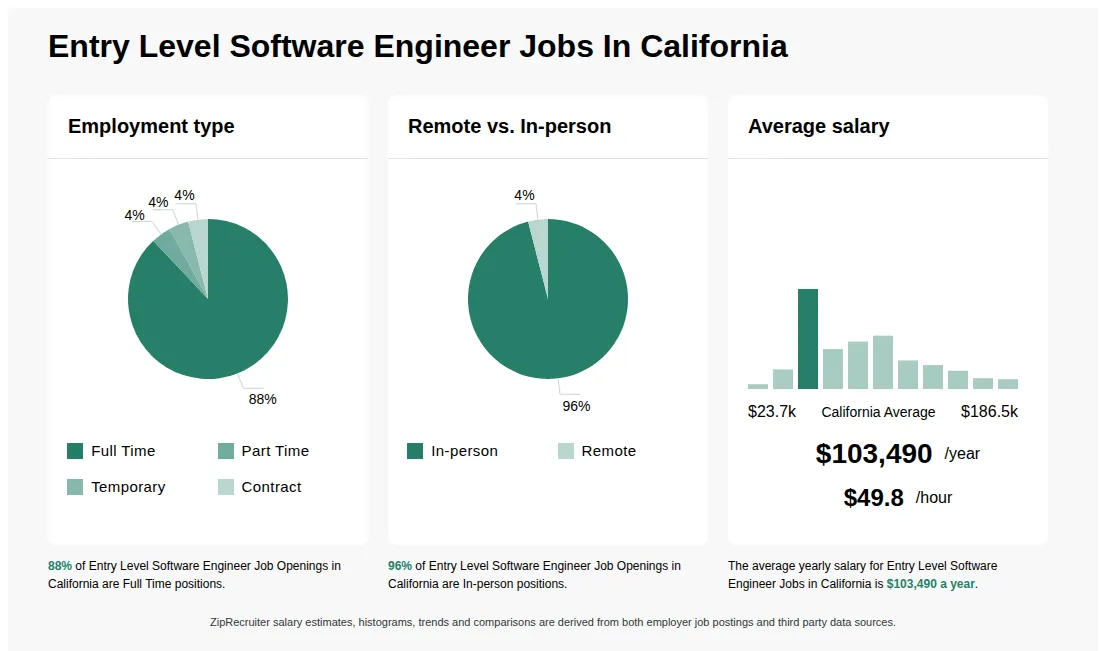
See California salary details
$23.7K - $38.5K
1% of jobs
$38.5K - $53.3K
5% of jobs
$62.8K is the 25th percentile. Wages below this are outliers.
$53.3K - $68.1K
29% of jobs
$68.1K - $82.9K
11% of jobs
The median wage is $86.3K / yr.
$82.9K - $97.7K
14% of jobs
$112.5K is the 75th percentile. Wages above this are outliers.
$97.7K - $112.5K
15% of jobs
$112.5K - $127.3K
8% of jobs
$127.3K - $142.1K
6% of jobs
$142.1K - $156.9K
5% of jobs
$156.9K - $171.7K
3% of jobs
$171.7K - $186.5K
2% of jobs
$23.7K
$103.5K
$186.5K
How much do entry level software engineer jobs pay per year?
As of Jul 23, 2026, the average yearly pay for entry level software engineer in California is $103,490.00, according to ZipRecruiter salary data. Most workers in this role earn between $64,100.00 and $118,400.00 per year, depending on experience, location, and employer.
Will AI replace developers in 2026?
Entry level software engineers will continue to play a vital role in software development, as AI tools are designed to assist rather than fully replace human programmers. Developing skills in coding, problem-solving, and understanding AI integration will remain valuable in the evolving tech environment.
What is the difference between Entry Level Software Engineer vs Software Developer?
| Aspect | Entry Level Software Engineer | Software Developer |
|---|---|---|
| Required Credentials | Bachelor's in CS or related field; some internships | Bachelor's in CS or related; coding experience |
| Work Environment | Team-based, collaborative projects, entry-level tasks | Project-focused, coding, debugging, and implementation |
| Employer & Industry Usage | Tech companies, startups, IT departments | Software firms, tech startups, enterprise IT |
| Common Search & Comparison | Yes | Yes |
Entry Level Software Engineers and Software Developers often share similar educational backgrounds and work environments. The main difference lies in their roles: engineers may focus more on designing systems and architecture, while developers typically concentrate on coding and implementation. Both roles are essential in tech industries and often overlap in job functions, but understanding these distinctions helps job seekers target the right positions.
What engineer makes $500,000 a year?
Highly experienced software engineers, especially those in senior or specialized roles such as machine learning engineers or software architects at large tech companies, can earn $500,000 or more annually. These roles often require advanced skills, extensive experience, and sometimes stock options or bonuses as part of compensation packages.
How to get a job as a software engineer with no experience?
Entry-level software engineer positions often require demonstrating programming skills through personal projects, internships, or coding bootcamps. Building a strong portfolio, learning relevant tools like Git and languages such as Python or Java, and obtaining certifications can improve chances of securing an entry-level role without prior work experience.
What types of projects do entry level software engineers typically work on, and how do they collaborate with other team members?
Entry level software engineers often start by working on smaller features, bug fixes, or assisting with testing and documentation within larger projects. They usually collaborate closely with senior engineers, product managers, and QA teams through code reviews, daily stand-ups, and pair programming sessions. This structure helps new engineers learn best practices, understand the codebase, and gradually take on more complex assignments. Effective communication and a willingness to learn are key to success in these collaborative environments.
What does an entry level software engineer do?
An entry level software engineer is responsible for assisting in the design, development, testing, and maintenance of software applications. They typically work under the guidance of more experienced engineers and may write code, debug programs, and participate in code reviews. The role often involves learning company-specific tools and workflows, collaborating with team members, and continuously improving technical skills. Entry level software engineers are expected to adapt quickly, communicate effectively, and contribute to the team's overall goals.
What are the key skills and qualifications needed to thrive as an Entry Level Software Engineer, and why are they important?
To thrive as an Entry Level Software Engineer, you need a solid understanding of programming languages (such as Java, Python, or C++), computer science fundamentals, and often a relevant bachelor’s degree. Familiarity with version control systems like Git, development frameworks, and basic software development tools is typically expected. Strong problem-solving abilities, eagerness to learn, and effective collaboration are standout soft skills in this role. These skills are crucial for building reliable software, adapting to evolving technologies, and contributing productively to team projects.
What Does an Entry Level Software Engineer Do?
An Entry-Level Software Engineer, also called a Junior Engineer, works with a team of mid-level and senior engineers to develop, test, and maintain software applications and programs. The job duties of Junior Software Engineers typically include relatively simple routine tasks, such as debugging, testing, and code documentation. These tasks hone a Junior Engineer’s skills and familiarize them with the company’s code base. As Software Engineers gain more years of experience, they work on more complex development projects.
Is it true that AI will replace software engineers?
AI is unlikely to fully replace entry-level software engineers, as human skills such as problem-solving, creativity, and understanding complex requirements remain essential. AI tools can assist with coding and automation, but software engineering involves tasks that require critical thinking and collaboration. Developing proficiency in programming languages and understanding AI capabilities can enhance job performance and adaptability in the field.
More about Entry Level Software Engineer jobs
What are the most commonly searched types of Software Engineer jobs in California? The most popular types of Software Engineer jobs in California are:
What are popular job titles related to Entry Level Software Engineer jobs in California? For Entry Level Software Engineer jobs in California, the most frequently searched job titles are:
- Contract Weights Engineer
- Roadway Design Engineer
- Entry Level Telecommunications Engineer
- Entry Level Structural Analysis Engineer
- Civil Planning Engineer
- Research Civil Engineer
- Entry Level Solutions Engineer
- Freelance Entry Level Mechanical Engineer
- Entry Level Stationary Engineer
- Entry Level Civil Engineering Technician
What job categories do people searching Entry Level Software Engineer jobs in California look for? The top searched job categories for Entry Level Software Engineer jobs in California are:
What cities in California are hiring for Entry Level Software Engineer jobs? Cities in California with the most Entry Level Software Engineer job openings:
What are popular job titles related to Entry Level Software Engineer jobs in CA? For Entry Level Software Engineer jobs in CA, the most frequently searched job titles are:
Other
Posted 4 days ago
Job description
The Job Market Isn’t Slow — It’s Selective Get Job Offers with a Process which works! Many job seekers think the tech market is dead, but the truth is companies are hiring selectively. They want candidates who are trained, polished, and ready to contribute immediately. SynergisticIT prepares you exactly for that. You’ll gain hands‑on experience, master in‑demand technologies, and receive interview coaching that helps you outperform other applicants. Plus direct access to 28000+ contacts at different employers. If you’re tired of waiting for the market to “get better,” become the candidate companies are already looking for. You’ve done a ton of Leetcode. You’ve racked up certificates, done LeetCode challenges, and you know your way around system design like the back of your hand. On paper, you’re everything a tech company wants. However tech stacks and requirements change every day. Companies are looking for Employees who can contribute on Projects from Day 1. So what is needed is the right tech stack and the right project work. Companies have options and as a Jobseeker you can have options also if you have the right tech stack and Project work Since 2010, we’ve helped thousands of candidates land full-time jobs at tech leaders like Google, Apple, PayPal, Visa, Western Union, Wells Fargo, Intel, Paypal, JPMC, Wayfair, BOA, CITI and hundreds more with Job offers of $95k to $154k. Synergisticit focuses on closing the gap between your tech skills and what employers want now. All visa types and U.S. citizens are encouraged to apply. We Focus on Java /Full stack/Devops and Data Science /Data Engineers/Data analysts/BI Analysts/ Machine learning/AI candidates Ideal Candidates: Recent grads in CS, Engineering, Math, or Statistics with limited or no job experience Jobseekers who had layoffs due to Downsizing and want to get in demand tech stack Professionals seeking a career switch to tech Candidates with career gaps or lacking real-world experience Individuals looking to boost their skill portfolio for better job prospects Computer Science grads with limited or no job experience Students who recently finished their Bachelor’s or Master’s programs Those struggling to land interviews despite having experience Currently, We are looking for entry-level software programmers, Java Full stack developers, Python/Java developers, Data analysts/Data Engineers/ Data Scientists, Machine Learning engineers for full time positions with clients. Top tech companies are flooded with smart grads. What gets you in the door now is real-world application, confidence in delivery, and the soft skills to own a room—or a Zoom. Please check below links: Event videos (OCW, JavaOne, Gartner): https://fast.wistia.com/embed/channel/k4mlq69ekl USA Today feature Discover JOPP: https://www.synergisticit.com/jopp/ Contact: https://www.synergisticit.com/contact-us/ please read our blogs Why do Tech Companies not Hire recent Computer Science Graduates | https://www.synergisticit.com/why-tech-companies-dont-hire-recent-cs-graduates/ Technical Skills or Experience? | Which one is important to get a Job? | https://www.synergisticit.com/tech-skill-or-experience-which-one-is-more-important-for-a-jobseeker/ The Market’s Changed—Have You? Please note: Resume databases are shared with clients and interested clients will reach out directly if they find a qualified candidate for their req. Resume submissions may be shared with our JOPP team database also. Please unsubscribe if contacted or if you don’t want to be contacted please don’t submit your resume. You’re Not Getting Rejected — You’re Getting Filtered Out Get Hired with a Process which is definite-When you want Surety not a Maybe Most rejections happen before a human ever sees your resume. Applicant tracking systems filter out thousands of qualified candidates every day. SynergisticIT helps you beat the system by optimizing your resume, preparing you for technical interviews, and getting your profile directly to Fortune 500 clients. No more getting lost in automated filters. Whether you’re a new grad, someone with a career gap, or a laid‑off developer, We ensure your skills reach real hiring managers. If you want to bypass the noise and get real opportunities, this program is built for you. If you're a Java developer, software programmer, data scientist, or data analyst struggling to break into the tech industry, you're not alone. The job market is competitive, and many talented professionals find themselves stuck in a cycle of applications, rejections, and missed opportunities. That’s where SynergisticIT comes in. Since 2010, we’ve helped thousands of candidates land full-time jobs at tech leaders like Google, Apple, PayPal, Visa, Western Union, Wells Fargo, Intel, Paypal, JPMC, Wayfair, BOA, CITI and hundreds more with Job offers of $95k to $154k. Synergisticit focuses on what employers want now. Why SynergisticIT Is Different? SynergisticIT offers a placement-first approach designed to close the gap between where you are and where you need to be to get hired. Currently, We are looking for entry-level software programmers, Java Full stack developers, Python/Java developers, Data analysts/Data Engineers/ Data Scientists, Machine Learning engineers for full time positions with clients. All visa types and U.S. citizens are encouraged to apply. Ideal Candidates: Recent grads in CS, Engineering, Math, or Statistics with limited or no job experience Jobseekers who had layoffs due to Downsizing and want to get in demand tech stack Professionals seeking a career switch to tech Candidates with career gaps or lacking real-world experience Individuals looking to boost their skill portfolio for better job prospects Computer Science grads with limited or no job experience Students who recently finished their Bachelor’s or Master’s programs Those struggling to land interviews despite having experience End-to-End Job Placement Support –we connect you with employers actively looking for entry-level talent. Our candidates have recently landed roles at Google, Visa, Intel, Walmart, Mcdonald’s, Apple, PayPal, Wayfair, Walgreens, Citi and many more. please read our blogs Why do Tech Companies not Hire recent Computer Science Graduates | https://www.synergisticit.com/why-tech-companies-dont-hire-recent-cs-graduates/ Technical Skills or Experience? | Which one is important to get a Job? | https://www.synergisticit.com/tech-skill-or-experience-which-one-is-more-important-for-a-jobseeker/ Please check below links: Event videos (OCW, JavaOne, Gartner): https://fast.wistia.com/embed/channel/k4mlq69ekl USA Today feature Discover JOPP: https://www.synergisticit.com/jopp/ Contact: https://www.synergisticit.com/contact-us/ Ready to Get Hired? If you’re tired of being overlooked, underpaid, or stuck in the job hunt, SynergisticIT is your launchpad. candidates don’t just get jobs—they build careers. Your future in tech starts now—with SynergisticIT. Please note: Resume databases are shared with clients and interested clients will reach out directly if they find a qualified candidate for their req. Resume submissions may be shared with our JOPP team database also. Please unsubscribe if contacted or if you don’t want to be contacted please don’t submit your resume.