Software Developer
Omaha, NE · On-site
The Opportunity Cordova is seeking a proactive Software Engineer to join our client's development ... Experience Levels: * Entry-Level: 0-2 years of experience. * Mid-Level: 2-7 years of experience.
Omaha, NE · On-site
The Opportunity Cordova is seeking a proactive Software Engineer to join our client's development ... Experience Levels: * Entry-Level: 0-2 years of experience. * Mid-Level: 2-7 years of experience.
Omaha, NE · On-site
The Opportunity Cordova is seeking a proactive Software Engineer to join our client's development ... Experience Levels: * Entry-Level: 0-2 years of experience. * Mid-Level: 2-7 years of experience.
Interested in being at the forefront of sourcing the next big software company? Join us for a virtual info session to learn more about opportunities at Insight Partners, a leading global venture ...
Interested in being at the forefront of sourcing the next big software company? Join us for a virtual info session to learn more about opportunities at Insight Partners, a leading global venture ...
Interested in being at the forefront of sourcing the next big software company? Join us for a virtual info session to learn more about opportunities at Insight Partners, a leading global venture ...
Interested in being at the forefront of sourcing the next big software company? Join us for a virtual info session to learn more about opportunities at Insight Partners, a leading global venture ...
Interested in being at the forefront of sourcing the next big software company? Join us for a virtual info session to learn more about opportunities at Insight Partners, a leading global venture ...
Interested in being at the forefront of sourcing the next big software company? Join us for a virtual info session to learn more about opportunities at Insight Partners, a leading global venture ...
Interested in being at the forefront of sourcing the next big software company? Join us for a virtual info session to learn more about opportunities at Insight Partners, a leading global venture ...
Interested in being at the forefront of sourcing the next big software company? Join us for a virtual info session to learn more about opportunities at Insight Partners, a leading global venture ...
La Vista, NE · On-site
$90 - $120/hr
Omaha, NE, US Requisition ID: 181563 Job Level: Entry Level Market: Corporate Home Office Employment Type: Full Time Position Overview Kiewit is seeking a Software Engineer to architect, design, and ...
La Vista, NE · On-site
$90 - $120/hr
Omaha, NE, US Requisition ID: 181563 Job Level: Entry Level Market: Corporate Home Office Employment Type: Full Time Position Overview Kiewit is seeking a Software Engineer to architect, design, and ...
Omaha, NE · On-site
Proficiency in scheduling including related scheduling software. Basic qualifications for Entry-Level Engineer candidates include: * Bachelor of Science in an Engineering discipline, Engineering ...
Omaha, NE · On-site
Proficiency in scheduling including related scheduling software. Basic qualifications for Entry-Level Engineer candidates include: * Bachelor of Science in an Engineering discipline, Engineering ...
Omaha, NE · On-site
Proficiency in scheduling including related scheduling software. Basic qualifications for Entry-Level Engineer candidates include: * Bachelor of Science in an Engineering discipline, Engineering ...
Omaha, NE · On-site
Proficiency in scheduling including related scheduling software. Basic qualifications for Entry-Level Engineer candidates include: * Bachelor of Science in an Engineering discipline, Engineering ...
We engineer and design solutions that improve the world around us. As a company, we promise to ... Gains knowledge and experience working within design and modeling software. * Receives guidance ...
Quick apply
We engineer and design solutions that improve the world around us. As a company, we promise to ... Gains knowledge and experience working within design and modeling software. * Receives guidance ...
Omaha, NE · On-site
$85K - $113K/yr
About the Role We are seeking a motivated Software Engineer to join our development team. In this ... Experience: * 1+ years of professional work experience. * 0-2 years of experience for entry-level ...
Omaha, NE · On-site
$85K - $113K/yr
About the Role We are seeking a motivated Software Engineer to join our development team. In this ... Experience: * 1+ years of professional work experience. * 0-2 years of experience for entry-level ...
This is an entry-level opportunity for someone who wants meaningful responsibility early in their ... software engineering position. You'll use AI every day to solve problems, improve processes, and ...
Quick apply
This is an entry-level opportunity for someone who wants meaningful responsibility early in their ... software engineering position. You'll use AI every day to solve problems, improve processes, and ...
This is an entry-level opportunity for someone who wants meaningful responsibility early in their ... software engineering position. You'll use AI every day to solve problems, improve processes, and ...
This is an entry-level opportunity for someone who wants meaningful responsibility early in their ... software engineering position. You'll use AI every day to solve problems, improve processes, and ...
Omaha, NE · On-site
$65 - $90/hr
Utilize AutoCAD Civil 3D and related software to support project planning and design. * Perform engineering calculations and assist with stormwater, drainage, and utility analyses. * Prepare reports ...
Omaha, NE · On-site
$65 - $90/hr
Utilize AutoCAD Civil 3D and related software to support project planning and design. * Perform engineering calculations and assist with stormwater, drainage, and utility analyses. * Prepare reports ...
Omaha, NE · On-site
$60 - $80/hr
Utilize AutoCAD Civil 3D and related software to support project planning and design. * Perform engineering calculations and assist with stormwater, drainage, and utility analyses. * Prepare reports ...
Omaha, NE · On-site
$60 - $80/hr
Utilize AutoCAD Civil 3D and related software to support project planning and design. * Perform engineering calculations and assist with stormwater, drainage, and utility analyses. * Prepare reports ...
Utilize AutoCAD Civil 3D and related software to support project planning and design. Perform engineering calculations and assist with stormwater, drainage, and utility analyses. Prepare reports ...
Utilize AutoCAD Civil 3D and related software to support project planning and design. Perform engineering calculations and assist with stormwater, drainage, and utility analyses. Prepare reports ...
Primary Duties and Responsibilities • Assist with the design and preparation of engineering plans, specifications, and construction documents. • Utilize AutoCAD Civil 3D and related software to ...
Primary Duties and Responsibilities • Assist with the design and preparation of engineering plans, specifications, and construction documents. • Utilize AutoCAD Civil 3D and related software to ...
Omaha, NE · On-site
Primary Duties and Responsibilities • Assist with the design and preparation of engineering plans, specifications, and construction documents. • Utilize AutoCAD Civil 3D and related software to ...
Omaha, NE · On-site
Primary Duties and Responsibilities • Assist with the design and preparation of engineering plans, specifications, and construction documents. • Utilize AutoCAD Civil 3D and related software to ...
This entry-level role contributes to the development of purposeful, high-quality design solutions ... Gain experience working within design and modeling software. * Support senior staff with project ...
This entry-level role contributes to the development of purposeful, high-quality design solutions ... Gain experience working within design and modeling software. * Support senior staff with project ...
This is an entry-level opportunity for someone who wants meaningful responsibility early in their ... Engineering teams. You will help understand customer workflows, implement and support those ...
This is an entry-level opportunity for someone who wants meaningful responsibility early in their ... Engineering teams. You will help understand customer workflows, implement and support those ...
Omaha, NE · On-site
$79K - $103K/yr
This entry-level role offers hands-on design, analysis, and project execution experience, with ... Use engineering software and tools to create detailed designs, specifications, and calculations ...
Omaha, NE · On-site
$79K - $103K/yr
This entry-level role offers hands-on design, analysis, and project execution experience, with ... Use engineering software and tools to create detailed designs, specifications, and calculations ...
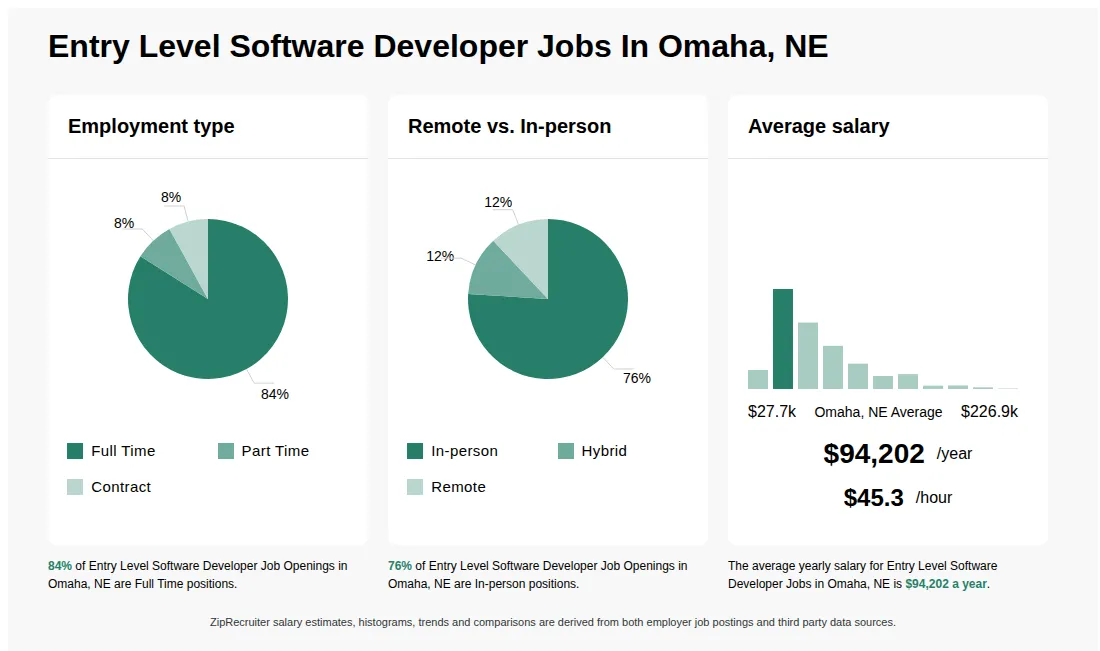
$28.2K - $46.7K
6% of jobs
$56.3K is the 25th percentile. Wages below this are outliers.
$46.7K - $65.1K
36% of jobs
The median wage is $71.4K / yr.
$65.1K - $83.5K
23% of jobs
$95.7K is the 75th percentile. Wages above this are outliers.
$83.5K - $102K
15% of jobs
$102K - $120.4K
8% of jobs
$120.4K - $138.8K
4% of jobs
$138.8K - $157.3K
5% of jobs
$157.3K - $175.7K
1% of jobs
$175.7K - $194.1K
1% of jobs
$194.1K - $212.6K
0% of jobs
$212.6K - $231K
0% of jobs
$28.2K
$95.9K
$231K
An entry-level software developer has simpler duties compared to more senior members of the field. At the entry level, your responsibilities are to create simple, single-thread code to achieve a specific task. These bits of code can be combined to create a larger program. You may also have to create or write a design algorithm by which you create software. However, most of the time, as an entry-level developer, you are in charge of debugging. You have to comb through the code of a piece of software to remove errors.
| Aspect | Entry Level Software Developer | Junior Software Engineer |
|---|---|---|
| Required Credentials | Bachelor's in CS or related field, coding bootcamp experience | Bachelor's in CS or related field, internship experience |
| Work Environment | Tech companies, startups, software firms | Tech companies, consulting firms, startups |
| Employer Usage | Commonly used in job postings and industry | Often used interchangeably with Entry Level Software Developer |
Both roles typically require a bachelor's degree in computer science or related fields and some coding experience. They work in similar environments like tech companies and startups. The terms are often used interchangeably, but 'Junior Software Engineer' may emphasize a slightly more engineering-focused role. Overall, they represent entry-level positions for aspiring software professionals.
The most popular types of Software Developer jobs in Omaha, NE are:
For Entry Level Software Developer jobs in Omaha, NE, the most frequently searched job titles are:
The top searched job categories for Entry Level Software Developer jobs in Omaha, NE are:
Cities near Omaha, NE with the most Entry Level Software Developer job openings:

Full-time
This job post has expired today. Applications are no longer accepted.
The Opportunity
Cordova is seeking a proactive Software Engineer to join our client’s development team. This role is focused on the design, development, and maintenance of high-quality software solutions that serve both external customers and internal employees. Whether you are building new features from scratch or customizing vendor-provided packaged software, you will play a key role in delivering capabilities that meet evolving business needs.
We are looking for a developer with a growth mindset—someone who understands the context of their code in relation to business objectives and is eager to adapt to new technologies and frameworks.
Key Responsibilities
Software Development & Configuration
Feature Engineering: Design and develop robust features and capabilities for end-users across various platforms.
Systems Customization: Configure and customize third-party packaged software to align with specific user requirements and enterprise standards.
API Development: Build and maintain APIs to support both internal and external product integrations.
Defect Management: Identify, isolate, and document software defects with a high attention to detail.
Agile Execution & DevOps
Lifecycle Management: Work within the full Software Development Lifecycle (SDLC) using Agile methodologies (Scrum/Kanban).
CI/CD Integration: Utilize DevOps principles and CI/CD practices to ensure stable and frequent code deployments.
Planning: Participate in Agile planning using tools such as Azure DevOps to prioritize tasks and meet project deadlines.
Collaboration & Business Alignment
Technical Communication: Translate complex technical information into condensed, actionable updates for various stakeholders.
Business Analysis: Analyze company business needs and procedures to ensure technical solutions drive measurable business value.
Continuous Learning: Actively incorporate feedback, learn new technologies quickly, and contribute to the team’s shared success.
The Ideal Candidate
Education & Experience
Education: Bachelor’s degree in a related field or equivalent professional work experience.
Experience Levels: * Entry-Level: 0–2 years of experience.
Mid-Level: 2–7 years of experience.
Technical Proficiency: Strong command of one or more coding languages (e.g., C#, .NET, or Java).
Core Competencies
Analytical Thinking: Excellent logic and problem-solving skills with basic knowledge of database management (SQL/NoSQL).
Insurance Domain (Preferred): Familiarity with Property & Casualty (P&C) rating, policy coverages, and endorsements is a plus.
Soft Skills: Excellent customer service, strong interpersonal collaboration, and the ability to maintain confidentiality.
Adaptability: A proactive approach to identifying issues and a willingness to adapt to changing project requirements.