2

Entry Level Process Operator Jobs (NOW HIRING)

Processing Operator

Hazleton, PA · On-site

$18.75 - $23.75/hr

... process. • Establishes and maintains an effective line of communication with Quality Assurance ... High school diploma and/or GED preferred. • Experience: Entry level • Willing to work in a team ...

Processing Operator

Hazleton, PA · On-site

$18.75 - $23.75/hr

Distinguishes colors and duplicates those colors in the extrusion process. Establishes and ... Experience: Entry level Willing to work in a team environment and contribute to group goals.

Production Process Operator II

San Diego, CA · On-site

$17.75 - $21.50/hr

... of entry-level operators. Works closely with the Production Supervisor and other team members to ... Monitor the production process to ensure that products meet company specifications and regulatory ...

Production Process Operator II

San Diego, CA

$17.75 - $21.50/hr

... of entry-level operators. Works closely with the Production Supervisor and other team members to ... Monitor the production process to ensure that products meet company specifications and regulatory ...

Drum Processing Operator

Saraland, AL · On-site

$16.25 - $20.50/hr

Weekly pay * Entry level! Start your career here, opportunity for growth * Monday-Friday 6am-2:30pm ... As a Drum Processing Operator , you'll help manage incoming and outgoing materials, maintain ...

Drum Processing Operator

Saraland, AL

$16.25 - $20.50/hr

Weekly pay * Entry level! Start your career here, opportunity for growth * Monday-Friday 6am-2:30pm ... As a Drum Processing Operator , you'll help manage incoming and outgoing materials, maintain ...

Although this is an entry level position, there is much opportunity for growth and advancement. As ... To process material, employees must operate industrial machinery and equipment, industrial mobile ...

Although this is an entry level position, there is much opportunity for growth and advancement. As ... To process material, employees must operate industrial machinery and equipment, industrial mobile ...

Although this is an entry level position, there is much opportunity for growth and advancement. As ... To process material, employees must operate industrial machinery and equipment, industrial mobile ...

Processing Operator-Black-Night

Bern, KS · On-site

$16.50 - $20.75/hr

Distinguishes colors and duplicates those colors in the extrusion process. * Establishes and ... Experience: Entry level * Willing to work in a team environment and contribute to group goals.

Processing Operator-Red-Days

Bern, KS · On-site

$16.50 - $20.75/hr

Distinguishes colors and duplicates those colors in the extrusion process. * Establishes and ... Experience: Entry level * Willing to work in a team environment and contribute to group goals.

Processing Operator-Green-Days

Bern, KS · On-site

$16.50 - $20.75/hr

Distinguishes colors and duplicates those colors in the extrusion process. * Establishes and ... Experience: Entry level * Willing to work in a team environment and contribute to group goals.

Processing Operator-Red-Days

Bern, KS · On-site

$16.50 - $20.75/hr

Distinguishes colors and duplicates those colors in the extrusion process. * Establishes and ... Experience: Entry level * Willing to work in a team environment and contribute to group goals.

Processing Operator-Black-Night

Bern, KS · On-site

$16.50 - $20.75/hr

Distinguishes colors and duplicates those colors in the extrusion process. * Establishes and ... Experience: Entry level * Willing to work in a team environment and contribute to group goals.

next page

Showing results 1-20

Entry Level Process Operator information

See salary details

$14

$21

$31

How much do entry level process operator jobs pay per hour?

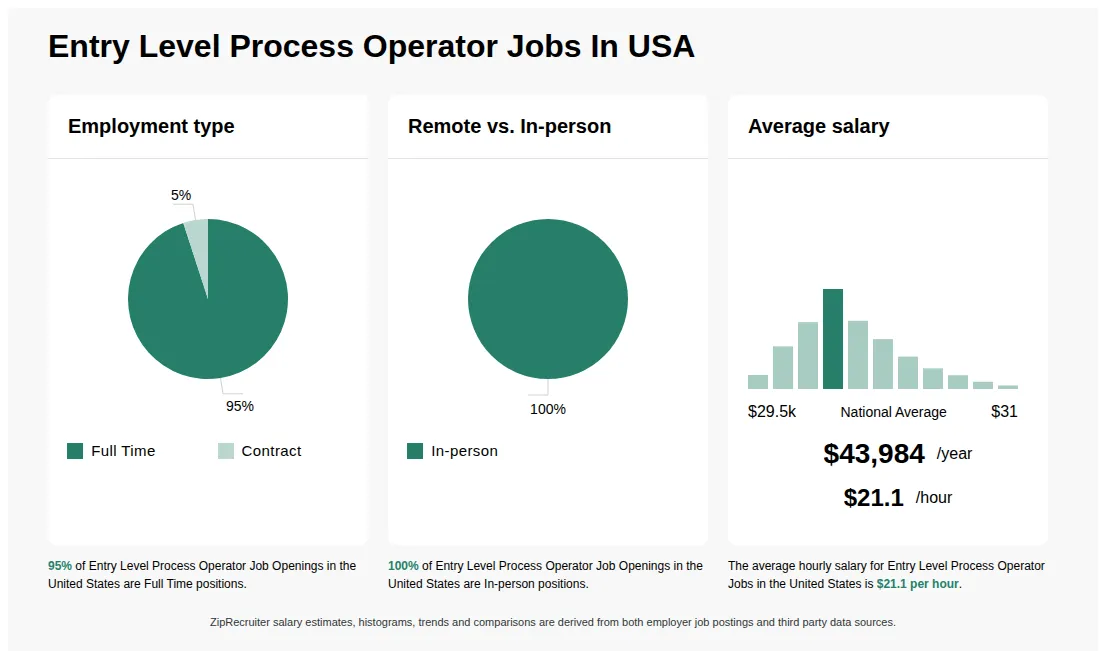
As of Jul 14, 2026, the average hourly pay for entry level process operator in the United States is $21.15, according to ZipRecruiter salary data. Most workers in this role earn between $18.27 and $23.08 per hour, depending on experience, location, and employer.

What are the key skills and qualifications needed to thrive as an Entry Level Process Operator, and why are they important?

To thrive as an Entry Level Process Operator, you need a basic understanding of industrial processes, safety protocols, and often a high school diploma or equivalent. Familiarity with process control systems, instrumentation, and sometimes certifications like OSHA safety training are commonly required. Strong attention to detail, communication skills, and teamwork help operators excel in monitoring equipment and responding to issues. These skills ensure safe, efficient, and continuous plant operations, minimizing downtime and maintaining product quality.

What are some typical challenges an Entry Level Process Operator may face when starting in this role?

As an Entry Level Process Operator, you may initially find it challenging to quickly learn and follow complex operational procedures and safety protocols, especially in fast-paced manufacturing or industrial environments. Adjusting to shift work and collaborating with experienced operators can also require adaptability and strong communication skills. However, with on-the-job training and support from your team, you'll gain practical experience and confidence in monitoring equipment, troubleshooting issues, and ensuring quality standards are met.

What is the difference between Entry Level Process Operator vs Production Technician?

AspectEntry Level Process OperatorProduction Technician
Required CredentialsHigh school diploma or equivalent; basic technical trainingHigh school diploma; technical or vocational training often preferred
Work EnvironmentManufacturing or processing plants, often in chemical, food, or pharmaceutical industriesManufacturing facilities, focusing on equipment maintenance and process support
Employer & Industry UsageCommonly used in chemical, oil & gas, and manufacturing sectorsUsed across similar industries, often overlapping with process roles

The Entry Level Process Operator and Production Technician roles share similar environments and credentials, often working in manufacturing plants. While both roles support production processes, process operators typically focus on monitoring and controlling equipment, whereas technicians may handle maintenance and troubleshooting tasks. Understanding these differences helps job seekers target the right roles based on their skills and career goals.

What is an entry level process operator?

An entry level process operator is responsible for monitoring and controlling machinery and equipment in manufacturing or processing plants. They ensure that processes run smoothly, safely, and efficiently by following standard operating procedures and reporting any issues to supervisors. Their duties often include starting or stopping equipment, taking readings, performing basic maintenance, and maintaining accurate logs. This role typically requires a high school diploma and some on-the-job training, making it an accessible entry point into industrial operations.

Is it hard to be a process operator?

Becoming a process operator typically requires technical skills, attention to detail, and the ability to follow safety protocols. The job involves monitoring equipment, troubleshooting issues, and working in a fast-paced environment, which can be challenging for some but is manageable with proper training and experience.

How to become a process operator with no experience?

To become a process operator with no experience, focus on gaining relevant skills such as understanding industrial equipment and safety procedures, often through on-the-job training or technical programs. Entry-level positions may require a high school diploma or equivalent, and obtaining certifications like OSHA safety training can improve your chances. Some employers offer training programs for new hires to develop necessary skills on the job.

What jobs pay 4000 a week without a degree?

Entry-level process operator roles in industries like manufacturing or oil and gas can pay around $4,000 per week with experience and overtime. These jobs often require technical skills, safety certifications, and the ability to work in shifts or hazardous environments.

Where do process operators make the most money?

Process operators tend to earn higher salaries in regions with a strong manufacturing or energy sector, such as areas with oil and gas, chemical plants, or large industrial facilities. Factors like experience, certifications, and working in hazardous environments can also increase earning potential.
More about Entry Level Process Operator jobs
What cities are hiring for Entry Level Process Operator jobs? Cities with the most Entry Level Process Operator job openings:
What are the most commonly searched types of Process Operator jobs? The most popular types of Process Operator jobs are:
What states have the most Entry Level Process Operator jobs? States with the most job openings for Entry Level Process Operator jobs include:
Infographic showing various Entry Level Process Operator job openings in the United States as of July 2026, with employment types broken down into 1% Locum Tenens, 86% Full Time, 12% Part Time, and 1% Contract. Highlights an 96% Physical, 1% Hybrid, and 3% Remote job distribution, with an average salary of $43,984 per year, or $21.1 per hour.
Processing Operator

Processing Operator

Alphia

Hazleton, PA • On-site

$18.75 - $23.75/hr

Full-time

Re-posted 18 days ago


Alphia rating

7.1

Company rating: 7.1 out of 10

Based on 16 frontline employees who took The Breakroom Quiz

197th of 395 rated food and drinks producers


Job description

Job Description:
Job description
DESCRIPTION OF ESSENTIAL DUTIES:
• Helps assemble, calibrate, operate, and monitor extruder and all auxiliary equipment (pumps, micro-motions, dry coating applicator, tanks, agitators, etc.) of one extrusion system.
• Inspects and evaluates equipment hourly; adjusts equipment variables to meet equipment and product requirements.
• Frequently dumps/weighs, carries, and stacks up to 50-pound bags of ingredients and/or product.
• Operates forklift and hand-held scanners to remove ingredients from inventory for use in production.
• Assists in evaluating orders; ensures paperwork is complete and accurate on all processing conditions; completes status reports.
• Calculates rates and performance percentages for product runs.
• Distinguishes colors and duplicates those colors in the extrusion process.
• Establishes and maintains an effective line of communication with Quality Assurance department.
• Thoroughly understands all quality assurance procedures and programs; ensures all products are within individual client specifications.
• Monitors and manages shrink losses to acceptable limits/standards.
• Responsible for all product quality attributes.
• Evaluates product quality attributes; makes immediate adjustments to correct out-of-specification products.
• Anticipates technical problems; proactively troubleshoots (where appropriate) and makes technical adjustments and/or notifies maintenance.
• Responsible for maintaining a safe and clean work area and environment.
• Participate in a full facility and equipment clean-up between each product run as directed.
• Ensures required changeovers are completed accurately and efficiently.
• Knowledge & proficiency in Alphia Business Systems as it relates to Position.
• Responsible for becoming familiar with GMP's and Standard Operating Procedures (SOP's) for all products.
• Complete simple production reports
• Required to notify a supervisor or a lead employee of any situation or observation that may adversely affect food safety and/or quality.
• Ensure the requirements of the CCP are met, and if a deviation occurs, notify Supervisor and Quality departments to hold all affected product.
• Other duties as assigned.
QUALIFICATION REQUIREMENTS: (To perform this job successfully, and individual must be able to perform each essential duty satisfactorily. The requirements listed below are representative of the knowledge, skill, and/or ability required).
• Education level: High school diploma and/or GED preferred.
• Experience: Entry level
• Willing to work in a team environment and contribute to group goals.
• Excellent communication skills
• Ability to receive and provide instructions in a positive manner.
• Ability to communicate both verbally and in written form.
• Basic math skills to include addition, subtraction, and percentages.
• Ability to multi-task.
PHYSICAL DEMANDS: (The physical demands described here are representatives of those that must be met by an employee to successfully perform the essential functions of this job. Reasonable accommodations may be made to enable individuals with disabilities to perform the essential function. The phrases "occasionally," "regularly," and "frequently" correspond to the following definitions: "occasionally" means up to 25% of working time, "regularly" means between 26 and 75% of working time, and "frequently" means 76% and more of working time.)
While performing the duties of this job, the employee is regularly required to talk or hear, walk, and move from place to place. The employee is occasionally required to sit, use foot/feet to operate machine, stoop, kneel, crouch or crawl or reach above shoulders. The employee is frequently required to stand and use hands to finger, handle, or touch.
The employee must exert 50 to 100 pounds of force occasionally, and / or up to 25 to 50 pounds of force frequently, and / or 10 to 20 pounds of force constantly. Specific vision abilities required by this job include close vision, distance vision, color vision, peripheral vision, depth perception, and the ability to adjust focus.
WORK ENVIRONMENT: (The work environment characteristics described here are representative of those an employee encounters while performing the essential functions of this job. Reasonable accommodations may be made to enable individuals with disabilities to perform the essential functions).
The employee may be frequently exposed to allergens and/or airborne particles in the production area. Production employees are exposed to temperatures ranging from 50 to 115 degrees, depending on the season and workstation, and may be working near moving mechanical parts. Occasional exposure to outdoor weather conditions may occur.
The noise level in the work environment may be loud while production equipment is running.
Personal Protection Equipment (including, but not limited to, boots, gloves, safety glasses, and/or face shields) is required during various processes in the production area. Ear plugs and bump caps are required at all times in the production area.
Alphia is an equal opportunity employer. We celebrate diversity and are committed to creating an inclusive environment for all employees.

What Alphia employees say

Pay

Benefits

Hours and flexibility

Workplace

Get the full story on Breakroom