A Bachelor's degree from an accredited college or university Electrical Engineering, Electronic Engineering, or Physics; * Degree may be substituted with four year specialized experience using ...
A Bachelor's degree from an accredited college or university Electrical Engineering, Electronic Engineering, or Physics; * Degree may be substituted with four year specialized experience using ...

Electrical Integration Engineer - Power Systems
Virginia Beach, VA · On-site
$80K/yr
Electrical Integration Engineer - Power Systems Location: Virginia Beach, VA Job Type: Direct Hire Salary: Starting at $80,000/year; higher starting salaries may be available based on experience.
Electrical Integration Engineer - Power Systems
Virginia Beach, VA · On-site
$80K/yr
Electrical Integration Engineer - Power Systems Location: Virginia Beach, VA Job Type: Direct Hire Salary: Starting at $80,000/year; higher starting salaries may be available based on experience.

Electrical EIT Engineer Intern
Lynchburg, VA · On-site
$55K - $78K/yr
This entry-level role offers a fantastic opportunity to start your journey in electrical engineering, working on a diverse range of projects in various sectors.As an Electrical EIT, you will work ...
Quick apply
Electrical EIT Engineer Intern
Lynchburg, VA · On-site
$55K - $78K/yr
This entry-level role offers a fantastic opportunity to start your journey in electrical engineering, working on a diverse range of projects in various sectors.As an Electrical EIT, you will work ...

Entry-Level Engineer
Newport News, VA · On-site
This posting is to collect resumes from students that are interested in entry-level or internship engineering opportunities. If you have any questions, please contact Thomas Steele. One Passion. Many ...
Entry-Level Engineer
Newport News, VA · On-site
This posting is to collect resumes from students that are interested in entry-level or internship engineering opportunities. If you have any questions, please contact Thomas Steele. One Passion. Many ...
This posting is to collect resumes from students that are interested in entry-level or internship engineering opportunities. If you have any questions, please contact Thomas Steele. One Passion. Many ...
This posting is to collect resumes from students that are interested in entry-level or internship engineering opportunities. If you have any questions, please contact Thomas Steele. One Passion. Many ...

With over 7,000 employees, our capabilities span electrical, electronic security ... Assign and manage tasks for entry level engineers * Assist Project Lead Engineers in managing ...
With over 7,000 employees, our capabilities span electrical, electronic security ... Assign and manage tasks for entry level engineers * Assist Project Lead Engineers in managing ...
Assign and manage tasks for entry level engineers * Assist Project Lead Engineers in managing ... Bachelor of Science in Electrical Engineering * Master's degree in engineering or management
Assign and manage tasks for entry level engineers * Assist Project Lead Engineers in managing ... Bachelor of Science in Electrical Engineering * Master's degree in engineering or management
Assign and manage tasks for entry level engineers * Assist Project Lead Engineers in managing ... Bachelor of Science in Electrical Engineering * Master's degree in engineering or management
Assign and manage tasks for entry level engineers * Assist Project Lead Engineers in managing ... Bachelor of Science in Electrical Engineering * Master's degree in engineering or management
This entry-level role offers a fantastic opportunity to start your journey in electrical engineering, working on a diverse range of projects in various sectors. As an Electrical EIT, you will work ...
This entry-level role offers a fantastic opportunity to start your journey in electrical engineering, working on a diverse range of projects in various sectors. As an Electrical EIT, you will work ...
Electrical EIT Engineer Intern (New graduate)
Lynchburg, VA · On-site
$55K - $78K/yr
This entry-level role offers a fantastic opportunity to start your journey in electrical engineering, working on a diverse range of projects in various sectors. As an Electrical EIT, you will work ...
Electrical EIT Engineer Intern (New graduate)
Lynchburg, VA · On-site
$55K - $78K/yr
This entry-level role offers a fantastic opportunity to start your journey in electrical engineering, working on a diverse range of projects in various sectors. As an Electrical EIT, you will work ...

Junior Electrical Engineer - Marine Power Systems with Security Clearance
Chesapeake, VA · On-site
$65K - $80K/yr
Junior Electrical Engineer - Marine Power Systems Location: Chesapeake, VA / Hampton Roads (Hybrid ... Secret Clearance Required or Ability to Obtain/Maintain as Required Experience Level: Entry-Level / ...
Junior Electrical Engineer - Marine Power Systems with Security Clearance
Chesapeake, VA · On-site
$65K - $80K/yr
Junior Electrical Engineer - Marine Power Systems Location: Chesapeake, VA / Hampton Roads (Hybrid ... Secret Clearance Required or Ability to Obtain/Maintain as Required Experience Level: Entry-Level / ...
This posting is to collect resumes from students that are interested in entry-level or internship engineering opportunities. If you have any questions, please contact Thomas Steele. One Passion. Many ...
This posting is to collect resumes from students that are interested in entry-level or internship engineering opportunities. If you have any questions, please contact Thomas Steele. One Passion. Many ...

ENGINEER ELECTRICAL 1
Newport News, VA · On-site
$84K - $101K/yr
... developers to solution architects, technical subject matter experts, and system users. We ... Designs electrical equipment, facilities, components, products, and systems for commercial ...
ENGINEER ELECTRICAL 1
Newport News, VA · On-site
$84K - $101K/yr
... developers to solution architects, technical subject matter experts, and system users. We ... Designs electrical equipment, facilities, components, products, and systems for commercial ...

Electrical Engineer - Recent Graduate (0-3 Years' Experience)
Mclean, VA · Hybrid
$78K - $96K/yr
Summer Consultants is looking for a recent graduate or early-career Electrical Engineer with up to three years of experience to join our McLean, VA team. This is a strong opportunity for someone who ...
Electrical Engineer - Recent Graduate (0-3 Years' Experience)
Mclean, VA · Hybrid
$78K - $96K/yr
Summer Consultants is looking for a recent graduate or early-career Electrical Engineer with up to three years of experience to join our McLean, VA team. This is a strong opportunity for someone who ...
Electrical Engineer - Recent Graduate (0-3 Years' Experience)
Mclean, VA · On-site
$78K - $96K/yr
Summer Consultants is looking for a recent graduate or early-career Electrical Engineer with up to three years of experience to join our McLean, VA team. This is a strong opportunity for someone who ...
Quick apply
Electrical Engineer - Recent Graduate (0-3 Years' Experience)
Mclean, VA · On-site
$78K - $96K/yr
Summer Consultants is looking for a recent graduate or early-career Electrical Engineer with up to three years of experience to join our McLean, VA team. This is a strong opportunity for someone who ...
Electrical Engineer - Recent Graduate (0-3 Years' Experience)
Mclean, VA · On-site
$78K - $96K/yr
Summer Consultants is looking for a recent graduate or early-career Electrical Engineer with up to three years of experience to join our McLean, VA team. This is a strong opportunity for someone who ...
Electrical Engineer - Recent Graduate (0-3 Years' Experience)
Mclean, VA · On-site
$78K - $96K/yr
Summer Consultants is looking for a recent graduate or early-career Electrical Engineer with up to three years of experience to join our McLean, VA team. This is a strong opportunity for someone who ...
ENGINEER ELECTRICAL 1-Newport News,Virginia
Smithfield, VA · On-site
$84K - $101K/yr
ENGINEER ELECTRICAL 1 Location: Newport News, Virginia, United States Date: Aug 31, 2026 Req ID: 49390 Team: E01 ENGRG & DESIGN Entity: Newport News Shipbuilding US Citizenship Required for this ...
ENGINEER ELECTRICAL 1-Newport News,Virginia
Smithfield, VA · On-site
$84K - $101K/yr
ENGINEER ELECTRICAL 1 Location: Newport News, Virginia, United States Date: Aug 31, 2026 Req ID: 49390 Team: E01 ENGRG & DESIGN Entity: Newport News Shipbuilding US Citizenship Required for this ...
ENGINEER ELECTRICAL 1-Newport News, Virginia
Smithfield, VA · On-site
$84K - $101K/yr
ENGINEER ELECTRICAL 1 Location: Newport News, Virginia, United States Date: Aug 31, 2026 Req ID: 49390 Team: E01 ENGRG & DESIGN Entity: Newport News Shipbuilding US Citizenship Required for this ...
ENGINEER ELECTRICAL 1-Newport News, Virginia
Smithfield, VA · On-site
$84K - $101K/yr
ENGINEER ELECTRICAL 1 Location: Newport News, Virginia, United States Date: Aug 31, 2026 Req ID: 49390 Team: E01 ENGRG & DESIGN Entity: Newport News Shipbuilding US Citizenship Required for this ...

PROLIM (www.prolim.com) is currently seeking 369-1 - ENGINEER ELECTRICAL 2 @ NNS Qualified candidates can directly send your updated resume and contact info via email: alec.dsouza@prolim.com ...
PROLIM (www.prolim.com) is currently seeking 369-1 - ENGINEER ELECTRICAL 2 @ NNS Qualified candidates can directly send your updated resume and contact info via email: alec.dsouza@prolim.com ...
$84K - $101K/yr
ENGINEER ELECTRICAL 1 Location: Newport News, Virginia, United States Date: Aug 31, 2026 Req ID: 49390 Team: E01 ENGRG & DESIGN Entity: Newport News Shipbuilding US Citizenship Required for this ...
$84K - $101K/yr
ENGINEER ELECTRICAL 1 Location: Newport News, Virginia, United States Date: Aug 31, 2026 Req ID: 49390 Team: E01 ENGRG & DESIGN Entity: Newport News Shipbuilding US Citizenship Required for this ...
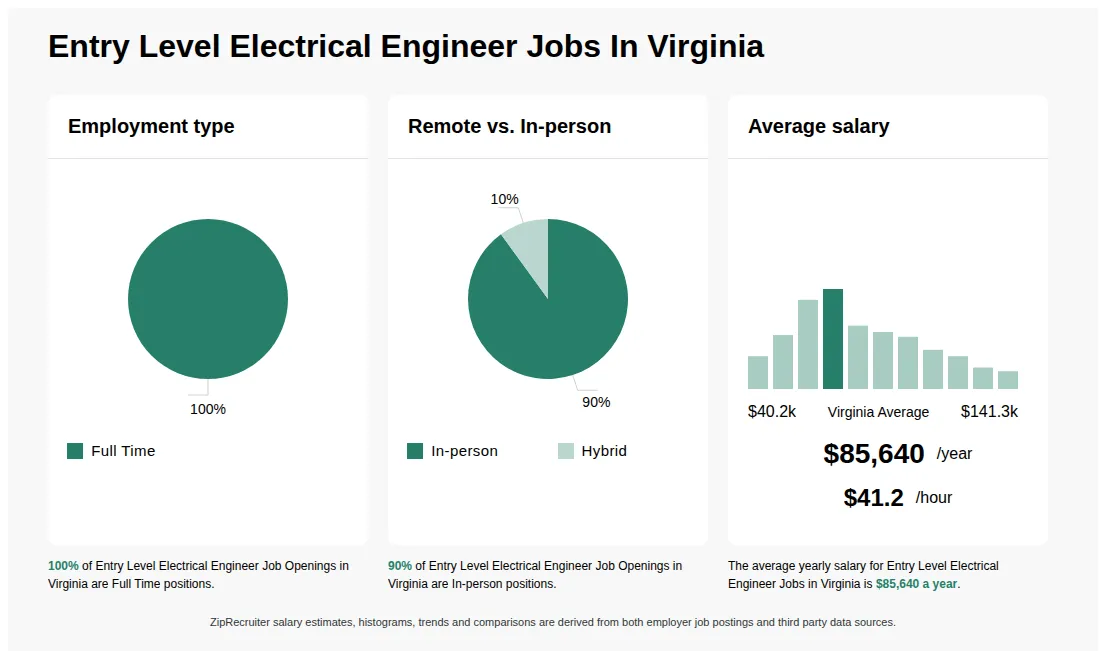
Entry Level Electrical Engineer information
See Virginia salary details
$40.2K - $49.3K
5% of jobs
$49.3K - $58.5K
10% of jobs
$64.4K is the 25th percentile. Wages below this are outliers.
$58.5K - $67.7K
16% of jobs
$67.7K - $76.9K
18% of jobs
The median wage is $77.8K / yr.
$76.9K - $86.1K
12% of jobs
$86.1K - $95.3K
11% of jobs
$98.9K is the 75th percentile. Wages above this are outliers.
$95.3K - $104.5K
10% of jobs
$104.5K - $113.7K
7% of jobs
$113.7K - $122.9K
5% of jobs
$122.9K - $132.1K
3% of jobs
$132.1K - $141.3K
3% of jobs
$40.2K
$85.6K
$141.3K
How much do entry level electrical engineer jobs pay per year?
As of Sep 13, 2026, the average yearly pay for entry level electrical engineer in Virginia is $85,640.00, according to ZipRecruiter salary data. Most workers in this role earn between $64,400.00 and $102,600.00 per year, depending on experience, location, and employer.
What does an entry level electrical engineer do?
An entry-level engineer performs a variety of tasks as part of their job. In this career, your main duties are to design, build, and test electronics, electrical systems, and electrical equipment, such as electric motors or navigation systems. Some electrical engineers design new industrial products, while others work on improving existing systems of products. You are responsible for creating all the standards and specifications, such as manufacturing blueprints, which the production staff reads and carries out. You also ensure that all systems or products meet safety and design standards.
What are the key skills and qualifications needed to thrive as an entry level electrical engineer, and why are they important?
To thrive as an Entry Level Electrical Engineer, you need a solid grasp of electrical engineering fundamentals, problem-solving skills, and a relevant bachelor's degree. Familiarity with technical tools such as CAD software (e.g., AutoCAD), circuit simulation programs, and industry standards, as well as an EIT (Engineer-in-Training) certification, is often expected. Strong teamwork, attention to detail, and effective communication skills help you contribute effectively to projects and collaborate with diverse teams. These abilities are crucial for delivering accurate engineering solutions, meeting project requirements, and supporting professional growth within the field.
What types of projects and responsibilities can an entry level electrical engineer expect during their first year on the job?
As an Entry Level Electrical Engineer, you'll often assist with designing electrical systems, drafting technical documents, and conducting tests under the supervision of senior engineers. You'll likely work on project teams, contributing to tasks such as circuit design, schematic reviews, and troubleshooting. Early responsibilities typically include supporting senior staff, learning company standards, and participating in client meetings or site visits. This hands-on experience helps new engineers develop practical skills and gain exposure to various aspects of electrical engineering projects.
What is the difference between Entry Level Electrical Engineer vs Electrical Technician?
| Aspect | Entry Level Electrical Engineer | Electrical Technician |
|---|---|---|
| Required Credentials | Bachelor's degree in electrical engineering | Associate degree or technical certification |
| Work Environment | Design, development, and testing of electrical systems | Installation, maintenance, and troubleshooting of electrical equipment |
| Employer & Industry Usage | Engineering firms, manufacturing, power generation | Construction, maintenance, and repair services |
While both roles involve electrical systems, Entry Level Electrical Engineers focus on designing and analyzing electrical projects, often requiring a bachelor's degree. Electrical Technicians typically handle installation and maintenance tasks with technical certifications. Understanding these differences helps job seekers identify the right career path based on their skills and credentials.
More about Entry Level Electrical Engineer jobs
What are the most commonly searched types of Electrical Engineer jobs in Virginia?
The most popular types of Electrical Engineer jobs in Virginia are:
What are popular job titles related to Entry Level Electrical Engineer jobs in Virginia?
For Entry Level Electrical Engineer jobs in Virginia, the most frequently searched job titles are:
- Internship Offshore Electrical Engineer
- Entry Level Electrical Hardware Engineer
- Entry Level Embedded Engineer
- Entry Level Engineering Technician
- Entry Level Firmware Engineer
- Commission Electrical Engineer Visa Sponsorship Available
- Entry Level Infrastructure Engineer
- Bio Electrical Engineer
- Entry Level Hardware Engineer
- Electrical Engineer Contract
What job categories do people searching Entry Level Electrical Engineer jobs in Virginia look for?
The top searched job categories for Entry Level Electrical Engineer jobs in Virginia are:
What cities in Virginia are hiring for Entry Level Electrical Engineer jobs?
Cities in Virginia with the most Entry Level Electrical Engineer job openings:
What are popular job titles related to Entry Level Electrical Engineer jobs in VA?
For Entry Level Electrical Engineer jobs in VA, the most frequently searched job titles are:

Entry Level Electrical/RF Engineer with Security Clearance
Dahlgren, VA • On-site
Amentum
• Guided Missile and Space Vehicle Manufacturing • 10K+ employees10,000+ employees
Other
Medical, Dental, Vision, Life, Retirement, PTO
Re-posted 2 days ago
Job description
Amentum is seeking a talented and motivated RF Test Engineer to join our team, supporting advanced laboratory and test event operations at the Naval Surface Warfare Center, Dahlgren Division (NSWCDD). The ideal candidate will have hands-on experience in Electromagnetic Compatibility (EMC), Electromagnetic Vulnerability (EMV), and Hazards of Electromagnetic Radiation to Ordnance (HERO) testing while contributing to mission-critical defense projects. Key Responsibilities * Conduct EMC, EMV, and HERO testing within the NSWCDD Electromagnetic Environmental Effects (E3) Test Facilities, including anechoic chambers, reverberation chambers, and open-air testing sites. * Operate and maintain instrumentation and measurement systems utilized for E3 testing. * Perform data collection, analysis, and reporting on electromagnetic environments and their potential vulnerabilities. * Execute comprehensive evaluations to identify and mitigate E3-related issues, such as electromagnetic interference (EMI). * Assist in the design, implementation, and verification of corrective measures to address identified E3 problems. * Participate in test event preparation, coordination, and execution, which may include local travel to other field testing locations. * Collaborate with team members and stakeholders to ensure seamless test execution and support for program requirements. Minimum Qualifications: * A Bachelor's degree from an accredited college or university Electrical Engineering, Electronic Engineering, or Physics; * Degree may be substituted with four year specialized experience using instrumentation and measurement systems required to conduct EMC, EMV, EMI, or HERO testing; using standard E3 test facilities, such as an anechoic chamber, reverberation chamber, and/or open air test site to conduct E3 tests; performing analyses and evaluations to predict and define E3 problems; and defining/designing corrective measures. * Test Event Support will include day travel to various test sites, locally. * Must be able to obtain and maintain Active Secret US Government Clearance. Note: US Citizenship is required to maintain a Secret Clearance. Compensation Details:
US: $75,000 to $95,000 The compensation range or hourly rate listed for this position is provided as a good-faith estimate of what the company intends to offer for this role at the time this posting was issued. Actual compensation may vary based on factors such as job responsibilities, education, experience, skills, internal equity, market data, applicable collective bargaining agreements, and relevant laws. Benefits Overview: Our health and welfare benefits are designed to support you and your priorities. Offerings include: * Health, dental, and vision insurance * Paid time off and holidays * Retirement benefits (including 401(k) matching) * Educational reimbursement * Parental leave * Employee stock purchase plan * Tax-saving options * Disability and life insurance * Pet insurance Note: Benefits may vary based on employment type, location, and applicable agreements. Positions governed by a Collective Bargaining Agreement (CBA), the McNamara-O'Hara Service Contract Act (SCA), or other employment contracts may include different provisions/benefits. Original Posting:
05/13/2026 - Until Filled
Amentum anticipates this job requisition will remain open for at least three days, with a closing date no earlier than three days after the original posting. This timeline may change based on business needs. Amentum is proud to be an Equal Opportunity Employer. Our hiring practices provide equal opportunity for employment without regard to race, sex, sexual orientation, pregnancy (including pregnancy, childbirth, breastfeeding, or medical conditions related to pregnancy, childbirth, or breastfeeding), age, ancestry, United States military or veteran status, color, religion, creed, marital or domestic partner status, medical condition, genetic information, national origin, citizenship status, low-income status, or mental or physical disability so long as the essential functions of the job can be performed with or without reasonable accommodation, or any other protected category under federal, state, or local law. Learn more about your rights under Federal laws and supplemental language at Labor Laws Posters .
US: $75,000 to $95,000 The compensation range or hourly rate listed for this position is provided as a good-faith estimate of what the company intends to offer for this role at the time this posting was issued. Actual compensation may vary based on factors such as job responsibilities, education, experience, skills, internal equity, market data, applicable collective bargaining agreements, and relevant laws. Benefits Overview: Our health and welfare benefits are designed to support you and your priorities. Offerings include: * Health, dental, and vision insurance * Paid time off and holidays * Retirement benefits (including 401(k) matching) * Educational reimbursement * Parental leave * Employee stock purchase plan * Tax-saving options * Disability and life insurance * Pet insurance Note: Benefits may vary based on employment type, location, and applicable agreements. Positions governed by a Collective Bargaining Agreement (CBA), the McNamara-O'Hara Service Contract Act (SCA), or other employment contracts may include different provisions/benefits. Original Posting:
05/13/2026 - Until Filled
Amentum anticipates this job requisition will remain open for at least three days, with a closing date no earlier than three days after the original posting. This timeline may change based on business needs. Amentum is proud to be an Equal Opportunity Employer. Our hiring practices provide equal opportunity for employment without regard to race, sex, sexual orientation, pregnancy (including pregnancy, childbirth, breastfeeding, or medical conditions related to pregnancy, childbirth, or breastfeeding), age, ancestry, United States military or veteran status, color, religion, creed, marital or domestic partner status, medical condition, genetic information, national origin, citizenship status, low-income status, or mental or physical disability so long as the essential functions of the job can be performed with or without reasonable accommodation, or any other protected category under federal, state, or local law. Learn more about your rights under Federal laws and supplemental language at Labor Laws Posters .

About Amentum
Sourced by ZipRecruiter
Industry
Guided missile and space vehicle manufacturing and machinery manufacturing
Company size
10,000+ Employees
Headquarters location
Chantilly, VA, US