1

Director Of Communications Jobs (NOW HIRING)

The Role The Director of Communications will report directly to the CEO and develop, maintain, and execute AnthoslHome's organization-wide communications strategy and manage all internal and external ...

Director of Communications

New York, NY · On-site

$100K - $125K/yr

The Role The Director of Communications will report directly to the CEO and develop, maintain, and execute AnthoslHome's organization-wide communications strategy and manage all internal and external ...

Director of Communications Job Summary: The Director of Communications will lead and refine the Jewish Connection Network's communications strategy for engaging constituents, while building and ...

The Communications Director will lead and execute the overall communications strategy for our client. This individual will serve as a key member of the leadership team, working across departments to ...

Director of Communications Job Summary: The Director of Communications will lead and refine the Jewish Connection Network's communications strategy for engaging constituents, while building and ...

Director of Communications

Manhattan, NY · On-site

$110K - $125K/yr

The Director of Communications manages the execution of media relations, content, and internal communications initiatives, ensuring consistent delivery of communications activities in support of ...

Starkey is seeking a strategic and creative Director of Communications to lead all internal and external communications, branding, advertising, media relations, and reputation management efforts.

next page

Showing results 1-20

Director Of Communications information

See salary details

$35K

$102.3K

$170K

How much do director of communications jobs pay per year?

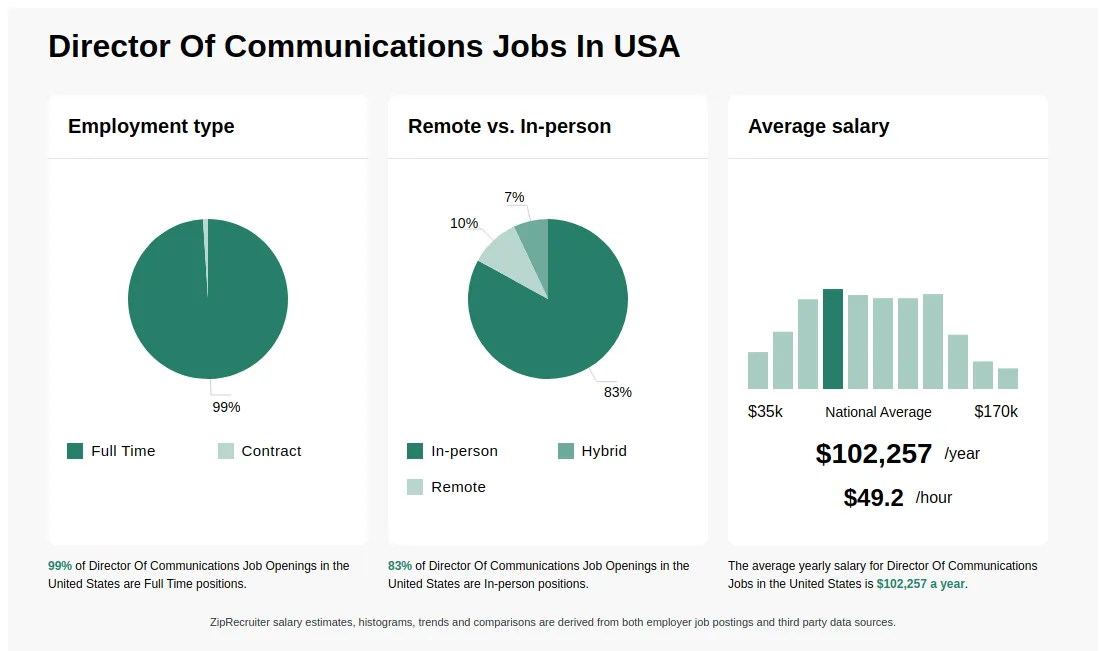
As of Aug 18, 2026, the average yearly pay for director of communications in the United States is $102,257.00, according to ZipRecruiter salary data. Most workers in this role earn between $74,000.00 and $126,000.00 per year, depending on experience, location, and employer.

What does a director of communications do?

A Director of Communications is responsible for managing and overseeing an organization's internal and external communications strategies. This role involves developing messaging, handling media relations, supervising communications teams, and ensuring that all public-facing information reflects the organization's goals and values. Directors of Communications often work closely with executive leadership to shape the organization's image and respond to public or media inquiries. They also play a key role in crisis communications and brand management.

What does a director of communications do?

The way that an organization communicates with its customers, audience, stakeholders, and internal members is central to its success. A director of communications manages internal and external messaging on behalf of the organization. Regular duties include coordinating print and digital communications, directing public relations events, approving press releases, and preparing public relations statements to address changes within the organization. One of their primary responsibilities is to develop and implement a communications strategy to be used throughout the organization. The communications strategy guides the organization in building relationships with partners and managing public relations.

How does a director of communications typically collaborate with other departments to ensure consistent messaging?

A Director of Communications works closely with leaders from marketing, human resources, public relations, and executive teams to align messaging across all channels. This collaboration often involves regular strategy meetings, sharing updates on current campaigns, and coordinating responses to media inquiries or public events. By fostering open communication and providing guidance, the Director helps maintain a unified voice for the organization, ensuring that both internal and external communications reflect the company's values and goals. This cross-departmental teamwork is vital for handling crises, launching initiatives, and managing the organization's reputation.

What are the key skills and qualifications needed to thrive as a director of communications, and why are they important?

To thrive as a Director of Communications, you need expertise in strategic communication, media relations, brand management, and typically a bachelor’s or master’s degree in communications, public relations, or a related field. Familiarity with media monitoring tools, content management systems, and digital analytics platforms is crucial. Outstanding leadership, crisis management, and persuasive writing skills set top performers apart in this role. These skills and qualities ensure effective messaging, protect organizational reputation, and drive successful communication strategies.

What is the difference between Director Of Communications vs Public Relations Manager?

AspectDirector Of CommunicationsPublic Relations Manager
CredentialsBachelor's degree in communications, marketing, or related field; often advanced degrees preferredBachelor's degree in communications, public relations, or related field
Work EnvironmentCorporate, nonprofit, or government organizations overseeing internal and external messagingPublic relations firms or corporate PR departments managing media and public image
Employer & Industry UsageUsed across various industries for strategic communication leadershipCommonly found in PR agencies and corporate settings focusing on media relations
Search & Comparison IntentPeople comparing strategic communication roles and leadership responsibilitiesIndividuals seeking roles focused on media relations and public image management

The main difference is that a Director Of Communications oversees overall communication strategies and manages teams, while a Public Relations Manager focuses more on media relations and public image execution. Both roles require strong communication skills and relevant experience, but the Director typically has broader strategic responsibilities.

What does a director of communications make?

A director of communications typically earns a salary that ranges from $70,000 to over $150,000 annually, depending on the industry, company size, and experience. They often oversee public relations, internal communications, and media strategies, requiring strong leadership and communication skills.

What cities are hiring for Director Of Communications jobs?

Cities with the most Director Of Communications job openings:

What are the most commonly searched types of Of Communications jobs?

The most popular types of Of Communications jobs are:

What states have the most Director Of Communications jobs?

States with the most job openings for Director Of Communications jobs include:

Infographic showing various Director Of Communications job openings in the United States as of August 2026, with employment types broken down into 1% As Needed, 87% Full Time, 10% Part Time, and 2% Contract. Highlights an 91% Physical, 3% Hybrid, and 6% Remote job distribution, with an average salary of $102,257 per year, or $49.2 per hour.

Full-time

Posted 10 days ago


Job description

Position Summary:

The Director of Communications leads the Community Food Bank of Southern Arizona's (CFB's) external communications, media relations, public messaging, and organizational storytelling across its five-county service area. This position is responsible for strengthening how CFB communicates its mission, impact, strategic direction, advocacy priorities, fundraising case, and role in building a stronger and more resilient regional food system. The Director works cross-functionally with executive leadership, Fund Development, Community Impact, Policy, Programs, Operations, and other teams to ensure CFB's public communications are clear, consistent, accessible, accurate, and grounded in the lived experiences of neighbors and communities. The role translates complex strategies, data, evaluation findings, food systems work, and policy issues into compelling public narratives that build trust, deepen donor and community engagement, and inspire action.

Available for after-hours or weekend work as needed to support media response, events, emergency communications, and organizational priorities.

Key Responsibilities:

External Communications Strategy and Organizational Alignment

  • In alignment with CFB's strategic plan, develop and implement an integrated external communications strategy that strengthens public understanding of CFB's mission, impact, programs, advocacy work, fundraising priorities, and food systems role.
  • Help evolve CFB's public narrative beyond food distribution alone to communicate the broader story of food access, community resilience, health, equity, and the root causes of hunger.
  • Partner with executive leadership and department leaders to establish organizational messaging priorities, annual communications plans, editorial calendars, and clear approval processes.
  • Translate strategic initiatives, program outcomes, evaluation findings, and operational changes into plain-language communications for donors, partners, neighbors, policymakers, volunteers, media, and the general public.
  • Develop and maintain organizational message, talking points, and other tools that support consistent communications across departments and counties.
  • Establish and monitor key performance indicators related to media coverage, message reach, audience engagement, storytelling, public awareness, and communications effectiveness.

Media Relations

  • Lead proactive and responsive media relations across nationally, regionally and in CFB’s service area (Pima, Cochise, Graham, Greenlee, and Santa Cruz counties), cultivating relationships with reporters, editors, producers, and community media partners.
  • Identify media opportunities that elevate CFB's programs, community needs, advocacy priorities, donor investments, partnerships, and measurable impact.
  • Coordinate media inquiries, interviews, press releases, media advisories, background materials, crisis statements, and follow-up; maintain a timely and accurate response process.
  • Serve as an organizational spokesperson when appropriate and prepare, coach, and support leaders and subject matter experts for interviews and public appearances.
  • Monitor media coverage, public discourse, emerging issues, and misinformation related to hunger, food insecurity, public benefits, nonprofit services, and food systems; recommend timely responses.

Storytelling and Community Voice

  • Lead CFB's storytelling strategy and build a sustainable story-gathering process that reflects the experiences of neighbors, partners, volunteers, donors, staff, and communities throughout the service area.
  • Develop, facilitate, and train a cross-functional staff storytelling committee to identify story opportunities, strengthen interviewing and writing practices, and maintain an accessible story bank.
  • Establish ethical standards and procedures for informed consent, privacy, dignity, compensation or recognition when appropriate with people sharing lived experiences.
  • Produce or oversee high-quality written, digital, visual, and multimedia content for media, web, social channels, reports, presentations, donor communications, campaigns, and community education.

Avocacy, Food Systems, and Public Education

  • Partner with Policy, Community Impact, and Program teams to communicate how public policy, public benefits, local food systems, health, and community investment affect food insecurity in Southern Arizona.
  • Translate advocacy priorities into accessible, accurate, and nonpartisan language that supports public understanding and appropriate action.
  • Develop communications for advocacy campaigns, community education, partner briefings, calls to action, and policy-related events.
  • Prepare talking points, fact sheets, public statements, op-eds, presentations, social media content, and other materials that explain the local impact of policy decisions and systems-level solutions.

Leadership, Training, and Cross-Functional Collaboration

  • Train staff and leadership on media protocols, storytelling practices, message discipline, public speaking, crisis communications, and appropriate external communications.
  • Build strong working relationships across CFB departments and locations to ensure communications reflect program expertise, operational realities, community needs, and organizational priorities.
  • Lead or support crisis and emergency communications, including rapid coordination, message development, approval, and dissemination across appropriate channels.

Other Duties

  • Perform other duties as assigned.

Please note this job description is not designed to cover or contain a comprehensive listing of activities, duties, or responsibilities required of the staff member for this job. Duties, responsibilities, and activities may change at any time with or without notice.

Reasonable accommodations may be made to enable individuals with disabilities to perform these essential functions.

Qualifications

Minimum Qualifications:

  • Eight (8) or more years of progressively responsible experience in communications, public relations, journalism, marketing, community relations, nonprofit communications, or a related field.
  • Bachelor's degree in communications, public relations, journalism, marketing, public affairs, or a related field.
  • Demonstrated experience managing media relations and producing high-quality communications for varied public audiences.
  • Intermediate proficiency in Microsoft Office applications (Outlook, Word, Excel, PowerPoint, Teams, SharePoint, etc.) and Adobe Suite.
  • Familiarity with digital communications and content-management tools.
  • Valid Arizona Driver's License with a clean driving record; ability to travel to CFB locations in the five-county service area, regionally and nationally

Preferred Qualifications:

  • Master's degree in communications, public relations, public health, public administration, journalism, marketing, or a related field.
  • Experience working in or with a nonprofit, food bank, public health organization, community-based organization, or mission-driven institution.
  • Familiarity with food systems, hunger relief, public benefits, health equity, or public health communications.
  • Experience communicating policy or advocacy issues in a nonpartisan environment.
  • Experience with crisis communications and organizational reputation management.
  • Bilingual English/Spanish.

Skills & Knowledge

  • Exceptional writing, editing, verbal communication, and public-speaking skills, with the ability to adapt voice, tone, and format for diverse audiences.
  • Ability to translate complex data, research, evaluation findings, policy information, and organizational strategy into accurate, accessible, and compelling public narratives.
  • Strong knowledge of media relations, public messaging, reputation management, and communications planning.
  • Familiarity with food systems or public health communications and the social, economic, and policy factors that influence food insecurity.
  • Experience working respectfully with community members who have lived experience of food insecurity
  • Ability to develop talking points, press materials, presentations, public statements, op-eds, advocacy communications, executive messaging, and digital content.
  • Strong editorial judgment, discretion, and ability to manage confidential, sensitive, or rapidly evolving information.
  • Ability to coach and train staff, leaders, and subject matter experts in storytelling, media engagement, and public communications.
  • Ability to build collaborative relationships with community organizations, media, funders, policymakers, partners, and stakeholders from diverse economic, social, cultural, and political backgrounds.
  • Knowledge of accessibility, inclusive language, cultural humility, informed consent, privacy, and dignity-centered communications practices.
  • Available for after-hours or weekend work as needed to support media response, events, emergency communications, and organizational priorities.

Core Competencies

  • Strategic Communications Leadership
  • Media Relations & Reputation Management
  • Organizational Storytelling & Community Voice
  • Data Translation & Public Narrative
  • Advocacy & Food Systems Communication
  • Leadership, Coaching & Cross-Functional Collaboration
  • Equity-Centered, Ethical & Accessible Communication
  • Equivalent combination of education and experience may be considered if applicable and must be directly related to the functions and body of knowledge required to successfully perform the job.

Physical Requirements:

Light Work - ability to exert 20 pounds of force occasionally, and/or up to 10 pounds of force frequently, and/or a negligible amount of force constantly to move objects.

Expectations:

CFB is dedicated to fostering a workplace where our Core Values of Dignity, Integrity, Collaboration, and Impact are actively demonstrated and supported in all aspects of our work.

CFB works diligently to maintain a culture of fairness, responsibility, trustworthiness, and teamwork to advance our mission: We change lives in the communities we serve by feeding the hungry today and building a healthy, hunger-free tomorrow.

CFB is a drug- and tobacco-free work environment.

CFB is committed to having a workforce that reflects diversity at all levels and is an equal opportunity employer. Qualified applicants are considered for employment, and staff members are treated during employment without regard to race, color, religion, national origin, citizenship, age, sex, sexual orientation, gender identity, marital status, ancestry, physical or mental disability, veteran status, or any other characteristic protected under applicable law.