1

Dea Intelligence Analyst Jobs (NOW HIRING)

Collection Operations Manager

Washington, DC · On-site

  • Medical

  • Dental

  • Vision

  • Retirement

... DEA, FBI, and department of treasury and state programs and products highly desired. Education: * Bachelor's degree. * Specialized training from any intelligence collection and analysis school or ...

Contract Marketing Analyst

Lake Zurich, IL

$62K - $78K/yr

  • Medical

  • Dental

  • Vision

  • Life

  • Retirement

... COT, DEA, HIN information, etc.). * Assist Manager, Contract Operations with Pre-deal contract ... Skills in MS Word, Excel, PowerPoint, Business Intelligence platforms, analytics, and organization.

Contract Marketing Analyst

Lake Zurich, IL · On-site

$62K - $78K/yr

  • Medical

  • Dental

  • Vision

  • Life

  • Retirement

... COT, DEA, HIN information, etc.). * Assist Manager, Contract Operations with Pre-deal contract ... Skills in MS Word, Excel, PowerPoint, Business Intelligence platforms, analytics, and organization.

Information Security Advisor

Merrifield, VA · On-site

  • Medical

  • Dental

  • Vision

  • Life

  • Retirement

  • PTO

Analyze and contextualize intelligence to produce actionable recommendations. c. Share relevant ... Support internal coordination with DEA sections, divisions, and external entities. 9. Maintain ...

Showing results 41-60

Dea Intelligence Analyst information

See salary details

$41K

$100.1K

$154.5K

How much do dea intelligence analyst jobs pay per year?

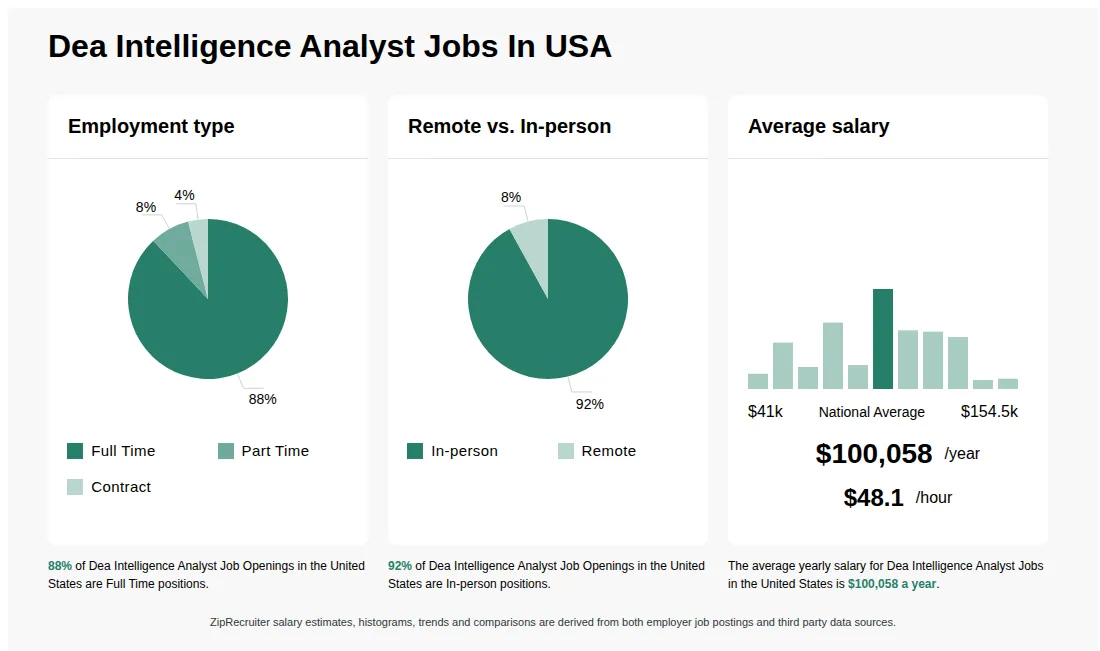
As of Aug 17, 2026, the average yearly pay for dea intelligence analyst in the United States is $100,058.00, according to ZipRecruiter salary data. Most workers in this role earn between $77,000.00 and $120,500.00 per year, depending on experience, location, and employer.

What does a DEA Intelligence Analyst do?

A DEA Intelligence Analyst gathers, analyzes, and interprets intelligence related to drug trafficking, criminal organizations, and national security threats. They use data from various sources, including law enforcement databases and surveillance, to identify trends and provide actionable insights. Their work supports DEA agents and other agencies in making informed decisions to combat drug-related crimes. Analysts may also collaborate with federal, state, and local agencies to disrupt criminal networks and enhance public safety.

What are the key skills and qualifications needed to thrive as a DEA Intelligence Analyst?

To thrive as a DEA Intelligence Analyst, you need strong analytical abilities, attention to detail, and experience with criminal justice or intelligence analysis, often supported by a relevant bachelor's degree and security clearance. Familiarity with intelligence databases, link analysis software, and tools such as Analyst's Notebook or Palantir is typically required, along with knowledge of federal law enforcement systems. Exceptional communication, critical thinking, and teamwork skills set top analysts apart in investigating and interpreting complex data. These skills are essential to accurately assess threats, support investigations, and contribute to the successful disruption of illegal drug activities.

What are some typical challenges a DEA Intelligence Analyst might encounter on the job?

DEA Intelligence Analysts often face the challenge of processing large volumes of complex and sensitive information while meeting tight deadlines. They must continually adapt to evolving tactics used by drug trafficking organizations and synthesize data from various sources to identify patterns and potential threats. Collaboration with special agents, other government agencies, and local law enforcement is crucial, requiring strong interpersonal and organizational skills. Staying current with changes in technology and drug trends is also essential for ongoing success and career advancement in this field.

How much does a DEA intelligence analyst make?

A DEA intelligence analyst typically earns between $60,000 and $100,000 annually, depending on experience, education, and location. The role often requires strong analytical skills and knowledge of law enforcement procedures, with opportunities for overtime and advancement.
More about Dea Intelligence Analyst jobs

What cities are hiring for Dea Intelligence Analyst jobs?

Cities with the most Dea Intelligence Analyst job openings:

What are the most commonly searched types of Dea Intelligence Analyst jobs?

The most popular types of Dea Intelligence Analyst jobs are:

What states have the most Dea Intelligence Analyst jobs?

States with the most job openings for Dea Intelligence Analyst jobs include:

Infographic showing various Dea Intelligence Analyst job openings in the United States as of August 2026, with employment types broken down into 94% Full Time, and 6% Part Time. Highlights an 89% In-person, and 11% Remote job distribution, with an average salary of $100,058 per year, or $48.1 per hour.

Performance/Data Analyst III with Security Clearance

AITHERAS, LLC

Washington, DC • On-site

Other

Re-posted 27 days ago


Job description

Performance/Data Analyst III
Standardized Job Description Title: Performance/Data Analyst III
Location: Washington, DC / DOJ Facilities / JMD OCIO / NCC
Clearance or Background Needs: U.S. Citizen; active Secret clearance minimum; Top Secret/SCI eligibility strongly preferred
Experience Band: 6–10+ years
Openings: 3 FTEs Summary The Performance/Data Analyst III serves as a senior data science and analytics professional supporting DOJ JMD/OCIO and HSTF. This role leads advanced analytics, machine learning modeling, network analysis, ETL development, Tableau dashboard enhancement, MIS data governance, and executive-level reporting. The analyst supports operational targeting, performance tracking, resource allocation, investigative prioritization, audit readiness, and interagency data integration. Key Responsibilities
Lead advanced analytics, statistical modeling, machine learning, and network analysis for HSTF operational and strategic use cases.
Integrate, clean, and merge data from DOJ MIS, FBI, DEA, HSI, ATF, IRS-CI, USAO, and other partner systems.
Develop and maintain ETL pipelines for recurring ingestion and transformation of interagency datasets.
Build predictive models for investigative prioritization, case success probability, resource allocation, and operational impact.
Maintain, enhance, and potentially migrate automated Tableau dashboards.
Produce executive, operational, congressional, and interagency performance reports.
Conduct quarterly MIS data quality audits and develop audit dashboards with remediation recommendations.
Document schemas, data dictionaries, business rules, transformation logic, and analytical methodologies.
Identify automation opportunities, workflow optimizations, and reporting improvements.
Support transition-in and transition-out activities, preserving institutional knowledge and continuity of operations.
Required Qualifications
Bachelor’s degree in Data Science, Computer Science, Statistics, Analytics, Mathematics, Information Systems, or related field.
6+ years of applied data science, advanced analytics, BI, or performance measurement experience.
Active Secret clearance; ability to obtain or maintain Top Secret/SCI eligibility where required.
U.S. citizenship by birth or naturalization.
Expert-level SQL skills for extraction, transformation, analysis, and optimization.
Strong Python and/or R experience for statistical modeling, data processing, and automation.
Tableau dashboard development and performance reporting experience.
Experience with machine learning, predictive modeling, statistical analysis, or network analysis.
Experience integrating complex, multi-source, structured datasets.
Experience with law enforcement, intelligence, investigations, asset forfeiture, financial crimes, or federal operational data.
Strong understanding of data governance, quality assurance, privacy, and secure handling of sensitive information.
Ability to communicate complex analytical findings to executives, operational teams, and non-technical stakeholders.
Preferred / Nice-to-Have Qualifications
Active Top Secret, TS/SCI, or SCI eligibility.
Prior DOJ, DHS, FBI, DEA, ATF, HSI, IRS-CI, USAO, or federal law enforcement analytics experience.
Experience with criminal network analysis, link analysis, target prioritization, or financial flow analysis.
Experience with audit readiness, reconciliation, financial management reporting, or asset forfeiture programs.
Experience designing enterprise dashboards for executive and operational audiences.
Familiarity with NIST, FISMA, CUI, PII, DOJ privacy/security policies, and federal data standards.
Experience with Tableau Server, Power BI, SAS, Alteryx, Palantir, i2 Analyst’s Notebook, Neo4j, ArcGIS, or cloud analytics platforms.
Master’s degree in Data Science, Statistics, Computer Science, Public Policy Analytics, Criminal Justice Analytics, or related field.
Tools / Technologies / Systems Python, R, SQL, Tableau, Excel, DOJ MIS, ETL pipelines, predictive models, machine learning libraries, statistical analysis tools, dashboards, data dictionaries, data governance tools, Tableau Server, Power BI, SAS, Alteryx, network analysis tools, law enforcement datasets, financial reporting systems Certifications Security+, CISSP, Tableau Certified Data Analyst, Tableau Certified Consultant, Microsoft Power BI Data Analyst, Certified Analytics Professional, AWS Certified Data Analytics, Google Professional Data Engineer, SAS Advanced Programmer, CISA, CDMP, PMP, ITIL Foundation KPIs / Performance Outcomes
Reliable integration of DOJ and interagency datasets into MIS analytics workflows.
Accurate and timely quarterly, ad hoc, congressional, and executive reports.
Improved investigative targeting and prioritization through predictive and network analytics.
Measurable reduction in data quality defects, reporting delays, and manual reporting effort.
Complete and reusable documentation of data lineage, business rules, dashboards, and model logic.