1

Contract Sewing Jobs (NOW HIRING)

Responsible for providing guidance and training to contract and full time ATC employees. The ... Provide job specific training for serge and single needle sewing as necessary. * Provide feedback ...

S. Army contracts. The Industrial Sewer should have knowledge of various fabrics, sewing techniques, and be familiar with commercial and industrial-grade machines. Activities include: * Sewing ...

Apply Early

Responsible for providing guidance and training to contract and full time ATC employees. The ... Provide job specific training for serge and single needle sewing as necessary. * Provide feedback ...

Industrial Sewer

Romulus, MI · On-site

$16 - $18/hr

This role focuses on operating industrial sewing machines to produce textile and canvas products ... Contract-to-hire opportunity Why Work With Workbox Staffing? * Weekly Pay * Hire-in Opportunities

Apply Early

Manage portable sewing equipment as well as industrial sewing machines and mobile workstation setup ... Short-term contracts typically 2-4 weeks depending on production schedule Benefits * All meals and ...

Operate sewing machines, industrial sewing machines, or knitting machines safely and efficiently ... You can earn a hire-on bonus after completing a contract-to-hire period, benefit from automatic ...

Apply Early

Flatwork/Cushion Sewer

Valdese, NC · On-site

$14 - $16.75/hr

... and contract markets. Shenandoah's artisans have been crafting high-quality upholstered seating ... Operate an industrial sewing machine to sew fabric together to complete cushions, pillows, and ...

Flatwork/Cushion Sewer

Valdese, NC · On-site

$14 - $16.75/hr

... and contract markets. Shenandoah's artisans have been crafting high-quality upholstered seating ... Operate an industrial sewing machine to sew fabric together to complete cushions, pillows, and ...

If you have sewing experience and are looking for a company that values quality, teamwork, and career growth, apply today! Job Type & Location This is a Contract to Hire position based out of Hickory ...

Apply Early

next page

Showing results 1-20

Contract Sewing information

See salary details

$9

$16

$21

How much do contract sewing jobs pay per hour?

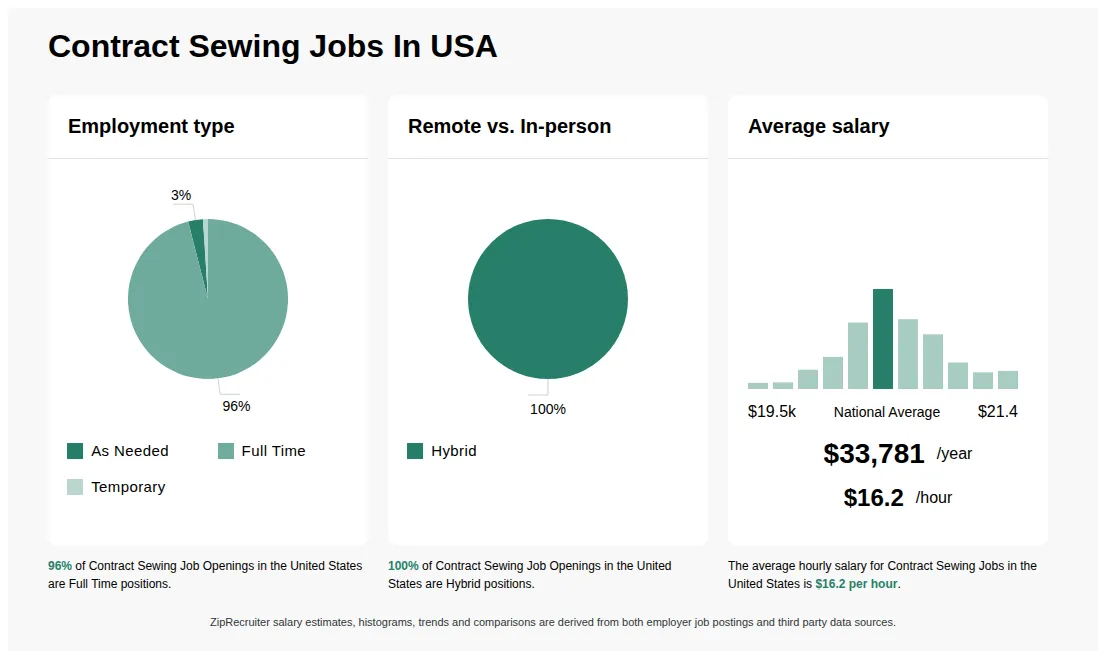
As of Jul 6, 2026, the average hourly pay for contract sewing in the United States is $16.24, according to ZipRecruiter salary data. Most workers in this role earn between $14.42 and $17.31 per hour, depending on experience, location, and employer.

What is the difference between Contract Sewing vs Pattern Maker?

AspectContract SewingPattern Maker
CredentialsTypically no formal certification required, but experience in sewing and industry knowledge preferredOften requires technical training or certification in pattern making or fashion design
Work EnvironmentFactories, sewing workshops, or production facilitiesDesign studios, pattern rooms, or manufacturing settings
Industry UsageUsed by apparel manufacturers, contractors, and production companiesUsed by fashion designers, apparel companies, and pattern companies
Job FocusAssembling garments based on specificationsCreating and developing patterns for garments

Contract Sewing involves assembling garments in a production setting, focusing on sewing and finishing. Pattern Makers design and develop patterns that guide garment construction. While Contract Sewing emphasizes manufacturing, Pattern Making centers on design and development. Both roles are essential in apparel production but differ in skills, responsibilities, and work environment.

What are the key skills and qualifications needed to thrive as a Contract Sewing Professional, and why are they important?

To excel as a Contract Sewing Professional, you need strong sewing skills, attention to detail, and experience with garment construction, often supported by vocational training or relevant certification. Familiarity with industrial sewing machines, sergers, and pattern-making software like Gerber or CAD systems is typically required. Excellent time management, problem-solving abilities, and clear communication help ensure efficiency and high-quality results when working with clients and teams. These competencies are crucial for meeting production deadlines, maintaining quality standards, and building successful client relationships in a competitive industry.

What are some common challenges faced by professionals in contract sewing, and how can they be addressed?

Professionals in contract sewing often encounter challenges such as fluctuating workloads, tight deadlines, and the need to adapt to a variety of client specifications. Managing time efficiently and maintaining clear communication with clients are crucial for meeting production targets and ensuring high-quality results. Building strong relationships with suppliers and staying updated on industry standards can also help contract sewers navigate material shortages or changes in project requirements. Collaborating closely with other team members, such as pattern makers and quality inspectors, is essential to address issues quickly and deliver consistent outcomes.

What Are Contract Sewing Jobs?

Contract sewing jobs focus on the production of clothing and other items using a sewing machine. Your duties and responsibilities as a contractor in this field vary depending on the details of each project on which you work. A client can ask you to sew materials for retail, custom designs, or personal use. However, as a contractor, you are not often responsible for mass production jobs. Your client should supply details for the project, such as the type of fabric, measurements, and required design elements. As a seamstress, you create a price for the project and ensure that you can complete the work by the deadline.

What is contract sewing?

Contract sewing refers to the process where a business or individual outsources the sewing and assembly of textile products to a specialized company or contractor. These contractors have the equipment and expertise to produce items such as clothing, bags, upholstery, or industrial fabric products at scale. Companies choose contract sewing to reduce overhead costs, increase production capacity, or access specialized skills and machinery. The contractor typically follows the client’s specifications and can handle anything from prototyping to full-scale manufacturing.
What cities are hiring for Contract Sewing jobs? Cities with the most Contract Sewing job openings:
What are the most commonly searched types of Sewing jobs? The most popular types of Sewing jobs are:
What states have the most Contract Sewing jobs? States with the most job openings for Contract Sewing jobs include:
Infographic showing various Contract Sewing job openings in the United States as of June 2026, with employment types broken down into 4% Temporary, and 96% Contract. Highlights an 82% Physical, 2% Hybrid, and 16% Remote job distribution, with an average salary of $33,781 per year, or $16.2 per hour.

$21 - $24/hr

Full-time

Posted 10 days ago


Job description

Industrial Sewer
Position Overview:
The Industrial Sewer is responsible for manufacturing textile assemblies for Newton's U.S. Army contracts. The Industrial Sewer should have knowledge of various fabrics, sewing techniques, and be familiar with commercial and industrial-grade machines.
Activities include:
  • Sewing fabrics using industrial sewing machines, such as Sailrite, Cordes and Consew
  • Maintaining equipment in good working order and a clean / organized workspace
  • Cutting textile components from raw material stock
  • Pinning layers and marking textile components using templates
  • Measuring and inspecting / verifying textiles meet dimensional / size requirements pre- and post-assembly
  • Constructing textiles according to templates and drawings / specifications
  • Performing other tasks as assigned

Required Skills:
  • Effective communication
  • Ability to adapt to evolving job responsibilities
  • Proven sewing experience
  • Demonstrated ability to work in a fast-paced environment under time constraints
  • Maintain strong attention to detail
  • Being authorized to work in the U.S.
  • Ability to consistently lift 30lbs+

Preferred Skills and Experience:
  • Ability to refine sewing processes and procedures to reduce completion time while maintaining quality standards
  • Ability to sew large, thick textiles such as boat sails
  • MIL-SPEC textile experience

Qualification:
To comply with U.S. Government space technology export regulations, applicants must be a U.S. citizen, lawful permanent resident of the U.S., protected individual as defined by 8 U.S.C. 1324b(a)(3), or eligible to obtain authorization from the U.S. Department of State.