Bestica is seeking a travel Clinical Lab Scientist (CLS) for a travel job in Orange, California. & Requirements * Specialty: Clinical Lab Scientist (CLS) * Discipline: Allied Health Professional
Bestica is seeking a travel Clinical Lab Scientist (CLS) for a travel job in Orange, California. & Requirements * Specialty: Clinical Lab Scientist (CLS) * Discipline: Allied Health Professional

Clinical Lab Scientist
Norfolk, VA · On-site
$32.07/hr
Reports to the Department Manager, Supervisor or Lead Clinical Lab Scientist and is responsible for following established policies, procedures, and regulations. Performs/assists with various clinical ...
Clinical Lab Scientist
Norfolk, VA · On-site
$32.07/hr
Reports to the Department Manager, Supervisor or Lead Clinical Lab Scientist and is responsible for following established policies, procedures, and regulations. Performs/assists with various clinical ...

CLINICAL LAB SCIENTIST
Temecula, CA · On-site
$44.74 - $67.12/hr
Clinical Lab Scientist (CLS) Reporting to the Director of Laboratory Services, the Clinical Lab Scientist is responsible for following established procedures to perform routine and STAT clinical ...
CLINICAL LAB SCIENTIST
Temecula, CA · On-site
$44.74 - $67.12/hr
Clinical Lab Scientist (CLS) Reporting to the Director of Laboratory Services, the Clinical Lab Scientist is responsible for following established procedures to perform routine and STAT clinical ...
Clinical Lab Scientist
Temecula, CA · On-site
Clinical Lab Scientist (CLS) Reporting to the Director of Laboratory Services, the Clinical Lab Scientist is responsible for following established procedures to perform routine and STAT clinical ...
Clinical Lab Scientist
Temecula, CA · On-site
Clinical Lab Scientist (CLS) Reporting to the Director of Laboratory Services, the Clinical Lab Scientist is responsible for following established procedures to perform routine and STAT clinical ...
Clinical Lab Scientist
Norfolk, VA · On-site
$32.07 - $48.11/hr
Reports to the Department Manager, Supervisor or Lead Clinical Lab Scientist and is responsible for following established policies, procedures, and regulations. Performs/assists with various clinical ...
Clinical Lab Scientist
Norfolk, VA · On-site
$32.07 - $48.11/hr
Reports to the Department Manager, Supervisor or Lead Clinical Lab Scientist and is responsible for following established policies, procedures, and regulations. Performs/assists with various clinical ...
Clinical Lab Scientist (CLS) * Discipline: Allied Health Professional * Start Date: 09/21/2026 * Duration: 13 weeks * 40 hours per week * Shift: 8 hours, nights * Employment Type: Travel TRA Clinical ...
Clinical Lab Scientist (CLS) * Discipline: Allied Health Professional * Start Date: 09/21/2026 * Duration: 13 weeks * 40 hours per week * Shift: 8 hours, nights * Employment Type: Travel TRA Clinical ...
Clinical Lab Scientist (CLS) * Discipline: Allied Health Professional * Start Date: 09/21/2026 * Duration: 13 weeks * 40 hours per week * Shift: 8 hours, nights * Employment Type: Travel TRA Clinical ...
Clinical Lab Scientist (CLS) * Discipline: Allied Health Professional * Start Date: 09/21/2026 * Duration: 13 weeks * 40 hours per week * Shift: 8 hours, nights * Employment Type: Travel TRA Clinical ...

Travel Clinical Lab Scientist (CLS) - $2,744 per week
Manhattan, NY · On-site
$111.12 - $138.59/hr
Travel Clinical Lab Scientist (CLS) - $2,744 per week Trustaff Allied is seeking a travel Clinical Lab Scientist (CLS) for a short‑term assignment in New York, New York. & Requirements * Specialty:
New
Travel Clinical Lab Scientist (CLS) - $2,744 per week
Manhattan, NY · On-site
$111.12 - $138.59/hr
Travel Clinical Lab Scientist (CLS) - $2,744 per week Trustaff Allied is seeking a travel Clinical Lab Scientist (CLS) for a short‑term assignment in New York, New York. & Requirements * Specialty:
New
Clinical Lab Scientist
Pelham, AL · On-site
$18 - $19/hr
Ongoing training Job Summary We are looking for a friendly and energetic Clinic Lab Scientist to join our clinic. Strong PC and Communication Skills needed. 1 year Clinical Lab experience preferred ...
Quick apply
Clinical Lab Scientist
Pelham, AL · On-site
$18 - $19/hr
Ongoing training Job Summary We are looking for a friendly and energetic Clinic Lab Scientist to join our clinic. Strong PC and Communication Skills needed. 1 year Clinical Lab experience preferred ...

Clinical Lab Scientist (CLS) * Discipline: Allied Health Professional * Start Date: 09/21/2026 * Duration: 13 weeks * 40 hours per week * Shift: 8 hours, rotating * Employment Type: Travel Coast ...
Clinical Lab Scientist (CLS) * Discipline: Allied Health Professional * Start Date: 09/21/2026 * Duration: 13 weeks * 40 hours per week * Shift: 8 hours, rotating * Employment Type: Travel Coast ...
Clinical Lab Scientist (CLS) * Discipline: Allied Health Professional * Start Date: 10/12/2026 * Duration: 13 weeks * 40 hours per week * Shift: 10 hours, rotating * Employment Type: Travel Coast ...
Clinical Lab Scientist (CLS) * Discipline: Allied Health Professional * Start Date: 10/12/2026 * Duration: 13 weeks * 40 hours per week * Shift: 10 hours, rotating * Employment Type: Travel Coast ...
Clinical Lab Scientist
Pelham, AL · On-site
$18 - $19/hr
Ongoing training Job Summary We are looking for a friendly and energetic Clinic Lab Scientist to join our clinic. Strong PC and Communication Skills needed. 1 year Clinical Lab experience preferred ...
Quick apply
Clinical Lab Scientist
Pelham, AL · On-site
$18 - $19/hr
Ongoing training Job Summary We are looking for a friendly and energetic Clinic Lab Scientist to join our clinic. Strong PC and Communication Skills needed. 1 year Clinical Lab experience preferred ...
Clinical Lab Scientist
Las Cruces, NM · On-site
$65 - $90/hr
Clinical Lab Scientist/Medical Technologist/Medical Lab Specialist (CLS/MT/MLS) Schedule: this is a full time, evening shift role. Your experience matters As a Clinical Lab Scientist joining our team ...
New
Clinical Lab Scientist
Las Cruces, NM · On-site
$65 - $90/hr
Clinical Lab Scientist/Medical Technologist/Medical Lab Specialist (CLS/MT/MLS) Schedule: this is a full time, evening shift role. Your experience matters As a Clinical Lab Scientist joining our team ...
New
Tenet Desert is seeking a Clinical Lab Scientist (CLS) for a job in Joshua Tree, California. & Requirements * Specialty: Clinical Lab Scientist (CLS) * Discipline: Allied Health Professional
Tenet Desert is seeking a Clinical Lab Scientist (CLS) for a job in Joshua Tree, California. & Requirements * Specialty: Clinical Lab Scientist (CLS) * Discipline: Allied Health Professional
Clinical Lab Scientist (CLS)
Manteca, CA · On-site
Clinical Lab Scientist (CLS) * Discipline: Allied Health Professional * Duration: Ongoing * Employment Type: Staff Job Type: Full Time Job Shift: Nights Holiday Rotation: Department: Laboratory ...
Clinical Lab Scientist (CLS)
Manteca, CA · On-site
Clinical Lab Scientist (CLS) * Discipline: Allied Health Professional * Duration: Ongoing * Employment Type: Staff Job Type: Full Time Job Shift: Nights Holiday Rotation: Department: Laboratory ...
Clinical Lab Scientist (CLS) * Discipline: Allied Health Professional * Start Date: 09/28/2026 * Duration: 13 weeks * 40 hours per week * Shift: 10 hours, days * Employment Type: Travel Coast ...
Clinical Lab Scientist (CLS) * Discipline: Allied Health Professional * Start Date: 09/28/2026 * Duration: 13 weeks * 40 hours per week * Shift: 10 hours, days * Employment Type: Travel Coast ...
Clinical Lab Scientist (CLS) * Discipline: Allied Health Professional * Start Date: 09/28/2026 * Duration: 13 weeks * 40 hours per week * Shift: 10 hours, days * Employment Type: Travel Coast ...
Clinical Lab Scientist (CLS) * Discipline: Allied Health Professional * Start Date: 09/28/2026 * Duration: 13 weeks * 40 hours per week * Shift: 10 hours, days * Employment Type: Travel Coast ...
Clinical Lab Scientist (CLS) * Discipline: Allied Health Professional * Start Date: 09/21/2026 * Duration: 13 weeks * 40 hours per week * Shift: 8 hours, nights * Employment Type: Local Contract TRA ...
Clinical Lab Scientist (CLS) * Discipline: Allied Health Professional * Start Date: 09/21/2026 * Duration: 13 weeks * 40 hours per week * Shift: 8 hours, nights * Employment Type: Local Contract TRA ...
Clinical Lab Scientist
Pelham, AL · On-site
$18 - $19/hr
Ongoing training Job Summary We are looking for a friendly and energetic Clinic Lab Scientist to join our clinic. Strong PC and Communication Skills needed. 1 year Clinical Lab experience preferred ...
Quick apply
Clinical Lab Scientist
Pelham, AL · On-site
$18 - $19/hr
Ongoing training Job Summary We are looking for a friendly and energetic Clinic Lab Scientist to join our clinic. Strong PC and Communication Skills needed. 1 year Clinical Lab experience preferred ...
Clinical Lab Scientist (CLS) * Discipline: Allied Health Professional * Start Date: 09/21/2026 * Duration: 13 weeks * 40 hours per week * Shift: 8 hours, nights * Employment Type: Local Contract TRA ...
Clinical Lab Scientist (CLS) * Discipline: Allied Health Professional * Start Date: 09/21/2026 * Duration: 13 weeks * 40 hours per week * Shift: 8 hours, nights * Employment Type: Local Contract TRA ...
Clinical Lab Scientist information
See salary details
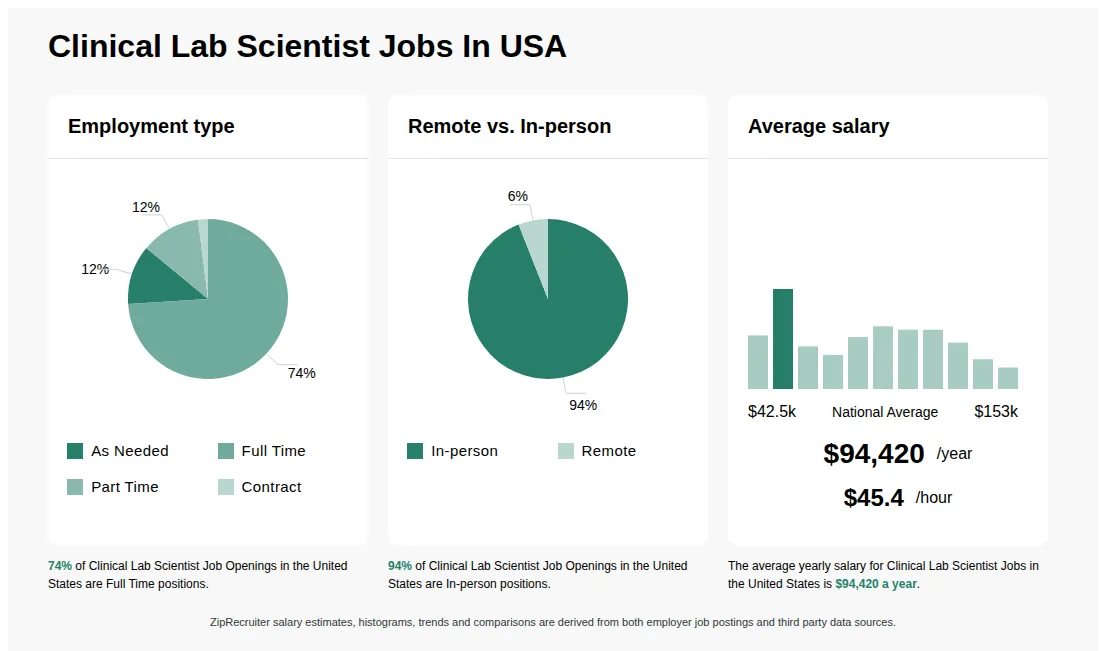
$42.5K - $52.5K
9% of jobs
$61.3K is the 25th percentile. Wages below this are outliers.
$52.5K - $62.6K
18% of jobs
$62.6K - $72.6K
7% of jobs
$72.6K - $82.7K
6% of jobs
The median wage is $92.2K / yr.
$82.7K - $92.7K
9% of jobs
$92.7K - $102.8K
12% of jobs
$102.8K - $112.8K
11% of jobs
$115.1K is the 75th percentile. Wages above this are outliers.
$112.8K - $122.9K
11% of jobs
$122.9K - $132.9K
8% of jobs
$132.9K - $143K
5% of jobs
$143K - $153K
3% of jobs
$42.5K
$94.4K
$153K
How much do clinical lab scientist jobs pay per year?
As of Sep 4, 2026, the average yearly pay for clinical lab scientist in the United States is $94,420.00, according to ZipRecruiter salary data. Most workers in this role earn between $59,000.00 and $119,000.00 per year, depending on experience, location, and employer.
What is a clinical lab scientist?
Clinical Lab Scientists, also known as medical laboratory scientists or medical technologists, are healthcare professionals who perform laboratory tests on patient samples to help diagnose, treat, and prevent diseases. They analyze blood, urine, tissue, and other bodily fluids using sophisticated equipment and techniques. Their work is essential for providing accurate and timely information to physicians, ensuring effective patient care. Clinical Lab Scientists must follow strict protocols and maintain quality control to ensure reliable results. They often work in hospitals, clinics, research labs, and public health organizations.
What does a clinical lab scientist do?
As a clinical lab scientist, you work in a laboratory to process tests used in the diagnosis and treatment of patients. Your duties may include monitoring test quality, analyzing tissue, cells, and body fluids, working with other lab staff, and communicating results to physicians. You identify bacteria and viruses, ensure proper handling of blood and potentially biologically hazardous materials, prepare lab tests, organize samples, review drug levels and toxicology, and make conclusions from test results. A clinical lab scientist typically works for a clinic, doctor's office, research lab, or a diagnostic lab.
What are the key skills and qualifications needed to thrive as a clinical lab scientist, and why are they important?
To thrive as a Clinical Lab Scientist, you need a solid background in biology, chemistry, and laboratory procedures, typically supported by a bachelor's degree in medical laboratory science and relevant certification (such as ASCP). Familiarity with laboratory information systems (LIS), automated analyzers, and quality control protocols is essential. Attention to detail, problem-solving abilities, and effective communication skills help ensure accurate testing and collaboration with healthcare teams. These competencies are crucial for delivering reliable diagnostic results that directly impact patient care and treatment decisions.
What are some common challenges clinical lab scientists face when handling high sample volumes, and how can they manage these effectively?
Clinical Lab Scientists often experience periods of high sample volume, especially during outbreaks or peak hospital admissions. Managing this workload requires strong organizational skills, attention to detail, and proficiency with laboratory information systems to track samples efficiently. Effective communication with team members and prioritizing urgent cases help ensure timely and accurate results. Continual process improvement and adherence to quality control protocols also play a key role in maintaining performance under pressure.
What is the difference between Clinical Lab Scientist vs Medical Laboratory Technician?
| Aspect | Clinical Lab Scientist | Medical Laboratory Technician |
|---|---|---|
| Credentials | Bachelor's degree in medical technology or related field, certification (ASCP, AMT) | Associate's degree in medical laboratory technology, certification (ASCP, AMT) |
| Work Environment | Hospitals, diagnostic labs, research facilities | Hospitals, clinics, smaller labs |
| Job Responsibilities | Perform complex tests, analyze results, supervise lab staff | Prepare samples, perform routine tests, maintain equipment |
Clinical Lab Scientists and Medical Laboratory Technicians both work in laboratory settings and require certification. However, Clinical Lab Scientists typically hold a bachelor's degree and perform more complex testing and analysis, often supervising others. Medical Laboratory Technicians usually have an associate's degree and focus on routine testing and sample preparation. Both roles are essential in healthcare diagnostics, but Clinical Lab Scientists generally have a broader scope of responsibilities.
How much do clinical lab scientists get paid?
Clinical lab scientists typically earn a median annual salary of around $55,000 to $70,000, depending on experience, location, and certifications. Salaries can vary based on work setting, specialization, and level of education, with some earning higher with advanced skills or supervisory roles.
Is it hard to become a clinical lab scientist?
Becoming a clinical lab scientist typically requires earning a bachelor's degree in medical laboratory science or a related field, completing clinical training, and obtaining certification such as the ASCP certification. The process involves academic coursework, practical experience, and passing a certification exam, making it a challenging but achievable career path for those with strong science skills and attention to detail.
More about Clinical Lab Scientist jobs
What cities are hiring for Clinical Lab Scientist jobs?
Cities with the most Clinical Lab Scientist job openings:
What are the most commonly searched types of Clinical Lab Scientist jobs?
The most popular types of Clinical Lab Scientist jobs are:
Who are the top companies hiring for Clinical Lab Scientist jobs?
The top employers for Clinical Lab Scientist jobs are:
What states have the most Clinical Lab Scientist jobs?
States with the most job openings for Clinical Lab Scientist jobs include:
What job categories do people searching Clinical Lab Scientist jobs look for?
The top searched job categories for Clinical Lab Scientist jobs are:
- Cgmbs
- Clinical Immunohematologist Scientist
- Noncertified Clinical Laboratory Scientist
- Cls Clinical Lab Scientist
- Clinical Laboratory Scientist Cls
- Remote International Clinical Laboratory Scientist
- Lab Scientist
- Clinical Laboratory
- Clinical Laboratory Scientist Trainee License
- Regional Medical Laboratory Scientist
What are popular job titles related to Clinical Lab Scientist jobs?
For Clinical Lab Scientist jobs, the most frequently searched job titles are:

Contractor
Re-posted 27 days ago
Job description
Bestica is seeking a travel Clinical Lab Scientist (CLS) for a travel job in Orange, California.
Job Description & Requirements- Specialty: Clinical Lab Scientist (CLS)
- Discipline: Allied Health Professional
- Start Date: 09/15/2026
- Duration: 13 weeks
- 40 hours per week
- Shift: 10 hours, nights
- Employment Type: Travel
Must have 2 years of Clinical Lab scientist.
Must have 2 years of Blood bank experience required.
Epic experience required.
Travel experience req.
Trauma level exp req.
BLS, ASCP (CA) req.
ACP-BB / Clin.Immunohem Sci*, ASCP-BB req
3427535.
Must have 2 years of Clinical Lab scientist. Must have 2 years of Blood bank experience required. Epic experience required. Travel experience req. Trauma level exp req. BLS, ASCP (CA) req. ACP-BB / Clin.Immunohem Sci*, ASCP-BB req 3427535.
About BesticaWe are a trusted provider of solutions in Information Technology and Healthcare sectors to the DoD, Federal and Commercial markets. Our guiding principle and core values help us care for our people and the community; and build a culture of excellence which in turn helps us achieve our organizational objective of exceeding customer’s expectations in each and every project. Headquartered in San Antonio, TX, we were founded in 2005 and are certified as an 8(a) Business.
- Referral bonus

About Bestica
Sourced by ZipRecruiter
Bestica is a recognized leader in the field of IT consulting and UX/UI staffing, located in San Antonio, TX, US. Its primary service offering revolves around connecting high-caliber IT and User Interface (UI)/User Experience (UX) talent with premier clients across a range of industries, with a particular emphasis on government services, healthcare, automotive, and education. Founded in 2011, Bestica has consolidated its position as a trusted service provider, exceeding client expectations and delivering expert insight into the rapidly evolving technology marketplace. The firm revolves around a mission of bridging the gap between businesses and exceptional IT and UX/UI professionals, recognizing the crucial role these experts play in contemporary business success.
Industry
Recruiting and staffing services
Company size
1 - 10 Employees
Headquarters location
San Antonio, TX, US
Year founded
2005