1

Clinical Lab Scientist Jobs (NOW HIRING)

We are looking for a Travel Clinical Lab Scientist Allied for a great Travel allied job in Price, UT. This Clinical Lab Scientist Travel allied job pays for 40 hours a week for 13 weeks. With ...

New

next page

Showing results 1-20

People also search for

Clinical Lab Scientist information

See salary details

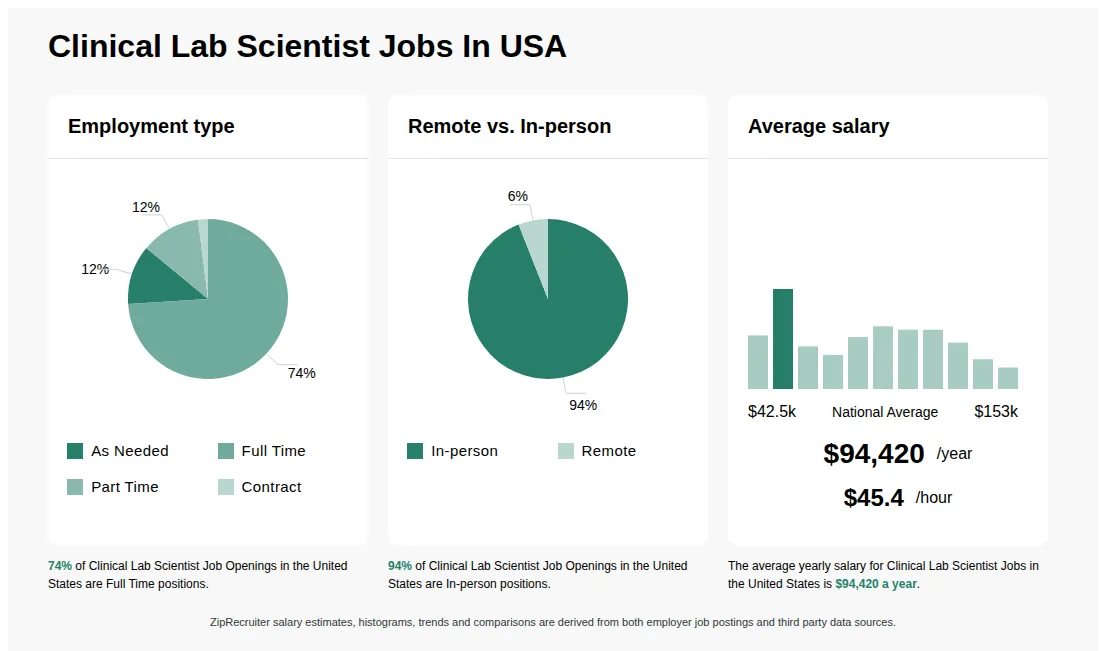
$42.5K

$94.4K

$153K

How much do clinical lab scientist jobs pay per year?

As of Jun 11, 2026, the average yearly pay for clinical lab scientist in the United States is $94,420.00, according to ZipRecruiter salary data. Most workers in this role earn between $59,000.00 and $119,000.00 per year, depending on experience, location, and employer.

What are Clinical Lab Scientists?

Clinical Lab Scientists, also known as medical laboratory scientists or medical technologists, are healthcare professionals who perform laboratory tests on patient samples to help diagnose, treat, and prevent diseases. They analyze blood, urine, tissue, and other bodily fluids using sophisticated equipment and techniques. Their work is essential for providing accurate and timely information to physicians, ensuring effective patient care. Clinical Lab Scientists must follow strict protocols and maintain quality control to ensure reliable results. They often work in hospitals, clinics, research labs, and public health organizations.

Is becoming a CLS worth it?

Becoming a Clinical Lab Scientist (CLS) offers stable employment, a competitive salary, and opportunities for specialization in areas like microbiology or hematology. The role requires a bachelor's degree, certification, and proficiency with laboratory equipment, making it a valuable career for those interested in healthcare diagnostics.

What are the key skills and qualifications needed to thrive as a Clinical Lab Scientist, and why are they important?

To thrive as a Clinical Lab Scientist, you need a solid background in biology, chemistry, and laboratory procedures, typically supported by a bachelor's degree in medical laboratory science and relevant certification (such as ASCP). Familiarity with laboratory information systems (LIS), automated analyzers, and quality control protocols is essential. Attention to detail, problem-solving abilities, and effective communication skills help ensure accurate testing and collaboration with healthcare teams. These competencies are crucial for delivering reliable diagnostic results that directly impact patient care and treatment decisions.

Who gets paid more, MLS or MLT?

Clinical Lab Scientists (MLS) typically earn higher salaries than Medical Laboratory Technicians (MLT) due to advanced training, certification, and responsibilities. MLS professionals often have a bachelor's degree and perform more complex testing, which is reflected in their higher pay scale compared to MLTs, who usually have an associate degree and perform routine lab work.

What are some common challenges Clinical Lab Scientists face when handling high sample volumes, and how can they manage these effectively?

Clinical Lab Scientists often experience periods of high sample volume, especially during outbreaks or peak hospital admissions. Managing this workload requires strong organizational skills, attention to detail, and proficiency with laboratory information systems to track samples efficiently. Effective communication with team members and prioritizing urgent cases help ensure timely and accurate results. Continual process improvement and adherence to quality control protocols also play a key role in maintaining performance under pressure.

What does a clinical lab scientist do?

A clinical lab scientist, also known as a medical laboratory technologist, performs laboratory tests on blood, tissue, and other specimens to help diagnose, treat, and monitor diseases. They operate and maintain complex laboratory equipment, analyze test results, and ensure quality control, often working in hospital or diagnostic lab settings and requiring certification or licensure. Their work supports healthcare providers in making accurate medical decisions.

What Does a Clinical Lab Scientist Do?

As a clinical lab scientist, you work in a laboratory to process tests used in the diagnosis and treatment of patients. Your duties may include monitoring test quality, analyzing tissue, cells, and body fluids, working with other lab staff, and communicating results to physicians. You identify bacteria and viruses, ensure proper handling of blood and potentially biologically hazardous materials, prepare lab tests, organize samples, review drug levels and toxicology, and make conclusions from test results. A clinical lab scientist typically works for a clinic, doctor's office, research lab, or a diagnostic lab.

What is the difference between Clinical Lab Scientist vs Medical Laboratory Technician?

AspectClinical Lab ScientistMedical Laboratory Technician
CredentialsBachelor's degree in medical technology or related field, certification (ASCP, AMT)Associate's degree in medical laboratory technology, certification (ASCP, AMT)
Work EnvironmentHospitals, diagnostic labs, research facilitiesHospitals, clinics, smaller labs
Job ResponsibilitiesPerform complex tests, analyze results, supervise lab staffPrepare samples, perform routine tests, maintain equipment

Clinical Lab Scientists and Medical Laboratory Technicians both work in laboratory settings and require certification. However, Clinical Lab Scientists typically hold a bachelor's degree and perform more complex testing and analysis, often supervising others. Medical Laboratory Technicians usually have an associate's degree and focus on routine testing and sample preparation. Both roles are essential in healthcare diagnostics, but Clinical Lab Scientists generally have a broader scope of responsibilities.

How much does CLS make?

Clinical Laboratory Scientists (CLS) in California typically earn an average annual salary of around $70,000 to $90,000, depending on experience, certification, and work setting. Salaries can vary based on location, with higher wages often found in urban areas and specialized laboratories. Certification through the ASCP or equivalent can also influence earning potential.
What cities are hiring for Clinical Lab Scientist jobs? Cities with the most Clinical Lab Scientist job openings:
What are the most commonly searched types of Clinical Lab Scientist jobs? The most popular types of Clinical Lab Scientist jobs are:
What states have the most Clinical Lab Scientist jobs? States with the most job openings for Clinical Lab Scientist jobs include:
Medical Technologist (Medical Tech) Allied

Medical Technologist (Medical Tech) Allied

TLC Nursing

Honolulu, HI

$1K/wk

Contractor

Posted 15 days ago


Job description

We are looking for a Travel Medical Technologist Allied for a great Travel allied job in Honolulu, HI.

This Medical Technologist Travel allied job pays for 32 hours a week for 13 weeks. With Wanderly you can compare Travel assignment salary from leading Travel assignment agencies in the United States.

With Wanderly you can chat and apply to any agency with Wanderly’s Universal Application, below are the details of this Travel Allied Job including the Travel assignment salary:

  • Specialty: Medical Technologist Allied
  • Travel Medical Technologist (Medical Tech) Allied : Honolulu, HI
  • Travel Assignment Salary: $1106/Week
  • Start Date: June 15, 2026
  • Travel Allied Job Assignment Length: 13 weeks
  • Travel Assignment Hours: 32 hours per week
  • Shift: 8 hours, Day

PK-36959893