A cardiovascular surgical technologist is responsible for knowing and supporting the mission, vision, values, and policies of Aspirus Wausau Hospital as well as the surgical services department. The ...
A cardiovascular surgical technologist is responsible for knowing and supporting the mission, vision, values, and policies of Aspirus Wausau Hospital as well as the surgical services department. The ...
Surgical Technician Cardiovascular Surgery
Portland, OR · On-site
$67K - $81K/hr
CST (Certified Surgical Technologist) credential required or eligible * Minimum 1 year of cardiovascular or cardiothoracic OR scrub experience * Proficiency with cardiovascular instrumentation and ...
Quick apply
Surgical Technician Cardiovascular Surgery
Portland, OR · On-site
$67K - $81K/hr
CST (Certified Surgical Technologist) credential required or eligible * Minimum 1 year of cardiovascular or cardiothoracic OR scrub experience * Proficiency with cardiovascular instrumentation and ...
A cardiovascular surgical technologist is responsible for knowing and supporting the mission, vision, values, and policies of Aspirus Wausau Hospital as well as the surgical services department. The ...
A cardiovascular surgical technologist is responsible for knowing and supporting the mission, vision, values, and policies of Aspirus Wausau Hospital as well as the surgical services department. The ...
A cardiovascular surgical technologist is responsible for knowing and supporting the mission, vision, values, and policies of Aspirus Wausau Hospital as well as the surgical services department. The ...
A cardiovascular surgical technologist is responsible for knowing and supporting the mission, vision, values, and policies of Aspirus Wausau Hospital as well as the surgical services department. The ...
CVOR Surgical Technologist
Glendale, AZ · On-site
Seeking an experienced CVOR Surgical Tech to support cardiovascular surgical cases. Responsibilities: * Prepare operating room for cardiac procedures * Maintain sterile field during open heart and ...
Quick apply
CVOR Surgical Technologist
Glendale, AZ · On-site
Seeking an experienced CVOR Surgical Tech to support cardiovascular surgical cases. Responsibilities: * Prepare operating room for cardiac procedures * Maintain sterile field during open heart and ...

Overview Join our team as a day shift, full-time, Cardiovascular OR (CVOR) Surgical Tech (CST) in Tyler, TX. Why Join Us? Thrive in a People-First Environment and Make Healthcare Better * Thrive: We ...
Overview Join our team as a day shift, full-time, Cardiovascular OR (CVOR) Surgical Tech (CST) in Tyler, TX. Why Join Us? Thrive in a People-First Environment and Make Healthcare Better * Thrive: We ...

Cardiovascular Surgical Technician
Rockford, IL · On-site
$2.3K/wk
CVOR Tech Location: Rockford, IL Total Travel Package: $2,366.00/week * Must reside over 50 miles ... At least 2+ years experience as Surgical Tech * Cardiovascular experience (at least 1 year) * Must ...
Cardiovascular Surgical Technician
Rockford, IL · On-site
$2.3K/wk
CVOR Tech Location: Rockford, IL Total Travel Package: $2,366.00/week * Must reside over 50 miles ... At least 2+ years experience as Surgical Tech * Cardiovascular experience (at least 1 year) * Must ...

Surgical Technologist (CVOR)
Glenwood Springs, CO · On-site
$2.6K - $2.8K/wk
Bring your CVOR surgical technology expertise to a collaborative cardiovascular team where your precision, technical skills, and commitment to exceptional patient care will make a meaningful impact.
Quick apply
Surgical Technologist (CVOR)
Glenwood Springs, CO · On-site
$2.6K - $2.8K/wk
Bring your CVOR surgical technology expertise to a collaborative cardiovascular team where your precision, technical skills, and commitment to exceptional patient care will make a meaningful impact.

Join our team as a day shift, full-time, Cardiovascular OR (CVOR) Surgical Tech (CST) in Tyler, TX. Why Join Us? Thrive in a People-First Environment and Make Healthcare Better * Thrive: We empower ...
Join our team as a day shift, full-time, Cardiovascular OR (CVOR) Surgical Tech (CST) in Tyler, TX. Why Join Us? Thrive in a People-First Environment and Make Healthcare Better * Thrive: We empower ...
Overview Join our team as a day shift, full-time, Cardiovascular OR (CVOR) Surgical Tech (CST) in Tyler, TX. Why Join Us? Thrive in a People-First Environment and Make Healthcare Better * Thrive: We ...
Overview Join our team as a day shift, full-time, Cardiovascular OR (CVOR) Surgical Tech (CST) in Tyler, TX. Why Join Us? Thrive in a People-First Environment and Make Healthcare Better * Thrive: We ...
Travel CVOR Surgical Tech (Lufkin, TX) / 13-week contract starting 07/06/2026 / Days, 6:30 AM-3:00 PM, 40 hrs/week + call required / Acute Care Cardiovascular Operating Room (CVOR) / Minimum 2 years ...
Travel CVOR Surgical Tech (Lufkin, TX) / 13-week contract starting 07/06/2026 / Days, 6:30 AM-3:00 PM, 40 hrs/week + call required / Acute Care Cardiovascular Operating Room (CVOR) / Minimum 2 years ...

CSWMCM-30985, Children's Wisconsin - Milwaukee Campus, Cardiovascular Surgical Tech, Cardiovascular Surgical Tech About CrossMed At CrossMed Healthcare Staffing, we aim to create lasting impressions ...
CSWMCM-30985, Children's Wisconsin - Milwaukee Campus, Cardiovascular Surgical Tech, Cardiovascular Surgical Tech About CrossMed At CrossMed Healthcare Staffing, we aim to create lasting impressions ...

Surgical Technologist (CVOR)
Salem, VA · On-site
A 500+ bed acute care hospital in Salem is seeking a Certified Surgical Technologist to join its Cardiovascular Operating Room team. The facility is recognized for its advanced heart and vascular ...
Quick apply
Surgical Technologist (CVOR)
Salem, VA · On-site
A 500+ bed acute care hospital in Salem is seeking a Certified Surgical Technologist to join its Cardiovascular Operating Room team. The facility is recognized for its advanced heart and vascular ...

Do you have the career opportunities as a(an) Open Heart Surgical Technologist you want with your ... These services include cardiovascular surgery and cancer treatment. These services include ...
Do you have the career opportunities as a(an) Open Heart Surgical Technologist you want with your ... These services include cardiovascular surgery and cancer treatment. These services include ...
Do you have the career opportunities as a(an) Open Heart Surgical Technologist you want with your ... These services include cardiovascular surgery and cancer treatment. These services include ...
Do you have the career opportunities as a(an) Open Heart Surgical Technologist you want with your ... These services include cardiovascular surgery and cancer treatment. These services include ...

Utilize advanced surgical technology and specialized cardiovascular equipment. * Expand your expertise through ongoing education, training, and professional development opportunities. * Enjoy the ...
Utilize advanced surgical technology and specialized cardiovascular equipment. * Expand your expertise through ongoing education, training, and professional development opportunities. * Enjoy the ...
Utilize advanced surgical technology and specialized cardiovascular equipment. * Expand your expertise through ongoing education, training, and professional development opportunities. * Enjoy the ...
Utilize advanced surgical technology and specialized cardiovascular equipment. * Expand your expertise through ongoing education, training, and professional development opportunities. * Enjoy the ...
Travel Pediatric Surgical Technologist - $2,578 per week
Milwaukee, WI · On-site
$2.5K/wk
CSWMCM-30985, Children's Wisconsin - Milwaukee Campus, Cardiovascular Surgical Tech, Cardiovascular Surgical Tech About CrossMed At CrossMed Healthcare Staffing, we aim to create lasting impressions ...
Travel Pediatric Surgical Technologist - $2,578 per week
Milwaukee, WI · On-site
$2.5K/wk
CSWMCM-30985, Children's Wisconsin - Milwaukee Campus, Cardiovascular Surgical Tech, Cardiovascular Surgical Tech About CrossMed At CrossMed Healthcare Staffing, we aim to create lasting impressions ...
Cardio-Vascular OR Surgical Technologist
Metairie, LA · On-site
$50 - $70/hr
Cardiovascular Operating Room Surgical Technologist Your job is more than a job. The Cardiovascular Operating Room Surgical Technologist is responsible for assisting in the care and preparation of ...
Cardio-Vascular OR Surgical Technologist
Metairie, LA · On-site
$50 - $70/hr
Cardiovascular Operating Room Surgical Technologist Your job is more than a job. The Cardiovascular Operating Room Surgical Technologist is responsible for assisting in the care and preparation of ...
Travel CVOR Surgical Technologist - $2,376 per week
Lufkin, TX · On-site
$2.3K/wk
Travel CVOR Surgical Tech (Lufkin, TX) / 13-week contract starting 07/06/2026 / Days, 6:30 AM-3:00 PM, 40 hrs/week + call required / Acute Care Cardiovascular Operating Room (CVOR) / Minimum 2 years ...
Travel CVOR Surgical Technologist - $2,376 per week
Lufkin, TX · On-site
$2.3K/wk
Travel CVOR Surgical Tech (Lufkin, TX) / 13-week contract starting 07/06/2026 / Days, 6:30 AM-3:00 PM, 40 hrs/week + call required / Acute Care Cardiovascular Operating Room (CVOR) / Minimum 2 years ...
Cardiovascular Surgical Tech information
See salary details
$875 - $1.1K
6% of jobs
$1.1K - $1.3K
15% of jobs
$1.4K is the 25th percentile. Wages below this are outliers.
$1.3K - $1.5K
7% of jobs
$1.5K - $1.7K
2% of jobs
$1.7K - $2K
5% of jobs
$2K - $2.2K
9% of jobs
The median wage is $2.2K / yr.
$2.2K - $2.4K
17% of jobs
$2.4K - $2.6K
11% of jobs
$2.7K is the 75th percentile. Wages above this are outliers.
$2.6K - $2.8K
10% of jobs
$2.8K - $3K
11% of jobs
$3K - $3.3K
7% of jobs
$875
$2.3K
$3.3K
How much do cardiovascular surgical tech jobs pay per week?
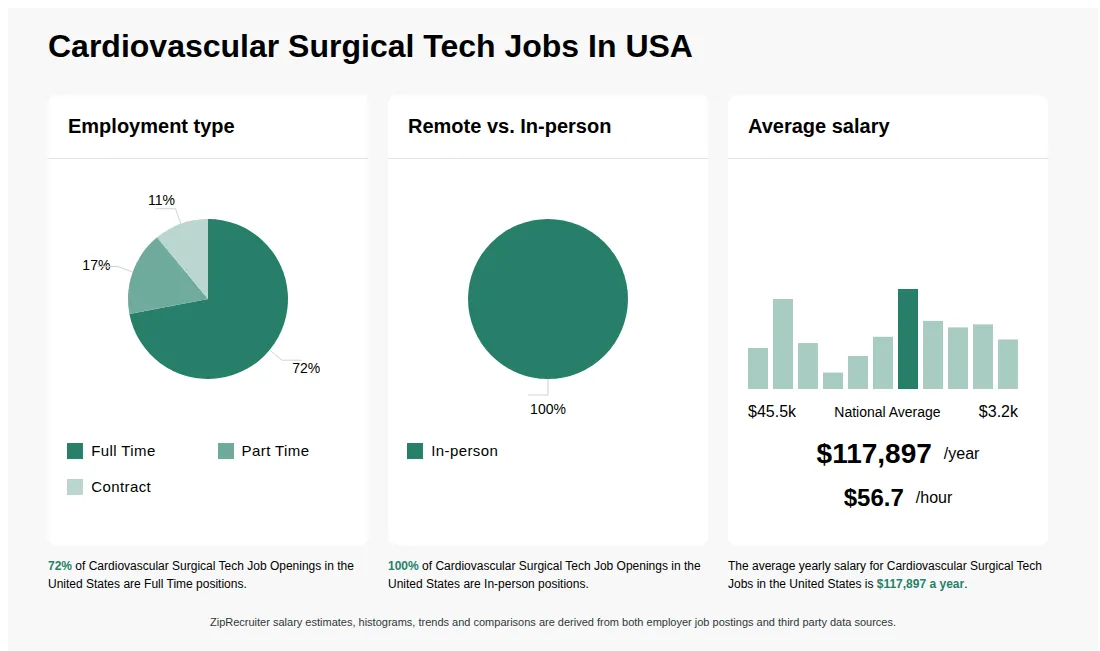
As of Sep 6, 2026, the average weekly pay for cardiovascular surgical tech in the United States is $2,267.25, according to ZipRecruiter salary data. Most workers in this role earn between $1,423.08 and $2,750.00 per week, depending on experience, location, and employer.
What is a cardiovascular surgical tech?
Cardiovascular surgical techs, also known as cardiovascular surgical technologists, are allied health professionals who assist surgeons during heart and blood vessel surgeries. They are responsible for preparing the operating room, sterilizing instruments, and ensuring all necessary equipment is available for procedures. During surgery, they pass instruments to the surgeon, help maintain a sterile field, and may assist with tasks such as monitoring patient vitals or handling specialized devices. Their role is crucial in supporting the surgical team and ensuring patient safety throughout cardiovascular operations.
What does a cardiovascular surgical tech do?
The duties of a cardiovascular surgical tech are to assist a cardiac surgeon before, during, and after heart surgery or a similar procedure. They prep the CVOR (cardiovascular operating room) and help with preoperative care and transport. During the operation, they assist the surgical staff, monitor patient condition, and transport them to a recovery room. The qualifications to become a surgical technologist include certification and a postsecondary degree.
What are the key skills and qualifications needed to thrive as a cardiovascular surgical tech, and why are they important?
To thrive as a Cardiovascular Surgical Tech, you need a thorough understanding of surgical procedures, anatomy, sterile techniques, and usually an accredited surgical technology program completion with certification (e.g., CST). Familiarity with specialized surgical instruments, operating room protocols, and patient monitoring systems is crucial. Attention to detail, calmness under pressure, and strong teamwork and communication skills help you excel in high-stakes surgical environments. These competencies ensure patient safety, efficient surgeries, and effective collaboration with surgeons and the operative team.
What are some common challenges faced by cardiovascular surgical techs during complex procedures, and how can they be managed?
Cardiovascular Surgical Techs often encounter high-pressure situations during lengthy or intricate heart surgeries, where quick thinking and precise teamwork are essential. Managing delicate instruments, anticipating the surgeon’s needs, and maintaining a sterile environment can be challenging, especially when unexpected complications arise. To navigate these challenges, effective communication, continual skills development, and familiarity with a wide range of surgical tools are vital. Many techs also find that building strong working relationships with their surgical team helps ensure smooth procedures and fosters a supportive work environment.
What is the difference between Cardiovascular Surgical Tech vs Operating Room Technician?
| Aspect | Cardiovascular Surgical Tech | Operating Room Technician |
|---|---|---|
| Certifications | Certified Surgical Technologist (CST), specialized in cardiovascular procedures | Generally CST or equivalent, with no specific specialization |
| Work Environment | Cardiovascular operating rooms, assisting in heart and blood vessel surgeries | Various surgical settings, assisting in general surgeries |
| Employer & Industry | Hospitals, cardiac centers, specialized surgical clinics | Hospitals, outpatient surgical centers, clinics |
Cardiovascular Surgical Techs focus on assisting in heart and blood vessel surgeries, requiring specialized training and certifications. Operating Room Technicians support a broader range of surgeries without specific specialization. Both roles are vital in surgical teams but differ in scope and environment.
How much does a cardiovascular surgical tech make?
The average annual salary for a cardiovascular surgical tech in Texas is approximately $50,000 to $70,000, depending on experience, certifications, and the healthcare facility. Salaries can vary based on location, workload, and additional skills such as proficiency with surgical instruments and patient care protocols.
More about Cardiovascular Surgical Tech jobs
- How do I become a cardiovascular surgical tech?
- What are the requirements to become a cardiovascular surgical tech?
- What is a certified cardiovascular technician?
- What is the future of cardiovascular tech jobs?
- The 10 Top Types Of Cardiovascular Surgical Tech Jobs
- What Is a Cardiovascular Surgical Tech and How to Become One
- Cardiovascular Surgical Tech Job Description Sample Template
What cities are hiring for Cardiovascular Surgical Tech jobs?
Cities with the most Cardiovascular Surgical Tech job openings:
What are the most commonly searched types of Cardiovascular Surgical Tech jobs?
The most popular types of Cardiovascular Surgical Tech jobs are:
Who are the top companies hiring for Cardiovascular Surgical Tech jobs?
The top employers for Cardiovascular Surgical Tech jobs are:
What states have the most Cardiovascular Surgical Tech jobs?
States with the most job openings for Cardiovascular Surgical Tech jobs include:
What job categories do people searching Cardiovascular Surgical Tech jobs look for?
The top searched job categories for Cardiovascular Surgical Tech jobs are:
What are popular job titles related to Cardiovascular Surgical Tech jobs?
For Cardiovascular Surgical Tech jobs, the most frequently searched job titles are:
- cardiovascular tech
- cardiovascular operating room technician
- cardiovascular technician
- cardiac surgical assistant
- cardiovascular radiologic technologist
- cardiovascular technologist
- cardiovascular non invasive technologist
- cardiovascular operating room nurse
- invasive cardiovascular technologist
- surgical technologist

Full-time
Medical, Retirement, PTO
Re-posted 29 days ago
Aspirus Health rating

6.4
Based on 262 frontline employees who took The Breakroom Quiz
648th of 898 rated healthcare providers
Job description
Compassion. Accountability. Collaboration. Foresight. Joy.
These are the Aspirus Core Values; and we are looking for the BEST around to join us as we demonstrate those values Every. Single. Day.
Aspirus Wausau Hospital in Wausau, WI is seeking a CARDIOVASCULAR SURGICAL TECHNOLOGIST to join our SURGERY team!
A cardiovascular surgical technologist is responsible for knowing and supporting the mission, vision, values, and policies of Aspirus Wausau Hospital as well as the surgical services department. The cardiovascular surgical technologist is responsible for planning and organizing supplies, instruments, and equipment for cardiovascular and thoracic procedures. The cardiovascular surgical technologist collaborates with all surgical team members to assure the quality and safety of our patients throughout the perioperative experience.
HOURS: Full Time or 1.0 FTE, 80 hours every pay period. Varied Shifts.
Experience/Qualifications
Employee Benefits
Aspirus Wausau Hospital is the flagship of the Aspirus system that serves patients in 14 counties across northern and central Wisconsin, as well as the Upper Peninsula of Michigan. It is a licensed private/not-for-profit facility with 325 beds and staffed by 350 physicians in 35 specialties. Aspirus Wausau Hospital is a Level II trauma center that provides primary, secondary and tertiary care services as a regional referral center. Specialty referral service emphasis exists in cardiology and cardiothoracic surgery, orthopedics and cancer. The hospital has an average daily inpatient census of 220 with approximately 15,000 admissions per year. Outpatient visits exceed 50,000 and there are also more than 24,000 annual emergency department visits. To learn more about Wausau click the following link: Wausau, Wisconsin
Best known for its world-class cardiovascular program, Aspirus Wausau Hospital also provides leading edge cancer, trauma, women's health, and spine and neurological care.
Our Mission: We heal people, promote health and strengthen communities.
Our Vision: Aspirus is a catalyst for creating healthy, thriving communities, trusted and engaged above all others.
As an Aspirus team, we demonstrate caring, we plan to impact the future, work with happiness and enthusiasm, recognize our power to make a difference and improve the health of our communities.
Aspirus Health is a nonprofit, community-directed health system based in Wausau, Wisconsin, serving northeastern Minnesota, northern and central Wisconsin and the Upper Peninsula of Michigan. The health system operates 19 hospitals and 130 outpatient locations with nearly 14,000 team members, including 1,300 employed physicians and advanced practice clinicians. For more information visit aspirus.org.
Click here to learn more.
These are the Aspirus Core Values; and we are looking for the BEST around to join us as we demonstrate those values Every. Single. Day.
Aspirus Wausau Hospital in Wausau, WI is seeking a CARDIOVASCULAR SURGICAL TECHNOLOGIST to join our SURGERY team!
A cardiovascular surgical technologist is responsible for knowing and supporting the mission, vision, values, and policies of Aspirus Wausau Hospital as well as the surgical services department. The cardiovascular surgical technologist is responsible for planning and organizing supplies, instruments, and equipment for cardiovascular and thoracic procedures. The cardiovascular surgical technologist collaborates with all surgical team members to assure the quality and safety of our patients throughout the perioperative experience.
HOURS: Full Time or 1.0 FTE, 80 hours every pay period. Varied Shifts.
Experience/Qualifications
- Knowledge of patient care standards and practices in a surgical setting normally acquired through completion of an approved surgical technologist program or related field, and/or three or more years of related experience in an operating room.
- Graduate of a certified surgical technologist program is desired.
- Basic ECG course should be completed within 1 year of hire date.
- Minimum of one-year acute surgical care experience.
- Certification completed within 1 year of hire.
- Surgical Technologist certification required within 1 year of hire into the position.
- Current BLS certification or obtained within 90 days of hire - All clinical personnel in identified job codes are required to maintain Basic Life Support (BLS) training through independent study, online manikin, and knowledge testing. An acceptable training program is the Basic Life Support (BLS) Health Care Provider course from the American Heart Association or the American Red Cross Professional Rescuer Program with AED. (See Cardiopulmonary Resuscitation Training Policy).
Employee Benefits
- Full benefits packages available for part- and full-time status.
- PTO accrual from day one!
- Generous retirement plan with match available.
- Wellness program for employees and their families.
Aspirus Wausau Hospital is the flagship of the Aspirus system that serves patients in 14 counties across northern and central Wisconsin, as well as the Upper Peninsula of Michigan. It is a licensed private/not-for-profit facility with 325 beds and staffed by 350 physicians in 35 specialties. Aspirus Wausau Hospital is a Level II trauma center that provides primary, secondary and tertiary care services as a regional referral center. Specialty referral service emphasis exists in cardiology and cardiothoracic surgery, orthopedics and cancer. The hospital has an average daily inpatient census of 220 with approximately 15,000 admissions per year. Outpatient visits exceed 50,000 and there are also more than 24,000 annual emergency department visits. To learn more about Wausau click the following link: Wausau, Wisconsin
Best known for its world-class cardiovascular program, Aspirus Wausau Hospital also provides leading edge cancer, trauma, women's health, and spine and neurological care.
Our Mission: We heal people, promote health and strengthen communities.
Our Vision: Aspirus is a catalyst for creating healthy, thriving communities, trusted and engaged above all others.
As an Aspirus team, we demonstrate caring, we plan to impact the future, work with happiness and enthusiasm, recognize our power to make a difference and improve the health of our communities.
Aspirus Health is a nonprofit, community-directed health system based in Wausau, Wisconsin, serving northeastern Minnesota, northern and central Wisconsin and the Upper Peninsula of Michigan. The health system operates 19 hospitals and 130 outpatient locations with nearly 14,000 team members, including 1,300 employed physicians and advanced practice clinicians. For more information visit aspirus.org.
Click here to learn more.
What Aspirus Health employees say
Pay
Benefits
Hours and flexibility
Workplace
Get the full story on Breakroom

About Aspirus
Sourced by ZipRecruiter