Invasive Cardiovascular Tech Full-time (40 hours) Day shift What you will do as a Cardiac Special Procedure Tech: * Scrubs and gowns for surgery to assist the cardiologist in all aspects of invasive ...
Invasive Cardiovascular Tech Full-time (40 hours) Day shift What you will do as a Cardiac Special Procedure Tech: * Scrubs and gowns for surgery to assist the cardiologist in all aspects of invasive ...

Travel 37596300 ❤️ Invasive Cardiovascular Technologist - Cardiac Cath Lab 📍 Location: Denver, Colorado 📅 Start Date: September 28, 2026 📅 Estimated End Date: December 26, 2026 🕐 ...
Travel 37596300 ❤️ Invasive Cardiovascular Technologist - Cardiac Cath Lab 📍 Location: Denver, Colorado 📅 Start Date: September 28, 2026 📅 Estimated End Date: December 26, 2026 🕐 ...

Invasive Cardiovascular Technologist
Flemington, NJ · On-site
$42.62 - $53.28/hr
Position Summary The Registered Radiology Technologist RT(R)/Cardiovascular Invasive Specialist (,Registered Cardiovascular Invasive Specialist (RCIS) serves as a member of the Cardiovascular ...
Invasive Cardiovascular Technologist
Flemington, NJ · On-site
$42.62 - $53.28/hr
Position Summary The Registered Radiology Technologist RT(R)/Cardiovascular Invasive Specialist (,Registered Cardiovascular Invasive Specialist (RCIS) serves as a member of the Cardiovascular ...
Invasive Cardiovascular Technologist
Flemington, NJ · On-site
$42.62 - $53.28/hr
Position Summary The Registered Radiology Technologist RT(R)/Cardiovascular Invasive Specialist (,Registered Cardiovascular Invasive Specialist (RCIS) serves as a member of the Cardiovascular ...
Invasive Cardiovascular Technologist
Flemington, NJ · On-site
$42.62 - $53.28/hr
Position Summary The Registered Radiology Technologist RT(R)/Cardiovascular Invasive Specialist (,Registered Cardiovascular Invasive Specialist (RCIS) serves as a member of the Cardiovascular ...
Position Summary The Registered Radiology Technologist RT(R)/Registered Cardiovascular Invasive Specialist (RCIS) serves as a member of the Cardiovascular Catheterization Team. Independently performs ...
Position Summary The Registered Radiology Technologist RT(R)/Registered Cardiovascular Invasive Specialist (RCIS) serves as a member of the Cardiovascular Catheterization Team. Independently performs ...
Position Summary The Registered Radiology Technologist RT(R)/Registered Cardiovascular Invasive Specialist (RCIS) serves as a member of the Cardiovascular Catheterization Team. Independently performs ...
Position Summary The Registered Radiology Technologist RT(R)/Registered Cardiovascular Invasive Specialist (RCIS) serves as a member of the Cardiovascular Catheterization Team. Independently performs ...
Invasive Cardiovascular Technologist Location: Not specified Contract Length: Not specified Job Summary: Provides technical support in the cardiac catheterization laboratory during invasive ...
Invasive Cardiovascular Technologist Location: Not specified Contract Length: Not specified Job Summary: Provides technical support in the cardiac catheterization laboratory during invasive ...

Invasive Cardiovascular Technologist III
Albany, NY · On-site
$77K - $119K/yr
Day (United States of America) Salary Range: $77,075.00 - $119,466.00 Invasive Cardiovascular Technologists are allied health professionals who performs diagnostic examinations at the request or ...
Invasive Cardiovascular Technologist III
Albany, NY · On-site
$77K - $119K/yr
Day (United States of America) Salary Range: $77,075.00 - $119,466.00 Invasive Cardiovascular Technologists are allied health professionals who performs diagnostic examinations at the request or ...
Invasive Cardiovascular Technologist III - 30hrs/week, Days
Albany, NY · On-site
$26.36 - $42.18/hr
Invasive Cardiovascular Technologist III - 30hrs/week, Days Apply Location: 43 New Scotland Avenue, Albany, NY 12208 Position Type: Part-time Posted: 30+ Days Ago Requisition ID: 62786 Department ...
Invasive Cardiovascular Technologist III - 30hrs/week, Days
Albany, NY · On-site
$26.36 - $42.18/hr
Invasive Cardiovascular Technologist III - 30hrs/week, Days Apply Location: 43 New Scotland Avenue, Albany, NY 12208 Position Type: Part-time Posted: 30+ Days Ago Requisition ID: 62786 Department ...

Openings: 1 Description American Traveler is seeking an Invasive Cardiovascular Technologist for a hospital Cardiac Cath Lab, requiring ARRT or RCIS certification along with BLS and ACLS. Details
Openings: 1 Description American Traveler is seeking an Invasive Cardiovascular Technologist for a hospital Cardiac Cath Lab, requiring ARRT or RCIS certification along with BLS and ACLS. Details
Invasive Cardiovascular Technologist III - 30hrs/week, Days
Albany, NY · On-site
$26.36 - $42.18/hr
Invasive Cardiovascular Technologist III - 30hrs/week, Days Apply Location: 43 New Scotland Avenue, Albany, NY 12208 Position Type: Part-time Posted: 30+ Days Ago Requisition ID: 62786 Department ...
Invasive Cardiovascular Technologist III - 30hrs/week, Days
Albany, NY · On-site
$26.36 - $42.18/hr
Invasive Cardiovascular Technologist III - 30hrs/week, Days Apply Location: 43 New Scotland Avenue, Albany, NY 12208 Position Type: Part-time Posted: 30+ Days Ago Requisition ID: 62786 Department ...

Invasive Cardiovascular Tech 1, Interventional Radiology, $25000 Bonus, FT, 7A-5:30P
Miami, FL · On-site
$34.08 - $47.71/hr
The Invasive Cardiovascular Technologist provides fundamental technical support by assisting the physician with patient preparation, intra and post-interventional/surgical procedures, management of ...
Invasive Cardiovascular Tech 1, Interventional Radiology, $25000 Bonus, FT, 7A-5:30P
Miami, FL · On-site
$34.08 - $47.71/hr
The Invasive Cardiovascular Technologist provides fundamental technical support by assisting the physician with patient preparation, intra and post-interventional/surgical procedures, management of ...

Cardiovascular Tech - Children's Hospital - Days
Richmond, VA · On-site
$39.41 - $61.09/hr
The Invasive Cardiovascular Technologist is a Registered Cardiovascular Invasive Specialist (RCIS), Registered Cardiovascular Electrophysiology Specialist (RCES) and/or Registered Radiologic ...
Cardiovascular Tech - Children's Hospital - Days
Richmond, VA · On-site
$39.41 - $61.09/hr
The Invasive Cardiovascular Technologist is a Registered Cardiovascular Invasive Specialist (RCIS), Registered Cardiovascular Electrophysiology Specialist (RCES) and/or Registered Radiologic ...
Travel Cath Lab Technologist
Denver, CO · On-site
$2.3K - $3.1K/wk
Registered Cardiovascular Invasive Technologist RCIS * Registered Respiratory Therapist with CV specific certification * RCES, RCIS * BLS * 2 years of experience in Cardiology/Cath Lab is preferred ...
Travel Cath Lab Technologist
Denver, CO · On-site
$2.3K - $3.1K/wk
Registered Cardiovascular Invasive Technologist RCIS * Registered Respiratory Therapist with CV specific certification * RCES, RCIS * BLS * 2 years of experience in Cardiology/Cath Lab is preferred ...

... of cardiovascular technology. Cath lab technicians are vital team members who assist doctors during invasive cardiovascular procedures such as angioplasty, cardiac catheterization, and ...
... of cardiovascular technology. Cath lab technicians are vital team members who assist doctors during invasive cardiovascular procedures such as angioplasty, cardiac catheterization, and ...

Pediatric Cardiovascular Technologist
Phoenix, AZ · On-site
$2.5K - $2.6K/wk
Pediatric Cardiovascular Technologist ... This position performs invasive cardiovascular procedures to produce consistently high quality ...
Quick apply
Pediatric Cardiovascular Technologist
Phoenix, AZ · On-site
$2.5K - $2.6K/wk
Pediatric Cardiovascular Technologist ... This position performs invasive cardiovascular procedures to produce consistently high quality ...

Invasive Cardiovascular Technologist * Location: South Florida * Employment: Full-Time * Department: Cardiac Cath Lab / Invasive Cardiology * Experience: 1+ year of relevant experience
Invasive Cardiovascular Technologist * Location: South Florida * Employment: Full-Time * Department: Cardiac Cath Lab / Invasive Cardiology * Experience: 1+ year of relevant experience

Cardiovascular Technologist - Cath Lab
Happy Valley, OR · On-site
$47.19 - $58.76/hr
Completion of an accredited invasive cardiovascular technologist training program OR two (2) years of education in an allied health science (e.g., nursing, respiratory therapy, radiologic technology ...
Cardiovascular Technologist - Cath Lab
Happy Valley, OR · On-site
$47.19 - $58.76/hr
Completion of an accredited invasive cardiovascular technologist training program OR two (2) years of education in an allied health science (e.g., nursing, respiratory therapy, radiologic technology ...
Cardiovascular Technologist - Cath Lab
Happy Valley, OR · On-site
$47.19 - $58.76/hr
Successful completion of an accredited invasive cardiovascular technologist training program OR two (2) years of education in an allied health science (e.g., nursing, respiratory therapy, radiologic ...
Cardiovascular Technologist - Cath Lab
Happy Valley, OR · On-site
$47.19 - $58.76/hr
Successful completion of an accredited invasive cardiovascular technologist training program OR two (2) years of education in an allied health science (e.g., nursing, respiratory therapy, radiologic ...

Continuous SUMMARY Summary Bates Technical College is seeking a knowledgeable and passionate Invasive Cardiovascular Technologist to lead and teach in the new Invasive Cardiovascular Technology ...
Continuous SUMMARY Summary Bates Technical College is seeking a knowledgeable and passionate Invasive Cardiovascular Technologist to lead and teach in the new Invasive Cardiovascular Technology ...
Invasive Cardiovascular Technologist information
See salary details
$24.28 - $28.76
25% of jobs
$28.81 is the 25th percentile. Wages below this are outliers.
$28.76 - $33.24
26% of jobs
$33.24 - $37.72
10% of jobs
$37.72 - $42.20
6% of jobs
$42.20 - $46.68
5% of jobs
$49.76 is the 75th percentile. Wages above this are outliers.
$46.68 - $51.16
4% of jobs
$51.16 - $55.64
5% of jobs
$55.64 - $60.12
5% of jobs
$60.12 - $64.60
4% of jobs
$64.60 - $69.08
4% of jobs
$69.08 - $73.56
4% of jobs
$24
$42
$73
How much do invasive cardiovascular technologist jobs pay per hour?
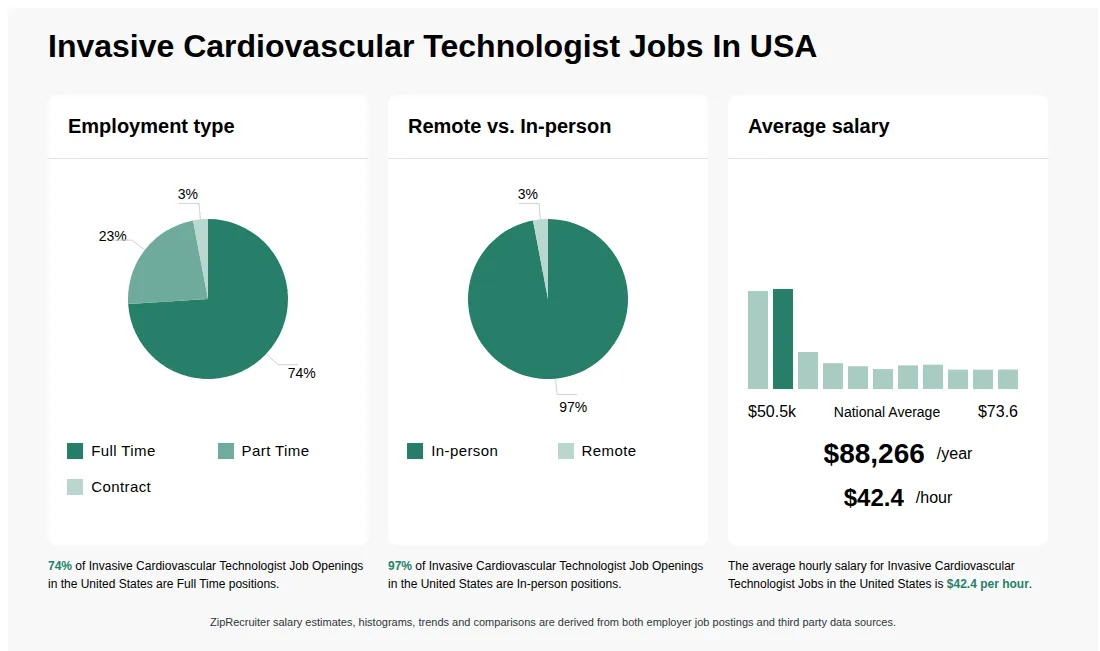
As of Sep 5, 2026, the average hourly pay for invasive cardiovascular technologist in the United States is $42.44, according to ZipRecruiter salary data. Most workers in this role earn between $29.09 and $54.81 per hour, depending on experience, location, and employer.
What is an invasive cardiovascular technologist?
An invasive cardiovascular technologist is part of a lab team and assists the cardiologist with all surgical and diagnostic procedures. As an invasive cardiovascular technologist, you responsibilities include collecting patient health history from physician reports and following all pre- and post-procedural guidelines from the World Health Organization (WHO) and your hospital’s policies. A typical workday involves preparing patients, transporting them to the surgical room, and helping monitor and record their condition throughout cardiovascular and minor surgical procedures, ensuring the team leader is aware of patients’ deteriorating health when applicable. You are also in charge of manipulating small tubes called cardiac catheters and guide wires. Other duties include calibrating monitoring equipment, sterilizing supplies, scheduling patients for specialized testing procedures, administering common procedure medications, and injecting contrast and flush fluids into their blood vessels under supervision. You also prepare diagnostic reports summarizing care activities.
What is an invasive cardiovascular technologist?
An Invasive Cardiovascular Technologist is a healthcare professional who assists physicians during procedures that diagnose and treat heart and blood vessel conditions. They are specially trained to operate equipment used during cardiac catheterizations, angioplasties, and other procedures involving the heart and vascular system. Their responsibilities include preparing patients, monitoring vital signs, and ensuring the safe operation of complex medical devices. These technologists play a critical role in helping physicians identify and address cardiovascular problems in real time.
What are the key skills and qualifications needed to thrive as an invasive cardiovascular technologist?
To thrive as an Invasive Cardiovascular Technologist, you need a solid understanding of cardiovascular anatomy, hemodynamics, and sterile techniques, typically validated by an associate degree and certification such as RCIS. Familiarity with catheterization lab equipment, fluoroscopy, and electronic medical record systems is essential. Attention to detail, teamwork, and the ability to remain calm under pressure are critical soft skills in this role. These competencies ensure accurate diagnostics, patient safety, and effective collaboration during high-stakes cardiac procedures.
What are some common challenges faced by invasive cardiovascular technologists during procedures, and how can they be managed?
Invasive Cardiovascular Technologists often work in high-pressure environments, especially during cardiac catheterizations or angioplasties. One common challenge is maintaining composure and accuracy when unexpected complications arise, such as arrhythmias or equipment malfunctions. Effective communication with physicians and the surgical team is essential for quick problem-solving. Staying current with procedural protocols and participating in regular training can help technologists confidently manage these challenges and ensure patient safety.
What is the difference between Invasive Cardiovascular Technologist vs Cardiovascular Technologist?
| Aspect | Invasive Cardiovascular Technologist | Cardiovascular Technologist |
|---|---|---|
| Certifications | Registered Cardiovascular Invasive Specialist (RCIS) | Registered Cardiovascular Technologist (RCVT) |
| Work Environment | Hospitals, cath labs, surgical settings | Clinics, diagnostic labs, outpatient facilities |
| Job Focus | Performing invasive procedures like angiograms | Performing diagnostic tests like EKGs and stress tests |
Invasive Cardiovascular Technologists specialize in invasive procedures such as angiograms and catheterizations, often working in surgical settings. Cardiovascular Technologists typically focus on diagnostic tests like EKGs and stress tests in outpatient or clinical environments. Both roles require similar certifications but differ mainly in procedure complexity and work setting.
More about Invasive Cardiovascular Technologist jobs
What cities are hiring for Invasive Cardiovascular Technologist jobs?
Cities with the most Invasive Cardiovascular Technologist job openings:
What are the most commonly searched types of Invasive Cardiovascular Technologist jobs?
The most popular types of Invasive Cardiovascular Technologist jobs are:
Who are the top companies hiring for Invasive Cardiovascular Technologist jobs?
The top employers for Invasive Cardiovascular Technologist jobs are:
What states have the most Invasive Cardiovascular Technologist jobs?
States with the most job openings for Invasive Cardiovascular Technologist jobs include:
What job categories do people searching Invasive Cardiovascular Technologist jobs look for?
The top searched job categories for Invasive Cardiovascular Technologist jobs are:
- International Cardiovascular Technologist
- International Invasive Cardiovascular Technologist
- Hourly Cardiovascular Technologist Cvt
- Full Time Impella Rep
- Trainee International Invasive Cardiovascular Techn
- Urgently Hiring International Invasive Cardiovascular Technologist
- Salary Cardiovascular Technologist
- Cardiovascular Credentialing International
- Internship Cardiovascular Technologist Cvt
- Pacific Cardiovascular Associates
What are popular job titles related to Invasive Cardiovascular Technologist jobs?
For Invasive Cardiovascular Technologist jobs, the most frequently searched job titles are:
- cardiovascular invasive specialist
- cardiovascular interventional technologist
- cardiovascular technologist
- cardiovascular non invasive technologist
- cardiovascular radiologic technologist
- cath lab technologist
- cardiac cath technologist
- interventional technologist
- cardiac cath lab technologist
- cardiovascular tech

Full-time
Re-posted 17 days ago
Trinity Health rating

6.6
Based on 354 frontline employees who took The Breakroom Quiz
572nd of 898 rated healthcare providers
Job description
Employment Type:
Full timeShift:
Day Shift
Description:
Invasive Cardiovascular Tech
Full-time (40 hours)
Day shift
What you will do as a Cardiac Special Procedure Tech:
What you will need as a Cardiac Special Procedure Tech:
Required skills and abilities:
Our Commitment
Rooted in our Mission and Core Values, we honor the dignity of every person and recognize the unique perspectives, experiences, and talents each colleague brings. By finding common ground and embracing our differences, we grow stronger together and deliver more compassionate, person-centered care. We are an Equal Opportunity Employer. All qualified applicants will receive consideration for employment without regard to race, color, religion, sex, sexual orientation, gender identity, national origin, disability, veteran status, or any other status protected by federal, state, or local law.
Full timeShift:
Day Shift
Description:
Invasive Cardiovascular Tech
Full-time (40 hours)
Day shift
What you will do as a Cardiac Special Procedure Tech:
- Scrubs and gowns for surgery to assist the cardiologist in all aspects of invasive cardiovascular procedures.
- Performs a variety of specialized and complex invasive and non-invasive cardiovascular procedures.
- Assists the cardiologist in all surgical and diagnostic procedures.
- Prepares patients and assists in monitoring the patient's condition during invasive cardiovascular procedures.
What you will need as a Cardiac Special Procedure Tech:
- Associates degree or equivalent combination of experience and education in Cardiovascular Technology or related field required.
- RCIS/RCES (CCI) or CI (ARRT) certification preferred.
- BLS/ACLS Required.
Required skills and abilities:
- Ability to recognize normal and abnormal ECG rhythms, ischemia and infarction patterns.
- Understands basic concepts in aseptic technique.
- Strong written and oral communication skills.
- Must have strong organizational skills and able to prioritize.
- Positive team player.
- Has both team-building and leadership skills.
- Critical thinking aptitude.
- Mechanical/mathematical aptitude needed for calibration and operation of equipment.
- Ability to interpret medical technology.
- Knowledge of potential radiation hazards and appropriate safety practices and procedures.
- Manual dexterity to assist during invasive procedures.
- Analytical and clinical ability to monitor patient condition during cardiac procedure.
Our Commitment
Rooted in our Mission and Core Values, we honor the dignity of every person and recognize the unique perspectives, experiences, and talents each colleague brings. By finding common ground and embracing our differences, we grow stronger together and deliver more compassionate, person-centered care. We are an Equal Opportunity Employer. All qualified applicants will receive consideration for employment without regard to race, color, religion, sex, sexual orientation, gender identity, national origin, disability, veteran status, or any other status protected by federal, state, or local law.
What Trinity Health employees say
Pay
Benefits
Hours and flexibility
Workplace
Get the full story on Breakroom

About Trinity Health
Sourced by ZipRecruiter
Trinity Health Ann Arbor is a 537 -bed teaching hospital located on 340 acre campus. Recognized by IBM Watson as a Top 100 Hospital and #1 Teaching Hospital, Trinity Health Ann Arbor has been a leading health care provider for more than 100 years. Trinity Health has received numerous local and national awards in recognition of our leadership, quality outcomes, and clinical excellence.
Industry
Health care and social assistance
Company size
10,000+ Employees
Headquarters location
Livonia, MI, US