Graduation from an accredited Invasive Cardiovascular Technology program; or equivalent education and/or experience and RCIS, RCES, CEPS, or RT(R)CI certification required; or CST (Certified Surgical ...
Graduation from an accredited Invasive Cardiovascular Technology program; or equivalent education and/or experience and RCIS, RCES, CEPS, or RT(R)CI certification required; or CST (Certified Surgical ...

Graduation from an accredited Invasive Cardiovascular Technology program; or equivalent education and/or experience and RCIS, RCES, CEPS, or RT(R)CI certification required; or CST (Certified Surgical ...
Graduation from an accredited Invasive Cardiovascular Technology program; or equivalent education and/or experience and RCIS, RCES, CEPS, or RT(R)CI certification required; or CST (Certified Surgical ...
Graduation from an accredited Invasive Cardiovascular Technology program; or equivalent education and/or experience and RCIS, RCES, CEPS, or RT(R)CI certification required; or CST (Certified Surgical ...
Quick apply
Graduation from an accredited Invasive Cardiovascular Technology program; or equivalent education and/or experience and RCIS, RCES, CEPS, or RT(R)CI certification required; or CST (Certified Surgical ...

Take your CVOR expertise on the road with Focus Staff as a Travel CVOR Technologist in DENVER, CO supporting complex cardiovascular procedures while experiencing new places, teams, and opportunities ...
Take your CVOR expertise on the road with Focus Staff as a Travel CVOR Technologist in DENVER, CO supporting complex cardiovascular procedures while experiencing new places, teams, and opportunities ...
Cardiovascular Technologist
La Quinta, CA · On-site
$2.2K - $3.1K/wk
Cardiovascular Technologist * Discipline: Allied Health Professional * Duration: Ongoing ... The technologist must possess the knowledge Et skills level of basic and complex invasive ...
Cardiovascular Technologist
La Quinta, CA · On-site
$2.2K - $3.1K/wk
Cardiovascular Technologist * Discipline: Allied Health Professional * Duration: Ongoing ... The technologist must possess the knowledge Et skills level of basic and complex invasive ...
Cardiovascular Technologist
Indio, CA · On-site
$2.1K - $3.0K/wk
Cardiovascular Technologist * Discipline: Allied Health Professional * Duration: Ongoing ... The technologist must possess the knowledge Et skills level of basic and complex invasive ...
Cardiovascular Technologist
Indio, CA · On-site
$2.1K - $3.0K/wk
Cardiovascular Technologist * Discipline: Allied Health Professional * Duration: Ongoing ... The technologist must possess the knowledge Et skills level of basic and complex invasive ...

The technologist will assist the physician as a scrub assistant, procedure circulator, recording technician, and as needed in the Invasive Cardiovascular Services Department or any other area. The ...
The technologist will assist the physician as a scrub assistant, procedure circulator, recording technician, and as needed in the Invasive Cardiovascular Services Department or any other area. The ...

Invasive Cardiovascular Tech II
$64K - $97K/yr
Through subjective data collection and recording, the technologist obtains information from which a ... Certification as a Registered Cardiovascular Invasive Specialist (RCIS) preferred. At least 1 year ...
Invasive Cardiovascular Tech II
$64K - $97K/yr
Through subjective data collection and recording, the technologist obtains information from which a ... Certification as a Registered Cardiovascular Invasive Specialist (RCIS) preferred. At least 1 year ...

Cardiovascular Invasive Technologist
Norfolk, VA · On-site
$55 - $75/hr
SVCC Outpatient Vascular Center is hiring a Part Time Cardiovascular Invasive Tech2-3 days during weekdays 8am-4:30pmA Cardiovascular Invasive Technologist, often referred to as a Cath Lab ...
Cardiovascular Invasive Technologist
Norfolk, VA · On-site
$55 - $75/hr
SVCC Outpatient Vascular Center is hiring a Part Time Cardiovascular Invasive Tech2-3 days during weekdays 8am-4:30pmA Cardiovascular Invasive Technologist, often referred to as a Cath Lab ...
The technologist will assist the physician as a scrub assistant, procedure circulator, recording technician, and as needed in the Invasive Cardiovascular Services Department or any other area. The ...
The technologist will assist the physician as a scrub assistant, procedure circulator, recording technician, and as needed in the Invasive Cardiovascular Services Department or any other area. The ...
Cardiovascular Invasive Technologist
Hampton, VA · On-site
$10K/mo
Sentara CarePlex Hospital is currently hiring a Cardiovascular Invasive Technologist in Hampton, VA. This is a full time, day shift position and requires "on-call" with a strict 30-minute response ...
Cardiovascular Invasive Technologist
Hampton, VA · On-site
$10K/mo
Sentara CarePlex Hospital is currently hiring a Cardiovascular Invasive Technologist in Hampton, VA. This is a full time, day shift position and requires "on-call" with a strict 30-minute response ...
A Cardiovascular Invasive Technologist, often referred to as a Cath Lab Technologist, is a healthcare professional specializing in assisting physicians during diagnostic and interventional ...
A Cardiovascular Invasive Technologist, often referred to as a Cath Lab Technologist, is a healthcare professional specializing in assisting physicians during diagnostic and interventional ...
Sentara CarePlex Hospital is currently hiring a Cardiovascular Invasive Technologist in Hampton, VA. This is a full time, day shift position and requires "on-call" with a strict 30-minute response ...
Sentara CarePlex Hospital is currently hiring a Cardiovascular Invasive Technologist in Hampton, VA. This is a full time, day shift position and requires "on-call" with a strict 30-minute response ...

Invasive Cardiovascular Tech 1, Surgical Center at Boca Raton Research Park, Per Diem, 06:30A-3P
Boca Raton, FL · On-site
$34.08 - $47.71/hr
The Invasive Cardiovascular Technologist provides fundamental technical support by assisting the physician with patient preparation, intra and post-interventional/surgical procedures, management of ...
Invasive Cardiovascular Tech 1, Surgical Center at Boca Raton Research Park, Per Diem, 06:30A-3P
Boca Raton, FL · On-site
$34.08 - $47.71/hr
The Invasive Cardiovascular Technologist provides fundamental technical support by assisting the physician with patient preparation, intra and post-interventional/surgical procedures, management of ...

Invasive Cardiovascular Technologist - Cath Lab
Milwaukee, WI · On-site
$35.50 - $53.25/hr
Pay Range $35.50 - $53.25 Join our team as an Invasive Cardiac Tech in the Cath Lab at St. Luke ... Identifies cardiovascular and peripheral vascular anatomy for documentation purposes. * Obtains and ...
Invasive Cardiovascular Technologist - Cath Lab
Milwaukee, WI · On-site
$35.50 - $53.25/hr
Pay Range $35.50 - $53.25 Join our team as an Invasive Cardiac Tech in the Cath Lab at St. Luke ... Identifies cardiovascular and peripheral vascular anatomy for documentation purposes. * Obtains and ...

Cardiovascular Technologist
Flint, MI · On-site
$2.0K - $2.8K/wk
... Technologist (ARRT) or Registered Cardiovascular Electrophysiology Specialist (RCES ... OR .Graduate of an accredited program, and Registration as a Cardiovascular Invasive Specialist ...
Cardiovascular Technologist
Flint, MI · On-site
$2.0K - $2.8K/wk
... Technologist (ARRT) or Registered Cardiovascular Electrophysiology Specialist (RCES ... OR .Graduate of an accredited program, and Registration as a Cardiovascular Invasive Specialist ...

Cardiovascular Technologist
Flint, MI · On-site
$2.0K - $2.8K/wk
... Technologist (ARRT) or Registered Cardiovascular Electrophysiology Specialist (RCES ... OR .Graduate of an accredited program, and Registration as a Cardiovascular Invasive Specialist ...
Cardiovascular Technologist
Flint, MI · On-site
$2.0K - $2.8K/wk
... Technologist (ARRT) or Registered Cardiovascular Electrophysiology Specialist (RCES ... OR .Graduate of an accredited program, and Registration as a Cardiovascular Invasive Specialist ...
Cardiovascular Technologist
Flint, MI · On-site
$2.0K - $2.8K/wk
... Technologist (ARRT) or Registered Cardiovascular Electrophysiology Specialist (RCES ... OR .Graduate of an accredited program, and Registration as a Cardiovascular Invasive Specialist ...
Cardiovascular Technologist
Flint, MI · On-site
$2.0K - $2.8K/wk
... Technologist (ARRT) or Registered Cardiovascular Electrophysiology Specialist (RCES ... OR .Graduate of an accredited program, and Registration as a Cardiovascular Invasive Specialist ...

Cardiovascular Invasive Technologist
Norfolk, VA · On-site
$32.07/hr
The Cardiovascular Invasive Technologist reports to the Cardiac Service Line Manager/ Director. Under supervision of the physician, performs diagnostic and interventional procedures and assists ...
Cardiovascular Invasive Technologist
Norfolk, VA · On-site
$32.07/hr
The Cardiovascular Invasive Technologist reports to the Cardiac Service Line Manager/ Director. Under supervision of the physician, performs diagnostic and interventional procedures and assists ...
Cardiovascular Technologist
Flint, MI · On-site
$2.0K - $2.8K/wk
... Technologist (ARRT) or Registered Cardiovascular Electrophysiology Specialist (RCES ... OR .Graduate of an accredited program, and Registration as a Cardiovascular Invasive Specialist ...
Cardiovascular Technologist
Flint, MI · On-site
$2.0K - $2.8K/wk
... Technologist (ARRT) or Registered Cardiovascular Electrophysiology Specialist (RCES ... OR .Graduate of an accredited program, and Registration as a Cardiovascular Invasive Specialist ...
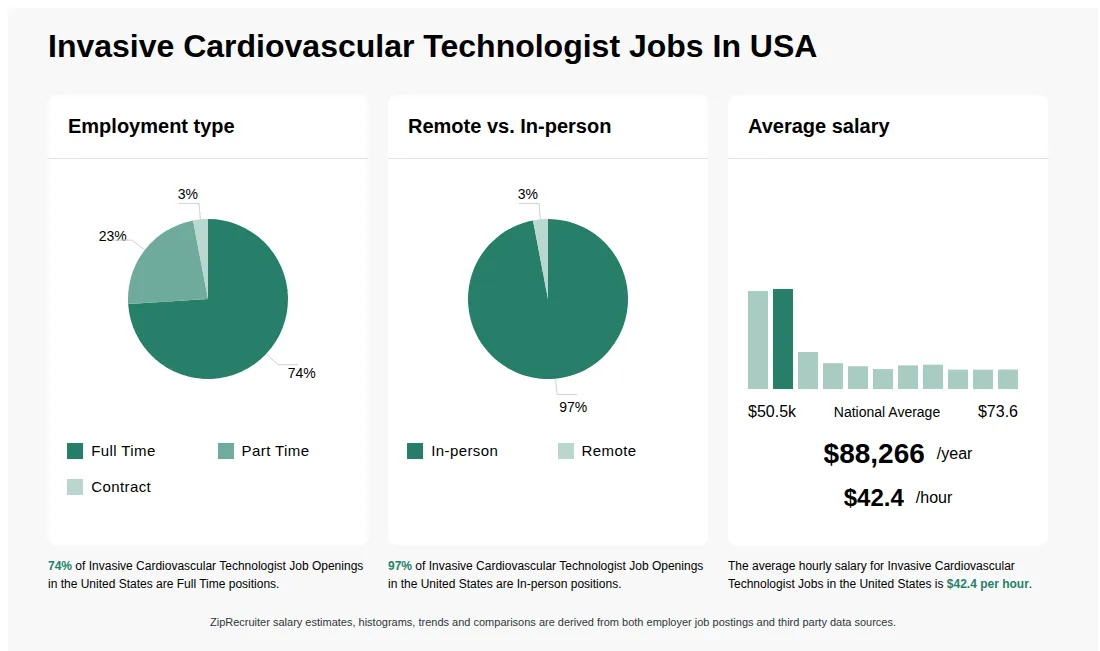
Invasive Cardiovascular Technologist information
See salary details
$24.28 - $28.76
25% of jobs
$28.81 is the 25th percentile. Wages below this are outliers.
$28.76 - $33.24
26% of jobs
$33.24 - $37.72
10% of jobs
$37.72 - $42.20
6% of jobs
$42.20 - $46.68
5% of jobs
$49.76 is the 75th percentile. Wages above this are outliers.
$46.68 - $51.16
4% of jobs
$51.16 - $55.64
5% of jobs
$55.64 - $60.12
5% of jobs
$60.12 - $64.60
4% of jobs
$64.60 - $69.08
4% of jobs
$69.08 - $73.56
4% of jobs
$24
$42
$73
How much do invasive cardiovascular technologist jobs pay per hour?
As of Sep 5, 2026, the average hourly pay for invasive cardiovascular technologist in the United States is $42.44, according to ZipRecruiter salary data. Most workers in this role earn between $29.09 and $54.81 per hour, depending on experience, location, and employer.
What is an invasive cardiovascular technologist?
An invasive cardiovascular technologist is part of a lab team and assists the cardiologist with all surgical and diagnostic procedures. As an invasive cardiovascular technologist, you responsibilities include collecting patient health history from physician reports and following all pre- and post-procedural guidelines from the World Health Organization (WHO) and your hospital’s policies. A typical workday involves preparing patients, transporting them to the surgical room, and helping monitor and record their condition throughout cardiovascular and minor surgical procedures, ensuring the team leader is aware of patients’ deteriorating health when applicable. You are also in charge of manipulating small tubes called cardiac catheters and guide wires. Other duties include calibrating monitoring equipment, sterilizing supplies, scheduling patients for specialized testing procedures, administering common procedure medications, and injecting contrast and flush fluids into their blood vessels under supervision. You also prepare diagnostic reports summarizing care activities.
What is an invasive cardiovascular technologist?
An Invasive Cardiovascular Technologist is a healthcare professional who assists physicians during procedures that diagnose and treat heart and blood vessel conditions. They are specially trained to operate equipment used during cardiac catheterizations, angioplasties, and other procedures involving the heart and vascular system. Their responsibilities include preparing patients, monitoring vital signs, and ensuring the safe operation of complex medical devices. These technologists play a critical role in helping physicians identify and address cardiovascular problems in real time.
What are the key skills and qualifications needed to thrive as an invasive cardiovascular technologist?
To thrive as an Invasive Cardiovascular Technologist, you need a solid understanding of cardiovascular anatomy, hemodynamics, and sterile techniques, typically validated by an associate degree and certification such as RCIS. Familiarity with catheterization lab equipment, fluoroscopy, and electronic medical record systems is essential. Attention to detail, teamwork, and the ability to remain calm under pressure are critical soft skills in this role. These competencies ensure accurate diagnostics, patient safety, and effective collaboration during high-stakes cardiac procedures.
What are some common challenges faced by invasive cardiovascular technologists during procedures, and how can they be managed?
Invasive Cardiovascular Technologists often work in high-pressure environments, especially during cardiac catheterizations or angioplasties. One common challenge is maintaining composure and accuracy when unexpected complications arise, such as arrhythmias or equipment malfunctions. Effective communication with physicians and the surgical team is essential for quick problem-solving. Staying current with procedural protocols and participating in regular training can help technologists confidently manage these challenges and ensure patient safety.
What is the difference between Invasive Cardiovascular Technologist vs Cardiovascular Technologist?
| Aspect | Invasive Cardiovascular Technologist | Cardiovascular Technologist |
|---|---|---|
| Certifications | Registered Cardiovascular Invasive Specialist (RCIS) | Registered Cardiovascular Technologist (RCVT) |
| Work Environment | Hospitals, cath labs, surgical settings | Clinics, diagnostic labs, outpatient facilities |
| Job Focus | Performing invasive procedures like angiograms | Performing diagnostic tests like EKGs and stress tests |
Invasive Cardiovascular Technologists specialize in invasive procedures such as angiograms and catheterizations, often working in surgical settings. Cardiovascular Technologists typically focus on diagnostic tests like EKGs and stress tests in outpatient or clinical environments. Both roles require similar certifications but differ mainly in procedure complexity and work setting.
More about Invasive Cardiovascular Technologist jobs
What cities are hiring for Invasive Cardiovascular Technologist jobs?
Cities with the most Invasive Cardiovascular Technologist job openings:
What are the most commonly searched types of Invasive Cardiovascular Technologist jobs?
The most popular types of Invasive Cardiovascular Technologist jobs are:
Who are the top companies hiring for Invasive Cardiovascular Technologist jobs?
The top employers for Invasive Cardiovascular Technologist jobs are:
What states have the most Invasive Cardiovascular Technologist jobs?
States with the most job openings for Invasive Cardiovascular Technologist jobs include:
What job categories do people searching Invasive Cardiovascular Technologist jobs look for?
The top searched job categories for Invasive Cardiovascular Technologist jobs are:
- International Cardiovascular Technologist
- International Invasive Cardiovascular Technologist
- Hourly Cardiovascular Technologist Cvt
- Full Time Impella Rep
- Trainee International Invasive Cardiovascular Techn
- Urgently Hiring International Invasive Cardiovascular Technologist
- Salary Cardiovascular Technologist
- Cardiovascular Credentialing International
- Internship Cardiovascular Technologist Cvt
- Pacific Cardiovascular Associates
What are popular job titles related to Invasive Cardiovascular Technologist jobs?
For Invasive Cardiovascular Technologist jobs, the most frequently searched job titles are:
- cardiovascular invasive specialist
- cardiovascular interventional technologist
- cardiovascular technologist
- cardiovascular non invasive technologist
- cardiovascular radiologic technologist
- cath lab technologist
- cardiac cath technologist
- interventional technologist
- cardiac cath lab technologist
- cardiovascular tech

Full-time
Re-posted 16 days ago
MUSC Health rating

7.0
Based on 202 frontline employees who took The Breakroom Quiz
421st of 898 rated healthcare providers
Job description
Job Description Summary
Under limited supervision, the Cardiovascular/Electrophysiology Technologist I assists physicians in diagnosing and treating cardiac disease in the EP procedure arena, specializing in the care of patients undergoing basic diagnostic and interventional electrophysiology procedures and cardiac device implantations. This role functions as a resource to staff.
Entity
Medical University Hospital Authority (MUHA)
Worker Type
Employee
Worker Sub-Type
Regular
Cost Center
CC003721 COL - EP Lab (DMC)
Pay Rate Type
Hourly
Pay Grade
Health-21
Scheduled Weekly Hours
40
Work Shift
Job Description
* Sign on bonus $20K with a 2-year commitment*
Job Description
Entity/Organization: MUHA (Medical University Hospital Authority/Medical Center)
FLSA Status: Hourly
Hours Per Week: 40
Job Description:
Under limited supervision, the Cardiovascular/Electrophysiology Technologist I assists physicians in diagnosing and treating cardiac disease in the EP procedure arena, specializing in the care of patients undergoing basic diagnostic and interventional electrophysiology procedures and cardiac device implantations. This role functions as a resource to staff.
Minimum Experience and Training Requirements: Minimum Experience and Training Requirements: High school diploma or equivalent (GED) and graduate of an accredited program in Invasive Cardiovascular Technology; or Graduate of a NON-programmatically accredited program in Invasive Cardiovascular Technology which has a minimum of one (1) year of specialty training and includes a minimum of 800 clinical hours in the specialty in which the examination is being requested; or Associate Degree in health, applied science, natural science, engineering, or any primary science and one (1) year (full-time or full-time equivalent) in Invasive Cardiovascular Technology; or Baccalaureate degree in health, science, natural science, engineering, or any primary science and six (6) months (full-time or full-time equivalent) in Invasive Cardiovascular Technology. Communicate effectively both verbally and in writing. Basic computer skills required. Participate in on-call rotation as scheduled. Telemetry and Arterial and Venous Sheath Removal experience required.
Required License Certification and Registration:
0-6 months. Graduation from an accredited Invasive Cardiovascular Technology program; or equivalent education and/or experience and RCIS, RCES, CEPS, or RT(R)CI certification required; or CST (Certified Surgical Technologist) certification/experience; or Graduation from an accredited school of radiologic technology and one year of radiologic experience. Telemetry and Arterial and Venous Sheath Removal experience preferred. Copy of academic degree or transcript required.
Job Duties:
Maintains a safe, therapeutic, and healing environment through ensuring patient privacy and responsive, respectful, accepting, and professional behavior.
Demonstrates the ability to function in a professional setting through active participation in a professional practice model. This includes participating in shared governance, adherence to standards of care, participation in peer review and professional development promoting leadership and clinical excellence, effective team skills, autonomous practice and acknowledgment of accountability for actions and critical thinking.
Coordinates the effective and efficient delivery of patient care services through the application of care management principles.
Identifies clinical priorities and initiates action to improve patient outcomes.
Demonstrates ability to function in a professional practice model through active participation in shared governance, promotion of a healthy work environment and acceptance of personal responsibility for professional growth.
As a critical member of the Electrophysiology Lab team, key responsibilities include preparing the sterile field, scrubbing in to assist the physician, operating advanced monitoring and recording systems, and maintaining procedural documentation.
EP lab specific Responsibilities and Duties
1. Procedural - 34%
2. Data Acquisition and Analysis - 33%:
3. Intra-Procedure - 33%: Monitor patient comfort and safety, and respond immediately to potential complications (e.g., cardiac arrest, pericardial effusion, vascular access issues).
Additional training and responsibilities set forth by departmental needs per management
Physical Requirements: Ability to perform job functions while standing. (Continuous) Ability to perform job functions while sitting. (Continuous) Ability to perform job functions while walking. (Continuous) Ability to climb stairs. (Infrequent) Ability to work indoors. (Continuous) Ability to work outside in temperature extremes. (Infrequent) Ability to work from elevated areas. (Frequent) Ability to work in confined/cramped spaces. (Frequent) Ability to perform job functions from kneeling positions. (Infrequent) Ability to bend at the waist. (Continuous) Ability to twist at the waist. (Frequent) Ability to squat and perform job functions. (Frequent) Ability to perform "pinching" operations. (Frequent) Ability to perform gross motor activities with fingers and hands. (Continuous) Ability to perform firm grasping with fingers and hands. (Continuous) Ability to perform fine manipulation with fingers and hands. (Continuous) Ability to reach overhead. (Frequent) Ability to perform repetitive motions with hands/wrists/elbows and shoulders. (Continuous) Ability to fully use both legs. (Continuous) Ability to use lower extremities for balance and coordination. (Frequent) Ability to reach in all directions. (Continuous) Ability to lift and carry 50 lbs. unassisted. (Infrequent) Ability to lift/lower objects 50 lbs. from/to floor from/to 36 inches unassisted. (Infrequent) Ability to lift from 36" to overhead 25 lbs. (Infrequent) Ability to exert up to 50 lbs. of force. (Frequent) Examples include: To transfer a 100 lb. patient that cannot assist in the transfer requires 50 lbs. of force. For every 100 additional pounds, assistance will be required from another healthcare worker. 20 lbs. of force is needed to push a 400 lb. patient in a wheelchair on carpet. 25 lbs. of force is required to push a stretcher with a patient with one hand. Ability to maintain 20/40 vision, corrected, in one eye or with both eyes. (Continuous) Ability to see and recognize objects close at hand or at a distance. (Continuous) Ability to match or discriminate between colors. (Continuous) Ability to determine distance/relationship between objects; depth perception. (Continuous) Good peripheral vision capabilities. (Continuous) Ability to maintain hearing acuity, with correction. (Continuous) Ability to perform gross motor functions with frequent fine motor movements. (Continuous) Ability to deal effectively with stressful situations. (Continuous) Ability to work rotating shifts. (Frequent) Ability to work overtime as required. Ability to work in a latex safe environment. (Continuous) Ability to maintain tactile sensory functions. *Ability to maintain good olfactory sensory function*Ability to be qualified physically for respirator use, initially and as required.
Additional Job Description
Minimum Experience and Training Requirements: High school diploma or equivalent (GED) and graduate of an accredited program in Invasive Cardiovascular Technology; or Graduate of a NON-programmatically accredited program in Invasive Cardiovascular Technology which has a minimum of one (1) year of specialty training and includes a minimum of 800 clinical hours in the specialty in which the examination is being requested; or Associate Degree in health, applied science, natural science, engineering, or any primary science and one (1) year (full-time or full-time equivalent) in Invasive Cardiovascular Technology; or Baccalaureate degree in health, science, natural science, engineering, or any primary science and six (6) months (full-time or full-time equivalent) in Invasive Cardiovascular Technology. Communicate effectively both verbally and in writing. Basic computer skills required. Participate in on-call rotation as scheduled. Telemetry and Arterial and Venous Sheath Removal experience required.
Required License Certification and Registration:
0-6 months. Graduation from an accredited Invasive Cardiovascular Technology program; or equivalent education and/or experience and RCIS, RCES, CEPS, or RT(R)CI certification required; or CST (Certified Surgical Technologist) certification/experience; or Graduation from an accredited school of radiologic technology and one year of radiologic experience. Telemetry and Arterial and Venous Sheath Removal experience preferred. Copy of academic degree or transcript required.
If you like working with energetic enthusiastic individuals, you will enjoy your career with us!
The Medical University of South Carolina is an Equal Opportunity Employer. MUSC does not discriminate on the basis of race, color, religion or belief, age, sex, national origin, gender identity, sexual orientation, disability, protected veteran status, family or parental status, or any other status protected by state laws and/or federal regulations. All qualified applicants are encouraged to apply and will receive consideration for employment based upon applicable qualifications, merit and business need.
Medical University of South Carolina participates in the federal E-Verify program to confirm the identity and employment authorization of all newly hired employees. For further information about the E-Verify program, please click here: http://www.uscis.gov/e-verify/employees
Under limited supervision, the Cardiovascular/Electrophysiology Technologist I assists physicians in diagnosing and treating cardiac disease in the EP procedure arena, specializing in the care of patients undergoing basic diagnostic and interventional electrophysiology procedures and cardiac device implantations. This role functions as a resource to staff.
Entity
Medical University Hospital Authority (MUHA)
Worker Type
Employee
Worker Sub-Type
Regular
Cost Center
CC003721 COL - EP Lab (DMC)
Pay Rate Type
Hourly
Pay Grade
Health-21
Scheduled Weekly Hours
40
Work Shift
Job Description
* Sign on bonus $20K with a 2-year commitment*
Job Description
Entity/Organization: MUHA (Medical University Hospital Authority/Medical Center)
FLSA Status: Hourly
Hours Per Week: 40
Job Description:
Under limited supervision, the Cardiovascular/Electrophysiology Technologist I assists physicians in diagnosing and treating cardiac disease in the EP procedure arena, specializing in the care of patients undergoing basic diagnostic and interventional electrophysiology procedures and cardiac device implantations. This role functions as a resource to staff.
Minimum Experience and Training Requirements: Minimum Experience and Training Requirements: High school diploma or equivalent (GED) and graduate of an accredited program in Invasive Cardiovascular Technology; or Graduate of a NON-programmatically accredited program in Invasive Cardiovascular Technology which has a minimum of one (1) year of specialty training and includes a minimum of 800 clinical hours in the specialty in which the examination is being requested; or Associate Degree in health, applied science, natural science, engineering, or any primary science and one (1) year (full-time or full-time equivalent) in Invasive Cardiovascular Technology; or Baccalaureate degree in health, science, natural science, engineering, or any primary science and six (6) months (full-time or full-time equivalent) in Invasive Cardiovascular Technology. Communicate effectively both verbally and in writing. Basic computer skills required. Participate in on-call rotation as scheduled. Telemetry and Arterial and Venous Sheath Removal experience required.
Required License Certification and Registration:
0-6 months. Graduation from an accredited Invasive Cardiovascular Technology program; or equivalent education and/or experience and RCIS, RCES, CEPS, or RT(R)CI certification required; or CST (Certified Surgical Technologist) certification/experience; or Graduation from an accredited school of radiologic technology and one year of radiologic experience. Telemetry and Arterial and Venous Sheath Removal experience preferred. Copy of academic degree or transcript required.
Job Duties:
Maintains a safe, therapeutic, and healing environment through ensuring patient privacy and responsive, respectful, accepting, and professional behavior.
Demonstrates the ability to function in a professional setting through active participation in a professional practice model. This includes participating in shared governance, adherence to standards of care, participation in peer review and professional development promoting leadership and clinical excellence, effective team skills, autonomous practice and acknowledgment of accountability for actions and critical thinking.
Coordinates the effective and efficient delivery of patient care services through the application of care management principles.
Identifies clinical priorities and initiates action to improve patient outcomes.
Demonstrates ability to function in a professional practice model through active participation in shared governance, promotion of a healthy work environment and acceptance of personal responsibility for professional growth.
As a critical member of the Electrophysiology Lab team, key responsibilities include preparing the sterile field, scrubbing in to assist the physician, operating advanced monitoring and recording systems, and maintaining procedural documentation.
EP lab specific Responsibilities and Duties
1. Procedural - 34%
- Aseptic Technique: Maintain strict adherence to sterile technique throughout the setup and duration of the procedure, ensuring patient safety and infection control.
- Instrumentation and Supply Preparation: Prepare and manage a complete sterile field, including all necessary catheters, wires, sheaths, mapping systems, ablations tools (RF, PFA and cryo), implants (pacemakers, ICDs, CRT), and emergency equipment.
- Direct Physician Assistance (Scrubbing):
- Scrub in and assist the physician at the sterile field with catheter manipulation, device preparation, troubleshooting equipment, and passing instruments/supplies efficiently.
- Anticipate physician needs based on procedure type and real-time hemodynamic/electrical data.
- Procedure Types: Routinely assist in procedures such as:
- Cardiac Ablations (e.g., Atrial Fibrillation, Atrial Flutter, SVT, Ventricular Tachycardia).
- Permanent Pacemaker, Implantable Cardioverter-Defibrillator (ICD), and Cardiac Resynchronization Therapy (CRT-D) implantations.
- Diagnostic EP Studies.
- Tilt Table Testing, Transesophageal echocardiograms, Loop recorder implants and Cardioversions, as needed.
2. Data Acquisition and Analysis - 33%:
- Continuously monitor, interpret, and document intracardiac electrograms (EGMs), surface ECGs, and hemodynamic parameters (e.g., blood pressure, oxygen saturation).
- Recognize and promptly alert the physician to significant changes in rhythm, conduction, or hemodynamic status.
- Stimulation Protocol Management: Assist the physician in programming and running pacing/stimulation protocols for diagnostic or therapeutic purposes.
- Documentation: Maintain comprehensive, accurate, and real-time documentation of the procedure, including all catheter placements, measurements, stimulation findings, energy delivery, and administered medications.
3. Intra-Procedure - 33%: Monitor patient comfort and safety, and respond immediately to potential complications (e.g., cardiac arrest, pericardial effusion, vascular access issues).
- Team Communication: Maintain clear, effective, and professional communication with the physician, radiologic technologists, and other EP lab personnel.
- Compliance: Adhere to all institutional policies, protocols, and regulatory standards (e.g., Joint Commission, HRS guidelines).
- Equipment Maintenance: Perform daily equipment checks and troubleshoot minor technical issues with EP systems, working closely with biomedical engineering.
- Provide support to patients and their families, addressing questions, concerns, and providing education as needed.
Additional training and responsibilities set forth by departmental needs per management
Physical Requirements: Ability to perform job functions while standing. (Continuous) Ability to perform job functions while sitting. (Continuous) Ability to perform job functions while walking. (Continuous) Ability to climb stairs. (Infrequent) Ability to work indoors. (Continuous) Ability to work outside in temperature extremes. (Infrequent) Ability to work from elevated areas. (Frequent) Ability to work in confined/cramped spaces. (Frequent) Ability to perform job functions from kneeling positions. (Infrequent) Ability to bend at the waist. (Continuous) Ability to twist at the waist. (Frequent) Ability to squat and perform job functions. (Frequent) Ability to perform "pinching" operations. (Frequent) Ability to perform gross motor activities with fingers and hands. (Continuous) Ability to perform firm grasping with fingers and hands. (Continuous) Ability to perform fine manipulation with fingers and hands. (Continuous) Ability to reach overhead. (Frequent) Ability to perform repetitive motions with hands/wrists/elbows and shoulders. (Continuous) Ability to fully use both legs. (Continuous) Ability to use lower extremities for balance and coordination. (Frequent) Ability to reach in all directions. (Continuous) Ability to lift and carry 50 lbs. unassisted. (Infrequent) Ability to lift/lower objects 50 lbs. from/to floor from/to 36 inches unassisted. (Infrequent) Ability to lift from 36" to overhead 25 lbs. (Infrequent) Ability to exert up to 50 lbs. of force. (Frequent) Examples include: To transfer a 100 lb. patient that cannot assist in the transfer requires 50 lbs. of force. For every 100 additional pounds, assistance will be required from another healthcare worker. 20 lbs. of force is needed to push a 400 lb. patient in a wheelchair on carpet. 25 lbs. of force is required to push a stretcher with a patient with one hand. Ability to maintain 20/40 vision, corrected, in one eye or with both eyes. (Continuous) Ability to see and recognize objects close at hand or at a distance. (Continuous) Ability to match or discriminate between colors. (Continuous) Ability to determine distance/relationship between objects; depth perception. (Continuous) Good peripheral vision capabilities. (Continuous) Ability to maintain hearing acuity, with correction. (Continuous) Ability to perform gross motor functions with frequent fine motor movements. (Continuous) Ability to deal effectively with stressful situations. (Continuous) Ability to work rotating shifts. (Frequent) Ability to work overtime as required. Ability to work in a latex safe environment. (Continuous) Ability to maintain tactile sensory functions. *Ability to maintain good olfactory sensory function*Ability to be qualified physically for respirator use, initially and as required.
Additional Job Description
Minimum Experience and Training Requirements: High school diploma or equivalent (GED) and graduate of an accredited program in Invasive Cardiovascular Technology; or Graduate of a NON-programmatically accredited program in Invasive Cardiovascular Technology which has a minimum of one (1) year of specialty training and includes a minimum of 800 clinical hours in the specialty in which the examination is being requested; or Associate Degree in health, applied science, natural science, engineering, or any primary science and one (1) year (full-time or full-time equivalent) in Invasive Cardiovascular Technology; or Baccalaureate degree in health, science, natural science, engineering, or any primary science and six (6) months (full-time or full-time equivalent) in Invasive Cardiovascular Technology. Communicate effectively both verbally and in writing. Basic computer skills required. Participate in on-call rotation as scheduled. Telemetry and Arterial and Venous Sheath Removal experience required.
Required License Certification and Registration:
0-6 months. Graduation from an accredited Invasive Cardiovascular Technology program; or equivalent education and/or experience and RCIS, RCES, CEPS, or RT(R)CI certification required; or CST (Certified Surgical Technologist) certification/experience; or Graduation from an accredited school of radiologic technology and one year of radiologic experience. Telemetry and Arterial and Venous Sheath Removal experience preferred. Copy of academic degree or transcript required.
If you like working with energetic enthusiastic individuals, you will enjoy your career with us!
The Medical University of South Carolina is an Equal Opportunity Employer. MUSC does not discriminate on the basis of race, color, religion or belief, age, sex, national origin, gender identity, sexual orientation, disability, protected veteran status, family or parental status, or any other status protected by state laws and/or federal regulations. All qualified applicants are encouraged to apply and will receive consideration for employment based upon applicable qualifications, merit and business need.
Medical University of South Carolina participates in the federal E-Verify program to confirm the identity and employment authorization of all newly hired employees. For further information about the E-Verify program, please click here: http://www.uscis.gov/e-verify/employees
What MUSC Health employees say
Pay
Benefits
Hours and flexibility
Workplace
Get the full story on Breakroom

About MUSC Health
Sourced by ZipRecruiter
MUSC is located in Charleston, SC, frequently named one of the best places in America to live. If charming, historic, vibrant, cultural, and coastal are adjectives that you find appealing, it's all here. In Charleston, you might find yourself dining at a world class restaurant tonight and relaxing on a boat as you explore our many waterways tomorrow. You might stroll along cobblestone streets, amidst centuries old homes by day and attend a jazz concert by night. Charleston is a place where you can live your life to its fullest.
Industry
Hospitality services
Company size
10,000+ Employees
Headquarters location
Charleston, SC, US
Year founded
1824