Invasive Cardiovascular Technologist * Location: South Florida * Employment: Full-Time * Department: Cardiac Cath Lab / Invasive Cardiology * Experience: 1+ year of relevant experience
Invasive Cardiovascular Technologist * Location: South Florida * Employment: Full-Time * Department: Cardiac Cath Lab / Invasive Cardiology * Experience: 1+ year of relevant experience

$39.41 - $61.09/hr
The Invasive Cardiovascular Technologist is a Registered Cardiovascular Invasive Specialist (RCIS), Registered Cardiovascular Electrophysiology Specialist (RCES) and/or Registered Radiologic ...
$39.41 - $61.09/hr
The Invasive Cardiovascular Technologist is a Registered Cardiovascular Invasive Specialist (RCIS), Registered Cardiovascular Electrophysiology Specialist (RCES) and/or Registered Radiologic ...

Invasive Cardiovascular Technologist About Anders Group About Anders Group Why Anders? At Anders Group, we do things differently. As a Joint Commission-accredited healthcare staffing agency, we're ...
Invasive Cardiovascular Technologist About Anders Group About Anders Group Why Anders? At Anders Group, we do things differently. As a Joint Commission-accredited healthcare staffing agency, we're ...
Cardiovascular Tech - Children's Hospital - Days
$39.41 - $61.09/hr
The Invasive Cardiovascular Technologist is a Registered Cardiovascular Invasive Specialist (RCIS), Registered Cardiovascular Electrophysiology Specialist (RCES) and/or Registered Radiologic ...
Cardiovascular Tech - Children's Hospital - Days
$39.41 - $61.09/hr
The Invasive Cardiovascular Technologist is a Registered Cardiovascular Invasive Specialist (RCIS), Registered Cardiovascular Electrophysiology Specialist (RCES) and/or Registered Radiologic ...

Invasive Cardiovascular Technologist III - 30hrs/week, Days
Albany, NY · On-site
$77K - $119K/yr
Day (United States of America) Salary Range: $77,075.00 - $119,466.00 Invasive Cardiovascular Technologists are allied health professionals who performs diagnostic examinations at the request or ...
Invasive Cardiovascular Technologist III - 30hrs/week, Days
Albany, NY · On-site
$77K - $119K/yr
Day (United States of America) Salary Range: $77,075.00 - $119,466.00 Invasive Cardiovascular Technologists are allied health professionals who performs diagnostic examinations at the request or ...

Invasive Cardiovascular Tech 1, Interventional Radiology, $25000 Bonus, FT, 7A-5:30P
Miami, FL · On-site
$34.08 - $47.71/hr
Description The Invasive Cardiovascular Technologist provides fundamental technical support by assisting the physician with patient preparation, intra and post-interventional/surgical procedures ...
Invasive Cardiovascular Tech 1, Interventional Radiology, $25000 Bonus, FT, 7A-5:30P
Miami, FL · On-site
$34.08 - $47.71/hr
Description The Invasive Cardiovascular Technologist provides fundamental technical support by assisting the physician with patient preparation, intra and post-interventional/surgical procedures ...

Invasive Cardiovascular Tech
Albany, NY · On-site
Invasive Cardiovascular Technologists are allied health professionals who performs diagnostic ... Through subjective data collection and recording, the technologist obtains information from which a ...
Invasive Cardiovascular Tech
Albany, NY · On-site
Invasive Cardiovascular Technologists are allied health professionals who performs diagnostic ... Through subjective data collection and recording, the technologist obtains information from which a ...
Cardiovascular Technologist
Albany, NY · On-site
$26.36 - $42.18/hr
Invasive Cardiovascular Technologist III - 30hrs/week, Days Apply Location: 43 New Scotland Avenue, Albany, NY 12208 Position Type: Part-time Posted: 30+ Days Ago Requisition ID: 62786 Department ...
Cardiovascular Technologist
Albany, NY · On-site
$26.36 - $42.18/hr
Invasive Cardiovascular Technologist III - 30hrs/week, Days Apply Location: 43 New Scotland Avenue, Albany, NY 12208 Position Type: Part-time Posted: 30+ Days Ago Requisition ID: 62786 Department ...
Cardiovascular Technologist
Albany, NY · On-site
$26.36 - $42.18/hr
Invasive Cardiovascular Technologist III - 30hrs/week, Days Apply Location: 43 New Scotland Avenue, Albany, NY 12208 Position Type: Part-time Posted: 30+ Days Ago Requisition ID: 62786 Department ...
Cardiovascular Technologist
Albany, NY · On-site
$26.36 - $42.18/hr
Invasive Cardiovascular Technologist III - 30hrs/week, Days Apply Location: 43 New Scotland Avenue, Albany, NY 12208 Position Type: Part-time Posted: 30+ Days Ago Requisition ID: 62786 Department ...

Registered ARRT is required or Registered Cardiovascular Invasive Technologist RCIS is required within 18 months of hire or Registered Respiratory Therapist with CV specific certification or RCIS or ...
Registered ARRT is required or Registered Cardiovascular Invasive Technologist RCIS is required within 18 months of hire or Registered Respiratory Therapist with CV specific certification or RCIS or ...

Per Diem Cardiovascular Technologist - Invasive Cardio Lab, Norwalk Hospital
Norwalk, CT · On-site
$64/hr
Per Diem Cardiovascular Technologist - Norwalk Hospital Invasive Cardio Lab, Norwalk, CT - Variable Per Diem, 8 & 10-hour shifts, 7:00am - 3:30pm or 7:00am - 5:30pm, on-call after hours, weekends ...
Per Diem Cardiovascular Technologist - Invasive Cardio Lab, Norwalk Hospital
Norwalk, CT · On-site
$64/hr
Per Diem Cardiovascular Technologist - Norwalk Hospital Invasive Cardio Lab, Norwalk, CT - Variable Per Diem, 8 & 10-hour shifts, 7:00am - 3:30pm or 7:00am - 5:30pm, on-call after hours, weekends ...

Per Diem Cardiovascular Technologist - Norwalk Hospital Invasive Cardio Lab, Norwalk, CT - Variable Per Diem, 8 & 10-hour shifts, 7:00am - 3:30pm or 7:00am - 5:30pm, on-call after hours, weekends ...
Quick apply
Per Diem Cardiovascular Technologist - Norwalk Hospital Invasive Cardio Lab, Norwalk, CT - Variable Per Diem, 8 & 10-hour shifts, 7:00am - 3:30pm or 7:00am - 5:30pm, on-call after hours, weekends ...
Per Diem Cardiovascular Technologist - Invasive Cardio Lab, Norwalk Hospital
Norwalk, CT · On-site
$64/hr
Per Diem Cardiovascular Technologist - Norwalk Hospital Invasive Cardio Lab, Norwalk, CT - Variable Per Diem, 8 & 10-hour shifts, 7:00am - 3:30pm or 7:00am - 5:30pm, on-call after hours, weekends ...
Per Diem Cardiovascular Technologist - Invasive Cardio Lab, Norwalk Hospital
Norwalk, CT · On-site
$64/hr
Per Diem Cardiovascular Technologist - Norwalk Hospital Invasive Cardio Lab, Norwalk, CT - Variable Per Diem, 8 & 10-hour shifts, 7:00am - 3:30pm or 7:00am - 5:30pm, on-call after hours, weekends ...
Per Diem Cardiovascular Technologist - Invasive Cardio Lab, Norwalk Hospital
Norwalk, CT · On-site
$64/hr
Per Diem Cardiovascular Technologist - Norwalk Hospital Invasive Cardio Lab, Norwalk, CT - Variable Per Diem, 8 & 10-hour shifts, 7:00am - 3:30pm or 7:00am - 5:30pm, on-call after hours, weekends ...
Per Diem Cardiovascular Technologist - Invasive Cardio Lab, Norwalk Hospital
Norwalk, CT · On-site
$64/hr
Per Diem Cardiovascular Technologist - Norwalk Hospital Invasive Cardio Lab, Norwalk, CT - Variable Per Diem, 8 & 10-hour shifts, 7:00am - 3:30pm or 7:00am - 5:30pm, on-call after hours, weekends ...
Per Diem Cardiovascular Technologist - Norwalk Hospital Invasive Cardio Lab, Norwalk, CT - Variable Per Diem, 8 & 10-hour shifts, 7:00am - 3:30pm or 7:00am - 5:30pm, on-call after hours, weekends ...
Quick apply
Per Diem Cardiovascular Technologist - Norwalk Hospital Invasive Cardio Lab, Norwalk, CT - Variable Per Diem, 8 & 10-hour shifts, 7:00am - 3:30pm or 7:00am - 5:30pm, on-call after hours, weekends ...

Invasive CardioVascular Tech, Electrophysiology Lab, $25,000 Bonus, Bethesda East, FT, 7A-5:30P
Boynton Beach, FL · On-site
$40.71 - $56.99/hr
The Invasive Cardiovascular Technologist provides fundamental technical support by assisting the physician with patient preparation, intra and post-interventional/surgical procedures, management of ...
Invasive CardioVascular Tech, Electrophysiology Lab, $25,000 Bonus, Bethesda East, FT, 7A-5:30P
Boynton Beach, FL · On-site
$40.71 - $56.99/hr
The Invasive Cardiovascular Technologist provides fundamental technical support by assisting the physician with patient preparation, intra and post-interventional/surgical procedures, management of ...
Per Diem Cardiovascular Technologist - Invasive Cardio Lab, Norwalk Hospital
Norwalk, CT · On-site
$64/hr
Per Diem Cardiovascular Technologist - Norwalk Hospital Invasive Cardio Lab, Norwalk, CT - Variable Per Diem, 8 & 10-hour shifts, 7:00am - 3:30pm or 7:00am - 5:30pm, on-call after hours, weekends ...
Per Diem Cardiovascular Technologist - Invasive Cardio Lab, Norwalk Hospital
Norwalk, CT · On-site
$64/hr
Per Diem Cardiovascular Technologist - Norwalk Hospital Invasive Cardio Lab, Norwalk, CT - Variable Per Diem, 8 & 10-hour shifts, 7:00am - 3:30pm or 7:00am - 5:30pm, on-call after hours, weekends ...
Invasive CardioVascular Tech, Electrophysiology Lab, $25,000 Bonus, Bethesda East, FT, 7A-5:30P
Boynton Beach, FL · On-site
$40.71 - $56.99/hr
The Invasive Cardiovascular Technologist provides fundamental technical support by assisting the physician with patient preparation, intra and post-interventional/surgical procedures, management of ...
Invasive CardioVascular Tech, Electrophysiology Lab, $25,000 Bonus, Bethesda East, FT, 7A-5:30P
Boynton Beach, FL · On-site
$40.71 - $56.99/hr
The Invasive Cardiovascular Technologist provides fundamental technical support by assisting the physician with patient preparation, intra and post-interventional/surgical procedures, management of ...

Invasive Cardiovascular Technologist-SIGN ON BONUS
Flemington, NJ · On-site
$42.62 - $53.28/hr
Position Summary The Registered Radiology Technologist RT(R)/Cardiovascular Invasive Specialist (, Registered Cardiovascular Invasive Specialist (RCIS) serves as a member of the Cardiovascular ...
Invasive Cardiovascular Technologist-SIGN ON BONUS
Flemington, NJ · On-site
$42.62 - $53.28/hr
Position Summary The Registered Radiology Technologist RT(R)/Cardiovascular Invasive Specialist (, Registered Cardiovascular Invasive Specialist (RCIS) serves as a member of the Cardiovascular ...
Invasive Cardiovascular Technologist-SIGN ON BONUS
Flemington, NJ · On-site
$42.62 - $53.28/hr
Position Summary The Registered Radiology Technologist RT(R)/Cardiovascular Invasive Specialist (, Registered Cardiovascular Invasive Specialist (RCIS) serves as a member of the Cardiovascular ...
Invasive Cardiovascular Technologist-SIGN ON BONUS
Flemington, NJ · On-site
$42.62 - $53.28/hr
Position Summary The Registered Radiology Technologist RT(R)/Cardiovascular Invasive Specialist (, Registered Cardiovascular Invasive Specialist (RCIS) serves as a member of the Cardiovascular ...
Invasive Cardiovascular Technologist information
See salary details
$24.28 - $28.76
25% of jobs
$28.81 is the 25th percentile. Wages below this are outliers.
$28.76 - $33.24
26% of jobs
$33.24 - $37.72
10% of jobs
$37.72 - $42.20
6% of jobs
$42.20 - $46.68
5% of jobs
$49.76 is the 75th percentile. Wages above this are outliers.
$46.68 - $51.16
4% of jobs
$51.16 - $55.64
5% of jobs
$55.64 - $60.12
5% of jobs
$60.12 - $64.60
4% of jobs
$64.60 - $69.08
4% of jobs
$69.08 - $73.56
4% of jobs
$24
$42
$73
How much do invasive cardiovascular technologist jobs pay per hour?
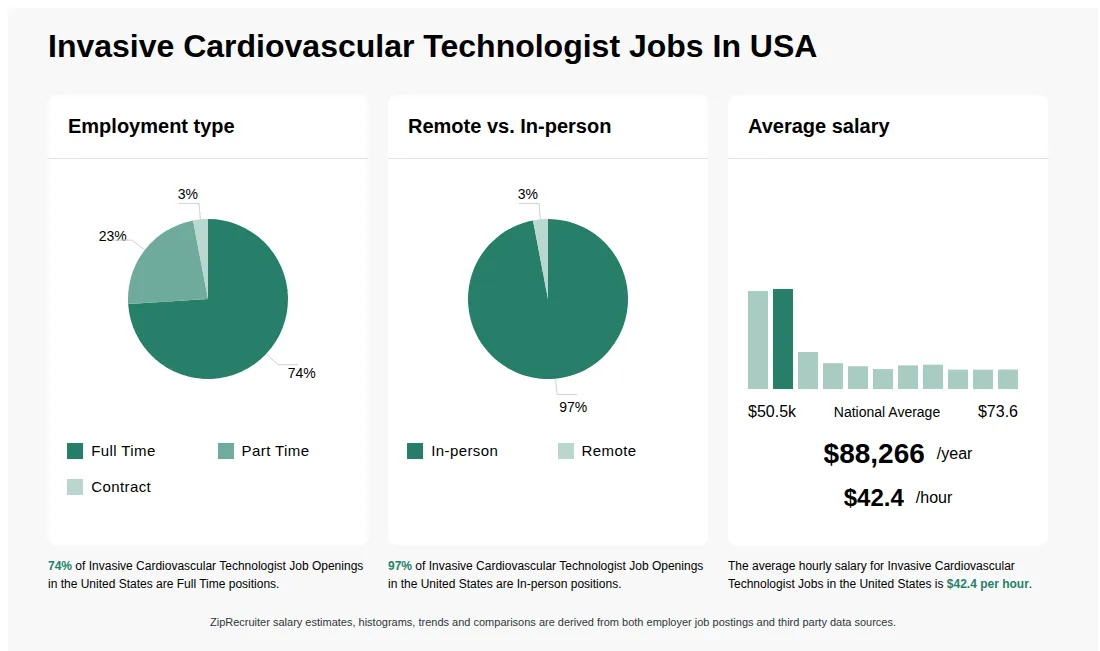
As of Sep 5, 2026, the average hourly pay for invasive cardiovascular technologist in the United States is $42.44, according to ZipRecruiter salary data. Most workers in this role earn between $29.09 and $54.81 per hour, depending on experience, location, and employer.
What is an invasive cardiovascular technologist?
An invasive cardiovascular technologist is part of a lab team and assists the cardiologist with all surgical and diagnostic procedures. As an invasive cardiovascular technologist, you responsibilities include collecting patient health history from physician reports and following all pre- and post-procedural guidelines from the World Health Organization (WHO) and your hospital’s policies. A typical workday involves preparing patients, transporting them to the surgical room, and helping monitor and record their condition throughout cardiovascular and minor surgical procedures, ensuring the team leader is aware of patients’ deteriorating health when applicable. You are also in charge of manipulating small tubes called cardiac catheters and guide wires. Other duties include calibrating monitoring equipment, sterilizing supplies, scheduling patients for specialized testing procedures, administering common procedure medications, and injecting contrast and flush fluids into their blood vessels under supervision. You also prepare diagnostic reports summarizing care activities.
What is an invasive cardiovascular technologist?
An Invasive Cardiovascular Technologist is a healthcare professional who assists physicians during procedures that diagnose and treat heart and blood vessel conditions. They are specially trained to operate equipment used during cardiac catheterizations, angioplasties, and other procedures involving the heart and vascular system. Their responsibilities include preparing patients, monitoring vital signs, and ensuring the safe operation of complex medical devices. These technologists play a critical role in helping physicians identify and address cardiovascular problems in real time.
What are the key skills and qualifications needed to thrive as an invasive cardiovascular technologist?
To thrive as an Invasive Cardiovascular Technologist, you need a solid understanding of cardiovascular anatomy, hemodynamics, and sterile techniques, typically validated by an associate degree and certification such as RCIS. Familiarity with catheterization lab equipment, fluoroscopy, and electronic medical record systems is essential. Attention to detail, teamwork, and the ability to remain calm under pressure are critical soft skills in this role. These competencies ensure accurate diagnostics, patient safety, and effective collaboration during high-stakes cardiac procedures.
What are some common challenges faced by invasive cardiovascular technologists during procedures, and how can they be managed?
Invasive Cardiovascular Technologists often work in high-pressure environments, especially during cardiac catheterizations or angioplasties. One common challenge is maintaining composure and accuracy when unexpected complications arise, such as arrhythmias or equipment malfunctions. Effective communication with physicians and the surgical team is essential for quick problem-solving. Staying current with procedural protocols and participating in regular training can help technologists confidently manage these challenges and ensure patient safety.
What is the difference between Invasive Cardiovascular Technologist vs Cardiovascular Technologist?
| Aspect | Invasive Cardiovascular Technologist | Cardiovascular Technologist |
|---|---|---|
| Certifications | Registered Cardiovascular Invasive Specialist (RCIS) | Registered Cardiovascular Technologist (RCVT) |
| Work Environment | Hospitals, cath labs, surgical settings | Clinics, diagnostic labs, outpatient facilities |
| Job Focus | Performing invasive procedures like angiograms | Performing diagnostic tests like EKGs and stress tests |
Invasive Cardiovascular Technologists specialize in invasive procedures such as angiograms and catheterizations, often working in surgical settings. Cardiovascular Technologists typically focus on diagnostic tests like EKGs and stress tests in outpatient or clinical environments. Both roles require similar certifications but differ mainly in procedure complexity and work setting.
More about Invasive Cardiovascular Technologist jobs
What cities are hiring for Invasive Cardiovascular Technologist jobs?
Cities with the most Invasive Cardiovascular Technologist job openings:
What are the most commonly searched types of Invasive Cardiovascular Technologist jobs?
The most popular types of Invasive Cardiovascular Technologist jobs are:
Who are the top companies hiring for Invasive Cardiovascular Technologist jobs?
The top employers for Invasive Cardiovascular Technologist jobs are:
What states have the most Invasive Cardiovascular Technologist jobs?
States with the most job openings for Invasive Cardiovascular Technologist jobs include:
What job categories do people searching Invasive Cardiovascular Technologist jobs look for?
The top searched job categories for Invasive Cardiovascular Technologist jobs are:
- International Cardiovascular Technologist
- International Invasive Cardiovascular Technologist
- Hourly Cardiovascular Technologist Cvt
- Full Time Impella Rep
- Trainee International Invasive Cardiovascular Techn
- Urgently Hiring International Invasive Cardiovascular Technologist
- Salary Cardiovascular Technologist
- Cardiovascular Credentialing International
- Internship Cardiovascular Technologist Cvt
- Pacific Cardiovascular Associates
What are popular job titles related to Invasive Cardiovascular Technologist jobs?
For Invasive Cardiovascular Technologist jobs, the most frequently searched job titles are:
- cardiovascular invasive specialist
- cardiovascular interventional technologist
- cardiovascular technologist
- cardiovascular non invasive technologist
- cardiovascular radiologic technologist
- cath lab technologist
- cardiac cath technologist
- interventional technologist
- cardiac cath lab technologist
- cardiovascular tech

Invasive Cardiac Technologist - Top healthcare facility
Pompano Beach, FL • On-site
Full-time
Posted 24 days ago
Job description
Position Details:
- Position: Invasive Cardiovascular Technologist
- Location: South Florida
- Employment: Full-Time
- Department: Cardiac Cath Lab / Invasive Cardiology
- Experience: 1+ year of relevant experience
- Certification: RCIS or RCES eligibility preferred
- BLS: Required
- Work alongside physicians and the cardiovascular team during invasive/interventional procedures
- Assist with patient preparation, monitoring, and procedural support
- Operate specialized cardiovascular and fluoroscopic imaging equipment
- Work in a fast-paced, high-acuity cardiovascular environment
- Opportunity for professional growth and advancement
- Full benefits and bonus/relocation offered
Please email your resume to ashley@ka-recruiting.com
Reference:ATK601

About KA Recruiting
Sourced by ZipRecruiter
Industry
Recruiting and staffing services
Company size
1 - 10 Employees
Headquarters location
Boston, MA, US
Year founded
2008