1

Cardiovascular Surgical Tech Jobs (NOW HIRING)

CVOR Surgical Technologist

Houston, TX · On-site

$54K - $83K/yr

A hospital in Houston, TX is seeking a mid-level CVOR Surgical Technologist to join its cardiovascular operating room team. This is an in-person, on-site position requiring direct, hands-on ...

Apply Early

Travel 37353255 ❤️ Travel CVOR Surgical Tech - Billings, MT 📍 Billings, Montana 💰 Competitive Pay | 3x12s | Cardiovascular OR ✨ Job Overview We're seeking an experienced CVOR Surgical ...

Seeking an experienced CVOR Surgical Tech to support cardiovascular surgical cases. Responsibilities: * Prepare operating room for cardiac procedures * Maintain sterile field during open heart and ...

Apply Early

next page

Showing results 1-20

Cardiovascular Surgical Tech information

See salary details

$875

$2.3K

$3.3K

How much do cardiovascular surgical tech jobs pay per week?

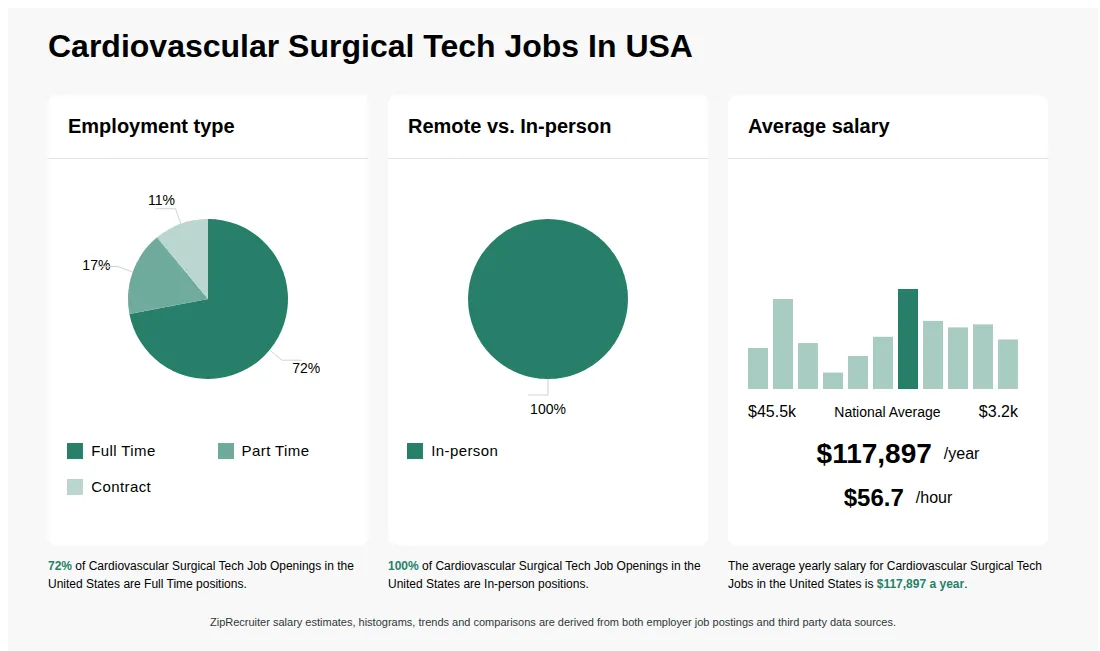
As of Jul 7, 2026, the average weekly pay for cardiovascular surgical tech in the United States is $2,267.25, according to ZipRecruiter salary data. Most workers in this role earn between $1,423.08 and $2,750.00 per week, depending on experience, location, and employer.

What is the difference between Cardiovascular Surgical Tech vs Operating Room Technician?

AspectCardiovascular Surgical TechOperating Room Technician
CertificationsCertified Surgical Technologist (CST), specialized in cardiovascular proceduresGenerally CST or equivalent, with no specific specialization
Work EnvironmentCardiovascular operating rooms, assisting in heart and blood vessel surgeriesVarious surgical settings, assisting in general surgeries
Employer & IndustryHospitals, cardiac centers, specialized surgical clinicsHospitals, outpatient surgical centers, clinics

Cardiovascular Surgical Techs focus on assisting in heart and blood vessel surgeries, requiring specialized training and certifications. Operating Room Technicians support a broader range of surgeries without specific specialization. Both roles are vital in surgical teams but differ in scope and environment.

What are the key skills and qualifications needed to thrive as a Cardiovascular Surgical Tech, and why are they important?

To thrive as a Cardiovascular Surgical Tech, you need a thorough understanding of surgical procedures, anatomy, sterile techniques, and usually an accredited surgical technology program completion with certification (e.g., CST). Familiarity with specialized surgical instruments, operating room protocols, and patient monitoring systems is crucial. Attention to detail, calmness under pressure, and strong teamwork and communication skills help you excel in high-stakes surgical environments. These competencies ensure patient safety, efficient surgeries, and effective collaboration with surgeons and the operative team.

What are cardiovascular surgical techs?

Cardiovascular surgical techs, also known as cardiovascular surgical technologists, are allied health professionals who assist surgeons during heart and blood vessel surgeries. They are responsible for preparing the operating room, sterilizing instruments, and ensuring all necessary equipment is available for procedures. During surgery, they pass instruments to the surgeon, help maintain a sterile field, and may assist with tasks such as monitoring patient vitals or handling specialized devices. Their role is crucial in supporting the surgical team and ensuring patient safety throughout cardiovascular operations.

What are some common challenges faced by Cardiovascular Surgical Techs during complex procedures, and how can they be managed?

Cardiovascular Surgical Techs often encounter high-pressure situations during lengthy or intricate heart surgeries, where quick thinking and precise teamwork are essential. Managing delicate instruments, anticipating the surgeon’s needs, and maintaining a sterile environment can be challenging, especially when unexpected complications arise. To navigate these challenges, effective communication, continual skills development, and familiarity with a wide range of surgical tools are vital. Many techs also find that building strong working relationships with their surgical team helps ensure smooth procedures and fosters a supportive work environment.

What Does a Cardiovascular Surgical Tech Do?

The duties of a cardiovascular surgical tech are to assist a cardiac surgeon before, during, and after heart surgery or a similar procedure. They prep the CVOR (cardiovascular operating room) and help with preoperative care and transport. During the operation, they assist the surgical staff, monitor patient condition, and transport them to a recovery room. The qualifications to become a surgical technologist include certification and a postsecondary degree.

Is it hard to become a cardiovascular surgical tech?

Becoming a cardiovascular surgical tech requires completing a postsecondary program in surgical technology and obtaining certification, which involves passing an exam. The role demands attention to detail, technical skills, and the ability to work in high-pressure environments, but with proper training and experience, it is achievable for dedicated individuals.

What is the highest paying surgical tech specialty?

In the field of surgical technology, cardiovascular surgical techs typically earn higher salaries due to the complexity and critical nature of cardiac procedures. Specializing in cardiovascular surgery often requires additional training and certifications, which can lead to increased compensation compared to general surgical tech roles.

What do cardiovascular surgical techs do?

Cardiovascular surgical techs assist during heart and vascular surgeries by preparing operating rooms, sterilizing instruments, and passing surgical tools to the surgeon. They also help with patient positioning, monitor equipment, and ensure a sterile environment to support successful procedures.

How long does it take to become a CVOR?

Becoming a cardiovascular surgical technologist (CVOR) typically requires completing a postsecondary surgical technology program, which takes about 9 months to 2 years. Afterward, gaining certification through the National Board of Surgical Technology and Surgical Assisting (NBSTSA) can enhance job prospects, and on-the-job training is often provided in the operating room environment.
What cities are hiring for Cardiovascular Surgical Tech jobs? Cities with the most Cardiovascular Surgical Tech job openings:
What are the most commonly searched types of Cardiovascular Surgical Tech jobs? The most popular types of Cardiovascular Surgical Tech jobs are:
Who are the top companies hiring for Cardiovascular Surgical Tech jobs? The top employers for Cardiovascular Surgical Tech jobs are:
What states have the most Cardiovascular Surgical Tech jobs? States with the most job openings for Cardiovascular Surgical Tech jobs include:
Cardiovascular Surgical Technologist

Cardiovascular Surgical Technologist

Sentara Healthcare

Harrisonburg, VA • On-site

Full-time

Medical, Dental, Vision, Life, Retirement, PTO

Posted 25 days ago


Sentara Health rating

6.9

Company rating: 6.9 out of 10

Based on 391 frontline employees who took The Breakroom Quiz

483rd of 877 rated healthcare providers


Job description

City/State
Harrisonburg, VA
Work Shift
First (Days)
Overview:
Sentara RMH Medical Center located in Harrisonburg; Virginia is hiring a Cardiovascular Surgical Technologist for the Cardiac Operating Room!
Hours: Monday through Friday 6:30am to 2:30pm and required call. Candidate must live within 30 minutes of the hospital for call purposes. Weekday call is 1430-0600 the following morning - Weekend call is 24 hours Saturday and Sunday
15,000 Sign on Bonus available for qualified candidates.
Department Overview:
We are made up of two operating rooms and one hybrid OR. The Surgical Tech will work with a multi-disciplinary team of Cardio-thoracic Surgeons, Anesthesiologists, Cardiovascular Technologists, and Physician Assistants and Registered Nurses. The Cardiothoracic Operating Room (CTOR) is part of the larger Surgical Services department at Sentara RMH in Harrisonburg, Virginia. Overall, there are 14 ORs, 2 minor surgery rooms, 6 procedure rooms, and 2 C-section suites. There are 2 dedicated CTORs, one Hybrid OR, and one Robotic OR where CTS cases are performed.
The Cardiovascular Surgical Technologist plays a critical role in assisting cardiovascular surgeons during open-heart, vascular, and thoracic surgical procedures. This highly specialized surgical technologist is responsible for preparing the operating room, organizing surgical instruments and supplies, and ensuring a sterile environment. The technologist anticipates the surgeon's needs and provides intraoperative support to optimize surgical outcomes, patient safety, and procedural efficiency.
As the primary scrub technician during all cardiovascular and thoracic surgeries, the role involves assisting the surgical team by passing instruments, sutures, grafts, and other sterile supplies as needed. All surgical instruments are properly sterilized and confirmed to be functioning prior to procedures, while maintaining sterile technique and infection control standards throughout the operation. Close collaboration with surgeons, anesthesiologists, perfusionists, and nursing staff ensures delivery of high-quality patient care. Responsibilities include handling specimens appropriately, documenting as required, and performing accurate counts with the circulator before the operation and at appropriate times during each body plane closure. Surgeons and assistants are gowned and gloved as needed, with active participation in preoperative briefings and postoperative debriefings to support ongoing surgical quality improvement.
Education
  • High school diploma or equivalent required
  • Trade School Graduate preferred

Certification/Licensure
  • National Board of Surgical Technology and Surgical Assisting (NBSTSA) certification and Surgical Technologist Licensure required IF license is required in the state of practice; otherwise must have NBSTSA certification.
  • Certified Surgical Technologist
  • BLS

Experience
  • 1 year of experience in cardio or thoracic surgery required

  • In-depth knowledge of cardiovascular anatomy, instrumentation, and procedures.

  • In depth knowledge of anatomy and physiology related to cardiac surgery achieved with independence on all CVOR cases, including TAVRS and combined Vascular cases.

  • In depth learning or knowledge of cardiac anatomy and physiology, tissue exposure, surgical flow and advanced techniques in cardiac surgery specialty

  • Ability to take call independently with advanced cardiac surgery skills required to perform in the scrub role for all cardiac surgery procedures

  • Excellent communication and teamwork skills.

  • Utilizes chain of command, practices open communication, promotes an inclusive team environment and supports all initiatives in the cardiac operating room.

  • Assists with room turnover between cases and participates in cleaning and organization of the department.

  • Ability to remain calm and focused under pressure.

  • Must have a strong attention to detail and physical stamina to handle long, intense, and high-risk cases

  • Strong attention to detail and adherence to safety protocols.

  • Performs a thorough review of the surgeons' preferences prior to each surgical procedure.

  • Checks supplies and equipment needed for surgical procedure, assists with selection and opening of sterile supplies.

  • Maintains a safe environment throughout procedure in regard to patient physical safety, fire prevention, infection control, and maintains highest of sterile field organization throughout procedure

#Talroo-Allied Health
Keywords: CST, NBSTSA, Surgical Tech, Technologist, Surg Tech, Scrub Tech, Cardiothoracic, CTOR, CVOR, Operating Room, OR
Benefits: Caring For Your Family and Your Career
Medical, Dental, Vision plans
• Adoption, Fertility and Surrogacy Reimbursement up to 10,000
• Paid Time Off and Sick Leave
• Paid Parental & Family Caregiver Leave
• Emergency Backup Care
• Long-Term, Short-Term Disability, and Critical Illness plans
• Life Insurance
• 401k/403B with Employer Match
• Tuition Assistance - 5,250/year and discounted educational opportunities through Guild Education
• Student Debt Pay Down - 10,000
• Reimbursement for certifications and free access to complete CEUs and professional development
• Pet Insurance
• Legal Resources Plan
• Colleagues may have the opportunity to earn an annual discretionary bonus if established system and employee eligibility criteria is met
Sentara RMH Medical Center, a Magnet designated hospital located in Harrisonburg VA, serves a seven-county area with a population of 218,000 residents, employing 2600 locals. The 238-bed community hospital has been serving Harrisonburg, Rockingham County and surrounding areas since 1912, then partnered with the Sentara Health System in May of 2011. Sentara RMH features the RMH Hahn Cancer Center, a state-of-the-art center equipped with the latest cancer fighting technologies available in the nation administrating more than 18,000 cancer treatments. With 1800 delivered babies, 60,000 emergency patients and 21,000 surgical procedures, Sentara has a position for you. We improve health every day, come be a part of the community.
Our Caring Workplace Environment
• A Caring Commitment serving our community for 100+ years
• Free and convenient parking
• Collaboration and shared governance
• CMS 5-Star and Magnet designated hospital
• EAP - 24 x 7
Sentara Health is an equal opportunity employer and prides itself on the diversity and inclusiveness of its close to an almost 30,000-member workforce. Diversity, inclusion, and belonging is a guiding principle of the organization to ensure its workforce reflects the communities it serves.
In support of our mission "to improve health every day," this is a tobacco-free environment.
For positions that are available as remote work, Sentara Health employs associates in the following states:
Alabama, Delaware, Florida, Georgia, Idaho, Indiana, Kansas, Louisiana, Maine, Maryland, Minnesota, Nebraska, Nevada, New Hampshire, North Carolina, North Dakota, Ohio, Oklahoma, Pennsylvania, South Carolina, South Dakota, Tennessee, Texas, Utah, Virginia, Washington, West Virginia, Wisconsin, and Wyoming.

What Sentara Health employees say

Pay

Benefits

Hours and flexibility

Workplace

Get the full story on Breakroom