1

Behavioral Health Navigator Jobs (NOW HIRING)

The Behavioral Health Navigator plays a critical role in supporting individuals in custody with substance use disorders, mental health challenges, and in need of preparation for release back into the ...

The Navigator provides direct support, education and resources to ensure successful outcomes for ... Partner with Early Intervention staff and Behavioral Health providers to offer training and ...

Summary The BH Navigator's primary responsibility is to guide behavioral health patients through the health care system. Serves as a single point of contact for referring physicians, clients ...

next page

Showing results 1-20

Behavioral Health Navigator information

See salary details

$13

$27

$43

How much do behavioral health navigator jobs pay per hour?

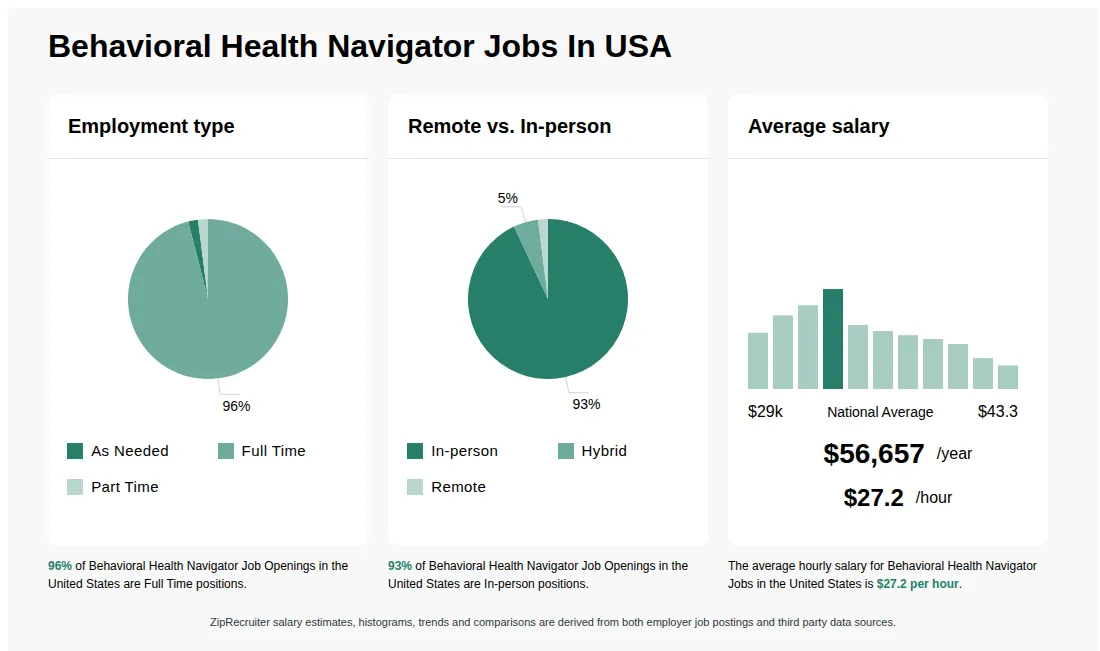
As of Jul 26, 2026, the average hourly pay for behavioral health navigator in the United States is $27.24, according to ZipRecruiter salary data. Most workers in this role earn between $20.43 and $33.41 per hour, depending on experience, location, and employer.

What skills do you need to be a BHT?

A Behavioral Health Navigator (BHT) typically needs strong communication and interpersonal skills to effectively support clients. Knowledge of mental health conditions, crisis intervention, and basic counseling techniques are important, along with the ability to work in a team and follow treatment plans. Certification or training in behavioral health or related fields is often required or preferred.

What is the highest paying job in behavioral health?

In behavioral health, the highest paying roles are often clinical directors, psychiatric nurse practitioners, or licensed psychologists, with salaries exceeding $100,000 annually. These positions typically require advanced degrees, licensure, and extensive experience, and may involve leadership or specialized clinical skills.

What is the difference between Behavioral Health Navigator vs Behavioral Health Case Manager?

AspectBehavioral Health NavigatorBehavioral Health Case Manager
CredentialsHigh school diploma or equivalent; certifications like Certified Peer Specialist often preferredHigh school diploma or equivalent; licensure or certification may be required depending on state
Work EnvironmentCommunity clinics, hospitals, outpatient settingsHospitals, clinics, community agencies
Employer & Industry UsageHealthcare providers, mental health organizationsHealthcare facilities, social service agencies
Common Search & ComparisonBehavioral Health Navigator vs Behavioral Health Case Manager

Behavioral Health Navigators primarily assist clients in navigating mental health services, providing support and resource guidance. Behavioral Health Case Managers often have a broader role, including care coordination and treatment planning. While both roles work within mental health settings, Navigators focus on guidance and resource connection, whereas Case Managers handle comprehensive case management tasks.

How does a Behavioral Health Navigator typically collaborate with other healthcare professionals to support patient care?

Behavioral Health Navigators work closely with a multidisciplinary team, including social workers, therapists, primary care providers, and case managers, to ensure patients receive comprehensive care. They regularly facilitate communication between patients and providers, coordinate referrals, and help bridge gaps between physical and mental health services. This collaborative approach not only streamlines the patient experience but also ensures that care plans are tailored to individual needs, improving outcomes and patient satisfaction.

How much does a patient navigator make?

In Pennsylvania, a Behavioral Health Navigator typically earns between $35,000 and $50,000 annually, depending on experience, certifications, and work setting. Entry-level positions may start lower, while experienced navigators or those with specialized training can earn higher salaries.

What qualifications do you need to be a patient navigator?

Behavioral health navigators typically need a high school diploma or equivalent, with some roles preferring post-secondary education or certifications in health or social services. Relevant skills include strong communication, organization, and knowledge of healthcare systems, and some positions may require experience working with mental health or community resources.

What are the key skills and qualifications needed to thrive as a Behavioral Health Navigator, and why are they important?

To thrive as a Behavioral Health Navigator, you need a background in psychology, social work, or counseling, often supported by a relevant degree or certification. Familiarity with case management software, electronic health records (EHR), and community resource databases is typically required. Strong interpersonal communication, empathy, and problem-solving abilities help build trust and effectively support clients navigating behavioral health systems. These skills are crucial for ensuring clients receive coordinated care, appropriate resources, and positive mental health outcomes.

What are Behavioral Health Navigators?

Behavioral Health Navigators are professionals who assist individuals in accessing and coordinating mental health and substance use services. They help clients understand their treatment options, connect with providers, and overcome barriers to care such as insurance issues or transportation. Behavioral Health Navigators often work in healthcare settings, community organizations, or social service agencies, acting as a bridge between clients and the behavioral health system. Their goal is to ensure individuals receive timely and appropriate care while providing guidance and support throughout the process.
More about Behavioral Health Navigator jobs
What cities are hiring for Behavioral Health Navigator jobs? Cities with the most Behavioral Health Navigator job openings:
What states have the most Behavioral Health Navigator jobs? States with the most job openings for Behavioral Health Navigator jobs include:
Infographic showing various Behavioral Health Navigator job openings in the United States as of July 2026, with employment types broken down into 91% Full Time, and 9% Contract. Highlights an 100% In-person job distribution, with an average salary of $56,657 per year, or $27.2 per hour.
Behavioral Health Navigator

Behavioral Health Navigator

Transitions Mental Health Association

San Luis Obispo, CA • On-site

$23 - $25/hr

Part-time

Retirement

Posted 6 days ago


Job description

Job Type
Part-time
Description
POSITION TITLE: Behavioral Health Navigator
PROGRAM/LOCATION: Behavioral Health Navigation / San Luis Obispo
POSITION SUMMARY:
The Behavioral Health Navigator provides trauma-informed system navigation and linkage, emotional support, education, information, referrals, and community outreach for adults with mental health challenges in San Luis Obispo County. In addition, Behavioral Health Navigators provide training, education, and outreach to clients, service providers, and the community regarding available programs, mental illness education, and agency services. The Behavioral Health Navigator will uphold the agency's mission in all duties performed and will promote recovery, wellness, and a trauma-informed approach to service delivery.
HOURS/ SALARY EMPLOYEE PERKS:
Part-Time, non-exempt position. 20 hours per week. Anticipated hiring range is $23.00-$25.00. Includes a generous individual benefits package that includes critical illness benefits, accident benefits, 403b retirement (with up to a 5% employer match) paid sick time and a variety of helpful employee perks as well. (*Full Salary Schedule $23.00-$29.10 per hour).
EMPLOYEE PERKS:
A few of our helpful employee benefits include membership discounts to various local fitness centers. We offer years of service gift cards to businesses of your choice. We offer gift cards for walking, biking, or carpooling to work as well as 20% discount for shopping at our Growing Grounds Downtown Store/Nursey/ Farm. We host two employee appreciation events for employees and their families yearly. We practice Trauma Informed Care Principles, Guidelines for Collaborative Conversations, and encourage the use of pronouns. We mindfully promote equality, respect and diversity of race, gender, sexual orientation, religion, ethnicity, national origin, and all the fascinating characteristics that make us different! TMHA is also a pet friendly workplace (upon approval)!
ORGANIZATION DESCRIPTION:
Transitions - Mental Health Association is a leading non-profit agency committed to providing comprehensive mental health services and support to individuals and families by inspiring hope, growth, recovery and wellness in our communities. TMHA has decades of experience with teams of compassionate staff. TMHA is a driving force in improving mental health and wellness in our communities and a supportive and inclusive work environment that values diversity and individual contributions.
MISSION STATEMENT:
Transitions-Mental Health Association is a nonprofit organization dedicated to eliminating stigma and promoting recovery and wellness for people with mental illness through work, housing, community and family support services.
RESPONSIBILITIES AND DUTIES:
1. Act as a resource and support for adults with mental health challenges.
2. Work with participants in person, over the phone, and as walk-ins to the main TMHA office.
3. Assist participants in navigating resources, support services, and educational materials relating to mental illness, providing linkage and/or referral when necessary.
4. Provide outreach to individuals through public speaking, correspondence, mailed literature, conferences, and involvement in "stigma busting" campaigns and local awareness activities.
5. Collaborate with local Community-Based Therapeutic Services by providing referrals and support services, which may include support groups, education and training and/or drop-in capacity.
6. Act as a liaison between SLO County Behavioral Health, PEI services, campus services, law enforcement, the jails, courts, hospitals, Psychiatric Health Facilities and Crisis Stabilization Units, and other institutions when participants need assistance or mediation.
7. Promote, encourage and maintain trauma-informed practices in all services and activities.
Practice and promote, both individually and in team meetings, TMHA's Collaborative Communication Guidelines in order to facilitate clear, empathetic and person-centered communication.
8. Accurately and consistently record client data electronically according to project protocols.
9. Meet weekly with the Program Manager to discuss program progress, challenges and potential enhancements.
10. Provide follow-up surveys to all program participants
11. Protect the privacy and confidentiality of participants.
12. Develop knowledge of community resources in order to refer participants when needed
13. Complete required hours of in-service training and attend all required meetings.
14. Understand, implement, and ensure recovery, wellness, and trauma-informed standards and philosophy in all elements of service, promoting the tenets of hope, personal responsibility, self-advocacy, education, and support.
15. All other duties as assigned.
JOB ENVIRONMENT:
1. Moderate, physical activity and frequent driving; may include moving or lifting up to 50 lbs.
2. Involves moderate risks that require safety precautions and the risk of exposure to potentially intense situations.
Requirements
Minimum Requirements:
1. Must be an individual with experience as a consumer of mental health services.
2. Completion of Peer to Peer, WRAP, In Our Own Voice presenter training and/or Stamp Out Stigma presenter training preferred.
3. Completion of a high school diploma or equivalent preferred.
4. Spanish Bilingual preferred.
5. Must be able to set and maintain strong professional boundaries.
6. Must be proactive regarding self-care, with the ability to identify triggers and burnout.
7. Dependable transportation and ability to travel within the county and state when needed.
8. Strong interpersonal skills, collaborative work style and strong oral/written and communication skills.
9. Well defined organizational and time management skills.
10. Ability to work independently and flexibly
11. Ability to handle intense situations, display good judgment and decision-making skills, and remain calm and clearheaded under pressure.
12. Able to work effectively with a variety of people and personality types regardless of age, ethnicity, race, religion, sexual orientation, gender identity/expression or socio-economic level
13. Ability to possess and maintain good physical and mental health.
14. Ability to work well within a team and maintain a professional, respectful attitude in the workplace.
15. Ability to be willing to work with supervisor oversight and direction.
16. Attendance is an essential function of this job that requires face-to-face interaction with clients and/or other employees.
17. Ability to mindfully promote equality and respect diversity of race, gender, sexual orientation, religion, ethnicity, national origin and all of the other fascinating characteristics that make us different.
18. Demonstrate the ability to successfully deliver culturally responsive services
19. Knowledge of the various dimensions of diversity, including mental health, gender, race and ethnicity.
20. Must use reasonable precautions in the performance of one's duties and adhere to all applicable safety rules and practices while acting in such a manner as to assure at all times, maximum safety to one's self, fellow employees, clients, and other persons contacted through TMHA business.
21. Conditions of employment include:
a. Must be at least 18 years of age; possess a valid CA Driver's License, at least 2 years driving experience, reliable transportation, proof of auto insurance, and DMV driving record that meets TMHA's current vehicle insurance requirements. May be required to utilize personal vehicle and auto insurance.
b. Must comply with a TB assessment (possibly a TB test if needed to confirm a negative tuberculosis result) and receipt of a criminal record clearance through fingerprinting.
c. Must be able to successfully complete First Aid and CPR training.
Physical Demands:
1. Seeing
2. Hearing
3. Speaking
4. Stooping/Bending
5. Moving around office
6. Moving between offices/clients
7. Driving
8. Climbing
9. Lifting/carrying heavy items
10. Computer use
11. Pushing/pulling/dragging items
12. Standing for long periods
13. Working outside
14. Using hands/fingers
Salary Description
$23.00-$25.00 (Full Salary $23.00-$29.10)