1

Veterinary Pathologist Jobs (NOW HIRING)

American College of Veterinary Surgeons or American College Veterinary Pathologist) preffered. State of Alabama Veterinary License must be obtained within two (2) years from hire date. Knowledge ...

Working as part of a team of 5 pathologists and 2 clinically oriented food animal veterinarians, the successful candidate will communicate with referring veterinarians, livestock producers, and other ...

next page

Showing results 1-20

Veterinary Pathologist information

See salary details

$45.5K

$249K

$387K

How much do veterinary pathologist jobs pay per year?

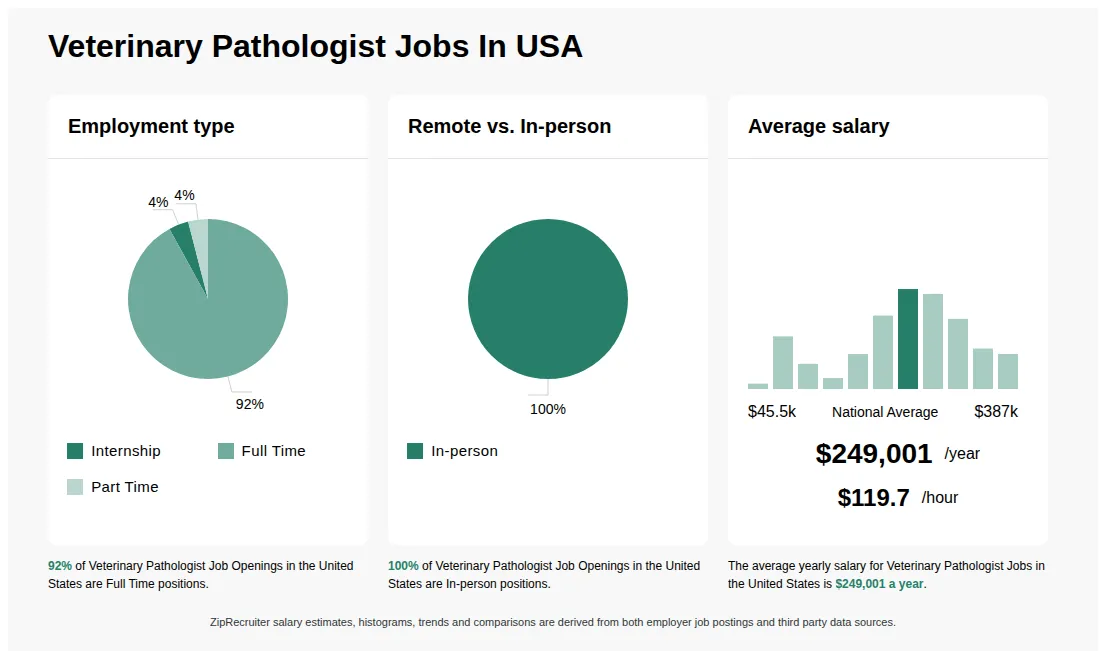
As of Jun 9, 2026, the average yearly pay for veterinary pathologist in the United States is $249,001.00, according to ZipRecruiter salary data. Most workers in this role earn between $203,500.00 and $301,000.00 per year, depending on experience, location, and employer.

What is the difference between Veterinary Pathologist vs Veterinary Laboratory Technician?

AspectVeterinary PathologistVeterinary Laboratory Technician
Required CredentialsDoctor of Veterinary Medicine (DVM) or equivalent, specialized training in pathologyAssociate's or Bachelor's degree in veterinary technology or related field
Work EnvironmentResearch labs, diagnostic laboratories, universities, or veterinary hospitalsVeterinary clinics, diagnostic labs, research facilities
Industry UsageFocuses on diagnosing diseases through tissue analysis and researchPerforms laboratory tests, prepares samples, and assists in diagnostics

While both roles work within veterinary diagnostics, Veterinary Pathologists specialize in disease diagnosis through tissue examination and research, requiring advanced degrees. Veterinary Laboratory Technicians support diagnostic processes by performing tests and preparing samples, often with less formal education. Understanding these differences helps clarify career paths and job expectations in veterinary diagnostics.

What Does a Veterinary Pathologist Do?

As a veterinary pathologist, your duties are slightly different depending on whether you work in small or large animal veterinary medicine and whether you run a practice that deals mainly with pets or a business that involves consulting and research services for a rancher or other livestock operation. As a small animal or family practice pathologist, your responsibilities are to diagnose diseases in animals. You study tissue samples from organs and body fluid to reach a diagnosis. In livestock veterinary pathology, a veterinary pathologist studies herds for communicable diseases that may affect production. Some veterinary pathologists work for the FDA or other federal programs to investigate outbreaks.

What are the key skills and qualifications needed to thrive as a Veterinary Pathologist, and why are they important?

To thrive as a Veterinary Pathologist, you need a Doctor of Veterinary Medicine (DVM) degree, board certification (such as from the ACVP), and expertise in animal disease diagnosis. Familiarity with laboratory diagnostic tools, histopathology techniques, and digital pathology systems is typically required. Strong analytical skills, attention to detail, and effective communication are vital for collaborating with veterinarians and researchers. These skills and qualifications are essential for ensuring accurate disease identification, advancing animal health research, and supporting effective treatment decisions.

What is a veterinary pathologist?

A veterinary pathologist is a specialized veterinarian who studies diseases in animals by examining tissues, organs, bodily fluids, and laboratory test results. They play a crucial role in diagnosing illnesses, understanding disease processes, and supporting animal health by working in laboratories, research institutions, universities, or diagnostic centers. Veterinary pathologists use their expertise to assist in disease surveillance, support public health, and contribute to advancements in both animal and human medicine. Their work can involve both clinical pathology (analyzing blood and other bodily fluids) and anatomical pathology (examining tissues and organs).

What are some common challenges faced by veterinary pathologists in their daily work?

Veterinary pathologists often encounter the challenge of diagnosing complex cases where clinical signs and laboratory findings may be ambiguous or overlap between different diseases. Additionally, they must stay current with rapidly advancing diagnostic techniques and emerging animal diseases. Balancing casework, research, and collaboration with clinicians or other scientists can also be demanding. Effective communication is essential, as pathologists frequently explain findings and recommendations to veterinarians, researchers, and sometimes animal owners.
What cities are hiring for Veterinary Pathologist jobs? Cities with the most Veterinary Pathologist job openings:
What are the most commonly searched types of Veterinary Pathologist jobs? The most popular types of Veterinary Pathologist jobs are:
Who are the top companies hiring for Veterinary Pathologist jobs? The top employers for Veterinary Pathologist jobs are:
What states have the most Veterinary Pathologist jobs? States with the most job openings for Veterinary Pathologist jobs include:

$90K/yr

Other

Posted 25 days ago


Job description

This position is located with the Department of Agriculture, Agricultural Research Service, Midwest Area, National Animal Disease Center in Ames, IA.
You will provide service in veterinary care and research support consistent with animal welfare and overall animal use programs.
Qualifications:Applicants must meet all qualifications and eligibility requirements by the closing date of the announcement including specialized experience and/or education, as defined below.
**This Position is being filled through OPM's government-wide Direct-Hire Authority for this occupation and is open to all U.S. Citizens. Your application will be evaluated for basic eligibility and to determine if your experience and/or education meet the minimum qualification requirements described in this announcement. All applicants who meet the minimum qualifications and other basic requirements will be referred and are eligible for selection. **
Must meet at least one (1) of the Basic Education Requirements listed in the "Education" section of this announcement along with one (1) of the Grade Level Requirements listed below:
GS-12 Grade Level:
Specialized Experience:
Qualifying experience for GS-12 includes one-year of specialized experience comparable to GS-11 which is directly related to the work of this position, and which equips the applicant with the knowledge, skills, and abilities to perform successfully the duties of the position. For this position, specialized experience is experience providing primary veterinary care; upholding and securing animal holding facilities to regulation and procedural standards; performing major and minor surgery on animals; and maintaining a pharmacy of controlled substances.
OR
Education Substitution: Master's degree in an area of specialization, including but not limited to, animal science, avian medicine, food safety, infectious diseases, veterinary clinical sciences, pathobiology, biomedical sciences, veterinary anatomy, veterinary preventive medicine, comparative biological sciences, epidemiology, veterinary parasitology, molecular veterinary biosciences, public health, microbiology, pathology, immunology, laboratory animal medicine, toxicology, wildlife, zoological animal medicine, or sciences related to the work of a veterinary medical officer position.
OR
Residency/Post-Graduate Training Programs: Successful completion of two years of an internship, residency program, or fellowship training program in a discipline related to the position.
OR
Board Certification: Successful completion of all requirements for a Diplomate status in an American Board of Veterinary Specialties (ABVS) recognized specialty organization. Such specialties may include, but are not limited to, veterinary toxicology, laboratory animal medicine, poultry veterinary medicine, theriogenology, veterinary anesthesiology, veterinary behaviorists, veterinary clinical pharmacology, veterinary dermatology, veterinary emergency and critical care, veterinary internal medicine, veterinary microbiology, veterinary nutrition, veterinary ophthalmology, veterinary pathology, veterinary preventive medicine, veterinary radiology, veterinary medicine, and veterinary dentistry.
GS-13 Grade Level:
Specialized Experience:
Qualifying experience for GS-13 includes one-year of specialized experience comparable to GS-12 which is directly related to the work of this position, and which equips the applicant with the knowledge, skills, and abilities to perform successfully the duties of the position. For this position, specialized experience is experience providing primary veterinary care; upholding and securing animal holding and biocontainment facilities to regulation and procedural standards; performing major and minor surgery on animals; maintaining a pharmacy of controlled substances; and authoring and reviewing research and operating procedures for animal care and operations in a research facility.
OR
Education Substitution: Ph.D. degree in an area of specialization, including but not limited to, animal science, avian medicine, food safety, infectious diseases, veterinary clinical sciences, pathobiology, biomedical sciences, veterinary anatomy, veterinary preventive medicine, comparative biological sciences, epidemiology, veterinary parasitology, molecular veterinary biosciences, public health, microbiology, pathology, immunology, laboratory animal medicine, toxicology, wildlife, zoological animal medicine, or sciences related to the work of a veterinary medical officer position.
OR
Residency/Post-Graduate Training Programs: Successful completion of three years of an internship, residency program, or fellowship training program in a discipline related to the position.
OR
Board Certification: Successful completion of all requirements for a Diplomate status in an American Board of Veterinary Specialties (ABVS) recognized specialty organization. Such specialties may include, but are not limited to, veterinary toxicology, laboratory animal medicine, poultry veterinary medicine, theriogenology, veterinary anesthesiology, veterinary behaviorists, veterinary clinical pharmacology, veterinary dermatology, veterinary emergency and critical care, veterinary internal medicine, veterinary microbiology, veterinary nutrition, veterinary ophthalmology, veterinary pathology, veterinary preventive medicine, veterinary radiology, veterinary medicine, and veterinary dentistry.
Physical Demands: This work involves physical effort such as prolonged standing walking in various kinds of farm conditions, stooping, bending, lifting, pushing, pulling, climbing, and handling restrained, large animals or large heavy carcasses. The ability to move quickly around unrestrained, often frightened, unpredictable, and ill-natured animals is also needed.
Work Environment: Work is performed in an office, indoor and outdoor animal holding facilities, necropsy rooms, and laboratories. Temperature extremes are common. Exposure to disagreeable odors, working around frightened, unpredictable, and ill-natured animals, and exposure to the risks and hazards of harmful biological, chemical, and physical agents are possible. This includes working in high biosecurity animal housing facilities which require special precautions and close coordination of personnel, animals, equipment, and facility safety controls. The use of personal protective equipment (PPE) such as masks or respirators, boots, gloves, laboratory coats, aprons, and coveralls when providing care to animals that represent a potential source of zoonotic disease or other biohazards is required. Certain environments may also necessitate the use of hearing protection. Strict agent safety regulations are applied to prevent the escape of animal pathogens from the work environment.
Experience refers to paid and unpaid experience, including volunteer work done through National Service programs (e.g., Peace Corps, AmeriCorps) and other organizations (e.g., professional; philanthropic; religious; spiritual; community, student, social). Volunteer work helps build critical competencies and can provide valuable training and experience that translates directly to paid employment. You will receive credit for all qualifying experience, including volunteer experience.Education:Basic Requirements:
1. Doctor of Veterinary Medicine (DVM) or equivalent degree, i.e., Veterinary Medical Doctor (VMD), obtained at a school or college of veterinarymedicine accredited by the American Veterinary Medical Association Council on Education (AVMA). The AVMA web site, http://www.avma.org(external link), has a listing of all AVMA-accredited veterinary medical schools.
OR
2. Graduates of foreign veterinary medical schools that are not accredited by the AVMA Council on Education (Refer to AVMA web site,http://www.avma.org (external link) for information about schools in this category) must meet one of the following requirements.
  • Proof of certification of their final transcript by the Educational Commission for Foreign Veterinary Graduates (ECFVG)
  • Possession of a permanent, full, and unrestricted license to practice veterinary medicine in a State, District of Columbia, the Commonwealth of Puerto Rico, or a territory of the United States that includes successful completion of the North American Veterinary Licensing Examination (NAVLE) or its predecessors, the National Board Examination (NBE) and the Clinical Competency Test (CCT).
  • Proof that the education obtained in a foreign veterinary medical program is equivalent to that gained in a veterinary medical program that is accredited by the American Veterinary Medical Association Council on Education. Under this provision, equivalency is established only if an AVMA-accredited veterinary medical school or college accepts the graduate's final transcript from the foreign veterinary medical school at full value for placement into an advanced degree, postgraduate educational program, or training program (e.g. residency or graduate program).
Graduates of foreign veterinary medical programs must also provide proof of proficiency in the English language by successfully completing one of the nationally and internationally recognized examinations that incorporate assessments of reading, writing, listening, and speaking skills. Examples of examinations that assess mastery of the English language are shown below
  • Test of English as a Foreign Language (TOEFL) - Minimum scores for the TOEFL are 560 for the paper-based version; 220 for the computer-based version; or overall score of 83 for the internet-based version (including 26 or higher in speaking, 26 or higher in listening, and 17 or higher in writing). For the computer-based and paper-based test versions, applicants must also complete the Test of Spoken English (TSE) and the Test of Written English (TWE). Minimum required scores are 55 for the TSE and 5.5 for the TWE;
  • Academic tests (listening, writing, and speaking) offered by the International English Language Testing System (IELTS). Applicants must achieve a minimum overall band score of 7.0, with at least 7.0 in speaking, 6.5 in listening, and 6.0 in writing;
OR
  • Canadian Academic English Language Assessment (CAEL). Applicants must achieve a minimum overall band score of 70, with at least 60 in speaking, 60 in listening, and 50 in writing.
Employment Type: OTHER