1

Veterinary Pathologist Jobs (NOW HIRING)

Director of Clinical Medicine

Denver, CO · On-site

$82K - $112K/yr

Duties include supervision of the Clinical Veterinarians and Veterinary Pathologist, development of clinical policies and processes in partnership with the Director of Veterinary Operations, and ...

The applicant will be a board certified veterinary clinical pathologist who will be able to read and interpret cytology, blood films, urinalysis and other microscopic samples for consult and cytology ...

Position Information Position Title Assistant/Associate/Full Professor of Veterinary Pathology Job Summary This is a tenure-track position that will advance the mission of the College and the ...

American College of Veterinary Surgeons or American College Veterinary Pathologist) preffered. State of Alabama Veterinary License must be obtained within two (2) years from hire date. Knowledge ...

next page

Showing results 1-20

Veterinary Pathologist information

See salary details

$45.5K

$249K

$387K

How much do veterinary pathologist jobs pay per year?

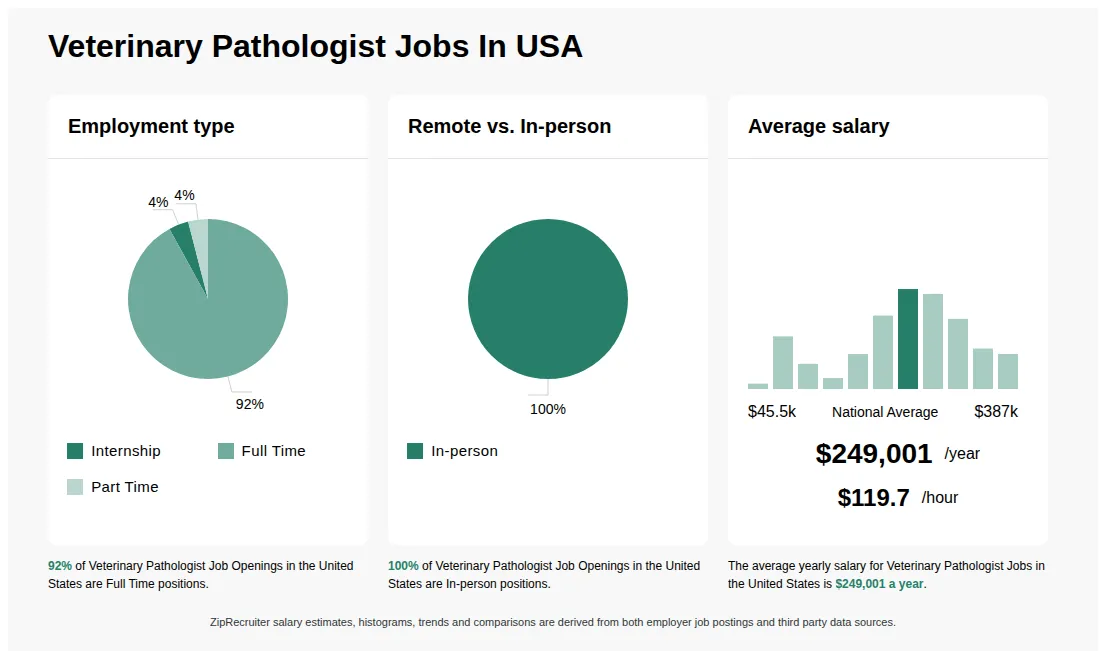
As of Jul 7, 2026, the average yearly pay for veterinary pathologist in the United States is $249,001.00, according to ZipRecruiter salary data. Most workers in this role earn between $203,500.00 and $301,000.00 per year, depending on experience, location, and employer.

What is the difference between Veterinary Pathologist vs Veterinary Laboratory Technician?

AspectVeterinary PathologistVeterinary Laboratory Technician
Required CredentialsDoctor of Veterinary Medicine (DVM) or equivalent, specialized training in pathologyAssociate's or Bachelor's degree in veterinary technology or related field
Work EnvironmentResearch labs, diagnostic laboratories, universities, or veterinary hospitalsVeterinary clinics, diagnostic labs, research facilities
Industry UsageFocuses on diagnosing diseases through tissue analysis and researchPerforms laboratory tests, prepares samples, and assists in diagnostics

While both roles work within veterinary diagnostics, Veterinary Pathologists specialize in disease diagnosis through tissue examination and research, requiring advanced degrees. Veterinary Laboratory Technicians support diagnostic processes by performing tests and preparing samples, often with less formal education. Understanding these differences helps clarify career paths and job expectations in veterinary diagnostics.

What Does a Veterinary Pathologist Do?

As a veterinary pathologist, your duties are slightly different depending on whether you work in small or large animal veterinary medicine and whether you run a practice that deals mainly with pets or a business that involves consulting and research services for a rancher or other livestock operation. As a small animal or family practice pathologist, your responsibilities are to diagnose diseases in animals. You study tissue samples from organs and body fluid to reach a diagnosis. In livestock veterinary pathology, a veterinary pathologist studies herds for communicable diseases that may affect production. Some veterinary pathologists work for the FDA or other federal programs to investigate outbreaks.

What are the key skills and qualifications needed to thrive as a Veterinary Pathologist, and why are they important?

To thrive as a Veterinary Pathologist, you need a Doctor of Veterinary Medicine (DVM) degree, board certification (such as from the ACVP), and expertise in animal disease diagnosis. Familiarity with laboratory diagnostic tools, histopathology techniques, and digital pathology systems is typically required. Strong analytical skills, attention to detail, and effective communication are vital for collaborating with veterinarians and researchers. These skills and qualifications are essential for ensuring accurate disease identification, advancing animal health research, and supporting effective treatment decisions.

What is a veterinary pathologist?

A veterinary pathologist is a specialized veterinarian who studies diseases in animals by examining tissues, organs, bodily fluids, and laboratory test results. They play a crucial role in diagnosing illnesses, understanding disease processes, and supporting animal health by working in laboratories, research institutions, universities, or diagnostic centers. Veterinary pathologists use their expertise to assist in disease surveillance, support public health, and contribute to advancements in both animal and human medicine. Their work can involve both clinical pathology (analyzing blood and other bodily fluids) and anatomical pathology (examining tissues and organs).

What are some common challenges faced by veterinary pathologists in their daily work?

Veterinary pathologists often encounter the challenge of diagnosing complex cases where clinical signs and laboratory findings may be ambiguous or overlap between different diseases. Additionally, they must stay current with rapidly advancing diagnostic techniques and emerging animal diseases. Balancing casework, research, and collaboration with clinicians or other scientists can also be demanding. Effective communication is essential, as pathologists frequently explain findings and recommendations to veterinarians, researchers, and sometimes animal owners.
What cities are hiring for Veterinary Pathologist jobs? Cities with the most Veterinary Pathologist job openings:
What are the most commonly searched types of Veterinary Pathologist jobs? The most popular types of Veterinary Pathologist jobs are:
Who are the top companies hiring for Veterinary Pathologist jobs? The top employers for Veterinary Pathologist jobs are:
What states have the most Veterinary Pathologist jobs? States with the most job openings for Veterinary Pathologist jobs include:
Infographic showing various Veterinary Pathologist job openings in the United States as of July 2026, with employment types broken down into 83% Full Time, and 17% Part Time. Highlights an 93% In-person, 2% Hybrid, and 5% Remote job distribution, with an average salary of $249,001 per year, or $119.7 per hour.
Open Rank Faculty Position, Research Faculty Appointment, Comparative Medicine Department

Open Rank Faculty Position, Research Faculty Appointment, Comparative Medicine Department

MD Anderson

Bastrop, TX • On-site, Remote

Full-time

Medical, Dental, Retirement, PTO

Posted 13 days ago


MD Anderson Cancer Center rating

8.4

Company rating: 8.4 out of 10

Based on 168 frontline employees who took The Breakroom Quiz

32nd of 877 rated healthcare providers


Job description

"Announcing a new hybrid (Onsite/Remote), full-time, benefits eligible, faculty position in the Department of Comparative Medicine at UT MD Anderson in Bastrop, Texas."
The Department of Comparative Medicine (DCM) at UT MD Anderson is seeking a Veterinary Anatomic Pathologist for a non-tenure track, open rank Research Faculty Appointment. The DCM is one of 10 basic science departments in the Science Division of the UT MD Anderson, but is the only department housed at the Michale E. Keeling Center for Comparative Medicine and Research (KCCMR) in Bastrop, Texas. The DCM and the KCCMR maintain several essential national research resources focused on non-human primates as well as other animals that are supported by grants from the National Institutes of Health. Research in the department is aimed at addressing diseases that impact both human and animal health, with an emphasis on research that will benefit cancer patients. The DCM also maintains a preclinical studies program that conducts GLP-compliant evaluations of new therapeutics to assure both safety and efficacy prior to clinical studies in humans. As the nation's leading cancer center, UT MD Anderson is committed to supporting groundbreaking cancer research to drive its mission to eliminate cancer, by developing and maintaining specialized programs in animal models, research and education.
This position will provide pathology diagnostic service, research collaboration, and education by providing anatomic pathology support to researchers, early drug discovery, preclinical development and safety assessment of novel therapeutic products, and educational training programs. The primary responsibilities of this position include pathology service in support of preclinical development and safety evaluation of new therapeutic compounds, necropsies associated with discovery studies, and colony health management. Nonhuman primates account for the majority of the caseload, with rodents (typically rats and mice) making up the remainder. Establishing research collaborations with scientists and sponsors across the institution, and service on various institutional academic and research committees are strongly encouraged and account for the remaining percent effort.
Candidate must have earned a Doctor of Veterinary Medicine degree from an American Veterinary Medical Association-accredited university or equivalent foreign degree. Post-doctoral experience and/or education in veterinary pathology (PhD in related field) is preferred. Board certification by the American College of Veterinary Pathologists (ACVP) or European College of Veterinary Pathologists (ECVP) or ACVP phase II eligibility is required is required.
Candidates must have a 3 years' experience as a veterinary pathologist (this would include formal training under the supervision of a Diplomate of the ACVP/ECVP in an institution that trains veterinary pathologists as one of its primary functions). Experience in toxicologic pathology and laboratory animal pathology is preferred. He/she must meet institutional requirements for an academic appointment.
UT MD Anderson offers competitive salaries, excellent benefits and incentive packages. Further, UT MD Anderson encourages remote work. Thus, individuals in this position would be provided with the necessary equipment to accommodate partial remote work to fulfill the responsibilities of this position.
UT MD Anderson's Michale E. Keeling Center for Comparative Medicine and Research is a 385-acre research complex in rural Bastrop Country, just 40 miles from Austin. The KCCMR houses over 2,200 nonhuman primates, representing eight species, and employs 150 faculty and staff.
  • Doctoral-level degree in a field appropriate to Faculty role and Department mission
  • Assistant Professor: At least 2 years' experience as postdoctoral fellow or instructor, required or equivalent time as a basic scientist.
  • Associate Professor: Typically, 5 years' experience as Assistant Professor or equivalent.
  • Professor: Typically, 5 years' experience as Associate Professor or equivalent doctoral training per discipline

UT MD Anderson offers excellent benefits, including medical, dental, paid time off, retirement, tuition benefits, educational opportunities, and individual and team recognition.
This position may be responsible for maintaining the security and integrity of critical infrastructure, as defined in Section 113.001(2) of the Texas Business and Commerce Code and therefore may require routine reviews and screening. The ability to satisfy and maintain all requirements necessary to ensure the continued security and integrity of such infrastructure is a condition of hire and continued employment.
It is the policy of UT MD Anderson to provide equal employment opportunity without regard to race, color, religion, age, national origin, sex, gender, sexual orientation, gender identity/expression, disability, protected veteran status, genetic information, or any other basis protected by institutional policy or by federal, state, or local laws unless such distinction is required by law.http://www.mdanderson.org/about-us/legal-and-policy/legal-statements/eeo-affirmative-action.html
Additional Information
  • Requisition ID: 180435
  • Employee Status: Regular
  • Minimum Salary: US Dollar (USD) 0
  • Midpoint Salary: US Dollar (USD) 0
  • Maximum Salary : US Dollar (USD) 0
  • FLSA: exempt and not eligible for overtime pay
  • Work Location: Hybrid Onsite/Remote

#LI-Hybrid

What MD Anderson Cancer Center employees say

Pay

Benefits

Hours and flexibility

Workplace

Get the full story on Breakroom