1

Supply Chain Management Jobs (NOW HIRING)

Job Title : IT - Senior Consultant | Supply Chain Management | JDA Supply Chain Planning Location : Austin , Texas-78753 Experience : 5+ Years Performance Expectations: Strong O9 techno functional ...

Manager, Supply Chain Management

Milpitas, CA ยท On-site

$100K - $125K/yr

Bachelor's degree in Supply Chain Management, Business Administration, or related field * 5+ years Supply Chain Management experience * Excellent knowledge of supply chain processes and digital ...

Principal, Supply Chain Management Job Code: 37656 Job Location: Melbourne, FL; Rochester, NY; Wilmington, MA Job Schedule: 9/80: Employees work 9 out of every 14 days - totaling 80 hours worked ...

next page

Showing results 1-20

Supply Chain Management information

See salary details

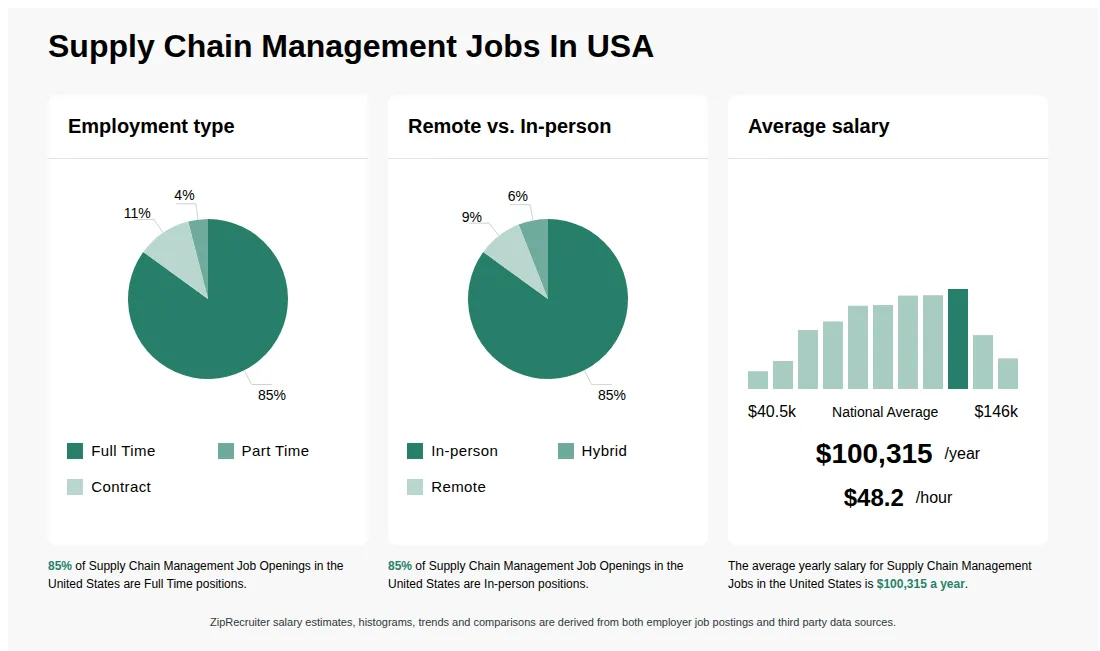
$40.5K

$100.3K

$146K

How much do supply chain management jobs pay per year?

As of Jun 14, 2026, the average yearly pay for supply chain management in the United States is $100,315.00, according to ZipRecruiter salary data. Most workers in this role earn between $80,000.00 and $120,000.00 per year, depending on experience, location, and employer.

What is the difference between Supply Chain Management vs Logistics Coordinator?

AspectSupply Chain ManagementLogistics Coordinator
Primary FocusOversees entire supply chain processes from procurement to deliveryCoordinates transportation, warehousing, and distribution activities
Required CredentialsBachelor's degree in supply chain, logistics, or related field; certifications like CSCPHigh school diploma or associate's; some certifications like CLTD beneficial
Work EnvironmentStrategic planning, cross-department collaborationOperational, hands-on coordination of shipments and inventory
Industry UsageUsed across manufacturing, retail, and distribution sectorsCommon in transportation, warehousing, and distribution companies

Supply Chain Management involves strategic oversight of the entire supply process, while Logistics Coordinators focus on the operational aspects of transportation and distribution. Both roles are essential but differ in scope and responsibilities.

What jobs do you get with supply chain management?

Supply chain management graduates can pursue roles such as supply chain analyst, logistics coordinator, procurement specialist, inventory manager, operations manager, and transportation manager. These positions involve coordinating procurement, transportation, inventory, and distribution processes, often requiring skills in data analysis, negotiation, and familiarity with supply chain software. Certifications like APICS or CSCP can enhance job prospects in this field.

Is supply chain high paying?

Supply chain management professionals often earn competitive salaries that vary based on experience, education, and location. Entry-level roles may start with moderate pay, while senior positions such as supply chain managers or logistics directors typically have higher compensation, especially with certifications like CSCP or CPSM. Overall, it is considered a well-paying field with growth potential.

Will SCM be replaced by AI?

Supply Chain Management (SCM) professionals use AI to optimize logistics, demand forecasting, and inventory management, but AI is designed to augment rather than replace human roles. Skills in data analysis, technology integration, and strategic planning remain essential, as AI tools require human oversight and decision-making. The role is evolving to include managing AI systems and interpreting their outputs.

What are the key skills and qualifications needed to thrive in Supply Chain Management, and why are they important?

To thrive in Supply Chain Management, you need strong analytical skills, a solid understanding of logistics and procurement processes, and typically a degree in supply chain, business, or engineering. Familiarity with ERP systems like SAP, inventory management software, and supply chain certifications such as APICS CPIM or CSCP are commonly required. Excellent problem-solving, negotiation, and communication skills help professionals manage relationships and adapt to changing conditions. These abilities are vital for ensuring efficient operations, cost control, and resilience across the supply chain network.

What jobs can you do with supply chain management?

Supply chain management skills open opportunities for roles such as supply chain analyst, logistics coordinator, procurement specialist, inventory manager, and operations manager. These jobs involve coordinating procurement, transportation, warehousing, and distribution, often requiring knowledge of supply chain software and certifications like APICS or CSCP.

What are some common challenges faced in supply chain management roles, and how do teams typically address them?

Supply chain management professionals often encounter challenges such as demand forecasting inaccuracies, supplier disruptions, and inventory imbalances. To address these issues, teams rely on strong communication, data analytics, and collaboration with suppliers and internal departments. Implementing technology solutions like ERP systems and regularly reviewing processes also help in identifying bottlenecks and improving efficiency. Continuous improvement and adaptability are key to overcoming these dynamic challenges in the field.

What is supply chain management?

Supply chain management (SCM) is the process of overseeing and coordinating the flow of goods, services, information, and finances as they move from supplier to manufacturer to wholesaler to retailer to consumer. It involves activities like sourcing raw materials, production, logistics, inventory management, and demand planning to ensure products are delivered efficiently and cost-effectively. Effective supply chain management helps organizations reduce costs, improve quality, and respond quickly to market changes. It is critical for maintaining smooth operations and customer satisfaction in today's global marketplace.
What cities are hiring for Supply Chain Management jobs? Cities with the most Supply Chain Management job openings:
What are the most commonly searched types of Supply Chain Management jobs? The most popular types of Supply Chain Management jobs are:
What states have the most Supply Chain Management jobs? States with the most job openings for Supply Chain Management jobs include:
Supply Chain Management

Supply Chain Management

Westinghouse Electric Company

Houston, TX โ€ข Hybrid

$54/hr

Other

Posted 3 days ago


Job description

Supply Chain Management Specialist III

Houston, TX

Hybrid schedule

Pay: $54 per hour

1 year contract


Summary

The role is an individual contributor responsible for delivering high-impact insights on global market trends, competing projects that impact Enbridge, tariff structures, and geopolitical developments. The successful candidate will partner closely with Supply Chain Management (SCM) Category Management to proactively identify risks, assess exposure, and help to form mitigation strategies that protect cost competitiveness and supply continuity.

This position acts as a subject matter expert and trusted advisor, translating complex external dynamics into actionable strategies for procurement and supply chain decision-making.


Key Responsibilities

Market Intelligence & Analysis

  • Monitor global commodity markets, supply-demand fundamentals, and cost drivers impacting key categories.
  • Monitor other competing projects (pipeline, facilities, LNG, solar, wind, data centers, etc.) that will take away resources from Enbridge projects
  • Develop forward-looking market outlooks and scenario-based analyses.
  • Synthesize macroeconomic, industry, and supplier-level insights into actionable recommendations.

Tariff & Trade Policy Expertise

  • Track global tariff regimes, trade agreements, sanctions, and regulatory changes affecting sourcing strategies.
  • Assess the financial and operational impacts of tariffs and trade policies on procurement categories.
  • Advise category management on duty mitigation strategies, including tariff engineering, country-of-origin shifts, and supplier diversification.

Geopolitical Risk Assessment

  • Analyze geopolitical developments (e.g., conflicts, elections, trade disputes, regulatory changes) and evaluate potential impacts on supply chains.
  • Identify emerging risks across regions, suppliers, and materials, providing early warning signals.
  • Develop risk scenarios and stress-test supply chains against potential disruptions.

Risk Mitigation & Strategic Support

  • Partner with category managers to identify vulnerabilities and co-develop mitigation strategies.
  • Support initiatives such as dual sourcing, regional diversification, inventory optimization, and supplier risk management.
  • Provide input into long-term category strategies with a focus on resilience and cost stability.

Insight Delivery & Influence

  • Deliver clear, concise, and data-driven insights to SCM leadership and cross-functional stakeholders.
  • Develop executive-ready reports, briefings, and dashboards.
  • Influence decision-making through subject matter expertise, without direct authority.

Tools, Data & Intelligence Frameworks

  • Utilize market intelligence platforms, trade databases, and analytics tools to generate insights.
  • Maintain structured monitoring systems for tariffs, markets, and geopolitical risks.
  • Continuously improve intelligence methodologies and reporting effectiveness.

Qualifications & Experience

  • Bachelorโ€™s degree in Economics, Supply Chain, Business, Political Science, or related field.
  • 5+ years of relevant experience in market intelligence, geopolitical analysis, supply chain strategy, or strategic sourcing.
  • Deep knowledge of global trade policy, tariffs, and geopolitical risk factors affecting supply chains.
  • Experience supporting procurement or category management in a global organization.

Key Skills & Competencies

  • Subject Matter Expertise: Deep understanding of global markets, tariffs, and geopolitical dynamics.
  • Strategic Insight: Ability to connect external trends to category-level implications.
  • Advanced Analytics: Strong capability in forecasting, modeling, and scenario planning.
  • Business Acumen: Understanding of procurement, cost structures, and supply chain operations.
  • Influence Without Authority: Proven ability to guide decisions across stakeholders and senior leaders.
  • Communication: Ability to distill complex information into clear, actionable insights.
  • Agility & Judgment: Strong decision-making in ambiguous and rapidly evolving environments.


Reporting Structure

  • Reports to: Manager, Category Management
  • Works closely with: Category Management, Strategic Sourcing, Finance, Risk/Compliance, Logistics