1

Statistician Jobs (NOW HIRING)

Statistician

Austin, TX ยท On-site

Carry out statistical analyses and provide direction to programmers, using standard software packages to interpret and translate results within a statistical framework into biomedical terms and ...

Carry out statistical analyses and provide direction to programmers, using standard software packages to interpret and translate results within a statistical framework into biomedical terms and ...

Statistician

Boston, MA ยท On-site

Carry out statistical analyses and provide direction to programmers, using standard software packages to interpret and translate results within a statistical framework into biomedical terms and ...

Carry out statistical analyses and provide direction to programmers, using standard software packages to interpret and translate results within a statistical framework into biomedical terms and ...

Statistician

Birmingham, AL ยท On-site +1

$63K - $118K/yr

Analyzes findings, evaluates the statistical limitations of available data and specifies the range of logically possible explanations of the findings. * Provides technical guidance to lower-graded ...

The statistician will be responsible for overseeing study data systems; developing and maintaining high-quality analytic datasets; implementing rigorous data quality assurance procedures; and ...

Carry out statistical analyses and provide direction to programmers, using standard software packages to interpret and translate results within a statistical framework into biomedical terms and ...

Statistician

Lynchburg, VA ยท On-site

$66K - $101K/yr

The Statistician works within our quality department to apply statistical methods to real-world manufacturing and quality assurance. Location: On-site in Lynchburg, Virginia Your Day to Day as a ...

ProSidian Seeks a Statistician (Contract Contingent) in Charlotte, NC / Remote to support an engagement for an independent agency of the United States Federal Govt. that is primarily responsible for ...

Statistician

Boston, MA ยท Hybrid

$75K - $80K/yr

The statistical analyses vary across patient-level clinical trial data, observational study (real-world) data, and published aggregate data. Our work involves a range of techniques such as basic ...

Development of statistical analysis plans and programs to perform analyses and display study data. Reviewing protocols and case report forms to ensure that protocol objectives are met and standards ...

next page

Showing results 1-20

Statistician information

See salary details

$50.5K

$86.9K

$116.5K

How much do statistician jobs pay per year?

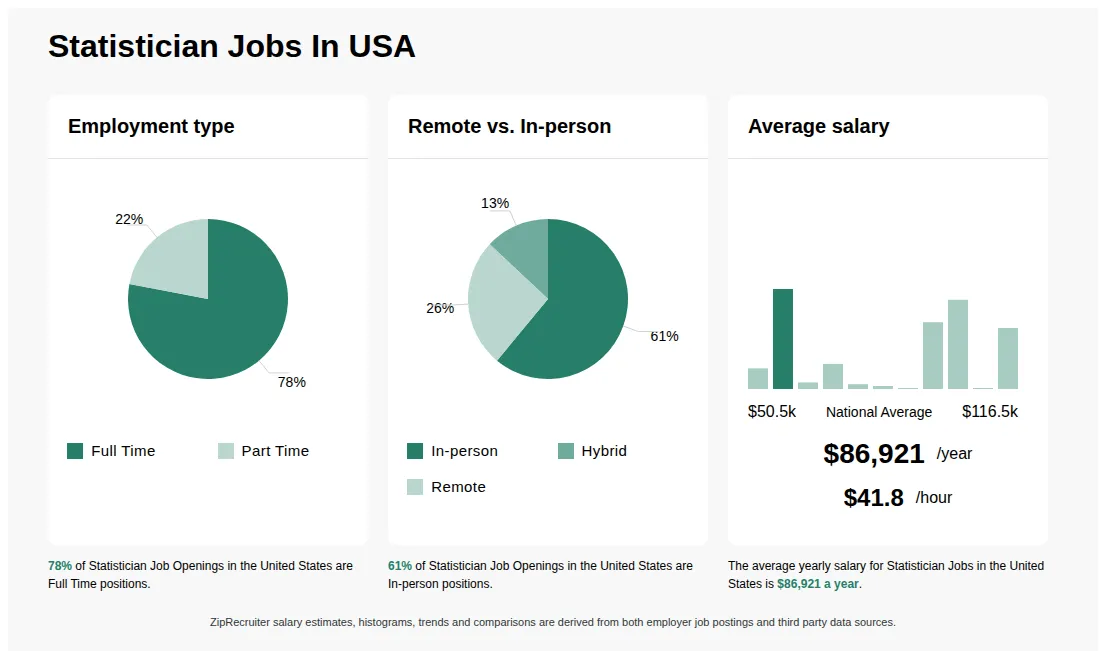
As of Jun 16, 2026, the average yearly pay for statistician in the United States is $86,921.00, according to ZipRecruiter salary data. Most workers in this role earn between $57,500.00 and $98,500.00 per year, depending on experience, location, and employer.

What do you do as a statistician?

A statistician analyzes data to identify trends, develop models, and support decision-making across various fields. They use statistical software and methods to interpret complex data sets and communicate findings clearly. Strong analytical skills and knowledge of statistical tools like R or SAS are essential for this role.

What jobs pay $500,000 a year in the US?

High-level roles such as chief executives, investment bankers, specialized surgeons, and successful entrepreneurs can earn $500,000 or more annually. Certain executive positions in large corporations, top-tier lawyers, and highly compensated professionals in finance or technology may also reach this income level, often requiring extensive experience, advanced skills, and significant responsibility.

What are the key skills and qualifications needed to thrive as a Statistician, and why are they important?

To thrive as a Statistician, you need strong analytical skills, a solid background in mathematics and statistics, and at least a bachelor's degree in a related field. Proficiency with statistical software such as R, SAS, Python, or SPSS and familiarity with data analysis tools are typically required. Attention to detail, problem-solving ability, and effective communication are crucial soft skills for interpreting results and conveying findings to diverse audiences. These skills ensure accurate data-driven insights and support informed decision-making in various industries.

What does a statistician do?

A statistician collects, analyzes, and interprets data to help solve real-world problems in fields such as business, healthcare, government, and science. They design surveys, experiments, or opinion polls to gather data, and then use mathematical techniques and statistical software to interpret their findings. Statisticians play a vital role in decision-making processes by providing accurate data analysis and insights, which can be used to inform policy, optimize processes, or improve products and services.

What are some common challenges statisticians face when working with large datasets, and how are these typically addressed?

Statisticians often encounter challenges such as data quality issues, missing values, and computational limitations when working with large datasets. To address these, they use data cleaning techniques, employ imputation methods for missing data, and leverage specialized statistical software or programming languages like R and Python for efficient data processing. Collaborating closely with data engineers and subject matter experts is also critical to ensure that the data is both accurate and relevant for analysis. Staying updated on best practices and new tools helps statisticians manage these challenges effectively.

What jobs make $1,000,000 a year?

For a statistician, earning $1,000,000 annually is uncommon and typically requires senior-level positions in large corporations, consulting firms, or executive roles such as Chief Data Officer or Chief Analytics Officer. High earnings may also come from entrepreneurship, consulting contracts, or specialized expertise in lucrative industries like finance or technology. Most statisticians earn a median salary well below this threshold, with top earners often combining multiple income sources or holding executive positions.

What Do Statisticians Do?

Statisticians collect and analyze mathematical data. They interpret data and statistics and find patterns to provide insights and solutions for a wide range of industries, such as business, healthcare, agriculture, and engineering. Statisticians may work alone, or collaborate on an interdisciplinary team to tackle a particular issue.

Do statisticians make a lot of money?

Statisticians typically earn a competitive salary, with median annual wages above the national average in many regions. Salaries vary based on experience, education, industry, and location, and advanced skills in data analysis and statistical software can lead to higher compensation.
What cities are hiring for Statistician jobs? Cities with the most Statistician job openings:
What are the most commonly searched types of Statistician jobs? The most popular types of Statistician jobs are:
What states have the most Statistician jobs? States with the most job openings for Statistician jobs include:
Infographic showing various Statistician job openings in the United States as of June 2026, with employment types broken down into 1% As Needed, 89% Full Time, 8% Part Time, 1% Temporary, and 1% Contract. Highlights an 81% Physical, 3% Hybrid, and 16% Remote job distribution, with an average salary of $86,921 per year, or $41.8 per hour.

$63K/yr

Other

Posted 15 days ago


Job description

This position is being offered through OPM's Direct Hire Authority.
See more about Direct Hire under Conditions of Employment below.
Oversees SSA's Program Integrity Program with responsibility for analytic projects related to detecting and preventing fraud in the agency's programs, measuring and/or enhancing program performance and increasing operational efficiencies.
See QUALIFICATIONS and EDUCATION for more information about this position.
Qualifications:To qualify for this Statistician position you must demonstrate:
(1) the Individual Occupational Requirement (IOR) for the federal 1530 series AND
(2) at least 52 weeks of Specialized Experience
For GS-11 ONLY: a Ph.D. (or equivalent doctoral degree) OR at least 3 academic years of progressively higher-level graduate education leading to a Ph.D. (or equivalent doctoral degree) in a course of study that directly reflects the job-related competencies for this position may be substituted for Specialized Experience.
(1) INDIVIDUAL OCCUPATIONAL REQUIREMENT (IOR) (All Applicants)
A. Successful completion of a course of study in an accredited college or university resulting in a bachelor's or higher degree that includes at least 15 semester hours in statistics (or in mathematics and statistics, with at least 6 semester hours in statistics) and 9 additional semester hours in one or more of the following:
-- physical or biological sciences
-- medicine,
-- education or
-- engineering OR
-- in social sciences, including
-- demography
-- history,
-- economics
-- social welfare
-- geography,
-- international relations
-- social or cultural anthropology,
-- health sociology,
-- political science
-- public administration
-- psychology
B. In lieu of a degree, successful completion of courses as shown in A above plus appropriate experience or additional education. Experience must include a full range of professional statistical work, such as:
(1) sampling,
(2) collecting, computing and analyzing statistical data and
(3) applying statistical techniques such as
-- measurement of central tendency
-- dispersion
-- skewness
-- sampling error
-- simple and multiple correction
-- analysis of variance and
-- tests of significance
SEE EDUCATION BELOW -- Applicants who don't demonstrate these requirements will not be considered.
(2) SPECIALIZED EXPERIENCE
FOR GS-11: SPECIALIZED EXPERIENCE must have been gained in a federal position at or above GS-09 OR (if your position is on another federal pay scale OR outside of federal service) by performing duties at a level of responsibility and difficulty equivalent to GS-09 or above.
Specialized Experience for GS-11 is work that primarily consists of :
(1) participating as a data analyst/statistician in studies involving statistical techniques and processes;
(2) transforming data into a form suitable for analysis using R, Python, SAS, or SQL; and
(3) summarizing projects in writing for a project leader or supervisor.
**If you have this experience, your resume must describe, in your own words, the specific duties you perform that demonstrate it.**
In lieu of Specialized Experience, you may qualify with a Ph.D. in a course of study that directly reflects the job-related competencies necessary for this position. This education must be in addition to the education used to meet the IOR.
In lieu of Specialized Experience or a Ph.D. you may qualify with at least 3 academic years of progressively higher-level graduate education leading to a Ph.D. (or equivalent degree) in a course of study that directly reflects the job-related for this position. This education must be in addition to the education used to meet the IOR.
In lieu of the full amount of Specialized Experience or the full amount of Optional Education, you may qualify with a portion of each that can be combined to meet the full requirement. Only education beyond the second year of graduate education can be used for this option and it must be in addition to the education used to meet the IOR. Experience used in combination with education must also be in addition to the experience used in IOR Option B. (HR will determine if the combination of experience and education is sufficient to meet the requirements.)
*************
FOR GS-12: SPECIALIZED EXPERIENCE must have been gained in a federal position at or above GS-11 OR (if your position is on another federal pay scale OR outside of federal service) by performing duties at a level of responsibility and difficulty equivalent to GS-11 or above.
Specialized Experience for GS-12 is work that primarily consists of:
(1) performing studies involving large datasets comprised of messy data and statistical or machine learning analytical techniques and processes;
(2) transforming data into a form suitable for analysis using R, Python, SAS, or SQL; and
(3) summarizing projects in writing for a project leader or supervisor.
**If you have this experience, your resume must describe, in your own words, the specific duties you perform that demonstrate it.**
*************
FOR GS-13: SPECIALIZED EXPERIENCE must have been gained in a federal position at or above GS-12 OR (if your position is on another federal pay scale OR outside of federal service) by performing duties at a level of responsibility and difficulty equivalent to GS-12 or above.
Specialized Experience for GS-13 is work that primarily consists of:
(1) overseeing studies involving large datasets comprised of messy data and statistical or machine learning analytical techniques and processes;
(2) transforming data into a form suitable for analysis using R, Python, SAS, or SQL;
(3) summarizing projects in writing for technical and non-technical audiences.
**If you have this experience, your resume must describe, in your own words, the specific duties you perform that demonstrate it.**
Reviewers cannot assume you perform duties you don't describe.
Since Specialized Experience also has a time component, it must be evident that the duties you describe are at the required level for at least 52 weeks.
MINIMUM QUALIFICATIONS (IOR and Specialized Experience for GS-12 and GS-13 or IOR and Specialized Experience and/or Optional Education for GS-11) must be met by the closing date of this announcement.
Information on this job series can be found at https://www.opm.gov/policy-data-oversight/classification-qualifications/general-schedule-qualification-standards/1500/statistics-series-1530/ .Education:This position has an Individual Occupational Requirement (IOR) that must be met and demonstrated by all applicants (see QUALIFICATIONS), even if you already hold a position in the federal 1530 series.
Submit a copy of your full transcript showing your name, the name of the school, the program in which you were enrolled and your degree AND/OR completion of *creditable course). If you attended more than one college or university, submit transcripts for all schools attended.
Transcripts that do not show that a Degree was conferred cannot be considered to have resulted in a Degree. Check your transcript to be sure this information is shown.
**Since course titles do not always indicate that a course pertains to a creditable curriculum you are advised to highlight qualifying courses on your transcript to ensure that consideration is given.**
APPLICATIONS WITHOUT ALL REQUIRED TRANSCRIPTS WILL CAUSE YOU TO LOSE CONSIDERATION FOR THIS POSITION.
DO NOT SUBMIT A DIPLOMA IN LIEU OF A FULL TRANSCRIPT THAT SHOWS THE REQUIRED INFORMATION.
TRANSCRIPTS MUST BE LEGIBLE or you may not receive credit for your degree or completed courses.
APPLICANTS FOR GS-11: Note that education used in lieu of Specialized Experience must be separate from and in addition to education used to support the IOR.
Unofficial transcripts or screenshots of electronic/web transcripts with the required information will be accepted at the time of application. CHECK YOUR UNOFFICIAL TRANSCRIPT TO CONFIRM IT SHOWS THE REQUIRED INFORMATION. You must upload your transcripts as part of your application. Documents will not be accepted via email or regular mail.
One academic year of graduate education is considered to be the number of credit hours the school has determined to represent 1 year of full-time study. If that number cannot be obtained from the school, 18 semester hours will be considered an academic year of graduate study.
Foreign Education: If your transcripts show education completed in foreign colleges or universities, you must also provide documentation that the education credentials have been evaluated by a private organization that specializes in interpretation of foreign education programs and such education has been deemed equivalent to that gained in a conventional/accredited U.S. education program; or full credit has been given for the courses at a U.S. accredited college or university.
If selected, you may be required to provide your official college transcripts prior to the effective date of your appointment.
Employment Type: OTHER