1

Survey Statistician Jobs (NOW HIRING)

Description Johnston County Tax Administration is currently looking a full-time Tax Appraisal Statistician. An employee in this class must possess a vast knowledge of real property appraisal with an ...

next page

Showing results 1-20

Survey Statistician information

See salary details

$33.5K

$90.8K

$135.5K

How much do survey statistician jobs pay per year?

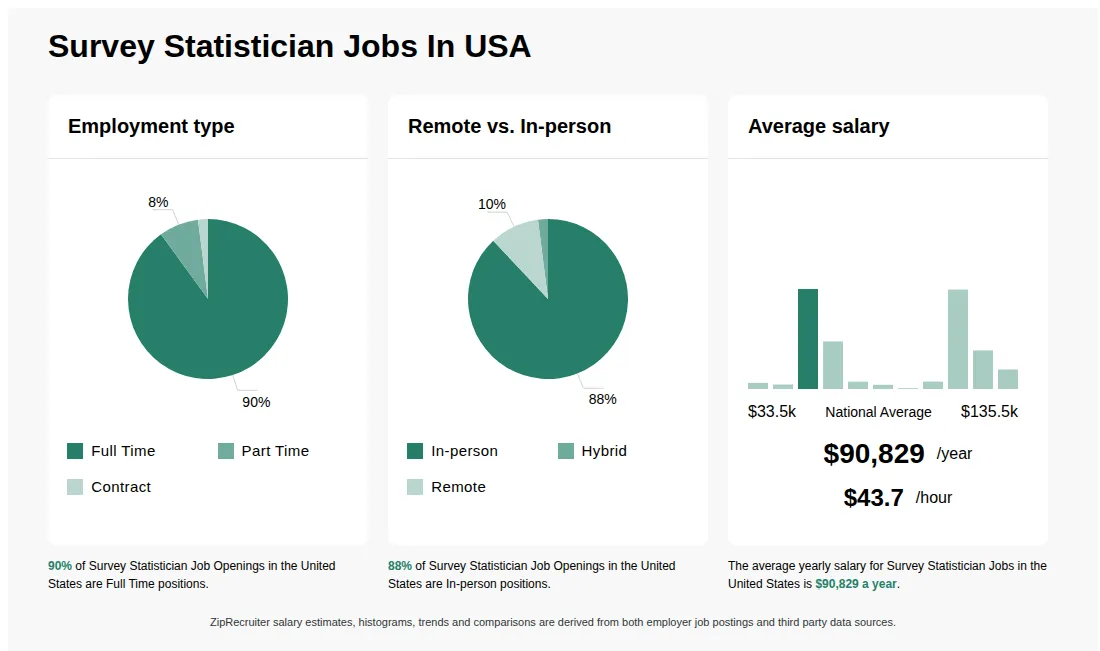
As of Sep 15, 2026, the average yearly pay for survey statistician in the United States is $90,829.00, according to ZipRecruiter salary data. Most workers in this role earn between $57,500.00 and $116,000.00 per year, depending on experience, location, and employer.

What is a survey statistician?

Survey statisticians are professionals who design, implement, and analyze surveys to collect and interpret data. They use statistical methods to ensure that the information gathered is accurate, reliable, and representative of the target population. Their work often includes developing sampling techniques, designing questionnaires, analyzing survey responses, and interpreting results to inform decisions in fields such as government, business, and research. Survey statisticians play a crucial role in turning raw data into actionable insights.

What does a survey statistician do?

As a survey statistician, your responsibilities are to collect and review data and create reports based on the findings of surveys. In addition to collecting and analyzing survey data, you may develop techniques or statistical models that interpret the data in a clear and accurate way. Your responsibilities may also involve ensuring that surveying teams collect the raw information with proper methods and creating reports of statistical analysis that provide the insights your employer needs.

What are the key skills and qualifications needed to thrive as a survey statistician?

To thrive as a Survey Statistician, you need a strong background in statistics, survey methodology, and data analysis, typically supported by a degree in statistics, mathematics, or a related field. Proficiency with statistical software such as SAS, R, or SPSS, as well as experience with survey design tools, is commonly required. Analytical thinking, attention to detail, and effective communication are key soft skills for interpreting results and conveying insights to stakeholders. These skills ensure accurate data collection and analysis, leading to reliable conclusions that inform organizational or policy decisions.

What are some common challenges faced by survey statisticians when designing and implementing large-scale surveys?

Survey Statisticians often encounter challenges such as ensuring representative sampling, minimizing nonresponse bias, and maintaining data quality throughout the survey process. They must carefully design questionnaires to avoid ambiguous questions and ensure high response rates, while also adapting methodologies to suit diverse populations. Collaboration with subject matter experts, IT teams, and field staff is essential to address logistical issues and interpret results accurately.

What is the difference between Survey Statistician vs Data Analyst?

AspectSurvey StatisticianData Analyst
Required CredentialsBachelor's or master's in statistics, mathematics, or related fieldBachelor's or master's in statistics, mathematics, or related field
Work EnvironmentResearch firms, government agencies, survey organizationsBusiness, healthcare, finance, tech companies
Employer & Industry UsagePrimarily in survey research, public opinion, social sciencesAcross various industries analyzing data for decision-making

Survey Statisticians and Data Analysts share similar educational backgrounds and often work in data-driven environments. However, Survey Statisticians focus specifically on designing and analyzing surveys, especially in research and public opinion contexts, while Data Analysts handle broader data sets across industries to inform business decisions.

How much does a survey statistician make?

Survey statisticians typically earn a median annual salary of around $70,000 to $90,000, depending on experience, education, and location. Advanced skills in statistical software and data analysis can lead to higher compensation, especially in government, research, or private sectors.

What cities are hiring for Survey Statistician jobs?

Cities with the most Survey Statistician job openings:

Who are the top companies hiring for Survey Statistician jobs?

The top employers for Survey Statistician jobs are:

What states have the most Survey Statistician jobs?

States with the most job openings for Survey Statistician jobs include:

What are popular job titles related to Survey Statistician jobs?

For Survey Statistician jobs, the most frequently searched job titles are:

Infographic showing various Survey Statistician job openings in the United States as of September 2026, with employment types broken down into 2% As Needed, 83% Full Time, 14% Part Time, and 1% Contract. Highlights an 93% Physical, 2% Hybrid, and 5% Remote job distribution, with an average salary of $90,829 per year, or $43.7 per hour.

Survey Statistician

Olivette, MO • On-site, Remote

National Agricultural Statistics Service
10K+ employees

$63K - $99K/yr

Full-time

This job post has expired 3 days ago. Applications are no longer accepted.


Job description

Summary
This position is located within the Office of the Administrator, National Agricultural Statistics Service (NASS), and supports national agricultural statistical programs through survey design, statistical analysis, estimation methodology, and preparation of official agricultural statistics and reports.
Learn more about this agency
Duties
Help
  • Develops both broad and detailed plans and procedures for the conduct of surveys and for the analysis and preparation of estimates, forecasts, and reports.
  • In cooperation with more senior staff members, devises new or improved methods and techniques for assembling, computing, and summarizing data.
  • Prepares reports and formulates and recommends new or revised survey forms and questionnaires to facilitate the gathering of data.
  • Examines listings and tabulations, recognizing deviations and trends and verifying the accuracy of data.
  • Analyzes summarized survey indications and prepares estimates, forecasts, and supporting analytical and interpretative comments for reports.
  • Analyzes current indications in relation to historical records and other existing conditions affecting items surveyed.
  • Reads and interprets regression and correlation charts.
  • Prepares final recommendations for estimates and/or forecasts and writes analytical and interpretive comments to substantiate conclusions.
  • Establishes guidelines for machine and other editing.
  • Examines survey forms and questionnaires obtained by mail, telephone, electronic, and enumerative survey methods from farmers, merchants, processors, and dealers in agricultural products.
  • Determines validity and representative quality of reports.
  • Assures comparability of indications.

Requirements
Help
Conditions of employment
  • You must be a US Citizen or US National.
  • Males born after 12/31/1959 must be Selective Service registered or exempt.
  • Subject to satisfactory adjudication of background investigation and/or fingerprint check.
  • Direct Deposit - Per Public Law 104-134 all Federal employees are required to have federal payments made by direct deposit to their financial institution.
  • Successfully pass the E-Verify employment verification check. To learn more about E-Verify, including your rights and responsibilities, visit https://www.e-verify.gov/.
  • As a condition of employment for accepting this position, you will be required to serve a 1-year probationary period unless previous federal service is creditable. During this time your employment will be evaluated, and we may consider: your performance and conduct, the needs and interests of the agency, whether your continued employment would advance organizational goals of the agency or the Government, and whether your continued employment would advance the efficiency of the Federal service. Upon completion of your probationary period your employment will be terminated unless you receive certification, in writing, that your continued employment advances the public interest.

Qualifications
Applicants must meet all qualifications and eligibility requirements by the closing date of the announcement including time-in-grade restrictions, specialized experience and/or education, as defined below.
Basic Requirements:
  1. Degree: that included 15 semester hours in statistics (or in mathematics and statistics, provided at least 6 semester hours were in statistics), and 9 additional semester hours in one or more of the following: physical or biological sciences, medicine, education, or engineering; or in the social sciences including demography, history, economics, social welfare, geography, international relations, social or cultural anthropology, health sociology, political science, public administration, psychology, etc. Credit toward meeting statistical course requirements should be given for courses in which 50 percent of the course content appears to be statistical methods, e.g., courses that included studies in research methods in psychology or economics such as tests and measurements or business cycles, or courses in methods of processing mass statistical data such as tabulating methods or electronic data processing.
    or
  2. Combination of education and experience courses as shown in A above, plus appropriate experience or additional education. The experience should have included a full range of professional statistical work such as (a) sampling, (b) collecting, computing, and analyzing statistical data, and (c) applying statistical techniques such as measurement of central tendency, dispersion, skewness, sampling error, simple and multiple correlation, analysis of variance, and tests of significance.

Evaluation of Education:
Courses acceptable toward meeting the mathematics course requirement of paragraphs A or B above must have included at least four of the following: differential calculus, integral calculus, advanced calculus, theory of equations, vector analysis, advanced algebra, linear algebra, mathematical logic, differential equations, or any other advanced course in mathematics for which one of these was a prerequisite. Courses in mathematical statistics or probability theory with a prerequisite of elementary calculus or more advanced courses will be accepted toward meeting the mathematics requirements, with the provision that the same course cannot be counted toward both the mathematics and the statistics requirement.
Evaluation of Experience:
The experience offered in combination with educational courses to meet the requirements in paragraph B above should include evidence of statistical work such as (a) sampling, (b) collecting, computing, and analyzing statistical data, and (c) applying known statistical techniques to data such as measurement of central tendency, dispersion, skewness, sampling error, simple and multiple correlation, analysis of variance, and tests of significance.
Without other indications of statistical experience, work required in the processing of numerical or quantified information by other than statistical methods is not considered appropriate qualifying experience. Examples of such nonqualifying work include statistical clerical work; statistical drafting; calculation of totals, averages, percentages, or other arithmetic summations; preparation of simple tables or charts; or verification of data by simple comparison or proofreading.
In addition to meeting the basic requirements described above, applicants must also meet additional qualification requirements as stated below.
GS-09: Specialized experience is experience directly related to the position to be filled. Qualifying experience for GS-9 includes one year of specialized experience comparable to the GS-7 which is directly related to the work of this position, and which equips the applicant with the knowledge, skills, and abilities to perform successfully the duties of the position. For this position, specialized experience is the experience analyzing statistical data; preparing statistical estimates/reports; and recognizing deviations or treads in collected data.
OR
Education: Completion of 2 years of progressively higher-level graduate education leading to a master's degree or master's or equivalent graduate degree, if related. Related degrees may include degrees in the field of agriculture, agricultural business, economics, mathematics, or statistics.
OR
Combination of specialized experience and graduate level education.
GS-11: Specialized experience is experience directly related to the position to be filled. Qualifying experience for GS-11 includes one year of specialized experience comparable to the GS-9 which is directly related to the work of this position, and which equips the applicant with the knowledge, skills, and abilities to perform successfully the duties of the position. For this position, specialized experience is the experience applying a wide range of analytical, mathematical, and statistical principles and practices to evaluate surveys or estimates.
OR
Education: Completion of 3 years of progressively higher-level graduate education leading to a Ph.D. degree or Ph.D. or equivalent doctoral degree, if related. Related degrees may include degrees in the field of agriculture, agricultural business, economics, mathematics, or statistics.
OR
Combination of specialized experience and graduate level education.
Experience refers to paid and unpaid experience, including volunteer work done through National Service programs (e.g., Peace Corps, AmeriCorps) and other organizations (e.g., professional; philanthropic; religious; spiritual; community, student, social). Volunteer work helps build critical competencies and can provide valuable training and experience that translates directly to paid employment. You will receive credit for all qualifying experience, including volunteer experience.
Education
Please see above for education qualification requirement information.
Additional information
Career Transition Assistance Plan (CTAP), Reemployment Priority List (RPL), or Interagency Career Transition Assistance Plan (ICTAP): Visit the OPM website for information on how to apply as a CTAP, RPL, or ICTAP eligible. To exercise selection priority for this vacancy, CTAP/RPL/ICTAP candidates must meet the basic eligibility requirements and all selective factors. CTAP/ICTAP candidates must be rated and determined to be well qualified (or above) based on an evaluation of the competencies listed in the How You Will Be Evaluated section. When assessed through a score-based category rating method, CTAP/ICTAP applicants must receive a rating of at least 85 out of a possible 100.
Reasonable Accommodation (RA) Requests: If you believe you have a disability (i.e., physical or mental), covered by the Rehabilitation Act of 1973 as amended, that would interfere with completing the USA Hire Competency Based Assessments, you will be granted the opportunity to request a RA in your online application. Requests for RA for the USA Hire Competency Based Assessments and appropriate supporting documentation for RA must be received prior to starting the USA Hire Competency Based Assessments. Decisions on requests for RA are made on a case-by-case basis. If you meet the minimum qualifications of the position, after notification of the adjudication of your request, you will receive an email invitation to complete the USA Hire Competency Based Assessments, based on your adjudication decision. You must complete all assessments within 48 hours of receiving the URL to access the USA Hire Competency Based Assessments, if you received the link after the close of the announcement. To determine if you need a RA, please review the Procedures for Requesting a Reasonable Accommodation for Online Assessments here.
If you are selected for a position with further promotion potential, you will be placed under a career development plan, and may be non-competitively promoted if you successfully complete the requirements and if recommended by management. However, promotion is neither implied nor guaranteed.
This position is being concurrently announced under Merit Promotion Announcement Number NASS-M26TAB-13049259-AR. Current or former Federal employees or other eligible applicants may apply to both announcements to expand all possibilities of consideration since different referral criteria apply to each type of announcement. See the above announcement for more information.
Expand Hide additional information
Candidates should be committed to improving the efficiency of the Federal government, passionate about the ideals of our American republic, and committed to upholding the rule of law and the United States Constitution.
Benefits
Help
A career with the U.S. government provides employees with a comprehensive benefits package. As a federal employee, you and your family will have access to a range of benefits that are designed to make your federal career very rewarding. Opens in a new windowLearn more about federal benefits.
Eligibility for benefits depends on the type of position you hold and whether your position is full-time, part-time or intermittent. Contact the hiring agency for more information on the specific benefits offered.