1

Sports Statistician Jobs (NOW HIRING)

... a given sports rules and regulations. • This position also requires a knowledge of, or ... Athletics Statistician Department: Athletics and Recreation Grade: Grade 6 Worker Type: Employee ...

Basic knowledge of each specific sport Knowledge, Skills, & Abilities: * Ability to stay calm under ... crime statistics, and our drug and alcohol abuse and prevention program designed to prevent the ...

The Sports Information Director is also the primary historian, statistician, and archivist for the Park University Department of Athletics. Position Accountabilities * Oversee the day-to-day ...

... statistics. Monitors and evaluates the effectiveness of and participation in the program. Requirements POSITION SUMMARY: The Sports Program Representative will work with the Program Director to ...

next page

Showing results 1-20

Sports Statistician information

See salary details

$50.5K

$86.9K

$116.5K

How much do sports statistician jobs pay per year?

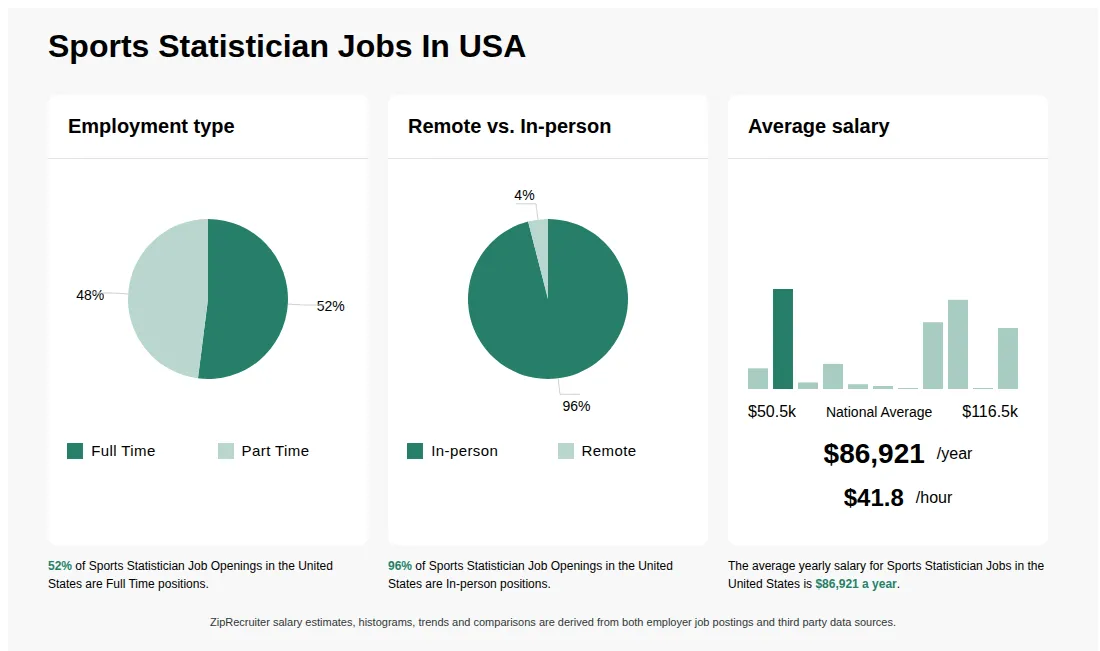
As of Jun 9, 2026, the average yearly pay for sports statistician in the United States is $86,921.00, according to ZipRecruiter salary data. Most workers in this role earn between $57,500.00 and $98,500.00 per year, depending on experience, location, and employer.

What Does a Sports Statistician Do?

There are two broad categories of sports statistician: academic statisticians and recorders. If you are an academic statistician, your responsibilities are to track players and team data and analyze this information to develop unique insights about the team, a specific athlete, or the effectiveness of a strategy or tactic. You then make recommendations to team management staff based on your analysis. If you are a recorder, your duties are to record statistics of games in real time. The data you collect provides insights for the team, academic statisticians, and news and media outlets that report on sports.

What are sports statisticians?

Sports statisticians are professionals who collect, analyze, and interpret data related to sports events and athletes' performances. They record statistics during games, such as player scores, assists, fouls, and other key metrics, either in real time or by reviewing footage. Their work helps coaches, teams, media, and fans understand player and team performance. Sports statisticians may also use statistical software to generate reports and identify trends that can influence coaching decisions, player recruitment, or betting odds.

How do you become a sports statistician?

To become a sports statistician, typically a bachelor's degree in statistics, mathematics, sports management, or a related field is required. Developing skills in data analysis, familiarity with statistical software, and knowledge of sports are important; some roles may also require experience with data collection and reporting tools. Gaining internships or experience with sports teams or organizations can improve job prospects.

What are some common challenges Sports Statisticians face during live events?

Sports Statisticians often work under high-pressure conditions during live games, where they must collect, verify, and input data in real time. One major challenge is maintaining accuracy while events unfold rapidly, as even a minor error can impact team strategies or broadcast information. Additionally, Statisticians must stay focused for extended periods and be prepared to troubleshoot technical issues on the spot. Effective communication with coaches, broadcasters, and other team members is also crucial to ensure data is relayed efficiently and accurately.

What are the key skills and qualifications needed to thrive as a Sports Statistician, and why are they important?

To thrive as a Sports Statistician, you need a solid background in mathematics, data analysis, and statistics, often supported by a relevant degree such as statistics, mathematics, or data science. Familiarity with statistical software (like R or SPSS), data visualization tools, and spreadsheet programs is typically required, and certifications in data analytics can be advantageous. Attention to detail, problem-solving abilities, and strong communication skills help statisticians interpret data accurately and present findings clearly to diverse audiences. These skills are essential for producing reliable insights that inform coaching decisions, media reporting, and organizational strategy in sports.

What is the difference between Sports Statistician vs Sports Data Analyst?

AspectSports StatisticianSports Data Analyst
Required CredentialsBachelor's degree in statistics, sports management, or related fieldBachelor's or master's in data science, statistics, or related field
Work EnvironmentSports teams, leagues, or sports organizationsSports organizations, analytics firms, or media companies
Employer & Industry UsagePrimarily in professional and college sportsBroader, including media, betting, and performance analysis
Common Search & ComparisonYesYes

While both roles involve analyzing sports data, a Sports Statistician primarily focuses on collecting and interpreting game statistics for teams and leagues. A Sports Data Analyst often works across various sectors, including media and betting, utilizing advanced data techniques to provide insights. The roles overlap in skills and credentials but differ in application and scope.

What cities are hiring for Sports Statistician jobs? Cities with the most Sports Statistician job openings:
What are the most commonly searched types of Sports Statistician jobs? The most popular types of Sports Statistician jobs are:
Who are the top companies hiring for Sports Statistician jobs? The top employers for Sports Statistician jobs are:
What states have the most Sports Statistician jobs? States with the most job openings for Sports Statistician jobs include:
What job categories do people searching Sports Statistician jobs look for? The top searched job categories for Sports Statistician jobs are:
Infographic showing various Sports Statistician job openings in the United States as of May 2026, with employment types broken down into 2% Locum Tenens, 1% Internship, 1% Full Time, 88% Part Time, and 8% Contract. Highlights an 82% Physical, 3% Hybrid, and 15% Remote job distribution, with an average salary of $86,921 per year, or $41.8 per hour.
Sports Photographer and Statistician

Sports Photographer and Statistician

Cornell College

Mount Vernon, IA

Full-time

Posted 13 days ago


Job description

Position Summary:

Primarily assist the athletics communications director with pre-game, in-game and post-game duties for home events. Also helps with some clerical duties in the office.


Principal Duties

In-game statistical data entry or “spotting” for the inputter, action photography, social media coverage and website maintenance. Other press box and office duties as assigned.


Knowledge and Skills

  • Typing
  • Phone Coverage
  • Microsoft Excel
  • Microsoft Word
  • Customer Service/PR
  • Photography
  • Filing
  • Photocopying
  • Sports Statistician

Working Conditions

Many weekends and nights, Block Break or Holiday work is expected. Most of the jobs are completed while at the event in the evenings and weekends.

Expectations

Knowledge of the Athletic Department’s guidelines and procedures of various sports.