Experience in stage lighting, pro audio systems and basic video systems. * Experience in the set-up, patching, and operation of conventional, intermediate, and advanced lighting consoles. * Strong ...
Experience in stage lighting, pro audio systems and basic video systems. * Experience in the set-up, patching, and operation of conventional, intermediate, and advanced lighting consoles. * Strong ...

Stage Manager- PT Gramercy
New York, NY · On-site
... stage Manager ... Cabling; assist audio & lighting crew as directed * Band Set changes * Ensure that members of the ...
Stage Manager- PT Gramercy
New York, NY · On-site
... stage Manager ... Cabling; assist audio & lighting crew as directed * Band Set changes * Ensure that members of the ...
Lighting Engineer
Los Angeles, CA · On-site
Experience in stage lighting, pro audio systems and basic video systems * Ability to handle multiple projects simultaneously * Proficiency with all Microsoft applications * Must possess superior ...
Lighting Engineer
Los Angeles, CA · On-site
Experience in stage lighting, pro audio systems and basic video systems * Ability to handle multiple projects simultaneously * Proficiency with all Microsoft applications * Must possess superior ...
Lighting Engineer
Los Angeles, CA · On-site
Experience in stage lighting, pro audio systems and basic video systems * Ability to handle multiple projects simultaneously * Proficiency with all Microsoft applications * Must possess superior ...
Lighting Engineer
Los Angeles, CA · On-site
Experience in stage lighting, pro audio systems and basic video systems * Ability to handle multiple projects simultaneously * Proficiency with all Microsoft applications * Must possess superior ...
Experience in stage lighting, pro audio systems and basic video systems * Ability to handle multiple projects simultaneously * Proficiency with all Microsoft applications * Must possess superior ...
Experience in stage lighting, pro audio systems and basic video systems * Ability to handle multiple projects simultaneously * Proficiency with all Microsoft applications * Must possess superior ...
Lighting Tech/Engineer
New York, NY · On-site
Experience in stage lighting, pro audio systems and basic video systems * Ability to handle multiple projects simultaneously * Proficiency with all Microsoft applications * Must possess superior ...
Lighting Tech/Engineer
New York, NY · On-site
Experience in stage lighting, pro audio systems and basic video systems * Ability to handle multiple projects simultaneously * Proficiency with all Microsoft applications * Must possess superior ...

Lighting and Sound Crew Position
Superior, WI · On-site
$14/hr
Student employees will be working with and repairing various stage lighting and sound equipment when needed, as well as climbing ladders and working in the catwalks above the theatre. The average ...
Lighting and Sound Crew Position
Superior, WI · On-site
$14/hr
Student employees will be working with and repairing various stage lighting and sound equipment when needed, as well as climbing ladders and working in the catwalks above the theatre. The average ...

Design, concept, draw, and oversee the implementation of new stage lighting configurations for events and weekend worship experiences. * Be part of a team that operates lighting for Sunday church ...
Design, concept, draw, and oversee the implementation of new stage lighting configurations for events and weekend worship experiences. * Be part of a team that operates lighting for Sunday church ...
Big Night Live - Stagehand
Boston, MA · On-site
$18/hr
Assisting lighting and audio crews as directed by stage manager or production manager * Assisting with maintenance and repair of sound, light and stage equipment * Maintaining and securing house ...
Big Night Live - Stagehand
Boston, MA · On-site
$18/hr
Assisting lighting and audio crews as directed by stage manager or production manager * Assisting with maintenance and repair of sound, light and stage equipment * Maintaining and securing house ...
Experience in stage lighting, pro audio systems and basic video systems. * Ability to handle multiple projects simultaneously. * Proficiency with all Microsoft applications * Must possess superior ...
Experience in stage lighting, pro audio systems and basic video systems. * Ability to handle multiple projects simultaneously. * Proficiency with all Microsoft applications * Must possess superior ...
Design, concept, draw, and oversee the implementation of new stage lighting configurations for events and weekend worship experiences. * Be part of a team that operates lighting for Sunday church ...
Design, concept, draw, and oversee the implementation of new stage lighting configurations for events and weekend worship experiences. * Be part of a team that operates lighting for Sunday church ...
Stage Hand- HOB Myrtle Beach
North Myrtle Beach, SC · On-site
$15 - $20/hr
... stage Manager ... Cabling; assist audio & lighting crew as directed * Band Set changes * Ensure that members of the ...
Stage Hand- HOB Myrtle Beach
North Myrtle Beach, SC · On-site
$15 - $20/hr
... stage Manager ... Cabling; assist audio & lighting crew as directed * Band Set changes * Ensure that members of the ...
Lighting Engineer - Gramercy
New York, NY · On-site
Experience in stage lighting, pro audio systems and basic video systems * Ability to handle multiple projects simultaneously * Proficiency with all Microsoft applications * Must possess superior ...
Lighting Engineer - Gramercy
New York, NY · On-site
Experience in stage lighting, pro audio systems and basic video systems * Ability to handle multiple projects simultaneously * Proficiency with all Microsoft applications * Must possess superior ...
Stage Manager- PT Gramercy
New York, NY · On-site
... stage Manager ... Cabling; assist audio & lighting crew as directed * Band Set changes * Ensure that members of the ...
Stage Manager- PT Gramercy
New York, NY · On-site
... stage Manager ... Cabling; assist audio & lighting crew as directed * Band Set changes * Ensure that members of the ...

Stage Hand- Opera
Rochester, NY · On-site
$17.50 - $22.79/hr
Prepares, sets up, tears down, adjusts, repairs, and maintains stage and theatre equipment, including orchestra instruments, seating, stage lighting, audio and visual equipment, scenery, and any ...
Stage Hand- Opera
Rochester, NY · On-site
$17.50 - $22.79/hr
Prepares, sets up, tears down, adjusts, repairs, and maintains stage and theatre equipment, including orchestra instruments, seating, stage lighting, audio and visual equipment, scenery, and any ...
Experience in stage lighting, pro audio systems and basic video systems. * Ability to handle multiple projects simultaneously. * Proficiency with all Microsoft applications * Must possess superior ...
Experience in stage lighting, pro audio systems and basic video systems. * Ability to handle multiple projects simultaneously. * Proficiency with all Microsoft applications * Must possess superior ...
Lighting Engineer - Gramercy
New York, NY · On-site
Experience in stage lighting, pro audio systems and basic video systems * Ability to handle multiple projects simultaneously * Proficiency with all Microsoft applications * Must possess superior ...
Lighting Engineer - Gramercy
New York, NY · On-site
Experience in stage lighting, pro audio systems and basic video systems * Ability to handle multiple projects simultaneously * Proficiency with all Microsoft applications * Must possess superior ...
Experience in stage lighting, pro audio systems and basic video systems * Ability to handle multiple projects simultaneously * Proficiency with all Microsoft applications * Must possess superior ...
Experience in stage lighting, pro audio systems and basic video systems * Ability to handle multiple projects simultaneously * Proficiency with all Microsoft applications * Must possess superior ...
Lighting Tech/Engineer
New York, NY · On-site
Experience in stage lighting, pro audio systems and basic video systems * Ability to handle multiple projects simultaneously * Proficiency with all Microsoft applications * Must possess superior ...
Lighting Tech/Engineer
New York, NY · On-site
Experience in stage lighting, pro audio systems and basic video systems * Ability to handle multiple projects simultaneously * Proficiency with all Microsoft applications * Must possess superior ...
Strong working knowledge of stage lighting, basic video systems, and basic audio systems * Ability to manage multiple projects and tasks simultaneously * Proficiency with Microsoft Office ...
Strong working knowledge of stage lighting, basic video systems, and basic audio systems * Ability to manage multiple projects and tasks simultaneously * Proficiency with Microsoft Office ...
Stage Lighting information
See salary details
$10.82 - $12.35
1% of jobs
$12.35 - $13.88
3% of jobs
$13.88 - $15.41
15% of jobs
$15.41 - $16.94
4% of jobs
$17.21 is the 25th percentile. Wages below this are outliers.
$16.94 - $18.47
11% of jobs
The median wage is $19.35 / hr.
$18.47 - $20
27% of jobs
$20 - $21.53
7% of jobs
$22.29 is the 75th percentile. Wages above this are outliers.
$21.53 - $23.06
13% of jobs
$23.06 - $24.58
13% of jobs
$24.58 - $26.11
3% of jobs
$26.11 - $27.64
3% of jobs
$10
$19
$27
How much do stage lighting jobs pay per hour?
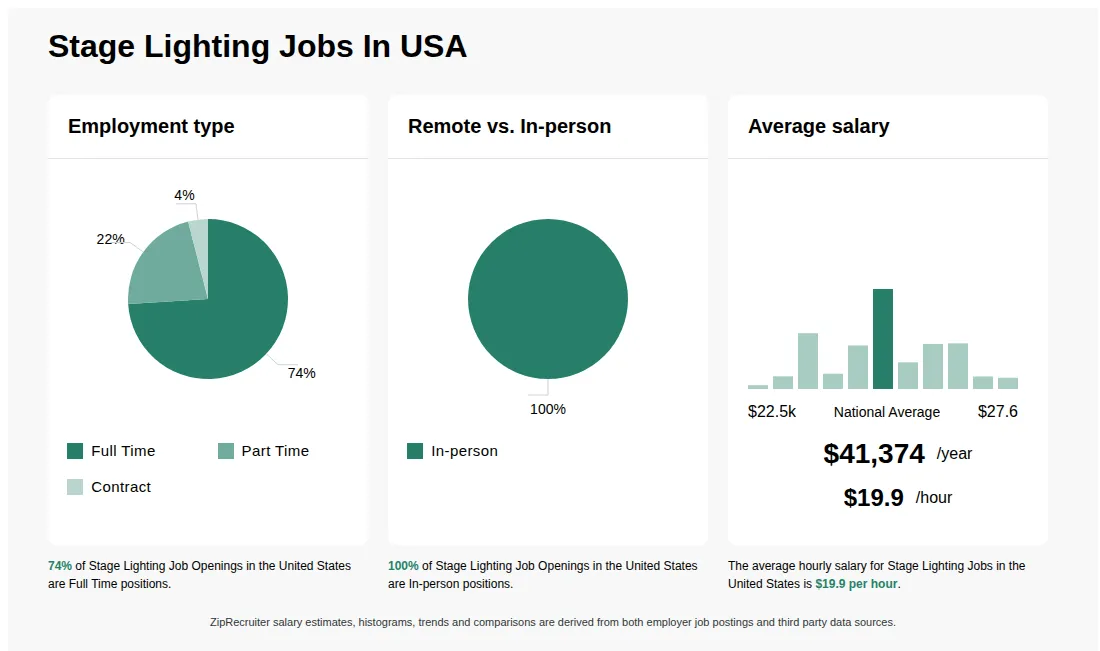
As of Sep 13, 2026, the average hourly pay for stage lighting in the United States is $19.89, according to ZipRecruiter salary data. Most workers in this role earn between $16.83 and $22.36 per hour, depending on experience, location, and employer.
What is stage lighting?
Stage lighting refers to the craft and technology of lighting up a stage for theater, concerts, dance, and other performances. It involves the use of different lighting instruments and techniques to highlight actors, set the mood, and enhance the overall visual experience for the audience. Stage lighting designers work closely with directors and other production staff to achieve the desired look and feel. Proper stage lighting can influence the atmosphere, focus attention, and help tell the story.
What are stage lighting jobs?
Stage lighting jobs involve the installation and rigging of lighting equipment for performances. In addition to setting up lights, stage lighting technicians also handle lighting operations during live theater shows and other stage productions. In this career, you work during both pre-production and performances. You arrange and connect lighting for the show as designers build the set. Your duties include testing the lights after setup and during rehearsals. You also operate and troubleshoot the lights during the show, observing the performance and using a console to control the lighting. Some lighting technicians have assistants who handle specific responsibilities during setup and performances.
What are the key skills and qualifications needed to thrive as a stage lighting technician, and why are they important?
To thrive as a Stage Lighting Technician, you need a solid understanding of lighting design principles, electrical systems, and hands-on experience with lighting equipment, often supported by technical training or certification. Familiarity with lighting consoles (such as ETC or GrandMA), DMX control systems, and rigging safety protocols is typically required. Attention to detail, problem-solving skills, and effective teamwork help technicians adapt to live performance demands and collaborate with directors and crew. These skills ensure safe, reliable, and visually impactful lighting that enhances the overall production quality.
What are some common challenges faced by stage lighting technicians during live performances?
Stage lighting technicians often face challenges such as last-minute changes to lighting cues, adapting to unexpected technical issues, and working under tight time constraints during rehearsals and shows. Collaboration with directors, performers, and other technical crew members is crucial to ensure lighting synchronizes seamlessly with the production. Additionally, technicians must balance creativity with safety, ensuring all equipment is set up correctly and meets safety standards while still achieving the desired visual effects.
What is the difference between Stage Lighting vs Lighting Technician?
| Aspect | Stage Lighting | Lighting Technician |
|---|---|---|
| Credentials | Lighting design certifications, technical training | Technical training, certifications often similar |
| Work Environment | Performances, theaters, concerts | Event setups, theaters, live shows |
| Job Focus | Design and programming lighting for productions | Installing, operating, maintaining lighting equipment |
| Industry Usage | Creative design, production planning | Technical execution, equipment management |
Stage Lighting involves designing and programming lighting setups to enhance performances, focusing on creative aspects. Lighting Technicians handle the installation, operation, and maintenance of lighting equipment during events. While both roles require technical skills and certifications, Stage Lighting emphasizes design and programming, whereas Lighting Technicians focus on technical execution and support.
What is a stage lighting technician?
A stage lighting technician is responsible for setting up, operating, and maintaining lighting equipment for theatrical, concert, or event productions. They work with lighting consoles, fixtures, and design to create the desired visual effects and ensure proper illumination. The role often requires technical skills, knowledge of electrical safety, and sometimes certification or training in lighting technology.
More about Stage Lighting jobs
What cities are hiring for Stage Lighting jobs?
Cities with the most Stage Lighting job openings:
What are the most commonly searched types of Stage Lighting jobs?
The most popular types of Stage Lighting jobs are:
What states have the most Stage Lighting jobs?
States with the most job openings for Stage Lighting jobs include:
What job categories do people searching Stage Lighting jobs look for?
The top searched job categories for Stage Lighting jobs are:
What other helpful pages are available for Stage Lighting?
Other pages related to Stage Lighting:
Lighting Design Technician
Airway Heights, WA • On-site
Sandbox Testing Account
Part-time
Re-posted 29 days ago
Job description
Job Summary:
Responsible for producing engaging, immersive, and innovative lighting designs that will resonate with audiences during live events. Collaborates with artists and representatives in developing the lighting design for a variety of events.
Key Duties and Responsibilities: These functions are intended as a general illustration of the work performed in this job classification and are not all inclusive for this position.
- Collaborate closely with content and production teams to create and implement compelling lighting designs.
- Use creativity, innovation, and technical expertise to create lighting design elements.
- Apply problem-solving in lighting design projects and quickly provide solid design solutions that resonate with audience.
- Performs the Load-in of band equipment and rental equipment.
- Set Up and break-down of band and event equipment.
- Focus and lighting adjustments to artist or event specifications.
- Spotlight Operations/Lighting Control Boards operation & programming.
- Maintenance of the lighting systems which includes changing blown lamps, focusing fixtures, cleaning fixtures, helping facilitate repairs, maintaining console show files, and system documentation.
- Accommodate artist/ event A/V requirements.
- Responsible for safe and consistent operation of lighting.
- Assist with the technical advance with Artists representatives.
- Ensure proper care and handling of all rental lighting & A/V equipment.
- Interact with visiting production crews to ensure a successful show.
- Distribute or create lighting plot plans.
- Oversee and operate systems pertaining to lighting throughout the entire event.
- Assist audio crew with stands, microphones, cables, etc.
- Attend Production Meetings.
- Attend all scheduled sound checks.
- Maintain a clean and orderly working environment at all times.
- Communicate updates and issues to applicable stakeholders.
- Assist in emergency procedures.
- Perform other duties as assigned.
General Conditions
- Willing and able to work evenings, late nights, weekends and holidays in a high profile and high-stress environment.
- Demonstrate ability to prioritize effectively and efficiently in a fast-paced environment.
- Demonstrate strong time management, problem-solving, and organizational skills.
- Demonstrate strong verbal and written communication skills.
- Demonstrate positive attitude and ability to effectively collaborate with others.
- Demonstrate personal initiative and resourcefulness; ability to act and resolve needs independently.
- Demonstrate ability to deliver excellence with minimal supervision and/or direction.
Job Qualifications
- High school diploma or GED. Extensive related work experience may be considered in lieu of educational requirement.
- Minimum of three (3) years' experience working live events, including production rigging, lighting, and lighting design.
- Experience in stage lighting, pro audio systems and basic video systems.
- Experience in the set-up, patching, and operation of conventional, intermediate, and advanced lighting consoles.
- Strong understanding of conventional, LED, and automated fixtures.
- Experience in hanging cabling, and patching lighting fixtures of all types.
- Experience assembling truss.
- Working knowledge of the principles and practices of workplace safety.
- Working knowledge and skill using Microsoft Office Suite applications and various lighting software; Grad MA2/3, High-End Systems, Vectorworks, WYSIWYG and Pathscape.
Physical Demands: The physical demands described here are representative of those that must be met by a team member to successfully perform the essential functions of this job. Reasonable accommodations may be considered to enable individuals with disabilities to perform the essential functions.
While performing the duties of this Job, the team member is regularly required to sit; stand; walk; use hands to finger, handle, or feel; reach with hands and arms; stoop, kneel, crouch, or crawl; ascend or descend ladders, stairs, scaffolding, ramps, poles; maintain body equilibrium to prevent falling when walking, standing, crouching, or navigating narrow, slippery, or erratically moving surfaces; bend body downward and forward by bending spine and legs; talk or hear.
This job is active in nature. Must be able to stand for long periods while performing various duties. Moderate to heavy lifting (25 - 100 pounds) required.
Specific hearing and vision abilities required by this job; Work in an environment with moderate to loud noise level, extreme lighting changes, strobes & moving lights; Able to wear a radio earpiece during the scheduled shift.