1

Sewing Machine Mechanic Jobs (NOW HIRING)

We are actively hiring for the position of Sewing Machine Operator I, for our plant in Salt Lake ... Mechanical and artistic aptitude. * Strong attention to detail and quality. * Good cutting and ...

We are actively hiring for the position of Sewing Machine Operator I, for our plant in Salt Lake ... Mechanical and artistic aptitude. * Strong attention to detail and quality. * Good cutting and ...

Sewing and Repair Tech

Englewood, CO · On-site

$20 - $21/hr

Operate and maintain industrial sewing machines (Juki and other industrial equipment) * Perform routine maintenance on sewing equipment * Troubleshoot equipment issues as they arise Collaboration ...

next page

Showing results 1-20

Sewing Machine Mechanic information

See salary details

$13

$23

$33

How much do sewing machine mechanic jobs pay per hour?

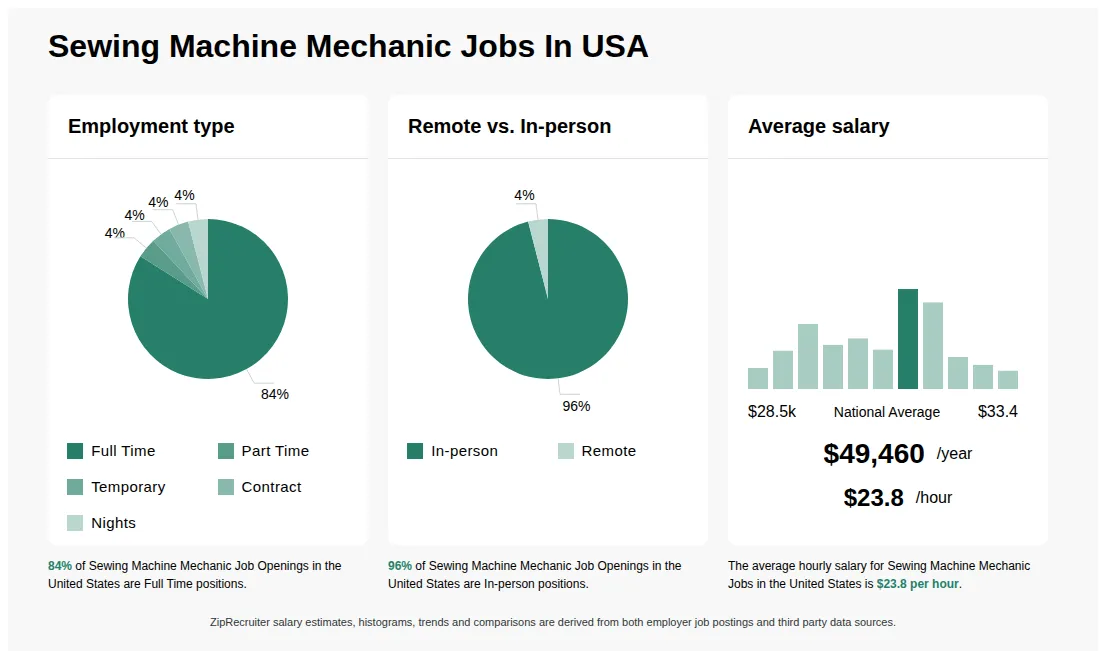
As of Jun 13, 2026, the average hourly pay for sewing machine mechanic in the United States is $23.78, according to ZipRecruiter salary data. Most workers in this role earn between $19.23 and $26.68 per hour, depending on experience, location, and employer.

How to become a brother sewing machine repairman?

To become a sewing machine mechanic, including those who repair Brother sewing machines, you should gain technical skills through vocational training or an apprenticeship, learn about sewing machine mechanics and electronics, and develop troubleshooting abilities. Certification from a recognized organization can enhance job prospects, and hands-on experience with different models is valuable in this field.

What is the hourly rate for sewing?

For a sewing machine mechanic, the hourly rate typically ranges from $15 to $30, depending on experience, location, and the complexity of repairs. Skilled technicians with specialized tools or certifications may earn higher wages, especially in industrial settings or for on-site service work.

What does a Sewing Machine Mechanic do?

A Sewing Machine Mechanic is responsible for installing, maintaining, troubleshooting, and repairing various types of sewing machines used in industries or by individuals. They ensure machines operate efficiently by inspecting parts, making adjustments, replacing worn components, and performing routine maintenance. Their expertise is essential in preventing production delays and ensuring the longevity of equipment. Sewing Machine Mechanics may work with both industrial and domestic machines, depending on their area of specialization.

What is the difference between Sewing Machine Mechanic vs Textile Equipment Technician?

AspectSewing Machine MechanicTextile Equipment Technician
CredentialsTechnical certifications, vocational trainingTechnical certifications, vocational training
Work EnvironmentRepair shops, manufacturing facilitiesTextile plants, manufacturing facilities
Industry UsageFashion, apparel, upholsteryTextile production, fabric manufacturing
Job FocusRepair and maintenance of sewing machinesMaintenance of broader textile machinery

While both roles involve technical skills and work in manufacturing environments, Sewing Machine Mechanics specialize in repairing and maintaining sewing machines used in fashion and upholstery industries. Textile Equipment Technicians focus on a wider range of textile machinery, supporting fabric production. The roles share similar credentials but differ in scope and industry focus.

How to become a sewing machine mechanic?

To become a sewing machine mechanic, you typically need a high school diploma or equivalent and gain experience through on-the-job training or technical programs in machine repair or electronics. Developing skills in mechanical troubleshooting, understanding sewing machine components, and obtaining certifications can improve job prospects in this field.

Which singer is best for heavy fabrics?

A sewing machine mechanic should use a heavy-duty sewing machine with a powerful motor and strong, durable needles for heavy fabrics. Machines with industrial-grade features, such as high stitch speed and reinforced frames, are best suited for sewing thick materials like denim, leather, or canvas.

What Does a Sewing Machine Mechanic Do?

As a sewing machine mechanic, you specialize in the repair and maintenance of sewing machines for both the consumer and industrial markets. Your duties include the operation of a variety of equipment for both sewing and embroidery, from sergers to a die press. You conduct diagnostic testing on more sophisticated machinery to ensure optimal operation, particularly in industrial sewing facilities. Qualifications include a high school diploma or GED certificate, supplemented by coursework at a community college or trade school. Troubleshooting skills are essential to complete repairs quickly and efficiently.

What are the key skills and qualifications needed to thrive as a Sewing Machine Mechanic, and why are they important?

To thrive as a Sewing Machine Mechanic, you need a solid understanding of mechanical systems, troubleshooting skills, and experience with industrial sewing machines, often supported by a technical diploma or vocational training. Familiarity with diagnostic tools, repair manuals, and maintenance management systems is typically required. Attention to detail, problem-solving ability, and effective communication with machine operators are standout soft skills in this role. These skills ensure efficient machine operation, minimize downtime, and maintain production quality in textile and manufacturing environments.

What are some common challenges faced by Sewing Machine Mechanics in industrial settings?

Sewing Machine Mechanics in industrial environments often encounter challenges such as troubleshooting a wide variety of machine brands and models, minimizing downtime during urgent repairs, and sourcing hard-to-find replacement parts. Additionally, they need to stay updated on the latest machine technology and work closely with production teams to ensure machines are operating efficiently. Adapting to shift work and responding to unexpected breakdowns promptly are also key aspects of the role.
What cities are hiring for Sewing Machine Mechanic jobs? Cities with the most Sewing Machine Mechanic job openings:
What are the most commonly searched types of Sewing Machine Mechanic jobs? The most popular types of Sewing Machine Mechanic jobs are:
What states have the most Sewing Machine Mechanic jobs? States with the most job openings for Sewing Machine Mechanic jobs include:
What job categories do people searching Sewing Machine Mechanic jobs look for? The top searched job categories for Sewing Machine Mechanic jobs are:
What are popular job titles related to Sewing Machine Mechanic jobs? For Sewing Machine Mechanic jobs, the most frequently searched job titles are:
Infographic showing various Sewing Machine Mechanic job openings in the United States as of June 2026, with employment types broken down into 90% Full Time, 5% Part Time, and 5% Nights. Highlights an 100% In-person job distribution, with an average salary of $49,460 per year, or $23.8 per hour.

Industrial Sewing Machine/Quilter Operators and Technicians

Textile Jobs | Textile Careers - Elevate Textiles

Greenville, SC

$13.25 - $16/hr

Full-time

Medical, Dental, Vision, Life, Retirement, PTO

Posted yesterday


Job description

Industrial Sewing Machine/Quilter Operators and Technicians

Safety Components is a global market leader in technology driven fabric solutions for first responders, military, outdoor, and other high-performance textiles. An Elevate Textiles company, Safety Components, has been manufacturing textile fabrics for over 100 years at our plant in Greenville, South Carolina. 

OPERATORS:

  • Operates a multi-needle quilting machine and other equipment to efficiently produce quilted products per quality and quantity requirements
  • Loads/reloads fabric, thread and bobbins on quilting and/or sewing machines
  • Sets up quilting machines through loading of backing material and adjusting needle positioning and patterns
  • Monitors machine and makes adjustments as needed in order to prevent skipping and/or creating waste
  • Operates a computer related to quilting function
  • Maintains workstation in a neat, clean, and orderly fashion, and performs job duties is a safe and efficient manner

TECHNICIANS:

  • Makes equipment adjustments (timing, feed, etc.) and repairs sewing & quilting machines and related equipment as necessary
  • Inspects, operates, or troubleshoots machinery and related equipment to diagnose machine malfunctions
  • Cleans or lubricates shaft, bearings, gears, or other parts of machinery.
  • Repairs or replaces defective equipment parts
  • Assists in training sewing machine operators in proper setup and operation of machines
  • Uses a variety of hand and power tools, electric meters, and material handling equipment
  • Maintains parts inventory
  • Performs duties safely and maintains a clean and safe work environment
  • Develops and maintains maintenance procedures

PHYSICAL DEMANDS AND WORK ENVIRONMENT:

  • Continually required to walk.
  • Continually required to utilize hand and finger dexterity.
  • Occasionally required to climb, balance, bend, stoop, kneel or crawl
  • Continually required to talk or hear.
  • Frequently utilize visual acuity to operate equipment, read technical information, and/or use a keyboard. Occasionally required to lift/push/carry items up to 50 pounds
  • Frequent work near moving mechanical parts.
  • Hearing protection required

GREAT BENEFITS
CLOSE TO HOME
DIRECT HIRE
Work Life Balance:  Paid Holidays, Vacation time
Professional Development: New Employee Orientation, On-the-Job Training, Educational Assistance Program
Employee Benefits: Medical, Dental, Vision, Life Insurance; Short & Long term Disability; 401K savings plan with company

Apply online or in person @ 30 Emery St Greenville SC 29605


Should you need assistance or reasonable accommodations in connection with the application or interview process, please contact Human Resources at 1-336-379-6220
Elevate Textiles is an Equal Opportunity Employer: employees and candidates are treated without regard to their race, color, religion, sex, sexual orientation, gender identity, national origin, or status as a qualified individual with a disability or Vietnam era or other protected veteran.