Risk Control Consultant
$95K - $131K/yr
Sentry Insurance, a Mutual Company, is excited to share this Risk Control Consultant opportunity. Our dedication to customer service is embodied by our best associates. At Sentry, our associates take ...
$95K - $131K/yr
Sentry Insurance, a Mutual Company, is excited to share this Risk Control Consultant opportunity. Our dedication to customer service is embodied by our best associates. At Sentry, our associates take ...
$95K - $131K/yr
Sentry Insurance, a Mutual Company, is excited to share this Risk Control Consultant opportunity. Our dedication to customer service is embodied by our best associates. At Sentry, our associates take ...
Lafayette, LA · On-site
Brown & Brown is seeking a Risk Control Consultant to join our growing team in Lafayette, LA! This position will report to the Director of Claims and will deliver Risk Control consulting, inspection ...
Lafayette, LA · On-site
Brown & Brown is seeking a Risk Control Consultant to join our growing team in Lafayette, LA! This position will report to the Director of Claims and will deliver Risk Control consulting, inspection ...
Detroit, MI · On-site
$99K - $149K/yr
The pay range for a Risk Control Consultant II is $82,400-$123,600 annually. * The pay range for a Risk Control Consultant Sr is $99,700-$149,500 annually. What You'll Do The following are some of ...
Detroit, MI · On-site
$99K - $149K/yr
The pay range for a Risk Control Consultant II is $82,400-$123,600 annually. * The pay range for a Risk Control Consultant Sr is $99,700-$149,500 annually. What You'll Do The following are some of ...
Detroit, MI · On-site
$99K - $149K/yr
The pay range for a Risk Control Consultant II is $82,400-$123,600 annually. * The pay range for a Risk Control Consultant Sr is $99,700-$149,500 annually. What You'll Do The following are some of ...
Detroit, MI · On-site
$99K - $149K/yr
The pay range for a Risk Control Consultant II is $82,400-$123,600 annually. * The pay range for a Risk Control Consultant Sr is $99,700-$149,500 annually. What You'll Do The following are some of ...
Old Republic Bitco is seeking is seeking a Senior Risk Control Consultant to join our team near Houston TX . As a respected specialty insurer with 11 branch offices across 10 states, OR Bitco ...
Old Republic Bitco is seeking is seeking a Senior Risk Control Consultant to join our team near Houston TX . As a respected specialty insurer with 11 branch offices across 10 states, OR Bitco ...
Old Republic Bitco is seeking is seeking a Senior Risk Control Consultant to join our team near Houston TX . As a respected specialty insurer with 11 branch offices across 10 states, OR Bitco ...
Old Republic Bitco is seeking is seeking a Senior Risk Control Consultant to join our team near Houston TX . As a respected specialty insurer with 11 branch offices across 10 states, OR Bitco ...
Overview The Risk Control Consultant II serves as a business consultant, helping policyholders improve workplace safety, reduce losses, and strengthen risk management practices. The consultant ...
Overview The Risk Control Consultant II serves as a business consultant, helping policyholders improve workplace safety, reduce losses, and strengthen risk management practices. The consultant ...
Roanoke, VA · On-site
$48K - $65K/yr
Located in Virginia or West Virginia | Full-Time Metis is searching for a Risk Control Consultant to join our Risk Control Team! Metis/Risk Management Programs is a Roanoke-owned and operated company ...
Quick apply
Roanoke, VA · On-site
$48K - $65K/yr
Located in Virginia or West Virginia | Full-Time Metis is searching for a Risk Control Consultant to join our Risk Control Team! Metis/Risk Management Programs is a Roanoke-owned and operated company ...
$81K - $143K/yr
As our Risk Control Consultant on the Risk Management team, you'll deliver value added risk control services to assigned commercial clients in service territory or industry vertical. You'll also ...
$81K - $143K/yr
As our Risk Control Consultant on the Risk Management team, you'll deliver value added risk control services to assigned commercial clients in service territory or industry vertical. You'll also ...
Detroit, MI · On-site +1
$99K - $149K/yr
The pay range for a Risk Control Consultant II is $82,400-$123,600 annually. * The pay range for a Risk Control Consultant Sr is $99,700-$149,500 annually. What You'll Do The following are some of ...
Detroit, MI · On-site +1
$99K - $149K/yr
The pay range for a Risk Control Consultant II is $82,400-$123,600 annually. * The pay range for a Risk Control Consultant Sr is $99,700-$149,500 annually. What You'll Do The following are some of ...
$75K - $116K/yr
As a Risk Control Consultant , you will engage with policyholder customers and agent partners, conduct workplace risk assessments, and assist customers in establishing and maintaining effective ...
$75K - $116K/yr
As a Risk Control Consultant , you will engage with policyholder customers and agent partners, conduct workplace risk assessments, and assist customers in establishing and maintaining effective ...
Old Republic Bitco is seeking is seeking an Associate Risk Control Consultant to join our team near San Antonio TX . As a respected specialty insurer with 11 branch offices across 10 states, OR Bitco ...
Old Republic Bitco is seeking is seeking an Associate Risk Control Consultant to join our team near San Antonio TX . As a respected specialty insurer with 11 branch offices across 10 states, OR Bitco ...
Boston, MA · On-site
Overview The Risk Control Consultant II serves as a business consultant, helping policyholders improve workplace safety, reduce losses, and strengthen risk management practices. The consultant ...
Boston, MA · On-site
Overview The Risk Control Consultant II serves as a business consultant, helping policyholders improve workplace safety, reduce losses, and strengthen risk management practices. The consultant ...
The Risk Control Consultant II serves as a business consultant, helping policyholders improve workplace safety, reduce losses, and strengthen risk management practices. The consultant partners with ...
The Risk Control Consultant II serves as a business consultant, helping policyholders improve workplace safety, reduce losses, and strengthen risk management practices. The consultant partners with ...
Overview The Risk Control Consultant II serves as a business consultant, helping policyholders improve workplace safety, reduce losses, and strengthen risk management practices. The consultant ...
Overview The Risk Control Consultant II serves as a business consultant, helping policyholders improve workplace safety, reduce losses, and strengthen risk management practices. The consultant ...
Old Republic Bitco is seeking is seeking an Associate Risk Control Consultant to join our team near San Antonio TX . As a respected specialty insurer with 11 branch offices across 10 states, OR Bitco ...
Old Republic Bitco is seeking is seeking an Associate Risk Control Consultant to join our team near San Antonio TX . As a respected specialty insurer with 11 branch offices across 10 states, OR Bitco ...
Calabasas, CA · On-site
$125K - $130K/yr
Senior Risk Control Consultant Compensation: Exempt; Starting rate at $125,000 with Incentive Compensation Schedule: Full-Time; hours of operation for the office are typically Monday through Friday ...
Calabasas, CA · On-site
$125K - $130K/yr
Senior Risk Control Consultant Compensation: Exempt; Starting rate at $125,000 with Incentive Compensation Schedule: Full-Time; hours of operation for the office are typically Monday through Friday ...
Dallas, TX · On-site
Overview The Risk Control Consultant II serves as a business consultant, helping policyholders improve workplace safety, reduce losses, and strengthen risk management practices. The consultant ...
Dallas, TX · On-site
Overview The Risk Control Consultant II serves as a business consultant, helping policyholders improve workplace safety, reduce losses, and strengthen risk management practices. The consultant ...
Glastonbury, CT · On-site
$72K - $141K/yr
Individual contributor responsible for the overall risk control assessment, evaluation, consulting and technical support on complex issues/assignments. Recognized as a technical expert in a product ...
Glastonbury, CT · On-site
$72K - $141K/yr
Individual contributor responsible for the overall risk control assessment, evaluation, consulting and technical support on complex issues/assignments. Recognized as a technical expert in a product ...
Glastonbury, CT · On-site
$72K - $141K/yr
Individual contributor responsible for the overall risk control assessment, evaluation, consulting and technical support on complex issues/assignments. Recognized as a technical expert in a product ...
Glastonbury, CT · On-site
$72K - $141K/yr
Individual contributor responsible for the overall risk control assessment, evaluation, consulting and technical support on complex issues/assignments. Recognized as a technical expert in a product ...
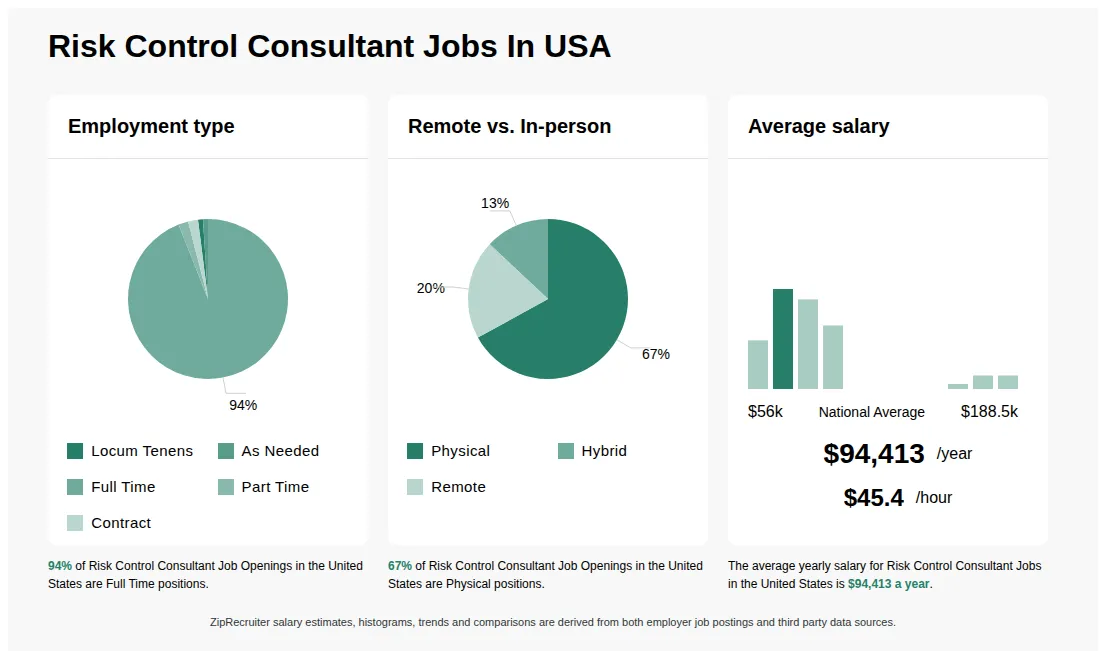
$56K - $68K
14% of jobs
$72.3K is the 25th percentile. Wages below this are outliers.
$68K - $80.1K
30% of jobs
The median wage is $82.6K / yr.
$80.1K - $92.1K
27% of jobs
$94.5K is the 75th percentile. Wages above this are outliers.
$92.1K - $104.2K
20% of jobs
$104.2K - $116.2K
0% of jobs
$116.2K - $128.3K
0% of jobs
$128.3K - $140.3K
0% of jobs
$140.3K - $152.4K
0% of jobs
$152.4K - $164.4K
1% of jobs
$164.4K - $176.5K
4% of jobs
$176.5K - $188.5K
4% of jobs
$56K
$94.4K
$188.5K
A Risk Control Consultant assesses potential risks in a business or organization and develops strategies to minimize financial losses, workplace injuries, or operational disruptions. They analyze data, conduct site inspections, and provide recommendations to improve safety and compliance. Their goal is to reduce risk exposure, lower insurance costs, and enhance overall risk management programs.
To thrive as a Risk Control Consultant, you need a solid background in risk assessment, loss prevention, and industry-specific regulations, often supported by a bachelor’s degree in risk management, finance, or a related field. Familiarity with risk management software, data analysis tools, and certifications such as the Associate in Risk Management (ARM) are commonly preferred. Strong analytical thinking, keen attention to detail, effective communication, and relationship-building skills set top performers apart. Mastering these areas ensures you can accurately identify risks, recommend actionable solutions, and foster trust with clients or internal stakeholders.
Risk Control Consultants often encounter challenges such as staying current with ever-changing regulations, adapting risk management strategies for a wide range of industries, and effectively communicating complex risk concepts to diverse clients. Addressing these challenges requires ongoing professional development, proactive research, and leveraging strong interpersonal skills to tailor recommendations. Consultants also collaborate regularly with clients, underwriters, and other internal teams, which helps build well-rounded and practical solutions. Learning to balance compliance demands with practical business operations is key to success in this role.
Cities with the most Risk Control Consultant job openings:
The most popular types of Risk Control Consultant jobs are:
The top employers for Risk Control Consultant jobs are:
States with the most job openings for Risk Control Consultant jobs include:
The top searched job categories for Risk Control Consultant jobs are:
For Risk Control Consultant jobs, the most frequently searched job titles are:

$95K - $131K/yr
Full-time
Medical, Dental, Vision, Life, Retirement, PTO
Re-posted 14 days ago
8.7
Based on 46 frontline employees who took The Breakroom Quiz
72nd of 315 rated insurance
We are currently seeking a risk control professional that is technically proficient, self-motivated and results driven to fill an open position within our Shared Services division. You must be able to conduct comprehensive safety and risk management assessments, provide our Underwriting teams with a strong analytical opinion of risk to support our goal of profitable growth within variety of middle to large premium market segment for Dealerships, Construction, Manufacturing, Wholesale Trade, Retail, Commercial Real Estate and Service industries. In addition, the successful candidate will develop close relationships with our agents and policyholders, conducting selected safety seminars and training, to build the value-added service that Sentry is known for.
The ideal candidate will be based in the Atlanta, Metro area with good access to major travel routes across the territory – encompassing southern and central Georgia. Servicing this territory requires car-travel and occasional hotel stays to efficiently reach account locations in neighboring states (SC, NC, AL) as business needs may require. You will also have access to growth/development through Home Office training, field job-shadows, safety conferences, career development and department networking opportunities.
Based on qualifications and experience, this position can be filled as a Risk Control Consultant I, II or a Risk Control Consultant Sr.
The pay range for a Risk Control Consultant I is $65,200-$89,500 annually.
The pay range for a Risk Control Consultant II is $78,800-$108,400 annually.
The pay range for a Risk Control Consultant Sr is $95,400-$131,200 annually.
What You’ll Do
The following are some of the responsibilities of the Risk Control Consultant position:
Conduct onsite facility evaluations to determine if operational exposures are being adequately controlled to prevent building losses. Determine scope and schedule of preventative maintenance programs on key mechanical equipment within the facility (electrical systems, HVAC, machinery in use, and roof condition).
Assist in determining if facility protections (fire suppression systems, alarm systems, etc.) are acceptable for the building occupancy, exposures, and special hazards.
Complete detailed reports for each covered line of business – Property, General Liability, Auto, & Workers Compensation, etc. – to assist our underwriting groups with account acceptability and insurability.
Assist customers with development and implementation of safety polices, programs and procedures specific to each account & loss exposure.
Provide advanced risk management and consultative services to assigned clients.
Conduct Job-site safety inspections and OSHA 10-hour seminars for our Regional construction line of business.
Maintain and demonstrate safety management and expertise in areas such as commercial property protection, general liability, product liability, fleet safety and employee safety.
Develop, coordinate and conduct safety/risk management seminars and training programs for accounts to promote awareness and reduce claim frequency and severity.
Develop and execute service proposals and plans to qualified accounts.
What it Takes
Four-year degree within Safety is preferred
Emphasis in Occupational Safety & Health, Engineering, or Physical Sciences preferred
1-5 years of insurance safety consulting or safety work in a private industry (construction and manufacturing)
High level of independence, organization, and self-motivation to work from home
Experience in coordinating and servicing large or multi location accounts preferred
Knowledge of OSHA, ANSI, NFPA Standards, and DOT regulations
High level of verbal and written communication skills
Ability to learn use of specialized building valuation systems, diagramming and report software
Acceptable motor vehicle record for travel (50%) including overnight travel in some cases
Desire to pursue professionals Safety designations including CSP and/or other designations
What You’ll Receive
At Sentry, your total rewards go beyond competitive compensation. Below are some benefits and perks that you’ll receive.
Generous Paid-Time Off plan for you to enjoy time out of the office.
Company vehicle with gas card
401(K) plan with a dollar for dollar match on your first eight percent, plus immediate vesting to help strengthen your financial future.
Group Medical, Dental, Vision and Life insurance to encourage a healthy lifestyle.
Extensive Work-Life Resources to lend a helping hand.
Sentry Foundation gift matching program to encourage charitable giving.
Continue your education and career development through Sentry University (SentryU).
About Sentry
We take great pride in making Forbes’ list of America’s Best Midsize Employers since 2017. A lot of different factors go into that honor, many of which contribute to your job satisfaction.
Our bright future is built on a long track record of success. We got our start in 1904 and have been helping businesses succeed and protect their futures ever since. Because of the trust placed in us, we’re one of the largest and financially strongest mutual insurance companies in the United States. We’re rated A+ by A.M. Best, the industry's leading rating authority.
Our headquarters is in Stevens Point, Wisconsin, with offices located throughout the United States. From sales to claims, and information technology to marketing, we enjoy a rewarding and challenging work environment with opportunities for ongoing professional development and growth.
Get ready to own your future at Sentry. Opportunities await!
Casey Van Der Geest
Casey.VanDerGeest@sentry.com
Equal Employment Opportunity
Sentry is an Equal Opportunity Employer. It is our policy that there be no discrimination in employment based on race, color, national origin, religion, sex, disability, age, marital status, or sexual orientation.
Get the full story on Breakroom

Sourced by ZipRecruiter
Insurance services
1,001 - 5,000 Employees
Stevens Point, WI, US