1

Restorative Justice Jobs (NOW HIRING)

Juvenile Justice Advocate

Chicago, IL · On-site

$20.10 - $22.50/hr

  • Medical

  • Dental

  • Vision

  • Life

  • Retirement

  • PTO

Our promotes mentoring, restorative justice, violence prevention, and community events for a safer and healthier South Shore community. We work to address the effects of trauma-which can lead to ...

Juvenile Justice Advocate

Chicago, IL · On-site

$20.10 - $22.50/hr

  • Medical

  • Dental

  • Vision

  • Life

  • Retirement

  • PTO

Our Community Wellness program promotes mentoring, restorative justice, violence prevention, and community events for a safer and healthier South Shore community. We work to address the effects of ...

As leaders in justice design, we stand committed to advancing restorative justice architecture. Designing justice facilities is both an immense responsibility and an opportunity to rethink and ...

Showing results 41-60

Restorative Justice information

See salary details

$11

$19

$27

How much do restorative justice jobs pay per hour?

As of Aug 18, 2026, the average hourly pay for restorative justice in the United States is $19.74, according to ZipRecruiter salary data. Most workers in this role earn between $16.59 and $21.63 per hour, depending on experience, location, and employer.

What is restorative justice?

A Restorative Justice job involves facilitating dialogue and healing between those harmed by crime or conflict and those responsible for it. Professionals in this field work with individuals, communities, and justice systems to address harm, promote accountability, and support reconciliation. They may serve as mediators, program coordinators, or advocates in schools, courts, and community organizations. The goal is to repair relationships, reduce recidivism, and foster a more restorative approach to justice.

What does a typical day look like for someone working in restorative justice?

A typical day in Restorative Justice often involves facilitating restorative circles or conferences, meeting individually with participants to prepare them for dialogue, and documenting outcomes in case management systems. Professionals in this field collaborate closely with community organizations, schools, and justice system stakeholders to coordinate support and resources. You may also spend time evaluating case progress, conducting follow-up sessions, and leading community workshops. The work environment is usually collaborative and flexible, requiring adaptability as each case may present unique challenges and needs.

What are the key skills and qualifications needed to thrive in restorative justice, and why are they important?

To thrive in Restorative Justice, you typically need a background in conflict resolution, social work, or criminal justice, along with strong facilitation and mediation skills. Familiarity with restorative practices, case management systems, and certifications such as Restorative Justice Practitioner training are often beneficial. Outstanding interpersonal skills, empathy, and cultural competence set candidates apart in this role. These skills are critical for effectively guiding restorative processes that repair harm, build trust, and promote community well-being.

How well does restorative justice work?

Restorative justice professionals facilitate processes that focus on repairing harm through dialogue between victims and offenders. Evidence shows it can reduce recidivism and promote accountability, especially when implemented with trained facilitators and community support. Its effectiveness varies based on context, participant engagement, and the specific approach used.

What can you do with a restorative justice degree?

A restorative justice degree prepares individuals for roles in conflict resolution, mediation, and community-based programs that focus on repairing harm and promoting healing. Graduates can work as mediators, community coordinators, or in criminal justice settings, often requiring strong communication and interpersonal skills. Certification or training in conflict management may enhance employment opportunities.

What do you do in restorative justice?

A restorative justice professional facilitates processes that bring together victims, offenders, and community members to discuss the impact of a crime and work toward healing and resolution. They often organize meetings, mediate conversations, and develop plans for restitution or community service, requiring strong communication and conflict resolution skills. The role aims to promote accountability and repair harm rather than traditional punitive measures.

What cities are hiring for Restorative Justice jobs?

Cities with the most Restorative Justice job openings:

What are the most commonly searched types of Restorative Justice jobs?

The most popular types of Restorative Justice jobs are:

What states have the most Restorative Justice jobs?

States with the most job openings for Restorative Justice jobs include:

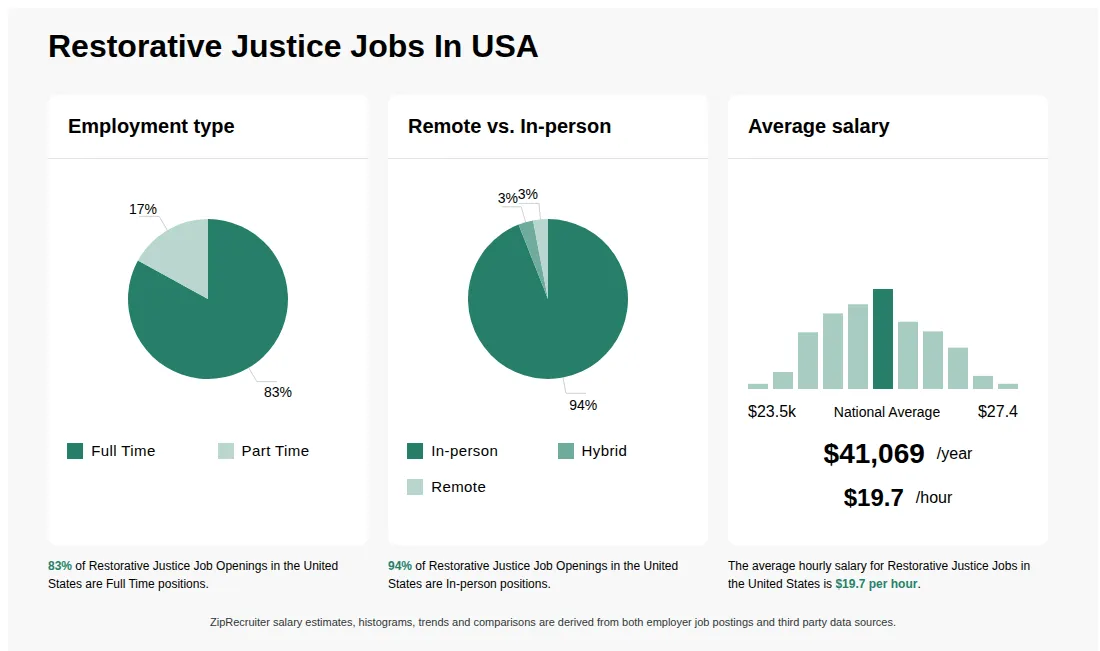
Infographic showing various Restorative Justice job openings in the United States as of August 2026, with employment types broken down into 1% As Needed, 81% Full Time, 16% Part Time, 1% Temporary, and 1% Contract. Highlights an 92% Physical, 3% Hybrid, and 5% Remote job distribution, with an average salary of $41,069 per year, or $19.7 per hour.

Participant Engagement Specialist

Center for Justice Innovation

Bronx, NY • On-site

$55K - $60K/yr

Temporary

Medical, Dental, Vision, Life, Retirement

Posted 19 days ago


Job description

THE ORGANIZATION

The Center for Justice Innovation is a nonprofit organization dedicated to advancing community safety and racial justice. Since 1996, we’ve worked alongside communities, courts, and those most directly affected by the justice system to build stronger, healthier, and more equitable neighborhoods. With a team of over 900 staff and an annual budget of $130 million, the Center carries out its mission through three core strategies:

  1. Operating Programs that pilot new ideas and address local challenges;
  2. Conducting original research to evaluate what works—and what doesn’t; and
  3. Providing expert assistance and policy guidance to reformers across the country and beyond.

Backed by decades of on-the-ground experience and nationally recognized expertise, we bring innovative, practical, and lasting solutions to justice systems nationwide.
Learn more about our work at www.innovatingjustice.org.

THE OPPORTUNITY

Bronx Community Solutions (BCS), aims to provide community-based alternatives to jail, restore community relationships, and center the needs and dignity of participants while helping them avoid further criminal legal involvement. With programming in the Bronx’s centralized criminal courthouse and the South Bronx community, BCS offers meaningful alternatives to the traditional criminal legal system, providing a variety of services including pre-arraignment diversion and alternative to incarceration programming.
The Restorative Justice Department at BCS has developed several court diversion initiatives centering restorative justice philosophy, providing opportunities for healing, relationship building and repair, and genuine expressions of accountability in lieu of isolation and punishment. These initiatives utilize “circles”, a unique form of communication inspired by indigenous justice and community building practices. Project Reset, a pre-court early diversion program, offers adults who receive desk appearance tickets for low-level misdemeanors the opportunity to participate in a one-time community building circle to resolve their arrest and avoid a criminal record. BCS also offers same-day at-arraignment programming for eligible individuals to resolve their case through a restorative circle on the day of their court appearance in the courthouse. Finally, BCS provides a more intensive restorative justice diversion and alternative-to-incarceration process for misdemeanor and felony cases involving harm or conflict. This programming brings together the person impacted by the harm, the person responsible, and their community members to discuss the impact of the harm, take accountability, explore underlying issues, and agree upon a pathway forward.
BCS is seeking a Part-Time Participant Engagement Specialist. Reporting to the Restorative Justice Coordinator, the Participant Engagement Specialist is primarily responsible for supporting the outreach and intakes of eligible Project Reset program participants who have received a desk appearance ticket for a low-level arrest and have been deemed eligible for pre-arraignment diversion programming. The Engagement Specialist will engage in a variety of forms of outreach including making cold calls to inform potential participants of their ability to resolve their arrest with the Project Reset program, conduct intakes, and schedule participants for programming, among other responsibilities


Responsibilities include but are not limited to: 

  • Conduct cold outreach calls, send texts, and mail letters to eligible participants;
  • Complete participant intakes and schedule participants for diversion programming;
  • Track outreach efforts and case notes in the Salesforce data management system and other program systems;
  • Assist with administrative tasks, record keeping, and participant follow-up as needed;
  • Research community resources and social services providers to gain knowledge of available services;
  • Compile and share legal and community resources with participants based on their needs;
  • Participate in restorative circles and other participant or community programming and events, as needed;
  • Attend team meetings and any staff training opportunities; and
  • Support the overall operations of the Restorative Justice department programs.

Qualifications: 

  • High school diploma and a minimum of two years of relevant lived, educational, and/or professional experience in the criminal legal field or a related social service field required;
  • Previous experience or familiarity with restorative justice strongly preferred;
  • Strong preference for bilingual English/Spanish language fluency;
  • Comfort conducting a variety of forms of outreach, including making cold calls;
  • Strong engagement and interpersonal skills;
  • Ability to convey information to participants clearly, accurately, and completely;
  • Collaborative working style and flexibility and openness to working on a variety of projects in various locations in a multifaceted role;
  • Problem-solving attitude and willingness to take initiative to address challenges;
  • Ability to navigate electronic platforms and document or outreach management systems such as Salesforce and Microsoft Suite; and
  • Ability to work with people from diverse backgrounds and identities, and demonstrate a commitment to an anti-racist, anti-oppressive, and social justice-centered practice.
Additional Preferred Qualifications Include:
  • Meaningful connections to the Bronx community;
  • Knowledge and/or lived experience related to the criminal legal system and its impact on communities;
  • Experience working with individuals impacted by violence or trauma and a familiarity with trauma-informed practices;
  • Candidates who are formerly incarcerated or who have otherwise been impacted by the criminal legal system are strongly encouraged to apply.

Position Type: Part-time temporary position working 21 hours a week for one-year working Monday, Wednesday, and Thursday from 9:00 AM - 5:00 PM with flexibility depending on the needs of the program.

Position Location: Bronx, NY.

Compensation: The compensation range for this position is $28.57 - $33.08 per hour based on a 35-hour work week and is commensurate with experience. 
Benefits: The Center for Justice Innovation offers an excellent benefits package including comprehensive healthcare with a national network, free basic dental coverage, vision insurance, short-term and long-term disability, life insurance, and flexible spending accounts including commuter FSA. We prioritize mental health care for our staff and offer services like Talkspace and Ginger through our healthcare plans. We offer a 403(b) retirement plan with a two-to-one employer contribution up to 5%.

The Center for Justice Innovation is an equal opportunity employer committed to fostering an inclusive and diverse workplace. We do not discriminate based on race, color, religion, gender identity, gender expression, pregnancy, national origin, age, military service eligibility, veteran status, sexual orientation, marital status, disability, or any other category protected by law. We strongly encourage and welcome applications from women, people of color, members of the LGBTQ+ community, and individuals with prior contact with the criminal justice system. Our goal is to create a supportive and respectful environment where everyone, regardless of background or identity, feels valued and included.

At this time, the Center is unable to sponsor or take over sponsorship of an employment visa. All applicants must be legally authorized to work in the United States at the time of application and throughout the duration of employment.

Candidates are expected to provide accurate and truthful information throughout the hiring process. Any misrepresentation, falsification, or omission of material facts may result in disqualification from consideration, withdrawal of an offer, or termination of employment, regardless of when discovered.

In compliance with federal law, all hires must verify their identity and eligibility to work in the United States and complete the required employment verification form upon hire. Please refer to the job posting for relevant contact information. If contact details are not provided, we kindly ask that you refrain from inquiries via phone or email, as only shortlisted candidates will be contacted.

Powered by JazzHR

TcdoOFKJpU