Reporting to the Director of Restorative Justice Initiatives, the CRJI will help with the replication and implementation of Project Restore (PR) and the coordination of community outreach activities ...
Reporting to the Director of Restorative Justice Initiatives, the CRJI will help with the replication and implementation of Project Restore (PR) and the coordination of community outreach activities ...

Restorative Justice Mentor/Facilitator (Pomona, CA)
Pomona, CA · On-site
$60 - $80/hr
Lead Restorative Sessions: Facilitate engaging and interactive restorative justice circles, discussions, and activities designed to help students develop conflict resolution skills and foster a ...
Restorative Justice Mentor/Facilitator (Pomona, CA)
Pomona, CA · On-site
$60 - $80/hr
Lead Restorative Sessions: Facilitate engaging and interactive restorative justice circles, discussions, and activities designed to help students develop conflict resolution skills and foster a ...
Restorative Justice Mentor/Facilitator (Pomona, CA)
Pomona, CA · On-site
$45/hr
Lead Restorative Sessions: Facilitate engaging and interactive restorative justice circles, discussions, and activities designed to help students develop conflict resolution skills and foster a ...
Restorative Justice Mentor/Facilitator (Pomona, CA)
Pomona, CA · On-site
$45/hr
Lead Restorative Sessions: Facilitate engaging and interactive restorative justice circles, discussions, and activities designed to help students develop conflict resolution skills and foster a ...

Restorative Practices Coach
Aurora, IL · On-site
$57K/yr
Our Restorative Justice (RJ) programs provide direct support, training, leadership development, and capacity-building to schools and organizations that seek to become restorative. This position ...
Restorative Practices Coach
Aurora, IL · On-site
$57K/yr
Our Restorative Justice (RJ) programs provide direct support, training, leadership development, and capacity-building to schools and organizations that seek to become restorative. This position ...
Restorative Practices Coach
Aurora, IL · On-site
$57K/yr
Our Restorative Justice (RJ) programs provide direct support, training, leadership development, and capacity-building to schools and organizations that seek to become restorative. This position ...
Quick apply
Restorative Practices Coach
Aurora, IL · On-site
$57K/yr
Our Restorative Justice (RJ) programs provide direct support, training, leadership development, and capacity-building to schools and organizations that seek to become restorative. This position ...
Restorative Practices Coach
Aurora, IL · On-site
$57K/yr
Our Restorative Justice (RJ) programs provide direct support, training, leadership development, and capacity-building to schools and organizations that seek to become restorative. This position ...
Restorative Practices Coach
Aurora, IL · On-site
$57K/yr
Our Restorative Justice (RJ) programs provide direct support, training, leadership development, and capacity-building to schools and organizations that seek to become restorative. This position ...

Restorative Practices Coach - Long Term Sub Sept/Oct/Nov
Sun Prairie, WI · On-site
$249.78/day
The RP Coach will be trained in Restorative Justice and will oversee the implementation of Restorative Justice programming at the school site. ESSENTIAL DUTIES & RESPONSIBILITIES include the ...
Restorative Practices Coach - Long Term Sub Sept/Oct/Nov
Sun Prairie, WI · On-site
$249.78/day
The RP Coach will be trained in Restorative Justice and will oversee the implementation of Restorative Justice programming at the school site. ESSENTIAL DUTIES & RESPONSIBILITIES include the ...
Restorative Practices Coach - Long Term Sub Sept/Oct/Nov
Sun Prairie, WI · On-site
$249.78/day
The RP Coach will be trained in Restorative Justice and will oversee the implementation of Restorative Justice programming at the school site. ESSENTIAL DUTIES & RESPONSIBILITIES include the ...
Restorative Practices Coach - Long Term Sub Sept/Oct/Nov
Sun Prairie, WI · On-site
$249.78/day
The RP Coach will be trained in Restorative Justice and will oversee the implementation of Restorative Justice programming at the school site. ESSENTIAL DUTIES & RESPONSIBILITIES include the ...

Temporary - Program Assistant - Restorative Justice
Ukiah, CA · On-site
$20.71/hr
Short-Term, Non-Continuing Program Assistant - Restorative Justice Mendocino-Lake Community College District is currently accepting applications for a Short-Term, Non-Continuing Program Assistant ...
Temporary - Program Assistant - Restorative Justice
Ukiah, CA · On-site
$20.71/hr
Short-Term, Non-Continuing Program Assistant - Restorative Justice Mendocino-Lake Community College District is currently accepting applications for a Short-Term, Non-Continuing Program Assistant ...

Restorative Justice Coordinator
Chicago, IL · On-site
$14.75 - $19/hr
CLASS TITLE: Special Education Classroom Assistant CHARACTERISTICS OF THE CLASS: Under the general direction of the school principal, and under the immediate supervision of a Special Education ...
Restorative Justice Coordinator
Chicago, IL · On-site
$14.75 - $19/hr
CLASS TITLE: Special Education Classroom Assistant CHARACTERISTICS OF THE CLASS: Under the general direction of the school principal, and under the immediate supervision of a Special Education ...
Restorative Justice Coordinator
Chicago, IL · On-site
$14.75 - $19/hr
CLASS TITLE: Special Education Classroom Assistant CHARACTERISTICS OF THE CLASS: Under the general direction of the school principal, and under the immediate supervision of a Special Education ...
Restorative Justice Coordinator
Chicago, IL · On-site
$14.75 - $19/hr
CLASS TITLE: Special Education Classroom Assistant CHARACTERISTICS OF THE CLASS: Under the general direction of the school principal, and under the immediate supervision of a Special Education ...

Project Director, Manhattan Justice Opportunities
Manhattan, NY · On-site
$108K - $139K/yr
Manhattan Justice offers onsite case management, psycho-educational groups, and restorative justice programming, and provides referrals to community-based service providers for mental health ...
Quick apply
Project Director, Manhattan Justice Opportunities
Manhattan, NY · On-site
$108K - $139K/yr
Manhattan Justice offers onsite case management, psycho-educational groups, and restorative justice programming, and provides referrals to community-based service providers for mental health ...
Restorative Justice Coordinator
Chicago, IL · On-site
$14.75 - $19/hr
CLASS TITLE: Special Education Classroom Assistant CHARACTERISTICS OF THE CLASS: Under the general direction of the school principal, and under the immediate supervision of a Special Education ...
Restorative Justice Coordinator
Chicago, IL · On-site
$14.75 - $19/hr
CLASS TITLE: Special Education Classroom Assistant CHARACTERISTICS OF THE CLASS: Under the general direction of the school principal, and under the immediate supervision of a Special Education ...
Project Director, Manhattan Justice Opportunities
Manhattan, NY · On-site
$100 - $125/hr
Manhattan Justice offers onsite case management, psycho-educational groups, and restorative justice programming, and provides referrals to community-based service providers for mental health ...
Project Director, Manhattan Justice Opportunities
Manhattan, NY · On-site
$100 - $125/hr
Manhattan Justice offers onsite case management, psycho-educational groups, and restorative justice programming, and provides referrals to community-based service providers for mental health ...
Manhattan Justice offers onsite case management, psycho-educational groups, and restorative justice programming, and provides referrals to community-based service providers for mental health ...
Manhattan Justice offers onsite case management, psycho-educational groups, and restorative justice programming, and provides referrals to community-based service providers for mental health ...
Parallel Justice Program Specialist
Burlington, VT · On-site
$65K - $73K/yr
AFSCME General Purpose This position provides trauma-informed, victim-centered advocacy, case management, resource coordination, referral, and restorative justice services for individuals impacted by ...
Parallel Justice Program Specialist
Burlington, VT · On-site
$65K - $73K/yr
AFSCME General Purpose This position provides trauma-informed, victim-centered advocacy, case management, resource coordination, referral, and restorative justice services for individuals impacted by ...

Parallel Justice Program Specialist
Burlington, VT · Hybrid
$65K - $73K/yr
General Purpose This position provides trauma-informed, victim-centered advocacy, case management, resource coordination, referral, and restorative justice services for individuals impacted by crime ...
Parallel Justice Program Specialist
Burlington, VT · Hybrid
$65K - $73K/yr
General Purpose This position provides trauma-informed, victim-centered advocacy, case management, resource coordination, referral, and restorative justice services for individuals impacted by crime ...

Implement our restorative justice practices to ensure there is a balance between strengthening relationships with students, while deepening their commitment to, and respect for the broader Austin ...
Quick apply
Implement our restorative justice practices to ensure there is a balance between strengthening relationships with students, while deepening their commitment to, and respect for the broader Austin ...

Experience Area of specialization in either social justice or restorative justice required. Applicants should be strongly committed to excellence in teaching, student advising, and student mentoring.
Experience Area of specialization in either social justice or restorative justice required. Applicants should be strongly committed to excellence in teaching, student advising, and student mentoring.
Planner
Manhattan, NY · On-site
$58K - $79K/yr
THE OPPORTUNITY The Restorative Justice Practice Department creates and supports the implementation of restorative justice practices to improve system-based and community responses to harm, both ...
Planner
Manhattan, NY · On-site
$58K - $79K/yr
THE OPPORTUNITY The Restorative Justice Practice Department creates and supports the implementation of restorative justice practices to improve system-based and community responses to harm, both ...
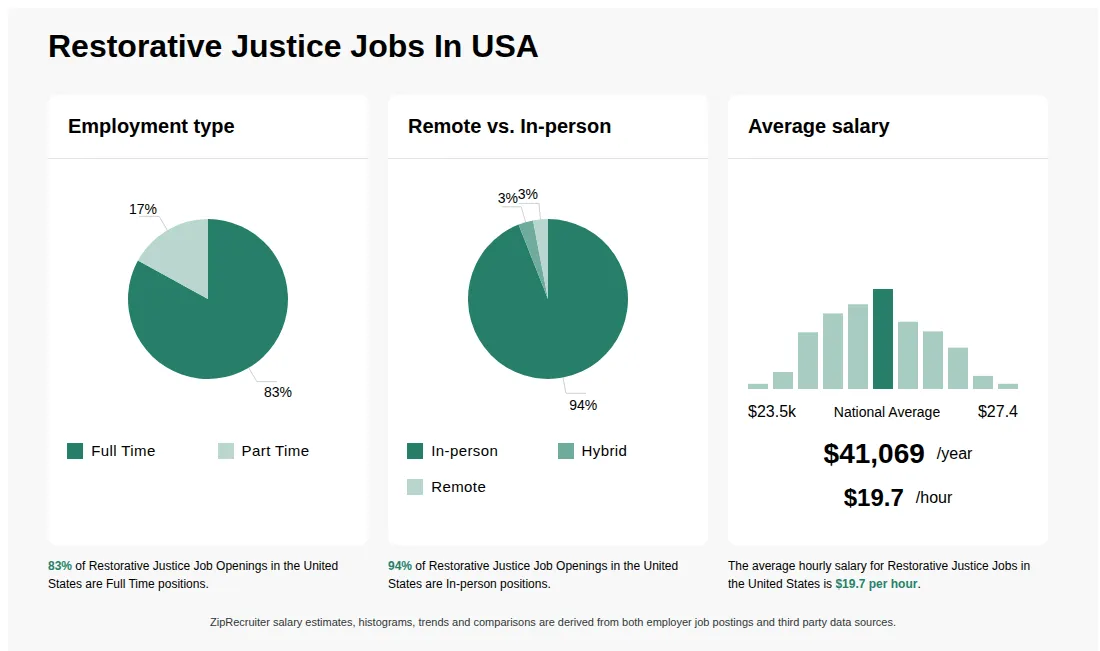
Restorative Justice information
See salary details
$11.30 - $12.76
0% of jobs
$12.76 - $14.23
3% of jobs
$14.23 - $15.69
11% of jobs
$16.76 is the 25th percentile. Wages below this are outliers.
$15.69 - $17.15
15% of jobs
$17.15 - $18.62
17% of jobs
The median wage is $18.89 / hr.
$18.62 - $20.08
20% of jobs
$21.03 is the 75th percentile. Wages above this are outliers.
$20.08 - $21.55
13% of jobs
$21.55 - $23.01
11% of jobs
$23.01 - $24.48
8% of jobs
$24.48 - $25.94
2% of jobs
$25.94 - $27.40
0% of jobs
$11
$19
$27
How much do restorative justice jobs pay per hour?
As of Sep 9, 2026, the average hourly pay for restorative justice in the United States is $19.74, according to ZipRecruiter salary data. Most workers in this role earn between $16.59 and $21.63 per hour, depending on experience, location, and employer.
What is restorative justice?
A Restorative Justice job involves facilitating dialogue and healing between those harmed by crime or conflict and those responsible for it. Professionals in this field work with individuals, communities, and justice systems to address harm, promote accountability, and support reconciliation. They may serve as mediators, program coordinators, or advocates in schools, courts, and community organizations. The goal is to repair relationships, reduce recidivism, and foster a more restorative approach to justice.
What does a typical day look like for someone working in restorative justice?
A typical day in Restorative Justice often involves facilitating restorative circles or conferences, meeting individually with participants to prepare them for dialogue, and documenting outcomes in case management systems. Professionals in this field collaborate closely with community organizations, schools, and justice system stakeholders to coordinate support and resources. You may also spend time evaluating case progress, conducting follow-up sessions, and leading community workshops. The work environment is usually collaborative and flexible, requiring adaptability as each case may present unique challenges and needs.
What are the key skills and qualifications needed to thrive in restorative justice, and why are they important?
To thrive in Restorative Justice, you typically need a background in conflict resolution, social work, or criminal justice, along with strong facilitation and mediation skills. Familiarity with restorative practices, case management systems, and certifications such as Restorative Justice Practitioner training are often beneficial. Outstanding interpersonal skills, empathy, and cultural competence set candidates apart in this role. These skills are critical for effectively guiding restorative processes that repair harm, build trust, and promote community well-being.
How well does restorative justice work?
Restorative justice professionals facilitate processes that focus on repairing harm through dialogue between victims and offenders. Evidence shows it can reduce recidivism and promote accountability, especially when implemented with trained facilitators and community support. Its effectiveness varies based on context, participant engagement, and the specific approach used.
What can you do with a restorative justice degree?
A restorative justice degree prepares individuals for roles in conflict resolution, mediation, and community-based programs that focus on repairing harm and promoting healing. Graduates can work as mediators, community coordinators, or in criminal justice settings, often requiring strong communication and interpersonal skills. Certification or training in conflict management may enhance employment opportunities.
What do you do in restorative justice?
A restorative justice professional facilitates processes that bring together victims, offenders, and community members to discuss the impact of a crime and work toward healing and resolution. They often organize meetings, mediate conversations, and develop plans for restitution or community service, requiring strong communication and conflict resolution skills. The role aims to promote accountability and repair harm rather than traditional punitive measures.
More about Restorative Justice jobs
What cities are hiring for Restorative Justice jobs?
Cities with the most Restorative Justice job openings:
What are the most commonly searched types of Restorative Justice jobs?
The most popular types of Restorative Justice jobs are:
What states have the most Restorative Justice jobs?
States with the most job openings for Restorative Justice jobs include:
What are popular job titles for Restorative Justice?
Popular job titles for Restorative Justice:

Coordinator of Restorative Justice Initiatives (CRJI)
Brooklyn, NY
City of New York •
Public Administration • 10K+ employees10,000+ employees
Full-time
Posted 18 days ago
City Of New York rating

7.2
Based on 81 frontline employees who took The Breakroom Quiz
628th of 858 rated public administrative organizations
Job description
Job Description
The Kings County District Attorney's Office (KCDA) is one of the largest prosecutors' offices in the country. With a commitment to developing and implementing innovative prosecutorial strategies that will fulfill our vision of keeping Brooklyn safe while at the same time ensuring fairness and justice for all. KCDA has an exciting opportunity to work as a Coordinator of Restorative Justice Initiative.
Reporting to the Director of Restorative Justice Initiatives, the CRJI will help with the replication and implementation of Project Restore (PR) and the coordination of community outreach activities to support its participants' success.
Specifically, the Coordinator of Restorative Justice Initiatives will work with the Assistant Director of Community Restorative Justice Initiatives(ADCRJI) to:
- Provide individualized case management and oversight for participants referred through the Kings County District Attorney's Office.
- Coordinate and manage KCDA diversion cases, including those handled internally and through community partners.
- Ensure individualized care, consistent follow-up, and development of participant accountability plans.
- Support participants in achieving restorative and rehabilitative goals aligned with program objectives.
- Maintain consistent case documentation, progress notes, and outcome tracking.
- Collaborate with community organizations, legal partners, and service providers to ensure wraparound support.
- Provide acute support for high-needs participants, including crisis intervention, advocacy, and linkage to mental health, educational, or employment resources.
- Participate in multidisciplinary team meetings, restorative circles, and case review sessions to ensure alignment and continuity of care.
Preferred Skills
- Experience in case management, restorative justice, or alternative-to-incarcerating programming.
- Understanding of criminal legal systems, diversion models, and reentry processes.
- Strong skills in motivational interviewing, crisis response, and community coordination.
- Ability to work with system-impacted individuals with compassion, discretion, and cultural humility.
- Excellent written and verbal communication skills; proficiency in Microsoft Office or case-tracking databases.
- Demonstrated exceptional clinical acumen and experience.
- Expert knowledge of local service providers and resources.
Additional Information.
Candidates must meet the additional requirements:
- A bachelor's degree in Human Services, Social Work or related field.
- Five years of relevant experience, including case management and supervision responsibilities.
- Demonstrated ability to support participants through trauma-informed and restorative approaches.
- Commitment to equity, accountability, and community-based healing practices.
Hours/Shift
Monday - Friday 11:00 A.M. to 7:00 P.M.
Flexibility required for evening and weekend events as needed.
To Apply
To apply click the "Apply Now" button.
We appreciate the interest and thank all applicants who apply, but only those candidates under
consideration will be contacted.
For Non-City/External Candidates: Visit the External Applicant NYC Careers site and type "DA - Brooklyn"
on the search line. Then locate the Job ID number. For Current City Employees: Visit Employee Self
Service (ESS) to view and click on Recruiting Activities, Careers, and search by Job ID number.
COMMUNITY ASSOCIATE - 56057
Qualifications
Qualification Requirements
1. High school graduation or equivalent and three years of experience in community work or community centered activities in an area related to duties described above; or
2. Education and/or experience which is equivalent to "1" above.
Additional Information
The City of New York is an inclusive equal opportunity employer committed to recruiting and retaining a diverse workforce and providing a work environment that is free from discrimination and harassment based upon any legally protected status or protected characteristic, including but not limited to an individual's sex, race, color, ethnicity, national origin, age, religion, disability, sexual orientation, veteran status, gender identity, or pregnancy.
What City Of New York employees say
Pay
Benefits
Hours and flexibility
Workplace
Get the full story on Breakroom

About City of New York
Sourced by ZipRecruiter
Industry
Public administration
Company size
10,000+ Employees
Headquarters location
New York, NY, US
Year founded
1971