Are you a Dermatology Resident looking to expand your hands-on clinical experience in a private practice setting? We're looking for a driven and capable Dermatology Resident Physician to moonlight at ...
Quick apply
Are you a Dermatology Resident looking to expand your hands-on clinical experience in a private practice setting? We're looking for a driven and capable Dermatology Resident Physician to moonlight at ...
Quick apply
Are you a Dermatology Resident looking to expand your hands-on clinical experience in a private practice setting? We're looking for a driven and capable Dermatology Resident Physician to moonlight at ...
Are you a Dermatology Resident looking to expand your hands-on clinical experience in a private practice setting? We're looking for a driven and capable Dermatology Resident Physician to moonlight at ...
Quick apply
Are you a Dermatology Resident looking to expand your hands-on clinical experience in a private practice setting? We're looking for a driven and capable Dermatology Resident Physician to moonlight at ...
... Moonlighting / Per Diem opportunities available for BC / BE Psychiatrists, or PGY3 / PGY4 ... Psychiatry Residents , practicing at Natchaug Hospital , located in Mansfield, CT. * A few ...
... Moonlighting / Per Diem opportunities available for BC / BE Psychiatrists, or PGY3 / PGY4 ... Psychiatry Residents , practicing at Natchaug Hospital , located in Mansfield, CT. * A few ...
... Moonlighting / Per Diem opportunities available for BC / BE Psychiatrists, or PGY3 / PGY4 ... Psychiatry Residents , practicing at Natchaug Hospital , located in Mansfield, CT. * A few ...
... Moonlighting / Per Diem opportunities available for BC / BE Psychiatrists, or PGY3 / PGY4 ... Psychiatry Residents , practicing at Natchaug Hospital , located in Mansfield, CT. * A few ...
Are you a Dermatology Resident looking to expand your hands-on clinical experience in a private practice setting? We're looking for a driven and capable Dermatology Resident Physician to moonlight at ...
Quick apply
Are you a Dermatology Resident looking to expand your hands-on clinical experience in a private practice setting? We're looking for a driven and capable Dermatology Resident Physician to moonlight at ...
Are you a Dermatology Resident looking to expand your hands-on clinical experience in a private practice setting? We're looking for a driven and capable Dermatology Resident Physician to moonlight at ...
Quick apply
Are you a Dermatology Resident looking to expand your hands-on clinical experience in a private practice setting? We're looking for a driven and capable Dermatology Resident Physician to moonlight at ...
Are you a Dermatology Resident looking to expand your hands-on clinical experience in a private practice setting? We're looking for a driven and capable Dermatology Resident Physician to moonlight at ...
Are you a Dermatology Resident looking to expand your hands-on clinical experience in a private practice setting? We're looking for a driven and capable Dermatology Resident Physician to moonlight at ...
Are you a Dermatology Resident looking to expand your hands-on clinical experience in a private practice setting? We're looking for a driven and capable Dermatology Resident Physician to moonlight at ...
Are you a Dermatology Resident looking to expand your hands-on clinical experience in a private practice setting? We're looking for a driven and capable Dermatology Resident Physician to moonlight at ...
Are you a Dermatology Resident looking to expand your hands-on clinical experience in a private practice setting? We're looking for a driven and capable Dermatology Resident Physician to moonlight at ...
Are you a Dermatology Resident looking to expand your hands-on clinical experience in a private practice setting? We're looking for a driven and capable Dermatology Resident Physician to moonlight at ...
Moonlighting opportunity available for Family Medicine or Emergency Medicine Resident physicians to work within our CareNow Urgent Care clinics in Austin, TX. Qualified Candidates: * Comfortable ...
Moonlighting opportunity available for Family Medicine or Emergency Medicine Resident physicians to work within our CareNow Urgent Care clinics in Austin, TX. Qualified Candidates: * Comfortable ...
Are you a Dermatology Resident looking to expand your hands-on clinical experience in a private practice setting? We're looking for a driven and capable Dermatology Resident Physician to moonlight at ...
Are you a Dermatology Resident looking to expand your hands-on clinical experience in a private practice setting? We're looking for a driven and capable Dermatology Resident Physician to moonlight at ...
Moonlighting opportunity available for Family Medicine or Emergency Medicine Resident physicians to work within our CareNow Urgent Care clinics in Austin, TX. Qualified Candidates: * Comfortable ...
Moonlighting opportunity available for Family Medicine or Emergency Medicine Resident physicians to work within our CareNow Urgent Care clinics in Austin, TX. Qualified Candidates: * Comfortable ...
Moonlighting opportunity available for Family Medicine or Emergency Medicine Resident physicians to work within our CareNow Urgent Care clinics in Austin, TX. Qualified Candidates: * Comfortable ...
Moonlighting opportunity available for Family Medicine or Emergency Medicine Resident physicians to work within our CareNow Urgent Care clinics in Austin, TX. Qualified Candidates: * Comfortable ...
Moonlighting opportunity available for Family Medicine or Emergency Medicine Resident physicians to work within our CareNow Urgent Care clinics in Austin, TX. Qualified Candidates: * Comfortable ...
Moonlighting opportunity available for Family Medicine or Emergency Medicine Resident physicians to work within our CareNow Urgent Care clinics in Austin, TX. Qualified Candidates: * Comfortable ...
$180 - $240/hr
Weekend PRN/Moonlighting Inpatient General Psychiatrist Location: Augusta, GA Lighthouse Care ... BE/BC in General Psychiatry, local 3rd or 4th year residents are welcome. * Active or eligible GA ...
$180 - $240/hr
Weekend PRN/Moonlighting Inpatient General Psychiatrist Location: Augusta, GA Lighthouse Care ... BE/BC in General Psychiatry, local 3rd or 4th year residents are welcome. * Active or eligible GA ...
Weekend Moonlighting Psychiatrist Opportunity for a licensed Psychiatrist to provide psychiatric ... 000 residents of Litchfield County and Northwest Connecticut. CHH offers personalized attention ...
Weekend Moonlighting Psychiatrist Opportunity for a licensed Psychiatrist to provide psychiatric ... 000 residents of Litchfield County and Northwest Connecticut. CHH offers personalized attention ...
Weekend Moonlighting Psychiatrist Opportunity for a licensed Psychiatrist to provide psychiatric ... 000 residents of Litchfield County and Northwest Connecticut. CHH offers personalized attention ...
Weekend Moonlighting Psychiatrist Opportunity for a licensed Psychiatrist to provide psychiatric ... 000 residents of Litchfield County and Northwest Connecticut. CHH offers personalized attention ...
Jamaica Plain, MA · On-site
$210K - $265K/yr
... for moonlighting opportunities. This PRN position offers flexibility to work weekends and ... Ideal for experienced psychiatrists or psychiatry residents with an unrestricted Massachusetts ...
Jamaica Plain, MA · On-site
$210K - $265K/yr
... for moonlighting opportunities. This PRN position offers flexibility to work weekends and ... Ideal for experienced psychiatrists or psychiatry residents with an unrestricted Massachusetts ...
Augusta, GA · On-site
$188K - $236K/yr
Weekend PRN/Moonlighting Inpatient General Psychiatrist Location: Augusta, GA Lighthouse Care ... BE/BC in General Psychiatry, local 3rd or 4th year residents are welcome. * Active or eligible GA ...
Augusta, GA · On-site
$188K - $236K/yr
Weekend PRN/Moonlighting Inpatient General Psychiatrist Location: Augusta, GA Lighthouse Care ... BE/BC in General Psychiatry, local 3rd or 4th year residents are welcome. * Active or eligible GA ...
Augusta, GA · On-site
$164K - $207K/yr
Weekend PRN/Moonlighting Inpatient General Psychiatrist Location: Augusta, GA Lighthouse Care ... BE/BC in General Psychiatry, local 3rd or 4th year residents are welcome. * Active or eligible GA ...
Augusta, GA · On-site
$164K - $207K/yr
Weekend PRN/Moonlighting Inpatient General Psychiatrist Location: Augusta, GA Lighthouse Care ... BE/BC in General Psychiatry, local 3rd or 4th year residents are welcome. * Active or eligible GA ...
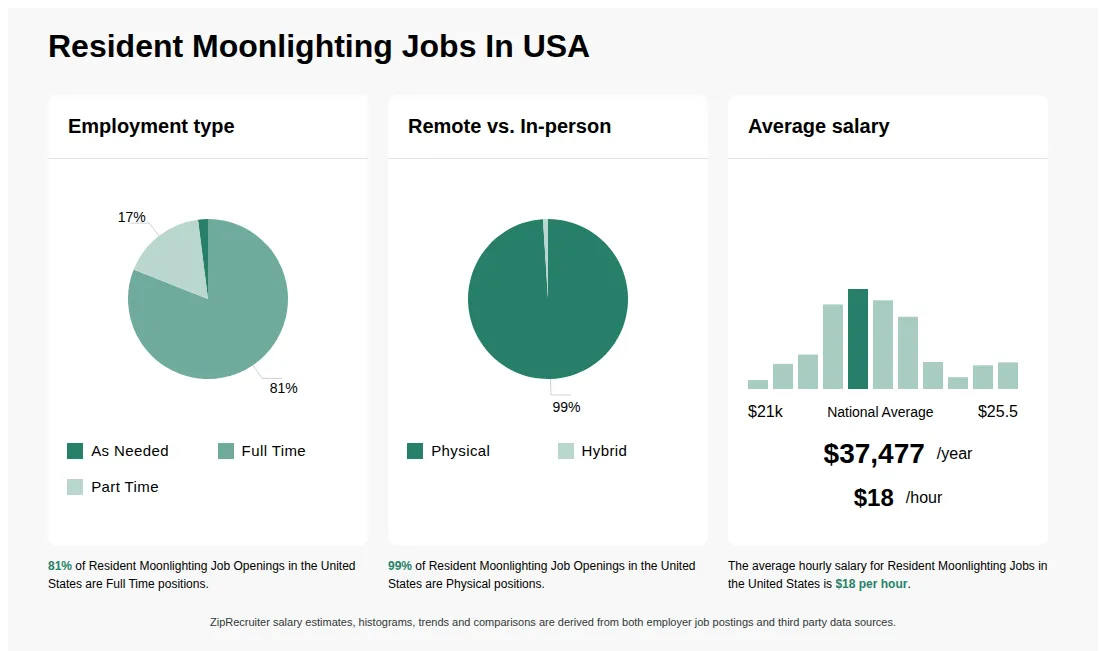
$10.10 - $11.49
1% of jobs
$11.49 - $12.89
5% of jobs
$12.89 - $14.29
6% of jobs
$15.30 is the 25th percentile. Wages below this are outliers.
$14.29 - $15.69
17% of jobs
The median wage is $17.09 / hr.
$15.69 - $17.09
20% of jobs
$17.09 - $18.49
18% of jobs
$19.14 is the 75th percentile. Wages above this are outliers.
$18.49 - $19.89
15% of jobs
$19.89 - $21.28
5% of jobs
$21.28 - $22.68
2% of jobs
$22.68 - $24.08
4% of jobs
$24.08 - $25.48
5% of jobs
$10
$18
$25
A moonlighting job for a medical resident is a secondary, part-time job that they perform in addition to their residency position. As a medical resident, you can undertake a moonlighting job to gain additional exposure and experience in your area of specialization. Your duties and responsibilities, as well as the number of patients you see each shift, vary depending on where you work. Opportunities to work outside regular hours exist in urgent care clinics or hospitals. You can also work during holidays or on weekends. Some moonlighting jobs are locum tenens positions, which means you fill in temporarily for full-time staff.
| Aspect | Resident Moonlighting | Resident Work Outside Residency |
|---|---|---|
| Credentials | Same as residency program requirements | Same as residency program requirements |
| Work Environment | Additional shifts outside primary residency | Employment outside primary residency setting |
| Employer & Industry | Hospitals, clinics, healthcare facilities | Hospitals, clinics, healthcare facilities |
| Search & Comparison | Commonly compared for workload and compensation | Less frequently compared directly to moonlighting |
Resident Moonlighting involves taking extra shifts within the same healthcare setting or similar environments outside regular residency hours, often for additional income. Resident Work Outside Residency refers to employment in different healthcare facilities or roles outside the primary residency program. Both involve working outside standard residency duties but differ mainly in location and scope. Understanding these differences helps residents manage workload and career planning effectively.
Cities with the most Resident Moonlighting job openings:
States with the most job openings for Resident Moonlighting jobs include:
The top searched job categories for Resident Moonlighting jobs are:

Full-time
Re-posted 21 days ago
6.5
Based on 12 frontline employees who took The Breakroom Quiz
Are you a Dermatology Resident looking to expand your hands-on clinical experience in a private practice setting? We’re looking for a driven and capable Dermatology Resident Physician to moonlight at our renowned dermatology clinics, offering you the opportunity to deliver care to outpatient dermatologic patients while maintaining flexibility with your training schedule.
What You'll Do:
You’re a Great Fit If You:
Requirements
Benefits
Get the full story on Breakroom

Sourced by ZipRecruiter
Health care and social assistance
1,001 - 5,000 Employees
Brentwood, TN, US
2017



