2

Remote Plc Programming Jobs (NOW HIRING)

Senior Controls Engineer

OR · On-site +1

$91K - $120K/yr

Siemens TIA Portal PLC programming, including Starter * You have experience with Ethernet/IP ... This full-time, exempt role offers a remote work setting. Can you see yourself in this profile?

Remote Operations Engineer

Sandy, UT · On-site +1

$66K - $89.30K/yr

United States - UT - Sandy Remote Operations Engineer Full-Time, Permanent Sandy, UT (In-person ... A strong background in electrical systems, PLC programming, instrumentation, automation, and HMI ...

Senior Controls Engineer

OR · On-site +1

$91K - $120K/yr

Siemens TIA Portal PLC programming, including Starter * You have experience with Ethernet/IP ... This full-time, exempt role offers a remote work setting. Can you see yourself in this profile?

AWT Applications Engineer

Sealy, TX · Remote

$110K - $120K/yr

Manage an in-house developed website that is used to monitor and manage IOT remote monitoring and ... Familiarity with PLC programming, MQTT IoT protocols, and the Django Python framework preferred.

Manage an in-house developed website that is used to monitor and manage IOT remote monitoring and ... Familiarity with PLC programming, MQTT IoT protocols, and the Django Python framework preferred.

Control Systems Engineer

$100K - $150K/yr

The location of the position is local is remote with up to 50% travel throughout a calendar year ... PLC Programming: Schneider Modicon, Allen-Bradley, CompactLogix, ControlLogix, Schneider Electric ...

Field Controls Engineer

$85.50K - $110.50K/yr

Hands‑on experience with industrial PLC programming (Rockwell, Siemens, Modicon, etc.) * Rockwell ... Ability to work independently in the field and collaborate effectively with remote teams

Controls Technician

Columbus, OH · Remote

$30.75 - $40.50/hr

This role blends hands-on field work with advanced troubleshooting and PLC programming. You will ... Provide remote and on-site technical support to customers * Troubleshoot and diagnose mechanical ...

Control Engineer

Albuquerque, NM · On-site +1

$80.90K - $104.70K/yr

... involving PLC programming, HMI/SCADA programming, control panel design, instrumentation ... within remote teams. * Computer proficiency with Microsoft Outlook, Excel, and Word. SharePoint ...

Controls Engineer II

OR · On-site +1

$78.30K - $101.30K/yr

You will design and deploy control systems, including programming and commissioning PLC code ... This full-time, exempt role offers a remote work setting. Your benefits * You will enjoy a flexible ...

next page

Showing results 1-20

Remote Plc Programming information

See salary details

$40.5K

$80.7K

$112K

How much do remote plc programming jobs pay per year?

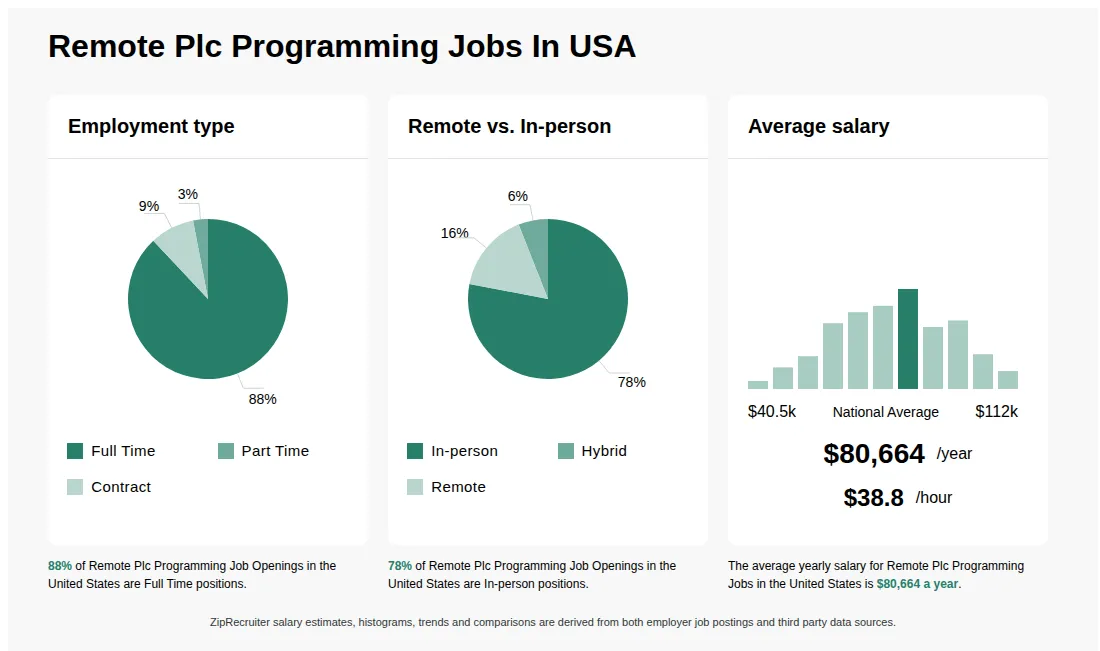
As of Jun 2, 2026, the average yearly pay for remote plc programming in the United States is $80,664.00, according to ZipRecruiter salary data. Most workers in this role earn between $68,000.00 and $92,500.00 per year, depending on experience, location, and employer.

What Are Remote PLC Programming Jobs?

PLC stands for programmable logic controller and is a specialized computer system that controls aspects of industrial manufacturing operations, such as automated processes. As a remote PLC programmer, you work from home to write code and create software for these purposes, as well as provide technical support for customers and companies that use this software. In addition to your programming responsibilities, you work on existing PLC systems to create more efficient processes and troubleshoot when the system has an issue. Other duties include documenting your work and training other employees on how to use the software in a manufacturing environment.

What are the key skills and qualifications needed to thrive as a Remote PLC Programmer, and why are they important?

To thrive as a Remote PLC Programmer, you need a solid background in electrical engineering or automation, strong PLC programming skills, and experience with control systems. Familiarity with PLC platforms like Siemens, Allen-Bradley, and associated SCADA or HMI software, along with relevant certifications, is typically required. Excellent problem-solving, independent work ethic, and effective remote communication are key soft skills that help manage projects and collaborate with teams from a distance. These skills ensure reliable automation solutions, minimize downtime, and support seamless integration in industrial environments.

What are some common challenges faced by remote PLC programmers and how can they be addressed?

Remote PLC programmers often encounter challenges such as limited access to onsite hardware, communication barriers with onsite teams, and troubleshooting issues without physical presence. To address these, it's important to use remote desktop tools, maintain clear and frequent communication with local technicians, and document all programming changes meticulously. Additionally, fostering strong collaboration with cross-functional teams can help ensure smooth project execution and rapid problem resolution.

What is remote PLC programming?

Remote PLC programming involves configuring, updating, and troubleshooting programmable logic controllers (PLCs) from a distance using network connections. This allows engineers and technicians to access industrial automation systems without being physically present on-site. Remote PLC programming increases efficiency, reduces travel time, and can help quickly resolve issues in manufacturing and industrial environments. It typically requires secure remote access tools and a strong understanding of both PLC hardware and software.

What is the difference between Remote Plc Programming vs Remote Automation Technician?

AspectRemote Plc ProgrammingRemote Automation Technician
CredentialsPLC certifications, technical degreesTechnical certifications, electrical or automation training
Work EnvironmentOffice, client sites, remote setupField, control rooms, remote troubleshooting
Industry UsageManufacturing, process control, automation firmsIndustrial facilities, manufacturing plants
Job FocusWriting and testing PLC code remotelyMaintaining, troubleshooting, and repairing automation systems remotely

Remote Plc Programming primarily involves developing and testing PLC code from a remote location, focusing on programming tasks. In contrast, Remote Automation Technicians handle troubleshooting and maintaining automation systems remotely, often involving on-site visits or remote diagnostics. Both roles require technical certifications and are common in manufacturing and industrial sectors, but their core responsibilities differ in scope and focus.

What cities are hiring for Remote Plc Programming jobs? Cities with the most Remote Plc Programming job openings:
What are the most commonly searched types of Plc Programming jobs? The most popular types of Plc Programming jobs are:
What states have the most Remote Plc Programming jobs? States with the most job openings for Remote Plc Programming jobs include:
Infographic showing various Remote Plc Programming job openings in the United States as of May 2026, with employment types broken down into 3% Locum Tenens, 56% Full Time, 38% Part Time, and 3% Temporary. Highlights an 88% Physical, 3% Hybrid, and 9% Remote job distribution, with an average salary of $80,664 per year, or $38.8 per hour.
BMS Controls Application Engineer

BMS Controls Application Engineer

Mantis Innovation

Chicago, IL • Remote

$86K - $111.30K/yr

Full-time

Posted 10 days ago


Job description

Position: Controls Application Engineer 
Start Date: Immediate 
 
As a Controls Application Engineer, you will be responsible for developing BMS/SCADA applications at both a supervisory and controller level. You will help refine engineering standards and provide remote support to project and field teams. You will also be involved in providing support across multiple engineering functions within the Controls Engineering group. You should be familiar with both DDC and PLC programming, BACnet & Modbus integrations, and have experience with building graphical front-end client interfaces.
Controls Application Engineering
  • This position will report to the Controls Engineering Manager.
  • Develop BMS applications across multiple platforms: e.g., Niagara, Ignition, Wonderware, Distech, PLC's.
  • Support the development and enforcement of engineering standards for programming, graphics, alarming, tagging, history management, and database creation. 
  • Provide remote technical support to Project Managers and Field Engineers during project execution. 
Qualifications
  • 10+ years of experience in the engineering field, preferably in Building Automation or Controls Engineering. 
  • 5+ years of BMS application development experience, with mission critical experience preferred. 
  • Strong knowledge of DDC control theory & HVAC applications and the ability to apply these principles to real-world scenarios. 
  • Basic networking knowledge; addressing & subnetting, IP + serial device configurations.
  • Comfortable working with industry standard protocol integrations such as: BACnet, Modbus, Ethernet/IP, SNMP, MQTT.
  • Basic networking knowledge, including manipulating PC settings to set up and commission devices on a network. 
  • Experience with servers, network equipment, and IoT practices, specifically for BMS applications. 
  • 2+ years of experience with Niagara platform (Niagara N4 certification is preferred).
  • Familiarity with Distech field controllers and GFX programming, Ignition SCADA, Wonderware, and PLC systems.
  • Proficiency in Microsoft Office Suite.
Competencies
  • Must be able to work independently and in a team, handling multiple tasks across different projects. 
  • Strong troubleshooting skills, with the ability to identify problems and develop effective solutions. 
  • Knowledge of the construction contracting industry, especially in MEP fields, with experience in mission-critical environments a plus. 
  • Understanding of Mechanical and Electrical equipment in typical Mission Critical environments.
This role will provide the opportunity to work in a dynamic and fast-paced environment, where you will gain valuable experience with cutting-edge technologies and play a pivotal role in the successful completion of projects 

We may use artificial intelligence (AI) tools to support parts of the hiring process, such as reviewing applications, analyzing resumes, or assessing responses. These tools assist our recruitment team but do not replace human judgment. Final hiring decisions are ultimately made by humans. If you would like more information about how your data is processed, please contact us.