2

Remote Plc Programming Jobs (NOW HIRING)

PLC Programmer (OT)

$69K - $94K/yr

Overview Amyx is seeking to hire a PLC Programmer for a remote position supporting a DLA Operational Technology (OT) contract. The PLC Programmer will assist a dynamic technical team to ensure the ...

Be Seen First

PLC Engineer - Conveyors - Traveling

Chicago, IL · Remote

$85K - $110K/yr

Experience programming or troubleshooting HMIs * Strong understanding of industrial electrical ... Remote I/O * Ability to read electrical schematics and troubleshoot systems using PLC logic and ...

Coordinate with PLC Engineers, project managers, contractors, vendors, commissioning agents ... remote access considerations. * Demonstrated ability to supervise technicians, coordinate with ...

Project Engineer

Novi, MI · On-site +1

... remote and or office within the Cleveland area. Requirements Equipment Design: Control Panels / Motor Control / Field Instrumentation (Schematics / Layout / Riser / BOM) PLC Programming: Rockwell ...

Senior PLC Engineer

$99K - $131K/yr

Where you'll work This is a remote role, with a preference for candidates based in Dallas, TX. ... Requirements * 5+ years programming industrial PLCs and SCADA/HMI systems in production ...

Senior Control Engineer

San Antonio, TX · Remote

$150K - $156K/yr

Remote (Texas-based) with occasional travel to San Antonio, TX Employment Type: Contract Position ... Review PLC programming, control philosophies, SCADA architecture, communications, and field ...

next page

Showing results 1-20

Remote Plc Programming information

See salary details

$40.5K

$80.7K

$112K

How much do remote plc programming jobs pay per year?

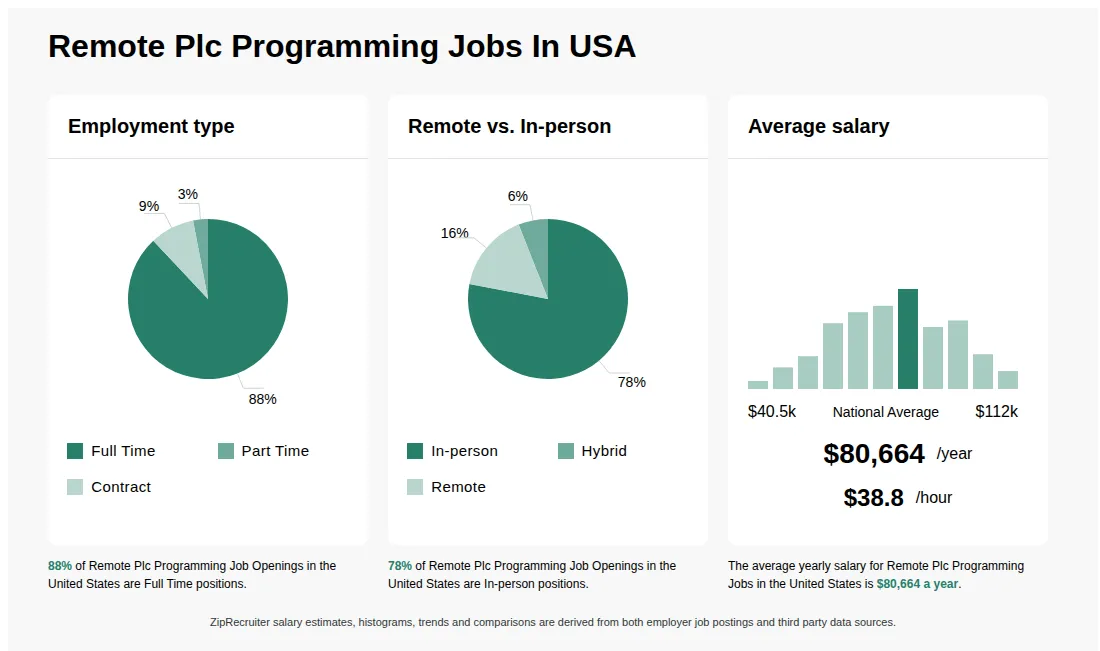
As of Sep 4, 2026, the average yearly pay for remote plc programming in the United States is $80,664.00, according to ZipRecruiter salary data. Most workers in this role earn between $68,000.00 and $92,500.00 per year, depending on experience, location, and employer.

What is remote PLC programming?

Remote PLC programming involves configuring, updating, and troubleshooting programmable logic controllers (PLCs) from a distance using network connections. This allows engineers and technicians to access industrial automation systems without being physically present on-site. Remote PLC programming increases efficiency, reduces travel time, and can help quickly resolve issues in manufacturing and industrial environments. It typically requires secure remote access tools and a strong understanding of both PLC hardware and software.

What are remote PLC programming jobs?

PLC stands for programmable logic controller and is a specialized computer system that controls aspects of industrial manufacturing operations, such as automated processes. As a remote PLC programmer, you work from home to write code and create software for these purposes, as well as provide technical support for customers and companies that use this software. In addition to your programming responsibilities, you work on existing PLC systems to create more efficient processes and troubleshoot when the system has an issue. Other duties include documenting your work and training other employees on how to use the software in a manufacturing environment.

What are the key skills and qualifications needed to thrive as a remote PLC programmer, and why are they important?

To thrive as a Remote PLC Programmer, you need a solid background in electrical engineering or automation, strong PLC programming skills, and experience with control systems. Familiarity with PLC platforms like Siemens, Allen-Bradley, and associated SCADA or HMI software, along with relevant certifications, is typically required. Excellent problem-solving, independent work ethic, and effective remote communication are key soft skills that help manage projects and collaborate with teams from a distance. These skills ensure reliable automation solutions, minimize downtime, and support seamless integration in industrial environments.

What are some common challenges faced by remote PLC programmers and how can they be addressed?

Remote PLC programmers often encounter challenges such as limited access to onsite hardware, communication barriers with onsite teams, and troubleshooting issues without physical presence. To address these, it's important to use remote desktop tools, maintain clear and frequent communication with local technicians, and document all programming changes meticulously. Additionally, fostering strong collaboration with cross-functional teams can help ensure smooth project execution and rapid problem resolution.

What is the difference between Remote Plc Programming vs Remote Automation Technician?

AspectRemote Plc ProgrammingRemote Automation Technician
CredentialsPLC certifications, technical degreesTechnical certifications, electrical or automation training
Work EnvironmentOffice, client sites, remote setupField, control rooms, remote troubleshooting
Industry UsageManufacturing, process control, automation firmsIndustrial facilities, manufacturing plants
Job FocusWriting and testing PLC code remotelyMaintaining, troubleshooting, and repairing automation systems remotely

Remote Plc Programming primarily involves developing and testing PLC code from a remote location, focusing on programming tasks. In contrast, Remote Automation Technicians handle troubleshooting and maintaining automation systems remotely, often involving on-site visits or remote diagnostics. Both roles require technical certifications and are common in manufacturing and industrial sectors, but their core responsibilities differ in scope and focus.

Are remote plc programmers in demand?

Remote PLC programmers are in demand due to the increasing adoption of automation and Industry 4.0 technologies. Skills in ladder logic, programming languages like Structured Text, and familiarity with PLC hardware are highly valued, and many companies seek professionals who can work remotely to support their automation projects.

Can you work as a remote PLC programmer?

Remote PLC programming is possible and increasingly common, especially for experienced professionals with strong knowledge of PLC software, industrial automation, and communication protocols. Many companies offer remote positions that require skills in ladder logic, programming tools like RSLogix or TIA Portal, and reliable internet connectivity. However, some roles may require on-site presence for installation, troubleshooting, or commissioning tasks.

What cities are hiring for Remote Plc Programming jobs?

Cities with the most Remote Plc Programming job openings:

What are the most commonly searched types of Plc Programming jobs?

The most popular types of Plc Programming jobs are:

What states have the most Remote Plc Programming jobs?

States with the most job openings for Remote Plc Programming jobs include:

What job categories do people searching Remote Plc Programming jobs look for?

The top searched job categories for Remote Plc Programming jobs are:

Infographic showing various Remote Plc Programming job openings in the United States as of August 2026, with employment types broken down into 1% Internship, 83% Full Time, 12% Part Time, 3% Contract, and 1% Nights. Highlights an 88% Physical, 3% Hybrid, and 9% Remote job distribution, with an average salary of $80,664 per year, or $38.8 per hour.

PLC Programmer/SCADA Subject Matter Expert

Delan Associates, Inc.

Remote

$69K - $94K/yr

Contractor

Re-posted 19 days ago


Job description

Location:
Remote with frequent trips.
Position:
Client is seeking an experienced PLC Programmer SCADA Subject Matter Expert (SME) to support our rapidly expanding Battery Energy Storage System (BESS) and renewable energy portfolio. This role will provide expert-level PLC programming and SCADA integration support for utility-scale projects, ensuring seamless commissioning and operational excellence.
Key Responsibilities:
PLC Programming & Development
  • Expert-level PLC programming for BESS and solar projects using Schneider M340/M580 platforms
  • Develop, modify, and optimize control logic for utility-scale energy storage systems
  • Create and maintain standardized PLC code libraries and templates
  • Implement advanced control algorithms for hybrid PV-BESS operations

SCADA Integration & Communications
  • Configure and troubleshoot Modbus communications between PLCs, inverters, and SCADA systems
  • Integrate PLCs with Ignition HMI platforms and historian systems
  • Establish robust communication protocols for real-time monitoring and control
  • Support OPC server configuration and data exchange protocols

Testing & Commissioning Support
  • Lead Factory Acceptance Testing (FAT) and Site Acceptance Testing (SAT) procedures
  • Perform comprehensive PLC code validation and system integration testing
  • Support commissioning teams with on-site troubleshooting and system optimization
  • Execute Power Purchase Agreement (PPA) and Large Generator Interconnection Agreement (LGIA) testing requirements

Technical Leadership & Collaboration
  • Serve as technical SME for PLC programming standards and best practices
  • Coordinate with SCADA leads, project managers, and vendor teams
  • Provide technical guidance for control system architecture decisions

Documentation & Standards
  • Develop and maintain PLC programming documentation and procedures
  • Create detailed Functional Requirements Documents (FRDs) for control systems
  • Establish coding standards and version control protocols

Support regulatory compliance documentation (NERC CIP, cybersecurity
Preferred Qualifications
  • Bachelor's degree in electrical engineering, Computer Engineering, or related field
  • 5+ years of experience in PLC programming, preferably Schneider Electric platforms
  • Expert knowledge of Modbus, DNP3, and industrial communication protocols
  • Experience with Ignition SCADA platform and HMI development
  • Strong understanding of power systems and utility-scale energy project
  • Proven experience in utility-scale renewable energy or power generation projects
  • Knowledge of BESS control systems, inverters, and energy storage technologies
  • Familiarity with grid interconnection requirements and utility standards
  • Experience with FAT/SAT testing procedures and commissioning protocols
  • Full accountability for PPA, LGIA, and OEM testing completion
  • Ability to travel up to 25% for project commissioning support
  • Strong analytical and troubleshooting skills
  • Excellent communication and documentation abilities
  • NERC CIP cybersecurity awareness preferred

Physical Requirements / Working Environment
  • Ability to lift up to 20 pounds frequently on a daily basis.
  • Standing on feet for extended periods of time.
  • Ability to work at desk position in front of a computer monitor for extensive periods of time.
  • Ability to operate a motor vehicle for purposes of commuting between 2 working locations.
  • Ability to travel as required.