2

Remote Historical Research Jobs (NOW HIRING)

Research Biologist

San Francisco, CA · Remote

$80 - $150/hr

Remote Role Responsibilities * Evaluate the technical quality and scientific reasoning across ... Meaningful publication history in peer-reviewed research. * 2+ years of industry experience in ...

Four years of experience in agricultural remote sensing and UAV flight operations. Or, a master ... Applicants are subject to a criminal history investigation, and employment is contingent upon the ...

$19 - $26/hr

Approval of remote and hybrid work is not guaranteed regardless of work location.For additional ... PA State Police Criminal Background Check, PA Child Abuse History Clearance Form, and Federal (FBI ...

Approval of remote and hybrid work is not guaranteed regardless of work location.For additional ... We also acknowledge the longer history of these lands and our place in that history. BACKGROUND ...

Historical Landscape Architect

Washington, DC · On-site +1

$62K - $92K/yr

Research, creative synthesis of archival documentation, historic mapping, and analysis to inform ... Travel to a range of project and office locations, including remote locations, isrequired,travel ...

$19K - $23K/mo

Partial Remote, Bethlehem Categories: Administrative Services Research Translation Coordinator ... Clearance and credit history based upon the requirements of the position. Only complete ...

next page

Showing results 1-20

Remote Historical Research information

See salary details

$20K

$74.7K

$152K

How much do remote historical research jobs pay per year?

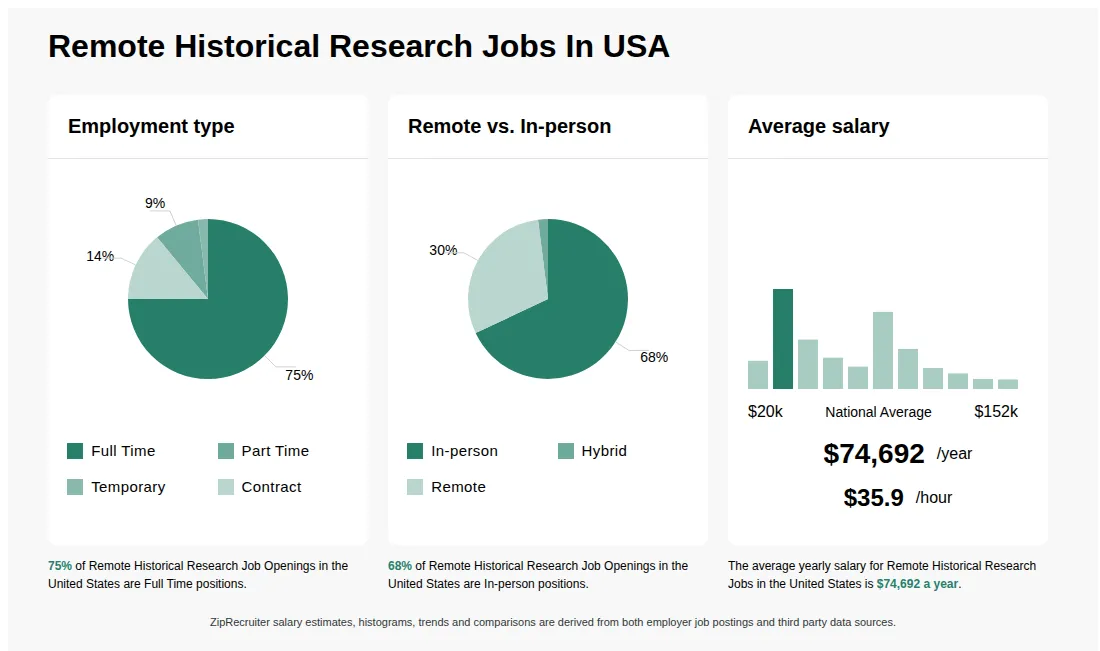
As of Jun 7, 2026, the average yearly pay for remote historical research in the United States is $74,692.00, according to ZipRecruiter salary data. Most workers in this role earn between $41,500.00 and $93,000.00 per year, depending on experience, location, and employer.

What are the key skills and qualifications needed to thrive as a Remote Historical Researcher, and why are they important?

To thrive as a Remote Historical Researcher, you need strong analytical skills, attention to detail, and a background in history or related fields, often supported by a relevant degree. Familiarity with digital archives, online databases, citation management software, and sometimes GIS tools is important for gathering and organizing historical data. Excellent written communication, critical thinking, and self-motivation are crucial soft skills for producing high-quality research and collaborating remotely. These skills are essential for ensuring accurate, credible research outputs and effective teamwork in a virtual environment.

What are some common challenges remote historical researchers face, and how can they overcome them?

Remote historical researchers often encounter challenges such as limited access to primary source materials, navigating copyright restrictions, and verifying the authenticity of online archives. To overcome these obstacles, researchers can utilize digital libraries, collaborate with academic institutions for special access, and participate in online historical forums to verify findings. Building strong digital communication skills and establishing relationships with librarians or archivists can also help in accessing hard-to-find resources and ensuring the credibility of their work.

What is the difference between Remote Historical Research vs Remote Archival Assistant?

AspectRemote Historical ResearchRemote Archival Assistant
Required CredentialsHistory degree or related certificationArchival or library science background often preferred
Work EnvironmentResearch-focused, analyzing historical data and sourcesOrganizing, cataloging, and maintaining archives
Employer & Industry UsageUniversities, research institutions, history firmsLibraries, archives, museums
Search & Comparison IntentUnderstanding research roles in historyClarifying archival support roles

Remote Historical Research involves analyzing historical data, interpreting sources, and producing research reports, often requiring a background in history. Remote Archival Assistants focus on organizing, cataloging, and maintaining archival collections, typically with a background in library or archival sciences. Both roles support historical work but differ in daily tasks and required expertise.

What is remote historical research?

Remote historical research involves investigating and analyzing historical events, figures, or periods using digital resources and tools, rather than working on-site in archives or libraries. Researchers access digitized documents, databases, and other online materials to gather information, interpret findings, and produce reports or publications. This allows historians and researchers to work from anywhere while still contributing valuable insights into the past. Remote historical research requires strong analytical skills, attention to detail, and proficiency with digital research tools.

What Are Remote Historical Research Jobs?

Remote historical research jobs involve working to study and collect data on a certain topic, era, or event in history. In these work from home jobs, your responsibilities include using the internet as well as online library resources, such as an archive, to collect information about your assigned historical topic. As a virtual historical researcher, you typically write a report on your findings for an academic institution, historical society, museum, journal, or private client. You may need to get creative to find the information you need. For example, you may need to contact a historian or interview an expert to gain additional insight.

What cities are hiring for Remote Historical Research jobs? Cities with the most Remote Historical Research job openings:
What are the most commonly searched types of Historical Research jobs? The most popular types of Historical Research jobs are:
What states have the most Remote Historical Research jobs? States with the most job openings for Remote Historical Research jobs include:
Infographic showing various Remote Historical Research job openings in the United States as of May 2026, with employment types broken down into 2% Locum Tenens, 2% As Needed, 52% Full Time, 11% Part Time, 2% Temporary, and 31% Contract. Highlights an 88% Physical, 3% Hybrid, and 9% Remote job distribution, with an average salary of $74,692 per year, or $35.9 per hour.

Genealogist (on-site work schedule)

Daughters of the American Revolution (DAR)

Washington, DC • On-site, Remote

$53K - $60K/yr

Full-time

Medical, Dental, Vision, Life, Retirement, PTO

Posted 6 days ago


Job description

The Daughters of the American Revolution (DAR) has several full-time Genealogist positions available. This position would be ideal for someone with a strong interest in American history and who has an eye for details.

A key step for an individual becoming a member of the DAR is to prove their lineal descent from a patriot of the American Revolution. Our Genealogists are responsible for examining and evaluating applications and supporting genealogical documentation submitted for consideration by prospective members.

This position requires experience with historical research and the ability to interpret such varied materials as vital, church, international, military, and estate records.

A successful Genealogist will be able to make the connections between generations using their knowledge of American history, both on a national and local level. Candidates with interest, education, and training in history or genealogy, or work experience as a historian, researcher, or generalist are highly desirable.

Essential Functions:

  • Evaluates and verifies new member applications for entry into the Daughters of the American Revolution.
  • Performs and conducts research as part of the application evaluation process using multiple resources such as the DAR Library, internet resources, and/or the Genealogical Research System (GRS) as necessary.
  • Prepares correspondence for prospective members and state and chapter officers requesting additional documentation as needed.
  • Demonstrates a high level of quality customer service to members, applicants, and the public related to the application process, and answers general questions to assist in completing the application process.

Reports to: Director, Genealogy

Work Schedule: This position can be considered for limited hybrid remote work-after onboarding and training. Flexible work hours and compressed work week options are also available.

Required Qualifications:

  • Demonstrates a genuine passion and interest in genealogy work.
  • Experience in conducting genealogical research, particularly in 18th & 19th century original records, including a familiarity and use of federal, state, and county repositories and online sources.
  • Demonstrated ability to research, analyze, and evaluate documentary evidence.
  • Highly detail oriented and shows ability to resolve issues from conflicting data quickly.
  • Experience writing professional correspondence is highly desired, as this position will need to explain difficult research problems to applicants.
  • Strong proficiency in using databases and Microsoft Office suite products.
  • Must be able to focus on a computer screen for long periods and read microfilm and microfiche. Use of a keyboard requires manual dexterity.

Perks and Pay:

  • Hiring salary range is between $53,000 and $60,000 with the final determination based upon the candidate's overall experience.
  • We offer both paid vacation and paid sick leave, up to 12 days each for the 1st year of employment and observe 14 holidays.
  • Medical/Rx, dental, and vision benefits.
  • Employer-paid life insurance/AD&D and Long-term disability insurance.
  • Flexible spending accounts (health and dependent care)
  • HSA with employer contribution if enrolled in the HDHP option.
  • 403(b) retirement plan with a full-vested employer match.
  • Free tickets to Constitution Hall events.

Submission Requirements:

To be considered further, candidates must include, along with a cover letter and resume, the following:

  • A sample analysis of genealogy or family research performed, consisting of at least 3 generations, submitted in narrative form.
  • The narrative must include appropriate source citations based on own research in original records as well as research findings and supporting documentation.
  • Printouts from genealogical software; online family trees, lineage society applications will not be considered appropriate sample analysis.

As an Equal Opportunity Employer, we are committed to building and retaining a team that represents a variety of skills, experiences, and perspectives. All employment decisions are based on business needs, job requirements, performance, and qualifications without regard to race, religion or belief, national or ethnic origin, gender/sex (including pregnancy), age, physical, mental, or sensory disability, sexual orientation, gender identity and/or expression, marital or domestic partnership status, veteran and military status, family or parental status, or any other status protected under federal, state, or local law. The DAR will not tolerate discrimination or harassment based on any of these characteristics.