Quantitative Risk Analyst
$64K - $105K/yr
Key Responsibilities: * Assist the Quantitative Risk Manager in constructing a Credit Decision Scorecards and statistically based credit risk modeling strategies based on quantitative modeling ...
$64K - $105K/yr
Key Responsibilities: * Assist the Quantitative Risk Manager in constructing a Credit Decision Scorecards and statistically based credit risk modeling strategies based on quantitative modeling ...
$64K - $105K/yr
Key Responsibilities: * Assist the Quantitative Risk Manager in constructing a Credit Decision Scorecards and statistically based credit risk modeling strategies based on quantitative modeling ...
Embedded within the Commercial Operations and Risk Management functions, this individual will deliver quantitative insights that inform fuel strategy, dispatch optimization, margin and basis exposure ...
Embedded within the Commercial Operations and Risk Management functions, this individual will deliver quantitative insights that inform fuel strategy, dispatch optimization, margin and basis exposure ...
Boston, MA · On-site
$90K - $157K/yr
The Quantitative Risk Analyst will conduct model validation to ensure model risks are correctly identified, assessed, and managed across the global asset management business. Diverse product ...
Boston, MA · On-site
$90K - $157K/yr
The Quantitative Risk Analyst will conduct model validation to ensure model risks are correctly identified, assessed, and managed across the global asset management business. Diverse product ...
Boston, MA · On-site
$90K - $157K/yr
The Quantitative Risk Analyst will conduct model validation to ensure model risks are correctly identified, assessed, and managed across the global asset management business. Diverse product ...
Boston, MA · On-site
$90K - $157K/yr
The Quantitative Risk Analyst will conduct model validation to ensure model risks are correctly identified, assessed, and managed across the global asset management business. Diverse product ...
As a Quantitative Risk Management Intern within Enterprise Risk Management (ERM), you will apply advanced analytical, technical, and quantitative skills to support risk management activities at one ...
As a Quantitative Risk Management Intern within Enterprise Risk Management (ERM), you will apply advanced analytical, technical, and quantitative skills to support risk management activities at one ...
As a Quantitative Risk Management Intern within Enterprise Risk Management (ERM), you will apply advanced analytical, technical, and quantitative skills to support risk management activities at one ...
As a Quantitative Risk Management Intern within Enterprise Risk Management (ERM), you will apply advanced analytical, technical, and quantitative skills to support risk management activities at one ...
Chicago, IL · On-site
$85K - $175K/yr
We are seeking a high-quality Quantitative Risk Developer / Analyst to join our proprietary trading ... management (SQL/NoSQL). * Market Knowledge: Practical understanding of futures markets, exchange ...
Chicago, IL · On-site
$85K - $175K/yr
We are seeking a high-quality Quantitative Risk Developer / Analyst to join our proprietary trading ... management (SQL/NoSQL). * Market Knowledge: Practical understanding of futures markets, exchange ...
As a Quantitative Risk Management Intern within Enterprise Risk Management (ERM), you will apply advanced analytical, technical, and quantitative skills to support risk management activities at one ...
As a Quantitative Risk Management Intern within Enterprise Risk Management (ERM), you will apply advanced analytical, technical, and quantitative skills to support risk management activities at one ...
Mclean, VA · On-site
$60 - $80/hr
As a Quantitative Risk Management Intern within Enterprise Risk Management (ERM), you will apply advanced analytical, technical, and quantitative skills to support risk management activities at one ...
Mclean, VA · On-site
$60 - $80/hr
As a Quantitative Risk Management Intern within Enterprise Risk Management (ERM), you will apply advanced analytical, technical, and quantitative skills to support risk management activities at one ...
As a Quantitative Risk Management Intern within Enterprise Risk Management (ERM), you will apply advanced analytical, technical, and quantitative skills to support risk management activities at one ...
As a Quantitative Risk Management Intern within Enterprise Risk Management (ERM), you will apply advanced analytical, technical, and quantitative skills to support risk management activities at one ...
As a Quantitative Risk Management Intern within Enterprise Risk Management (ERM), you will apply advanced analytical, technical, and quantitative skills to support risk management activities at one ...
As a Quantitative Risk Management Intern within Enterprise Risk Management (ERM), you will apply advanced analytical, technical, and quantitative skills to support risk management activities at one ...
You will manage client data workflows, maintain and troubleshoot Python-based automations, and ... How We Work As a Quantitative Risk Analyst you will be expected to work in a hybrid environment.
You will manage client data workflows, maintain and troubleshoot Python-based automations, and ... How We Work As a Quantitative Risk Analyst you will be expected to work in a hybrid environment.
You will manage client data workflows, maintain and troubleshoot Python-based automations, and ... How We Work As a Quantitative Risk Analyst you will be expected to work in a hybrid environment.
You will manage client data workflows, maintain and troubleshoot Python-based automations, and ... How We Work As a Quantitative Risk Analyst you will be expected to work in a hybrid environment.
$90K - $157K/yr
BACKGROUND The Centralized Modeling & Analytics and Operations(CMAO) team within State Street's Enterprise Risk Management (ERM) organization is looking for an experienced quantitative analyst to ...
$90K - $157K/yr
BACKGROUND The Centralized Modeling & Analytics and Operations(CMAO) team within State Street's Enterprise Risk Management (ERM) organization is looking for an experienced quantitative analyst to ...
If so, being a Quantitative Risk Modeling Analyst II with Frost could be for you. At Frost, it ... Participate in collaboration efforts with Risk Management Teams to identify ways to use data ...
If so, being a Quantitative Risk Modeling Analyst II with Frost could be for you. At Frost, it ... Participate in collaboration efforts with Risk Management Teams to identify ways to use data ...
Jersey City, NJ · On-site
$75 - $90/hr
Focused on VaR/Greeks/derivatives risk calculation work rather than stakeholder management. * Work on portfolio VaR and Greeks calculations for derivatives positions * Support quant-adjacent risk ...
Jersey City, NJ · On-site
$75 - $90/hr
Focused on VaR/Greeks/derivatives risk calculation work rather than stakeholder management. * Work on portfolio VaR and Greeks calculations for derivatives positions * Support quant-adjacent risk ...
If so, being a Quantitative Risk Modeling Analyst II with Frost could be for you. At Frost, it ... Participate in collaboration efforts with Risk Management Teams to identify ways to use data ...
If so, being a Quantitative Risk Modeling Analyst II with Frost could be for you. At Frost, it ... Participate in collaboration efforts with Risk Management Teams to identify ways to use data ...
New York, NY · On-site
$100K - $150K/yr
Quantitative risk management background with direct ownership of model development, not just consumption of outputs from a research team. * Strong financial modeling skills in Python. You write clean ...
New York, NY · On-site
$100K - $150K/yr
Quantitative risk management background with direct ownership of model development, not just consumption of outputs from a research team. * Strong financial modeling skills in Python. You write clean ...
$200 - $250/hr
Quantitative risk management background with direct ownership of model development, not just consumption of outputs from a research team. * Strong financial modeling skills in Python. You write clean ...
$200 - $250/hr
Quantitative risk management background with direct ownership of model development, not just consumption of outputs from a research team. * Strong financial modeling skills in Python. You write clean ...
Position Summary As a Quantitative Risk Modeling Led in the Ryan Credit Solutions department at ... We partner with banks, asset managers, and insurers to create bespoke solutions that address ...
Position Summary As a Quantitative Risk Modeling Led in the Ryan Credit Solutions department at ... We partner with banks, asset managers, and insurers to create bespoke solutions that address ...
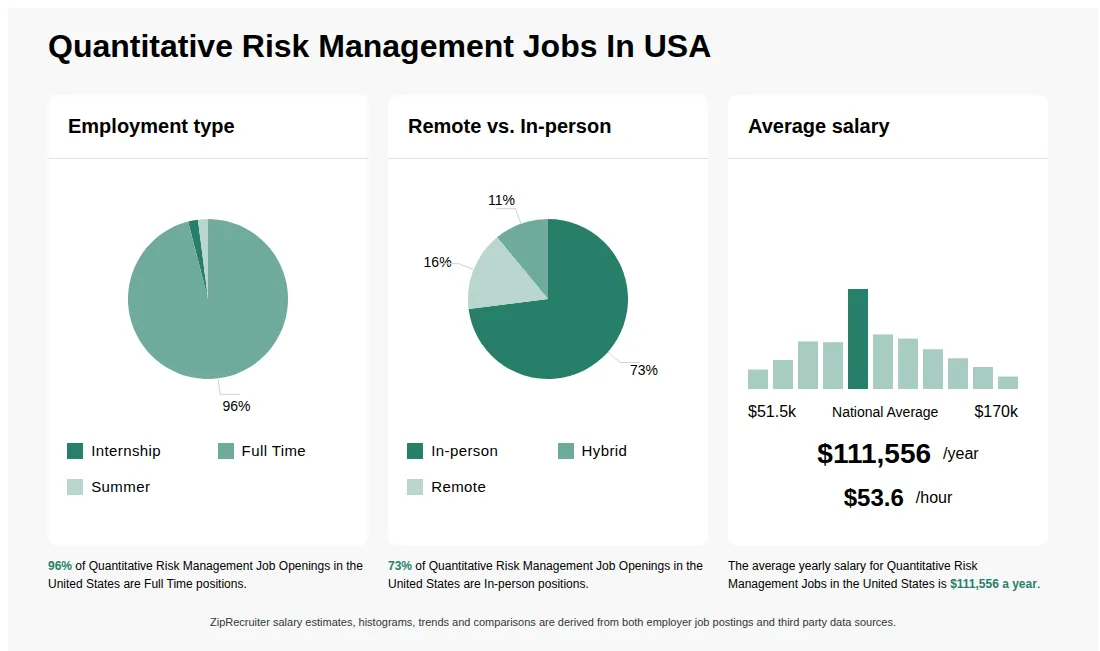
$51.5K - $62.3K
4% of jobs
$62.3K - $73K
6% of jobs
$73K - $83.8K
11% of jobs
$87.9K is the 25th percentile. Wages below this are outliers.
$83.8K - $94.6K
11% of jobs
The median wage is $103.2K / yr.
$94.6K - $105.4K
23% of jobs
$105.4K - $116.1K
13% of jobs
$123.2K is the 75th percentile. Wages above this are outliers.
$116.1K - $126.9K
12% of jobs
$126.9K - $137.7K
8% of jobs
$137.7K - $148.5K
6% of jobs
$148.5K - $159.2K
4% of jobs
$159.2K - $170K
2% of jobs
$51.5K
$111.6K
$170K
| Aspect | Quantitative Risk Management | Quantitative Analyst |
|---|---|---|
| Primary Focus | Assessing and managing financial risks | Developing models for investment strategies |
| Certifications | FRM, PRM | CFA, CQF |
| Work Environment | Financial institutions, risk departments | Investment banks, asset management firms |
| Key Skills | Risk modeling, regulatory knowledge | Statistical analysis, programming |
Quantitative Risk Management focuses on identifying and mitigating financial risks within organizations, often requiring risk-specific certifications like FRM. In contrast, Quantitative Analysts develop models to support trading and investment decisions, emphasizing statistical and programming skills. Both roles are vital in finance but serve different strategic purposes.
Cities with the most Quantitative Risk Management job openings:
States with the most job openings for Quantitative Risk Management jobs include:
Popular job titles for Quantitative Risk Management:

$64K - $105K/yr
Full-time
Medical, Dental, Vision, Life, Retirement, PTO
Re-posted 2 days ago
7.2
Based on 7 frontline employees who took The Breakroom Quiz
118th of 176 rated banks
Job Description
NewLane Finance is seeking an individual to assist the credit and risk modeling and analytics function using data to advance credit risk behavior and quantification of these risk and return tradeoffs through the deployment of models and algorithms to optimize such strategies. This role will be responsible for providing analytical/quantitative input to help develop, implement, and monitor the build of complex commercial small business Expected Default (ED) and Probability of Default (PD) credit default models.
The successful candidate will use their business analysis, process, and quantitative knowledge to ensure business intent is matched with modeling outcome, and document development decisions under SR117 guidelines. In addition to responsibilities on individual modeling projects this role will be expected to work on adhoc projects as needed. Communicating model mechanics and articulating nuances to leadership will be an important aspect of the role. This is a great opportunity for someone who is a modeler/statistician/data analyst/coder (or a combination) with experience in commercial small business credit analysis.
Key Responsibilities:
Experience:
Desired Characteristics:
Salary Range:
$64,491.00 - $105,949.50Individual base pay may vary on additional factors such as the candidate's experience, job-related skills, relevant education, geographic location, and other specific business and organizational needs.
In addition to base salary, WSFS Financial Corporation (WSFS) and its subsidiaries may offer eligible Associates discretionary and formula-based incentive and retention awards. WSFS provides a competitive benefits package, which includes medical, dental, and vision coverage; a 401(k) plan; life, accident, and disability insurance; flexible spending accounts (FSAs) and health savings accounts (HSAs); and wellness programs. Additional benefits may include paid parental leave, military leave, vacation and other paid time off, sick leave in accordance with applicable state laws, and paid holidays. Benefit offerings are subject to eligibility requirements, legal limitations, and may vary based on an Associate's location and employment status. For more information about Associate benefits, please visit https://www.wsfsbank.com/about/careers/
WSFS Bank is inclusive and supportive of individual needs. If you have a physical or other impairment that might require an accommodation, including technical assistance with the WSFS Bank Careers website or submission process, please contact us via email at careers@wsfsbank.com.
WSFS is an equal opportunity employer. We do not discriminate based upon race, religion, color, national origin, gender (including pregnancy, childbirth, or related medical conditions), sexual orientation, gender identity, gender expression, age, status as a protected veteran, status as an individual with a disability, or other applicable legally protected characteristics.
Get the full story on Breakroom

Sourced by ZipRecruiter
Commercial banking
1,001 - 5,000 Employees
Wilmington, DE, US
1832