1

Quantitative Risk Management Jobs (NOW HIRING)

Experience with quantitative and qualitative risk management techniques * Familiarity with systems ... engineering or program control environments in government or aerospace sectors * Knowledge of risk ...

Quantitative Risk Analyst Contract Type: Permanent Time Type: Full time Quantitative Risk Analyst ... the Head of Risk and Senior Management. Aggregate data from various sources and maintain ...

... Risk and Senior Management. โ€ข Aggregate data from various sources and maintain disciplined data science practices. Profile โ€ข At least 3-10 years' experience in quantitative role in a trading ...

Key Responsibilities: * Assist the Quantitative Risk Manager in constructing a Credit Decision Scorecards and statistically based credit risk modeling strategies based on quantitative modeling ...

Quantitative Risk Analyst

Philadelphia, PA ยท On-site

$64.49K - $105.95K/yr

Key Responsibilities: * Assist the Quantitative Risk Manager in constructing a Credit Decision Scorecards and statistically based credit risk modeling strategies based on quantitative modeling ...

Key Responsibilities: * Assist the Quantitative Risk Manager in constructing a Credit Decision Scorecards and statistically based credit risk modeling strategies based on quantitative modeling ...

Responsibilities include pricing and risk analytics, representation of instruments in production ... Experience in a bank, asset manager, hedge fund, insurer or pension fund - quantitative skills ...

next page

Showing results 1-20

Quantitative Risk Management information

See salary details

$51.5K

$111.6K

$170K

How much do quantitative risk management jobs pay per year?

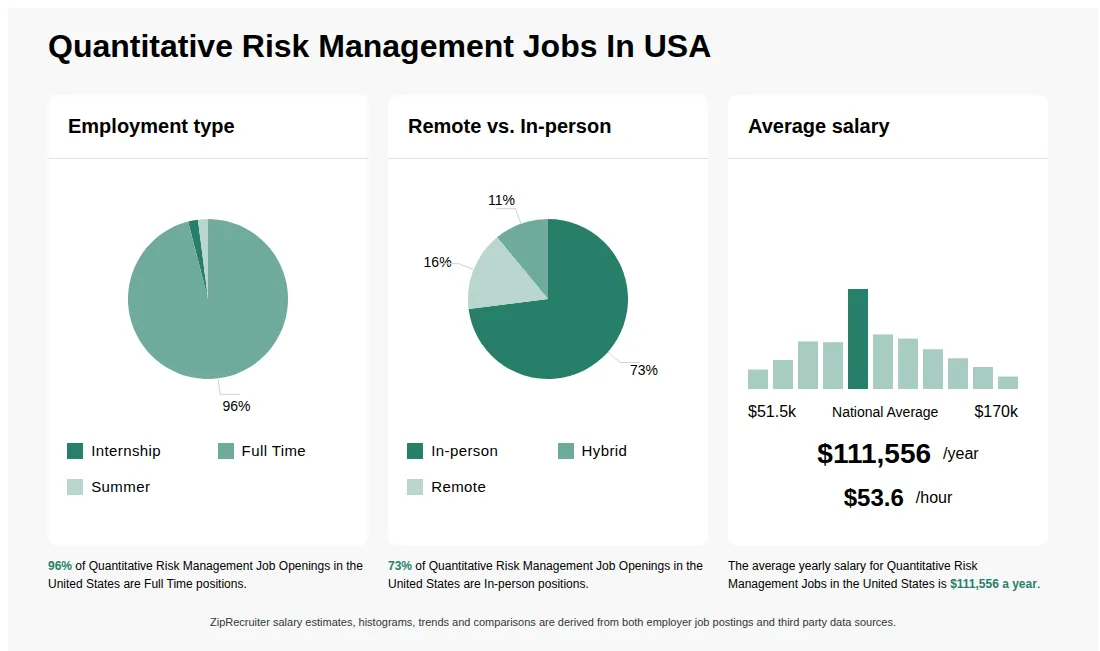
As of May 30, 2026, the average yearly pay for quantitative risk management in the United States is $111,556.00, according to ZipRecruiter salary data. Most workers in this role earn between $90,000.00 and $129,000.00 per year, depending on experience, location, and employer.

What are the key skills and qualifications needed to thrive as a Quantitative Risk Manager, and why are they important?

To thrive as a Quantitative Risk Manager, you need strong analytical skills, expertise in statistics or mathematics, and typically a degree in finance, economics, or a quantitative discipline. Familiarity with risk modeling software, programming languages like Python or R, and industry certifications such as FRM or CFA is often required. Outstanding problem-solving abilities, attention to detail, and effective communication set top professionals apart in this role. These skills are crucial for accurately assessing financial risks, making informed decisions, and communicating complex findings to stakeholders.

How does a Quantitative Risk Management professional typically collaborate with other departments within a financial institution?

Quantitative Risk Management professionals frequently work closely with departments such as trading, finance, and compliance. They provide analytical support by developing risk models and stress-testing scenarios, ensuring that trading strategies and investment decisions align with the institution's risk appetite. Regular communication with IT teams is also common, as these professionals often need to implement or improve risk measurement tools and data systems. This cross-functional collaboration is essential for maintaining a robust risk management framework and responding effectively to emerging risks.

What is quantitative risk management?

Quantitative risk management is the process of using mathematical models, statistical techniques, and data analysis to identify, measure, and manage financial risks within an organization. Professionals in this field apply quantitative methods to assess potential losses from market movements, credit events, or operational failures, and help organizations make informed decisions to mitigate these risks. This approach is widely used in banking, insurance, asset management, and other financial sectors to ensure regulatory compliance and optimize risk-adjusted returns.

What is the difference between Quantitative Risk Management vs Quantitative Analyst?

AspectQuantitative Risk ManagementQuantitative Analyst
Primary FocusAssessing and managing financial risksDeveloping models for investment strategies
CertificationsFRM, PRMCFA, CQF
Work EnvironmentFinancial institutions, risk departmentsInvestment banks, asset management firms
Key SkillsRisk modeling, regulatory knowledgeStatistical analysis, programming

Quantitative Risk Management focuses on identifying and mitigating financial risks within organizations, often requiring risk-specific certifications like FRM. In contrast, Quantitative Analysts develop models to support trading and investment decisions, emphasizing statistical and programming skills. Both roles are vital in finance but serve different strategic purposes.

More about Quantitative Risk Management jobs
What cities are hiring for Quantitative Risk Management jobs? Cities with the most Quantitative Risk Management job openings:
What states have the most Quantitative Risk Management jobs? States with the most job openings for Quantitative Risk Management jobs include:
What job categories do people searching Quantitative Risk Management jobs look for? The top searched job categories for Quantitative Risk Management jobs are:
Infographic showing various Quantitative Risk Management job openings in the United States as of May 2026, with employment types broken down into 3% As Needed, 75% Full Time, 8% Part Time, 1% Temporary, and 13% Contract. Highlights an 13% Physical, 6% Hybrid, and 81% Remote job distribution, with an average salary of $111,556 per year, or $53.6 per hour.
Risk Management Analyst

Risk Management Analyst

Tecolote Research

Huntsville, AL โ€ข On-site

Full-time

Posted 13 days ago


Job description

Overview
Tecolote Research, Inc. is seeking a skilled and proactive Risk Management Analyst to support systems engineering and risk management activities for high-visibility defense and space programs. Working under minimal supervision, this role involves the development and evaluation of both routine and complex risk management processes and documentation. The analyst will support risk assessments, participate in program decision-making forums, and contribute to quantitative risk analysis efforts.
Responsibilities
  • Provide direct support in identifying, assessing, and managing program and project risks
  • Develop and maintain risk registers, mitigation plans, and supporting documentation
  • Participate in and support trade studies and decision tree development
  • Support program/product review meetings with analysis and risk recommendations
  • Assist in the development and application of Quantitative Risk Analysis (QRA) techniques
  • Collaborate across functional teams to ensure effective risk integration into broader program management

Skills Required
  • Bachelor's degree (BS/BA) in Business Management, Economics, Math, Engineering, or Economics
  • 3-6 years of applicable experience, or 3-4 years of Government or aerospace industry experience
  • Strong analytical and problem-solving skills
  • Proficiency in Microsoft Office applications
  • Ability to communicate clearly and effectively, both written and verbally
  • Must be a U.S. Citizen and able to obtain a government security clearance

Preferred Qualifications:
  • Experience with quantitative and qualitative risk management techniques
  • Familiarity with systems engineering or program control environments in government or aerospace sectors
  • Knowledge of risk tools or software (e.g., @RISK, Primavera Risk Analysis)

Education
Bachelor's degree required, preferably in math, engineering, business, or the sciences.