The Quantitative Risk Team in the Risk Management Department is responsible for developing, analyzing, and back-testing models for clearing initiatives. Daily responsibilities include code release ...
The Quantitative Risk Team in the Risk Management Department is responsible for developing, analyzing, and back-testing models for clearing initiatives. Daily responsibilities include code release ...

The Quantitative Risk Team in the Risk Management Department is responsible for developing, analyzing, and back-testing models for clearing initiatives. Daily responsibilities include code release ...
The Quantitative Risk Team in the Risk Management Department is responsible for developing, analyzing, and back-testing models for clearing initiatives. Daily responsibilities include code release ...
$200 - $250/hr
... appetite management, governance, and regulatory oversight * Develop, maintain, and enhance ... Perform independent quantitative assessment and challenge business assumptions, risk methodologies ...
$200 - $250/hr
... appetite management, governance, and regulatory oversight * Develop, maintain, and enhance ... Perform independent quantitative assessment and challenge business assumptions, risk methodologies ...

The Opportunity The Director, Quantitative Risk Management - Stress Testing leads the design, execution, and enhancement of capital stress testing programs that support effective risk management and ...
The Opportunity The Director, Quantitative Risk Management - Stress Testing leads the design, execution, and enhancement of capital stress testing programs that support effective risk management and ...
Quantitative Risk Principal - Critical Risk Reporting
Charlotte, NC · On-site
$200 - $250/hr
... appetite management, governance, and regulatory oversight * Develop, maintain, and enhance ... Perform independent quantitative assessment and challenge business assumptions, risk methodologies ...
Quantitative Risk Principal - Critical Risk Reporting
Charlotte, NC · On-site
$200 - $250/hr
... appetite management, governance, and regulatory oversight * Develop, maintain, and enhance ... Perform independent quantitative assessment and challenge business assumptions, risk methodologies ...

$200 - $250/hr
What We're Looking For: * 8+ years in model risk management, model validation, model governance, or quantitative risk, including proven experience building or scaling a governance/risk team (not just ...
$200 - $250/hr
What We're Looking For: * 8+ years in model risk management, model validation, model governance, or quantitative risk, including proven experience building or scaling a governance/risk team (not just ...
Influences association-wide risk management practices, analytical standards, and long-term ... Applies deep quantitative, statistical, econometric, financial, and risk management expertise to ...
Influences association-wide risk management practices, analytical standards, and long-term ... Applies deep quantitative, statistical, econometric, financial, and risk management expertise to ...
Influences association-wide risk management practices, analytical standards, and long-term ... Applies deep quantitative, statistical, econometric, financial, and risk management expertise to ...
Influences association-wide risk management practices, analytical standards, and long-term ... Applies deep quantitative, statistical, econometric, financial, and risk management expertise to ...
Influences association-wide risk management practices, analytical standards, and long-term ... Applies deep quantitative, statistical, econometric, financial, and risk management expertise to ...
Influences association-wide risk management practices, analytical standards, and long-term ... Applies deep quantitative, statistical, econometric, financial, and risk management expertise to ...
Influences association-wide risk management practices, analytical standards, and long-term ... Applies deep quantitative, statistical, econometric, financial, and risk management expertise to ...
Influences association-wide risk management practices, analytical standards, and long-term ... Applies deep quantitative, statistical, econometric, financial, and risk management expertise to ...
Influences association-wide risk management practices, analytical standards, and long-term ... Applies deep quantitative, statistical, econometric, financial, and risk management expertise to ...
Influences association-wide risk management practices, analytical standards, and long-term ... Applies deep quantitative, statistical, econometric, financial, and risk management expertise to ...

Quantitative Risk Management, QRM is responsible for the development and support of models and methodologies for the quantification of risk. QRM also carries out quantitative analysis and other ...
Quantitative Risk Management, QRM is responsible for the development and support of models and methodologies for the quantification of risk. QRM also carries out quantitative analysis and other ...

Quantitative Risk Management, QRM is responsible for the development and support of models and methodologies for the quantification of risk. QRM also carries out quantitative analysis and other ...
Quantitative Risk Management, QRM is responsible for the development and support of models and methodologies for the quantification of risk. QRM also carries out quantitative analysis and other ...

Quantitative Risk Manager
Spring, TX · On-site
Job Summary We are seeking a Senior Quantitative Risk Manager to develop, enhance, and govern quantitative models used to value, risk assess, and explain exposures across natural gas, LNG, power, and ...
Quantitative Risk Manager
Spring, TX · On-site
Job Summary We are seeking a Senior Quantitative Risk Manager to develop, enhance, and govern quantitative models used to value, risk assess, and explain exposures across natural gas, LNG, power, and ...
Quantitative Risk Manager
Spring, TX · On-site
Job Summary We are seeking a Senior Quantitative Risk Manager to develop, enhance, and govern quantitative models used to value, risk assess, and explain exposures across natural gas, LNG, power, and ...
Quantitative Risk Manager
Spring, TX · On-site
Job Summary We are seeking a Senior Quantitative Risk Manager to develop, enhance, and govern quantitative models used to value, risk assess, and explain exposures across natural gas, LNG, power, and ...

Staff Quantitative Risk Management Analyst - Credit Risk
Chelmsford, MA · Hybrid
$116K - $140K/yr
Description This role supports the organization's credit risk management framework through advanced quantitative analysis, model development, validation activities, and risk measurement methodologies.
Staff Quantitative Risk Management Analyst - Credit Risk
Chelmsford, MA · Hybrid
$116K - $140K/yr
Description This role supports the organization's credit risk management framework through advanced quantitative analysis, model development, validation activities, and risk measurement methodologies.
Staff Quantitative Risk Management Analyst - Credit Risk
Hillsboro, OR · Hybrid
$116K - $140K/yr
Description This role supports the organization's credit risk management framework through advanced quantitative analysis, model development, validation activities, and risk measurement methodologies.
Staff Quantitative Risk Management Analyst - Credit Risk
Hillsboro, OR · Hybrid
$116K - $140K/yr
Description This role supports the organization's credit risk management framework through advanced quantitative analysis, model development, validation activities, and risk measurement methodologies.
Staff Quantitative Risk Management Analyst - Credit Risk
Marlborough, MA · Hybrid
$116K - $140K/yr
Description This role supports the organization's credit risk management framework through advanced quantitative analysis, model development, validation activities, and risk measurement methodologies.
Staff Quantitative Risk Management Analyst - Credit Risk
Marlborough, MA · Hybrid
$116K - $140K/yr
Description This role supports the organization's credit risk management framework through advanced quantitative analysis, model development, validation activities, and risk measurement methodologies.

Quantitative Risk
Boston, MA · Hybrid
$104K - $180K/yr
The role has significant impact on the BAU risk management as well as the regulatory CCAR ... quantitative analysis, and implementation process; design and implement suitable and effective ...
Quantitative Risk
Boston, MA · Hybrid
$104K - $180K/yr
The role has significant impact on the BAU risk management as well as the regulatory CCAR ... quantitative analysis, and implementation process; design and implement suitable and effective ...

Quantitative Risk
Boston, MA · On-site
$104K - $180K/yr
The role has significant impact on the BAU risk management as well as the regulatory CCAR ... quantitative analysis, and implementation process; design and implement suitable and effective ...
Quantitative Risk
Boston, MA · On-site
$104K - $180K/yr
The role has significant impact on the BAU risk management as well as the regulatory CCAR ... quantitative analysis, and implementation process; design and implement suitable and effective ...
Quantitative Risk Management information
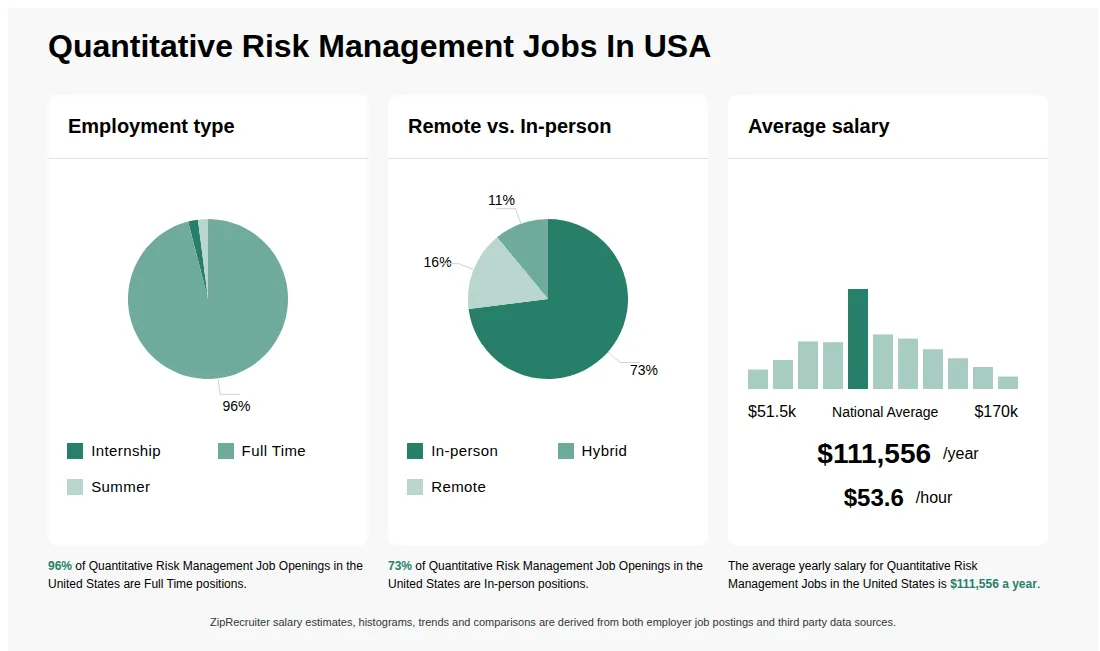
See salary details
$51.5K - $62.3K
4% of jobs
$62.3K - $73K
6% of jobs
$73K - $83.8K
11% of jobs
$87.9K is the 25th percentile. Wages below this are outliers.
$83.8K - $94.6K
11% of jobs
The median wage is $103.2K / yr.
$94.6K - $105.4K
23% of jobs
$105.4K - $116.1K
13% of jobs
$123.2K is the 75th percentile. Wages above this are outliers.
$116.1K - $126.9K
12% of jobs
$126.9K - $137.7K
8% of jobs
$137.7K - $148.5K
6% of jobs
$148.5K - $159.2K
4% of jobs
$159.2K - $170K
2% of jobs
$51.5K
$111.6K
$170K
How much do quantitative risk management jobs pay per year?
As of Sep 8, 2026, the average yearly pay for quantitative risk management in the United States is $111,556.00, according to ZipRecruiter salary data. Most workers in this role earn between $90,000.00 and $129,000.00 per year, depending on experience, location, and employer.
What is quantitative risk management?
Quantitative risk management is the process of using mathematical models, statistical techniques, and data analysis to identify, measure, and manage financial risks within an organization. Professionals in this field apply quantitative methods to assess potential losses from market movements, credit events, or operational failures, and help organizations make informed decisions to mitigate these risks. This approach is widely used in banking, insurance, asset management, and other financial sectors to ensure regulatory compliance and optimize risk-adjusted returns.
How does a quantitative risk management professional typically collaborate with other departments within a financial institution?
Quantitative Risk Management professionals frequently work closely with departments such as trading, finance, and compliance. They provide analytical support by developing risk models and stress-testing scenarios, ensuring that trading strategies and investment decisions align with the institution's risk appetite. Regular communication with IT teams is also common, as these professionals often need to implement or improve risk measurement tools and data systems. This cross-functional collaboration is essential for maintaining a robust risk management framework and responding effectively to emerging risks.
What are the key skills and qualifications needed to thrive as a quantitative risk manager, and why are they important?
To thrive as a Quantitative Risk Manager, you need strong analytical skills, expertise in statistics or mathematics, and typically a degree in finance, economics, or a quantitative discipline. Familiarity with risk modeling software, programming languages like Python or R, and industry certifications such as FRM or CFA is often required. Outstanding problem-solving abilities, attention to detail, and effective communication set top professionals apart in this role. These skills are crucial for accurately assessing financial risks, making informed decisions, and communicating complex findings to stakeholders.
What is the difference between Quantitative Risk Management vs Quantitative Analyst?
| Aspect | Quantitative Risk Management | Quantitative Analyst |
|---|---|---|
| Primary Focus | Assessing and managing financial risks | Developing models for investment strategies |
| Certifications | FRM, PRM | CFA, CQF |
| Work Environment | Financial institutions, risk departments | Investment banks, asset management firms |
| Key Skills | Risk modeling, regulatory knowledge | Statistical analysis, programming |
Quantitative Risk Management focuses on identifying and mitigating financial risks within organizations, often requiring risk-specific certifications like FRM. In contrast, Quantitative Analysts develop models to support trading and investment decisions, emphasizing statistical and programming skills. Both roles are vital in finance but serve different strategic purposes.
What can I do with a quantitative risk management degree?
A degree in quantitative risk management prepares individuals for roles such as risk analyst, risk manager, or financial analyst in banking, insurance, or investment firms. These roles involve assessing and mitigating financial risks using statistical models, data analysis, and tools like Excel, R, or Python. Certification programs like FRM or PRM can enhance career prospects.
What does a quantitative risk management do?
A quantitative risk management professional analyzes financial data and models to identify, measure, and mitigate potential risks to an organization. They use statistical tools, programming skills, and risk assessment techniques to develop strategies that minimize losses and ensure regulatory compliance.
More about Quantitative Risk Management jobs
What cities are hiring for Quantitative Risk Management jobs?
Cities with the most Quantitative Risk Management job openings:
What states have the most Quantitative Risk Management jobs?
States with the most job openings for Quantitative Risk Management jobs include:
What are popular job titles for Quantitative Risk Management?
Popular job titles for Quantitative Risk Management:

Quantitative Risk Management Consultant
Chicago, IL • On-site
Informatic Technologies •
201 - 500 employees201 - 500 employees
Other
Re-posted 20 days ago
Job description
The Quantitative Risk Team in the Risk Management Department is responsible for developing, analyzing, and back-testing models for clearing initiatives. Daily responsibilities include code release testing, historical data validation, margin and stress testing model validation, and portfolio back-testing. The candidate must have the ability to efficiently, effectively conduct research, analyze problems, formulate and implement solutions, and produce high quality results on time.
Candidates should also be willing to relocate to Chicago at their own costs.
Qualifications:
- Masters in Computer Science, Financial Engineering, Financial Mathematics, Mathematics, Physics, or a related discipline.
- Superb quantitative and analytical background.
- Excellent programming, communication, and documentation skills.
- Knowledge of financial markets.
- Work experience or education in advanced quantitative risk modeling and knowledge of statistical models in risk management preferred.
- Work experience or education in advanced derivatives modeling and knowledge of volatility models preferred.
- Work experience or education in curve construction and data validation preferred.

About Informatic Technologies
Sourced by ZipRecruiter
Company size
201 - 500 Employees
Headquarters location
North Brunswick, NJ, US
Year founded
1996