1

Private Equity Data Science Jobs (NOW HIRING)

Overview: Job Title: Data Scientist **Exp:10****Client analytics and statistical modelling ... Desirable Skills - (1) Past experience in Private Equity (PE) Investor Relations or understanding ...

next page

Showing results 1-20

Private Equity Data Science information

See salary details

$37.5K

$122.7K

$196.5K

How much do private equity data science jobs pay per year?

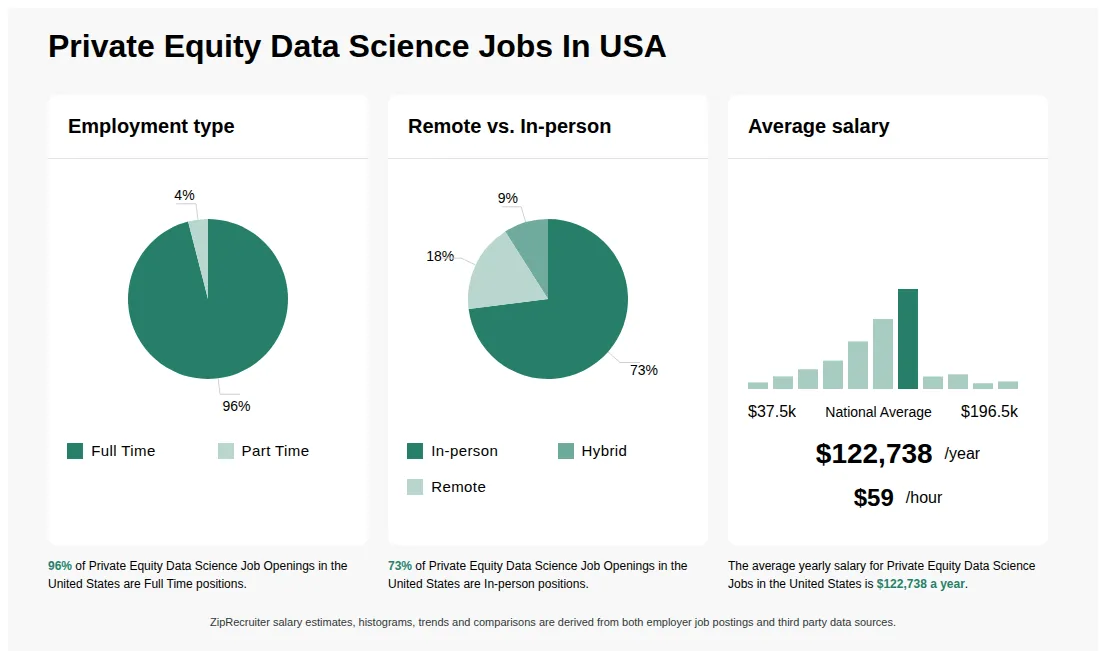
As of Jun 11, 2026, the average yearly pay for private equity data science in the United States is $122,738.00, according to ZipRecruiter salary data. Most workers in this role earn between $98,500.00 and $136,000.00 per year, depending on experience, location, and employer.

What is the 80 20 rule in data science?

In data science, the 80/20 rule, also known as Pareto principle, suggests that roughly 80% of results come from 20% of the efforts or features. Private equity data scientists often focus on the most impactful variables or data sources to optimize models and decision-making processes efficiently.

What are some common challenges faced by professionals in Private Equity Data Science roles?

Professionals in Private Equity Data Science often encounter challenges such as integrating data from various sources, handling incomplete or unstructured data, and communicating complex analyses to non-technical stakeholders. The fast-paced and confidential nature of private equity deals means timelines can be tight and priorities may shift rapidly. Building scalable data solutions and frameworks that can adapt to diverse portfolio companies is also a frequent demand. Despite these challenges, the role offers high visibility within the firm and the opportunity to directly impact investment outcomes.

How much do private equity data scientists make?

Private equity data scientists typically earn between $100,000 and $150,000 annually, with senior roles reaching over $200,000. Compensation often includes bonuses and stock options, and strong skills in data analysis, machine learning, and financial modeling are highly valued in this field.

Do private equity firms hire data scientists?

Private equity firms increasingly hire data scientists to analyze investment opportunities, optimize portfolio companies, and improve decision-making processes. These roles often require skills in data analysis, machine learning, and financial modeling, with familiarity in tools like Python, R, and SQL. Data scientists in private equity contribute to competitive advantage through data-driven insights.

What are the key skills and qualifications needed to thrive in the Private Equity Data Science position, and why are they important?

To thrive in Private Equity Data Science, you need strong analytical abilities, advanced skills in statistical modeling and machine learning, and a solid grounding in finance or economics, typically supported by a quantitative degree. Expertise with data analytics tools like Python, R, SQL, and data visualization software such as Tableau is often required, and certifications like CFA or data science credentials are advantageous. Effective communication, business acumen, and an ability to translate data insights for investment teams are key soft skills. These qualities enable you to drive data-driven investment decisions and add measurable value to private equity firms.

Is 40 too late for data science?

Private equity data science roles often value relevant skills and experience over age, and many professionals transition into data science later in their careers. Gaining proficiency in programming, statistics, and tools like Python or R can enable individuals of any age to succeed in this field, especially with continuous learning and certifications. Age should not be a barrier if you develop the necessary technical expertise and industry knowledge.

What is a Private Equity Data Science job?

A Private Equity Data Science job involves using data analytics, machine learning, and statistical modeling to support investment decisions, portfolio management, and risk assessment in private equity firms. Data scientists in this field analyze financial statements, market trends, and alternative data to identify investment opportunities and optimize fund performance. They work closely with investment teams to provide data-driven insights that improve due diligence, deal sourcing, and operational efficiency. The role requires expertise in programming, data engineering, financial modeling, and predictive analytics.

More about Private Equity Data Science jobs
What cities are hiring for Private Equity Data Science jobs? Cities with the most Private Equity Data Science job openings:
What are the most commonly searched types of Private Equity Data Science jobs? The most popular types of Private Equity Data Science jobs are:
What states have the most Private Equity Data Science jobs? States with the most job openings for Private Equity Data Science jobs include:
Infographic showing various Private Equity Data Science job openings in the United States as of June 2026, with employment types broken down into 1% As Needed, 89% Full Time, 9% Part Time, and 1% Contract. Highlights an 94% Physical, 2% Hybrid, and 4% Remote job distribution, with an average salary of $122,738 per year, or $59 per hour.
Private Equity Senior Analyst

Other

Retirement

Posted 20 days ago


Job description

Theideal candidate for this role is intellectually curious, capable of analyzingcomplex data to identify risks and opportunities, and able to thrive in afast-paced, collaborative team environment. This individual is motivated tocontribute to and enhance the team's investment approach through thoughtfulanalysis and innovation. Responsibilities include conducting due diligence onpotential private equity investment opportunities and supporting the ongoingmonitoring and reporting of the investment portfolio. The role offerssignificant latitude for initiative and independent judgment. The SeniorAnalyst will work proactively with the Private Equity Team and IMD staff andwill report directly to a Private Equity Director.
This position will be filled at the Senior Analyst level.
Compensation: The TRS Investment Management Division offers an attractivecompensation package consisting of base salary, annual performance incentivebonus, a defined-benefit pension plan as well as 401(k) and 457 retirementplans, and comprehensive benefits. Salary is commensurate with experience.
Candidates must attach a resume to the application to be considered. Pleaseinclude relevant work experience, education, GPA, and standardized test scoresin the resume.
WHAT YOU WILL DO:
Due Diligence and Analysis
Perform due diligence and investment analysis to support evaluation of co-investments across multiple sectors and geographies, with a smaller portion of time spent evaluating fund investments.
Evaluate the overall merits, risks, valuation, return profiles, and terms of Private Equity and Venture Capital transactions alongside investment partners, including but not limited to reviewing detailed company information, conducting in-depth industry analysis, completing reference checks, building complex financial (LBO) models, and performing valuation analyses (comparable and DCF) to assess overall transaction attractiveness.
Communicate analysis of investment opportunities, results, and recommendations with the relevant team members and/or senior team via verbal and written reports and presentations, including preparing qualitative and quantitative reports, memoranda, and spreadsheets.
Portfolio Monitoring
Consult or coordinate with team members, analysts, investment\accounting, legal counsel, custodian, and third-party advisors and consultants.
Evaluate portfolio diversification by geography, sector type, and investment style.
Assist with the development, monitoring, and reporting of diverse portfolio investments.
Prepare reports related to performance, risk and other ad-hoc topics related to the PE portfolio.
Develop and maintain professional relationships and contacts within the investment industry in order to conduct research and gain knowledge of appropriate investment opportunities.
Utilize TRS portfolio management systems such as DealCloud and PowerBI.