1

Post Market Surveillance Jobs (NOW HIRING)

You will lead the Designated Complaint Handling Unit, Product Investigations team, global adverse event reporting (FDA MDR, EU Vigilance), field actions, and the post-market surveillance processes ...

Post Market Analyst

Burlingame, CA · On-site

$35 - $40/hr

This role will focus on post-market surveillance (PMS), complaint investigations, and customer quality activities supporting regulated products. The ideal candidate will have experience handling ...

$150 - $200/hr

Lead post-market surveillance activities within Customer Quality scope, including data analytics, trending, planning support, reporting, and escalation of emerging product quality or patient safety ...

The role ensures compliant, timely, and effective execution of complaint handling, medical device reporting, field action coordination, post-market surveillance, customer defect tracking and ...

The role ensures compliant, timely, and effective execution of complaint handling, medical device reporting, field action coordination, post-market surveillance, customer defect tracking and ...

The role ensures compliant, timely, and effective execution of complaint handling, medical device reporting, field action coordination, post-market surveillance, customer defect tracking and ...

Showing results 41-60

Post Market Surveillance information

See salary details

$82K

$96K

$107.5K

How much do post market surveillance jobs pay per year?

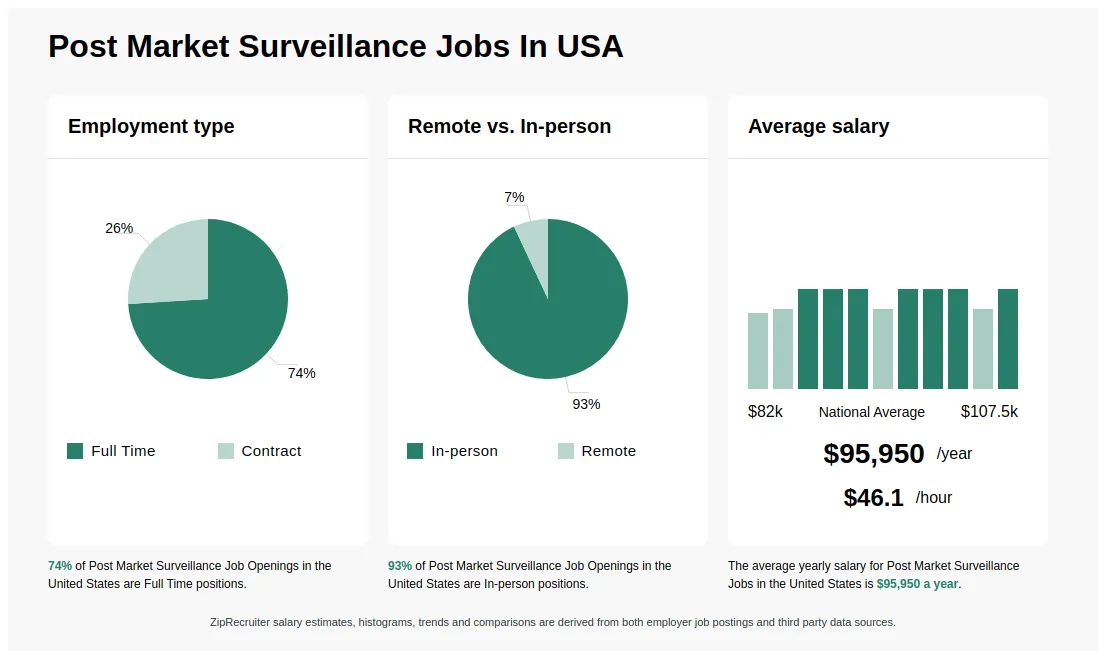
As of Sep 7, 2026, the average yearly pay for post market surveillance in the United States is $95,950.00, according to ZipRecruiter salary data. Most workers in this role earn between $89,000.00 and $103,000.00 per year, depending on experience, location, and employer.

What is a post market surveillance?

A Post Market Surveillance (PMS) job involves monitoring the safety, performance, and compliance of medical devices or pharmaceuticals after they have been released to the market. PMS professionals collect and analyze data from customer feedback, adverse event reports, clinical studies, and regulatory sources to ensure product safety. They work closely with regulatory authorities to report findings and take corrective actions if needed. This role helps companies meet compliance requirements and improve product quality over time.

What are some typical daily responsibilities in a post market surveillance role?

In a Post Market Surveillance role, you can expect to review and analyze data from product complaints, adverse events, and customer feedback to identify potential product issues or trends. Your daily tasks often include preparing regulatory reports, coordinating with cross-functional teams like Quality Assurance, Regulatory Affairs, and R&D, and ensuring timely communication of possible risks or recalls. The job involves a mix of hands-on data analysis, documentation, and collaboration to constantly monitor the safety and performance of products in the market. These responsibilities play a critical part in continuous product improvement and maintaining regulatory compliance.

What are the key skills and qualifications needed to thrive in a post market surveillance position, and why are they important?

To excel in Post Market Surveillance, you need a strong understanding of regulatory requirements, data analysis, and medical device or pharmaceutical product knowledge, often supported by a degree in science or engineering. Familiarity with quality management systems (QMS), complaint handling databases, and regulatory submission tools is typically required, alongside certifications like ISO 13485 or Six Sigma being advantageous. Excellent analytical thinking, attention to detail, and effective communication skills help professionals collaborate across departments and accurately report findings. These capabilities ensure timely identification and mitigation of product issues, safeguarding both patient safety and company compliance.


More about Post Market Surveillance jobs

What cities are hiring for Post Market Surveillance jobs?

Cities with the most Post Market Surveillance job openings:

What are the most commonly searched types of Post Market Surveillance jobs?

The most popular types of Post Market Surveillance jobs are:

What states have the most Post Market Surveillance jobs?

States with the most job openings for Post Market Surveillance jobs include:

Infographic showing various Post Market Surveillance job openings in the United States as of August 2026, with employment types broken down into 86% Full Time, 11% Part Time, and 3% Contract. Highlights an 86% Physical, 4% Hybrid, and 10% Remote job distribution, with an average salary of $95,950 per year, or $46.1 per hour.

Director - Post Market Quality

Heartflow

Austin, TX • On-site

Full-time

Posted 24 days ago


HeartFlow rating

7.2

Company rating: 7.2 out of 10

Based on 11 frontline employees who took The Breakroom Quiz

184th of 247 rated software companies


Job description

As the Director of Post-Market Quality, you own the systems that tell Heartflow how its products perform in the field, and the regulatory obligations that follow from what those systems reveal. You will lead the Designated Complaint Handling Unit, Product Investigations team, global adverse event reporting (FDA MDR, EU Vigilance), field actions, and the post-market surveillance processes required under EU MDR. This role requires deep, working expertise in post-market requirements applied to AI Software as a Medical Device (SaMD), where failure modes may be more algorithmic rather than mechanical.  This role is highly visible with direct interaction and collaboration with leadership and executive management throughout Heartflow.   

You will lead a high-performing team of complaint specialists, product investigators, and engineers working on investigations.  You will lead the championing a Quality-first, patient-centric culture and driving data-driven decisions, while modernizing a proactive approach to obtaining feedback data as it relates to product quality and performance. Your ability to convert post-market signal into credible, timely input for risk management, CAPA, and design teams - under 21 CFR Parts 820, 803, and 806, EU MDR, ISO 13485, and ISO 14971 - is essential to our success.

Job Responsibilities:

Complaint Handling

  • Working through the Manager of Complaint Handling, direct the designated complaint handling unit, ensuring intake, triage, documentation, investigation, and closure satisfy ISO 13485:2016, the FDA Quality Management System Regulation (21 CFR Part 820, as amended), and EU MDR requirements.
  • Own complaint handling processes, procedures, and decision criteria, ensuring every complaint carries a robust documented reportability decision and a defensible closure rationale in the record.
  • Approve closure of high-severity complaint files, including event coding to IMDRF adverse event terminology, and ensure coding is applied consistently enough to support credible and robust trending.
  • Manage complaint cycle time against defined service levels, escalating aged, high-severity, or patient-impacting cases to the Executive Leadership Team.
  • Ensure customer-facing investigation responses are technically accurate, consistent with the underlying investigation record, and insightful to the customers. 
  • Utilize emerging AI tools to incorporate improved quality, consistency, and efficiency within the complaint handling process and incorporate proactive monitoring of SaMD algorithm performance in the field. 

Product Investigations

  • Lead the Product Investigations (PI) function through the Manager of PI, ensuring root cause analysis is evidence-based, proportionate to risk, and traceable from the reported symptom through to disposition for robust trend analysis.
  • Route confirmed product issues into CAPA, risk management file updates, and other non-conformance and corrective action subsystems. 
  • Enhance the investigation process to ensure a tiering system for product investigations, while partnering with R&D, Clinical, and Product Management on investigations requiring algorithm review and/or design enhancements. 

Adverse Event Reporting

  • Own reportability decision-making and timely submission of FDA Medical Device Reports under 21 CFR Part 803, including 30-day, 5-day, and supplemental reports.
  • Own international reporting, including EU vigilance obligations under EU MDR and coordinate with the Heartflow Japan team to ensure proper and timely reporting to PMDA, including serious incident reporting and Field Safety Corrective Actions to Competent Authorities and the Notified Body within prescribed timelines.
  • Maintain and defend the reportability decision trees, rationale documentation, and non-reportable justifications that underpin every complaint file.
  • Govern reporting timeliness as a standing, executive-visible quality metric, with root cause and corrective action in case of any missed or late submission.

Field Actions, Recalls and Health Hazard Evaluation

  • Own the Health Hazard Evaluation process in relation to the post-market processes. 
  • Ensure complaint files align with documented, risk-based assessment of severity, probability of occurrence, and population at risk.
  • Direct corrections and removals under 21 CFR Part 806, including the written report to FDA within ten working days, engagement with the Recall Coordinator, and records for non-reportable actions.

EU MDR Post-Market Surveillance

  • Own the Post-Market Surveillance (PMS) system under EU MDR including the PMS plan, the PMS Report, and the Periodic Safety Update Reports, as applicable to device classification.
  • Direct Post-Market Clinical Follow-up planning and evaluation with Clinical and Regulatory Affairs, ensuring PMCF output feeds the Clinical Evaluation Report on a defined cycle.
  • Establish proactive trending and signal detection across complaints, service data, and published literature, with statistically justified thresholds and a documented route from signal to risk management, including trend reporting.
  • Establish real-world performance monitoring for AI/ML-enabled device functions, with predetermined thresholds for accuracy and subgroup performance, and a defined escalation path when drift or performance disparity is detected.
  • Ensure post-market output is demonstrably fed back into the risk file, Clinical Evaluation Report, labelling, and design controls. 

Strategic Leadership, Governance and Team Development

  • Lead, mentor, and scale a team of complaint specialists and product investigators, owning hiring, onboarding, performance management, and succession for a function that runs to regulatory clocks.
  • Serve as the primary subject matter expert for post-market topics during FDA inspections, Notified Body audits, and MDSAP assessments.
  • Own post-market inputs to Management Review. 
  • Champion a "Quality-first", patient-centric mindset, using impactful KPIs, robust training, reportability timeliness, investigation cycle time, complaint closure rate, and signal escalation - to drive accountability and data-driven decisions.
  • Collaborate with leaders and partners in Regulatory Affairs, Clinical, R&D, Customer Support, and Commercial to integrate post-market processes seamlessly, balancing compliance with business objectives.
  • Manage departmental resources, including headcount planning, budget, and long-term strategic planning for a fast-growing business. 

Skills Needed:

  • Effective, clear, and concise communication skills, bringing clarity to complex decisions across the leadership spectrum.
  • Sound regulatory judgement under time pressure, with the confidence to make and defend a reportability decision on incomplete information within a regulatory clock.
  • Operating with high integrity and patient-centric decision-making
  • Ability to coach, mentor, and drive a collaborative quality culture through influence.
  • Deep understanding of complaint handling, MDR and vigilance reporting, post-market surveillance, and field action management for regulated medical devices.
  • Experience interacting with auditors, including Notified Body auditors and FDA Investigators.
  • Understanding of Software as Medical Device products, ideally AI based SaMD. 

Educational Requirements & Work Experience: 

  • Bachelor's degree in engineering or scientific discipline, or equivalent.
  • 13+ years of progressive experience in Quality within the medical device industry, with at least 7+ years in a leadership/management role.
  • Expert-level knowledge of relevant regulations and standards, including 21 CFR Parts 803 and 806, the FDA Quality Management System Regulation, EU MDR, ISO 13485, and ISO 14971.
  • Demonstrated ownership of MDR and vigilance reporting decisions.
  • Proven track record of successfully leading or playing a key SME role in regulatory inspections (FDA, Notified Body).

Preferred:

  • Direct experience with AI/ML-driven SaMD and cloud-based medical device platforms.
  • Experience defining and monitoring real-world performance thresholds for an AI/ML-enabled device, including drift and subgroup performance.
  • Experience authoring and defending Periodic Safety Update Reports and Post-Market Surveillance Reports at Notified Body audit.
  • Experience running complaint handling using modern tools to incorporate quality, compliance, and efficiency. 
  • Experience implementing and scaling post-market processes in a fast-paced and growing environment.

A reasonable estimate of the base salary compensation range is $180,000 to $225,000 per year, cash bonus, and equity. #LI-Hybrid


What HeartFlow employees say

Pay

Benefits

Hours and flexibility

Workplace

Get the full story on Breakroom